
 Glenn Greenwald


| Traducir—Translate! | |
| Make fonts bigger>>> | Resize text-+= |
The ACLU Has Become “Caricature” of Left-Liberal Culture

First run on Mar 24, 2024
Summary
The video presents a critical examination of the American Civil Liberties Union (ACLU), highlighting its dramatic transformation from a principled defender of free speech rights to an organization mired in internal conflicts rooted in modern left-wing identity politics. Greenwald reflects on the ACLU’s historic defense of the American Nazi party’s right to march in Skokie, Illinois, emphasizing the organization’s commitment to protecting free speech regardless of ideology. However, the speaker argues that the ACLU today has largely abandoned this mission, morphing into an entity focused primarily on social justice causes and internal culture wars.
A key example illustrating this shift is a recent lawsuit involving an Asian female employee at the ACLU who was fired after being accused of making racist statements against her Black supervisors. This employee had previously positioned herself as a whistleblower exposing sexism and toxic working conditions within the ACLU. Yet, when her complaints targeted Black managers, she was accused of racism and terminated. The ACLU’s defense hinges on an expansive definition of hate speech, asserting that speech causing offense or discomfort to Black colleagues qualifies as racist, regardless of intent or explicit content.
This case underscores the paradox within the ACLU: an organization originally dedicated to defending broad free speech rights now seeks to limit speech under the guise of protecting marginalized groups. Greenwald connects this phenomenon to a wider crisis affecting progressive organizations, which are increasingly paralyzed by infighting and accusations of bigotry among their own members. This atmosphere of hypersensitivity and internal policing undermines their ability to function effectively.
The transcript also references reporting from The Intercept that documents how many left-wing advocacy groups have been debilitated by these culture wars. Greenwald points out that this issue is not unique to the left, but is especially visible there because of their explicit commitment to social justice frameworks. The video closes by emphasizing the importance of consistently upholding free speech principles, especially when confronted with uncomfortable or dissenting viewpoints, warning that failure to do so reveals a fundamental hypocrisy.
Key Insights
-
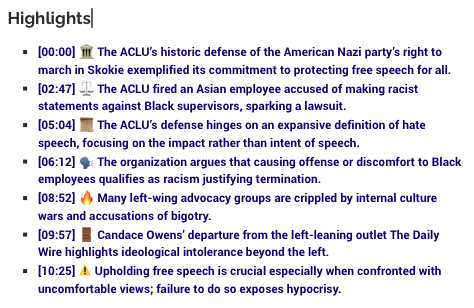
[00:00] ️ The ACLU’s original mission: defending free speech for all, including unpopular groups
The ACLU’s defense of the American Nazi party’s right to march in Skokie, a community of Holocaust survivors, represents a foundational moment in civil liberties history. This act showed a principled commitment to protecting free speech regardless of content or popularity, a stance rooted in the idea that rights must be protected universally to be meaningful. This historical context contrasts sharply with the organization’s current trajectory, illuminating how far the ACLU’s focus has shifted from principle to politics. -
[02:47] ⚖️ Internal conflicts can undermine organizational integrity and mission
The lawsuit involving an Asian employee accused of racism against Black supervisors is emblematic of deep internal contradictions within the ACLU. The employee’s role as a whistleblower on sexism turned into a racially charged conflict, illustrating how identity politics and accusations can destabilize organizational cohesion. Such internal disputes distract from the core mission and can damage public trust in the organization’s ability to advocate fairly and effectively. -
[05:04] Expansive definitions of hate speech threaten traditional free speech protections
The ACLU’s legal defense strategy in this case involves broadening the concept of hate speech to include any language that causes offense or discomfort to marginalized groups, regardless of intent or explicit content. This shift represents a radical departure from the ACLU’s historic free speech stance, where the right to express unpopular or offensive views was zealously defended. Such redefinitions risk curtailing open dialogue and expanding grounds for censorship. -
[06:12] ️ Impact-based standards of racism introduce subjectivity into employment and speech policies
The organization’s argument that speech need not be overtly racist but only needs to make certain groups uncomfortable introduces a subjective standard for identifying racism. This creates a precarious environment where intent is irrelevant and the emotional response of others becomes the primary criterion. Such a standard can suppress legitimate criticism and foster a culture of fear and self-censorship, undermining the free exchange of ideas. -
[08:52] Culture wars within progressive organizations can lead to paralysis and ineffectiveness
The transcript highlights reporting that many left-wing advocacy groups are debilitated by infighting and accusations of racism, sexism, and other forms of bigotry among their own members. This internal strife distracts from their advocacy goals and can result in organizational dysfunction. The self-destructive nature of these conflicts poses a significant challenge to progressive movements seeking social change. -
[09:57] Ideological intolerance is not confined to the left
The example of Candace Owens’ departure from The Daily Wire over her views on Israel demonstrates that ideological gatekeeping and intolerance exist across the political spectrum. While the left may be more transparent about its social justice commitments, right-leaning organizations also struggle with balancing free speech and ideological conformity. This underscores the broader challenge of maintaining open discourse in polarized environments. -
[10:25] ⚠️ True commitment to free speech requires defending uncomfortable viewpoints
The video’s concluding message stresses that organizations claiming to champion free speech must uphold these principles especially when confronted with views they find uncomfortable or disagreeable. Failure to do so exposes hypocrisy and undermines their credibility. Genuine free speech advocacy demands tolerance for dissent and the protection of unpopular opinions, which is essential to a vibrant democratic society.
This comprehensive analysis of the ACLU’s recent challenges serves as a cautionary tale about the perils of ideological rigidity and the abandonment of foundational civil liberties principles in favor of identity politics and internal culture wars.

Special Addendum
The Murderous History and Deceitful Function of the CIA - System Update with Glenn Greenwald
Summary
This episode of System Update hosted by Glenn Greenwald features an in-depth discussion with journalist Vincent Bevins about the brutal and violent history of the Central Intelligence Agency (CIA) in the post-World War II era. Bevins, author of The Jakarta Method: Washington’s Anti-Communist Crusade and the Mass Murder Program That Shaped Our World, exposes the CIA’s role in orchestrating military coups, supporting murderous dictatorships, and running disinformation campaigns, primarily to suppress leftist movements and maintain U.S. geopolitical dominance. The conversation highlights how these covert operations were not isolated incidents but systemic, widespread, and shaped the modern global political order.
Bevins focuses heavily on Indonesia’s 1965 mass killings, where the CIA aided the military-backed slaughter of up to a million civilians—an event that became a blueprint for similar operations in Latin America and beyond. These atrocities were often justified under the guise of fighting communism, but many targeted leaders and movements were reformist or nationalist rather than loyal to Moscow. The discussion also reveals the complicity of mainstream U.S. media in suppressing the truth about these operations during the Cold War, as well as the bipartisan political support within the United States for these interventions.
The episode critiques the exaggerated American liberal narrative around Russian interference in the 2016 U.S. election, contrasting it with the far more violent and devastating covert actions the U.S. government has conducted globally. It argues that understanding this history is essential for grasping the current political landscape, confronting American exceptionalism, and reconsidering U.S. foreign policy and identity. The episode ends by emphasizing the importance of educating oneself on these suppressed histories to navigate the present and future more effectively.
Highlights
- [00:06] Introduction to the brutal post-WWII history of the CIA and its global impact.
- [10:05] The scale of CIA-backed violence in countries like Indonesia, Brazil, and Guatemala compared to minor Russian interference in 2016.
- [27:12] ⚔️ Detailed account of the 1965 Indonesian mass killings and U.S. complicity.
- [41:58] The CIA’s strategy of collaborating with military regimes to suppress leftist movements worldwide.
- [55:52] ️ Continuity of CIA tactics and institutional culture from the Cold War to the present.
- [01:03:04] The media’s role in suppressing truths about U.S. foreign interventions during the Cold War.
- [01:22:38] Why Americans must confront and understand the true history of U.S. interventions to understand current global politics.
Key Insights
- [02:01] Ignorance and Propaganda Shape Political Perceptions: Greenwald explains how historical ignorance and deliberate propaganda obscure the true nature of U.S. foreign interventions, leading many Americans to misunderstand the scale and brutality of CIA operations. This ignorance also distorts how liberals respond to current political events, such as Russia Gate, by recycling Cold War rhetoric without understanding its origins or implications.
- [10:40] ⚖️ Contextualizing Russian Interference vs. U.S. Covert Actions: The episode highlights the disproportionate American liberal outrage over Russian election interference compared to the far deadlier and more systemic CIA-backed coups and massacres. This illustrates American exceptionalism and selective moral outrage, where minor adversarial acts are treated as unprecedented threats, while U.S. global violence is normalized or ignored.
- [33:00] ️ Indonesia as the Prototype of the “Jakarta Method”: Bevins details Indonesia’s 1965 massacre as a template for U.S.-backed anti-communist violence globally. This method involved mass killings and political repression disguised as anti-communism but often targeted moderate reformists or nationalist movements asserting independence from superpower influence. This systemic violence shaped decades of global political repression.
- [40:28] Mass Political Engagement by Leftist Movements: The Indonesian Communist Party’s success stemmed from broad societal engagement including peasants, women, and cultural programs. Their peaceful, democratic approach threatened Washington’s Cold War agenda, which preferred compliant authoritarian regimes over genuine democracy that might empower popular leftist forces.
- [48:41] ️ U.S. Global Hegemony Rooted in Violent Repression: Bevins argues the U.S. post-WWII global order was not about defending democracy but about maintaining imperial dominance. The violent suppression of alternative political orders in the “third world” was central to this project, enabling the U.S. to enforce a capitalist, neoliberal world system favorable to its economic and geopolitical interests.
- [01:03:04] Mainstream Media as an Instrument of State Propaganda: Throughout the Cold War, leading U.S. media outlets routinely suppressed or distorted coverage of CIA covert operations, often collaborating with intelligence officials to maintain the official narrative. This relationship between media and state interests continues to influence public perception and limits critical engagement with U.S. foreign policy.
- [01:14:10] Bipartisan Support for Cold War Repression: Contrary to popular belief that Democrats opposed Cold War excesses, key Democratic presidents like Truman, Kennedy, and Johnson actively supported or escalated covert operations and military interventions. The bipartisan consensus prioritized anti-communism over human rights, reflecting systemic continuity rather than ideological opposition.
Extended Analysis
Vincent Bevins’ research exposes the deep contradictions and moral failures of U.S. Cold War foreign policy. The narrative that the U.S. fought a defensive war against an existential communist threat is debunked by documents revealing that many targeted regimes were neither communist nor aligned with Moscow, but rather independent left-leaning governments seeking reforms. The “Jakarta Method” exemplifies how the U.S. used extreme violence to crush these movements, effectively prioritizing geopolitical control over democracy or human rights.
The episode also provides a critical lens on contemporary political discourse, particularly the liberal fixation on Russian interference in the 2016 election. By contextualizing this interference against the backdrop of decades of CIA-backed violence, Greenwald and Bevins challenge American exceptionalism and call for a more nuanced, historically informed understanding of foreign interference and national security. The episode encourages skepticism toward simplified narratives and promotes a deeper engagement with history to better understand current global power dynamics.
Lastly, the discussion about the media’s complicity in shaping Cold War narratives highlights the challenges of uncovering and disseminating inconvenient truths. This historical media behavior parallels contemporary issues with disinformation, state propaganda, and the limits of journalistic independence in democratic societies. The episode serves as a call to critically evaluate official narratives, both past and present, and to actively seek out marginalized histories to foster a more accurate and just political understanding.
Conclusion
This conversation with Vincent Bevins offers a powerful, fact-based reassessment of U.S. Cold War history, revealing a legacy of violence and repression that continues to influence global politics and American identity today. Understanding this history is crucial not only for moral accountability but for critically engaging with the present and shaping a more informed and equitable future. The episode underscores the importance of confronting uncomfortable truths and challenges prevailing myths that obscure the realities of power, violence, and imperialism in modern history.
 BEFORE you leave, PLEASE pay attention to this alert.
[t4b-ticker id="1"]
Print this article [bws_pdfprint display=’print’]
 This work is licensed under a Creative Commons Attribution-NonCommercial 4.0 International License •
ALL CAPTIONS AND PULL QUOTES BY THE EDITORS NOT THE AUTHORS