
[su_spoiler title=”Please make sure these dispatches reach as many readers as possible. Share with kin, friends and workmates and ask them to do likewise. ” open=”yes” style=”fancy” icon=”arrow-circle-1″]

 Simplicius the Thinker

| Traducir—Translate! | |
| Make fonts bigger>>> | [wpavefrsz-resizer] |
Bombshell NYT Report Reveals ‘Invisible’ F-35 Nearly Shot Down by Houthis
[su_note note_color=”#a5e0ef” radius=”0″]This nearly ~4,000 word premium article covers the recent ‘bombshell’ reports about US failures in Yemen, then segues into the perennial ‘drone war’ topic, with new updates from the front which include new Russian drone units, technology, missiles, and how militaries of the world are adapting.[/su_note]
A truly ‘bombshell’ New York Times article revealed the jaw-dropping truth a few days ago about the real reasons Trump pulled out of Yemen.
First a summary for those who don’t want to read the article:
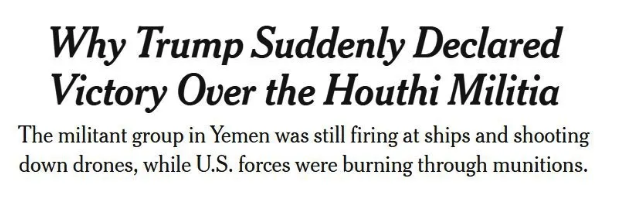
According to a New York Times article, U.S. President Donald J. Trump grew frustrated after the lack of immediate results and numerous mishaps and setbacks during Operation Rough Rider (ORR), the operation to degrade and destroy Houthi military capabilities and hamper their ability to strike commercial and naval shipping in the Red Sea.
New details were also revealed in the article, including those on the nature of strike operations themselves. Already known to many, the Houthis downed a staggering 7 MQ-9 “Predator” drones in just the first 30 days of ORR, which started back in March 2025.
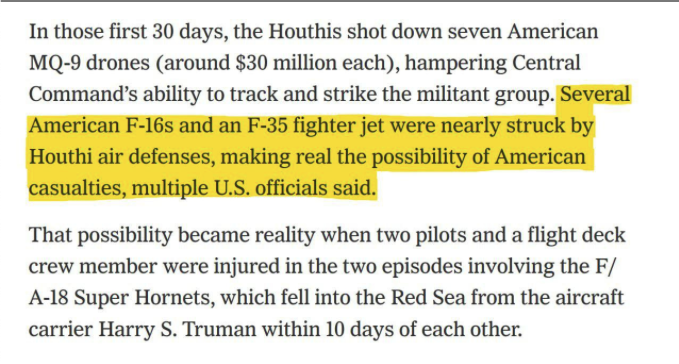
Additionally, citing unnamed U.S. officials, an unspecified amount of F-35 and F-16 fighter jets were nearly downed by Houthi air defenses in the same time period. While U.S. pilots are well trained enough to be able to evade, counter, and/or defeat incoming surface-to-air missiles, the article detailed the looming possibility that a U.S. pilot could be shot down, killed, or captured.
Ultimately, intelligence agencies were able to quantify “some degradation” of the Houthis’ capabilities but caveated their assessment with the fact that reconstitution efforts would be easy for the Houthis.
After deliberation with top U.S. officials and Saudi Arabia and the United Arab Emirates, key players in the fight against the Houthis, a consensus on how to move forward was unable to be reached. the last straw for President Trump? The accidental loss of two F/A-18 fighter jets in just as many weeks.
As the above notes, Trump didn’t want to get into a long entanglement and demanded a ‘progress report’ of results from the Yemeni campaign after 30 days. The report was not promising: the US was unable to even establish ‘air superiority’ over the Houthis:
But the results were not there. The United States had not even established air superiority over the Houthis. Instead, what was emerging after 30 days of a stepped-up campaign against the Yemeni group was another expensive but inconclusive American military engagement in the region.
Let’s first make something clear. Some have claimed that the US established ‘air superiority’ but not ‘air supremacy’, as if there’s a difference between the two. These are phony terms concocted—or at least popularized—by the US MIC to sell its Iraq war adventures, with claims that the modern ‘unstoppable’ American ‘airpower’ is capable of somehow totally dominating the skies against a foe. In reality, no such thing as true ‘air supremacy’ exists in a near-peer conflict, and has never been established in history over a foe that can fight back. These are nothing more than marketing terms to sell weapons for a war that doesn’t exist.
What we find in Yemen is that the US had to engage in distant ‘stand off’ strikes, as was the case with Israel when it attempted to hit Iran. Long ago our detective work here proved that Israel was firing missiles from well within Iraqi borders, with its F-35s terrified to cross over into Iran proper. Amongst other evidence, this was indicated by the booster casings of the Air LORA ballistic missiles fired from Israeli F-35Is being found well within Iraqi territory, where they were launched.
But we’ll get back to the F-35s in a moment.
The NYT article goes on to mention how the US was essentially blindsided and blinded by the Houthis’ destruction of a large amount of Reaper drones within the first month of the operation:
In those first 30 days, the Houthis shot down seven American MQ-9 drones (around $30 million each), hampering Central Command’s ability to track and strike the militant group.
As we know, the Houthis then caused the USS Truman to lose two F/A-18 Super Hornets, valued at ~$70M each. NYT writes that by then, Trump had had enough.
But the cost of the operation was staggering. The Pentagon had deployed two aircraft carriers, additional B-2 bombers and fighter jets, as well as Patriot and THAAD air defenses, to the Middle East, officials acknowledged privately. By the end of the first 30 days of the campaign, the cost had exceeded $1 billion, the officials said.
But of course, the most shocking of the article’s admissions that has everyone in fantods relates to how an American F-35 was reportedly nearly shot down by Houthi air defenses. The strike came so close that the F-35 had to take evasive dodging maneuvers:
Many top military publications immediately jumped on this:
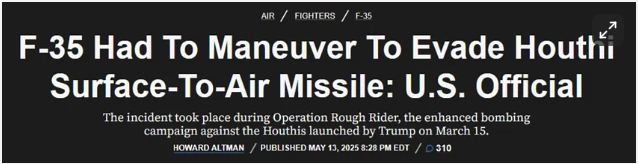
TWZ provides a further scoop:
U.S. F-35 stealth fighter had to take evasive maneuvers to avoid being hit by Houthi surface-to-air (SAM) missiles, a U.S. official told The War Zone.
“They got close enough that the [F-35] had to maneuver,” the official said.
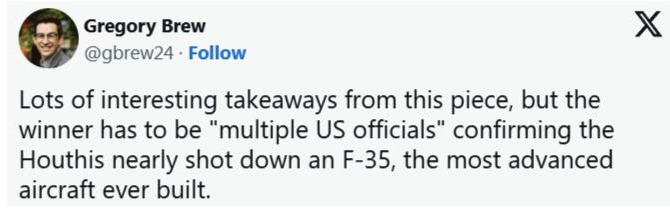
The fact that even the Houthis, with their relatively rudimentary air defenses, were able to keep many U.S. aircraft from making direct attacks, with a heavy reliance on valuable standoff weapons and even stealth bombers instead, certainly has broader implications that we will be exploring further in future articles.
First of all, recall this earlier quote about US heavily favoring long-range munitions, particularly as used with the stealth B-2 Spirits:
However, so “many precision munitions were being used, especially advanced long-range ones, that some Pentagon contingency planners were growing increasingly concerned about overall stocks and the implications for any situation in which the United States might have to ward off an attempted invasion of Taiwan by China,” the Times explained.
This gives us a clear picture of the situation. The US is unable to safely conduct operations near even Yemen’s airspace, with its so-called ‘rudimentary’ air defenses. F-35s—claimed to be ‘the most advanced fighter jets ever assembled’—are unable to safely operate without being detected. What do you think it could be that’s allowing the Houthis to detect “invisible” F-35s to such an extent as to fire on them, causing evasive maneuvers? Is it hand-me-down Iranian radars, which themselves are likely hand-me-down Russian ones? How would the vaunted F-35s and B-2s handle the far larger and superior national Iranian AD network if they can’t even handle the Houthi one?
It now makes all the more sense as to why Israel dared not go anywhere near Iran’s border with its own F-35Is: the West knows their planes are in fact detectable by the radars of the resistance, and the latest episode merely proves this fact. The only reason the Houthis didn’t get the shoot down likely comes down to the fact that it’s easier to manufacture a radar—a much older technology—than it is to make a missile with the kinematic properties that allow it to chase down a maneuverable fighter jet; the radar likely did its job but the missile couldn’t quite finish it.
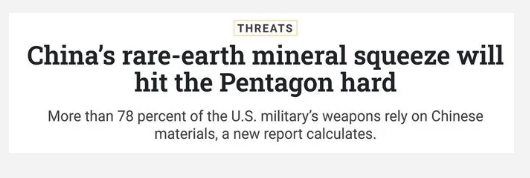
The fact is, the West has spent decades building up an entire doctrine of warfare that is slowly becoming obsolete—one that relies on high-tech, high-cost weapons which cannot be reproduced at scale. Part of this is due to the fact that with the increasing complexity of modern ‘high-tech’ weapons, supply chains become problematic, particularly when China controls most of the world’s rare earths.

Just listen to this stunning new Macron statement, wherein he admits that France has nothing left to give to Ukraine because their model of warfare was never designed for such high-intensity fighting:
“You have to understand we had an army model that wasn’t designed for high-intensity land conflicts. So we gave everything we had, even produced more and more faster…but we can’t give what we don’t have.”
This has been increasingly the theme in world conflicts of late: the surge in innovations from the Global South outpacing the outmoded, profit-driven military models of the West.
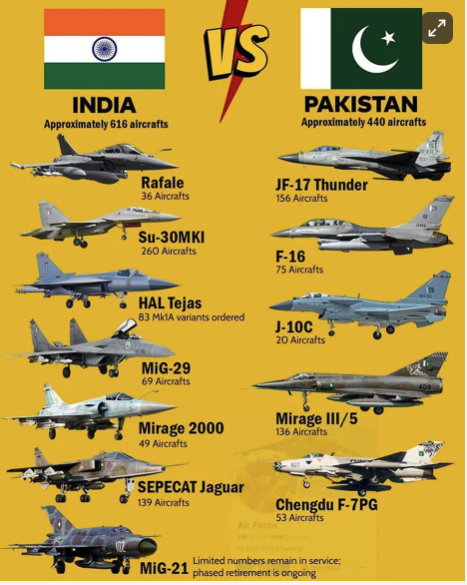
The recent Pakistani-Indian clash appeared to be another example, as Chinese arms in the hands of Pakistanis were said to have punched well above their weight, and—if reports are accurate—were more than a match for equivalent Western weapons, particularly in the case of fighter jets:
From Bloomberg:
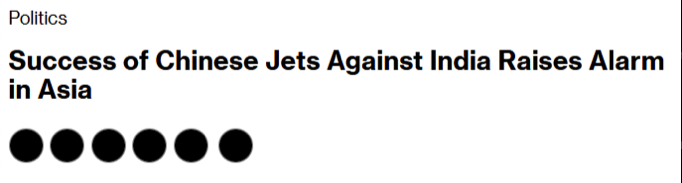

[Editor’s Note: Can’t reproduce the rest since it’s behind a paywall. But we have attached below a very similar report filed by Japan Times, a medium which, belonging to Japan, an occupied vassal of the US, is clearly hostile to China, and whose media reflect this posture. Read it for what it’s worth, and discount all the inevitable (and specious) badmouthing about China’s weapons’ quality. Such comments are laughable when we take into account the calamitous record of for-profit US arms producers, with the mishaps of the F-35, an exorbitantly priced fighter, being but the latest example of this notorious feature.
Success of Chinese-made fighter jets against India raises alarm in Asia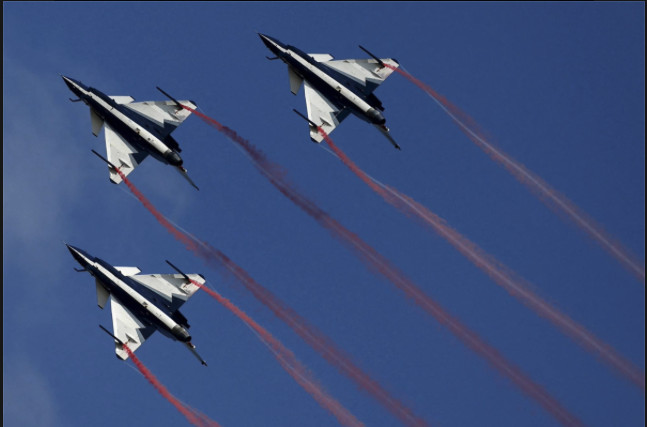 Chinese J-10 fighter jets from the People’s Liberation Army Air Force August 1st Aerobatics Team perform during a media demonstration at the Korat Royal Thai Air Force Base, Nakhon Ratchasima province, Thailand, in November 2015. | REUTERS May 14, 2025
The recent conflict between India and Pakistan is prompting a reassessment of Chinese weapons, challenging long-held perceptions of their inferiority to Western arms and sparking concern in places wary of Beijing. Pakistan hailed the use of its Chinese J-10Cs to shoot down five Indian fighters, including French-made Rafale aircraft, last week in response to Indian military strikes. Although the reports haven’t been confirmed, and India hasn’t commented, the jet’s maker saw its market capitalization soar by over 55 billion yuan ($7.6 billion), or more than a fourth, by the end of last week. Hu Xijin, the ex-editor-in-chief of China’s nationalist tabloid Global Times, warned on social media that if Pakistan’s successful strikes were true, Taiwan should feel “even more scared.” Beijing sees the self-ruled democracy as its own, and reserves the right to use military force to bring it under control. Taiwan closely watched the clash between Pakistan and India, according to Shu Hsiao-Huang, an associate research fellow at the Institute of National Defense and Security Research, a government-funded military think tank based in Taipei. “We may need to reassess the PLA’s air combat capabilities, which may be approaching — or even surpassing — the level of U.S. air power deployments in East Asia,” Shu said, adding that Washington might want to consider selling more advanced systems to Taiwan. While Chinese leader Xi Jinping has been trying to modernize the world’s biggest military by the number of active personnel, the People’s Liberation Army (PLA) has been mired in scandals. That had raised questions about the combat-readiness of its powerful and secretive Rocket Force, which is responsible for conventional missiles and would play a crucial role in any invasion of Taiwan. The reported success of J-10Cs, which have had few battle tests and are used to patrol the Taiwan Strait, appears to counter those doubts. It’s still uncertain, however, how they would fare against U.S. fighters such as the F-16, which make up the bulk of Taiwan’s jets and have been combat-proven across decades and militaries. Another Chinese weapon Pakistan uses will also be coming under intense scrutiny by Beijing’s adversaries. Parts of Chinese air-to-air PL-15 missiles found in India after the reported shoot-downs suggest the weapons, deployed on Pakistan’s J-10C aircraft, proved effective in their first known combat use. With a top speed above Mach 5, the PL-15 is a rival to Western air-to-air missiles. China is the world’s fourth-largest arms exporter but its customers are mostly developing nations like Pakistan that have limited funds. The latest developments could bolster Beijing’s sales pitch as major economies from Europe to Asia heed U.S. President Donald Trump’s call to ramp up defense spending. “There is a good chance the weapons systems China is able to offer will be even more appealing to potential buyers” especially in the Global South, said James Char, assistant professor of the China Program at the S. Rajaratnam School of International Studies, noting the J-10C is not even China’s most advanced jet. Buying weapons has also become a focus for developing nations, mulling U.S. arms purchases to appease Trump and his demands to reduce American trade imbalances. Several of these countries list China as a top trading partner and could consider hedging bets by acquiring systems from the Asian country, too. China’s overseas arms sales have been growing, with its five-year average weapons exports more than tripling in 2020-24 from 2000-04, according to calculations based on data from Stockholm International Peace Research Institute. Chinese government and state-owned enterprises do not disclose data on arms exports. Some of the largest state-owned players — also blacklisted by the U.S. — include Norinco Group, which makes armored vehicles and anti-missiles systems; Aviation Industry Corporation of China, whose subsidiary AVIC Chengdu Aircraft manufactured the J-10Cs; as well as China State Shipbuilding, a producer of frigates and submarines. M. Taylor Fravel, director of the Security Studies Program at the Massachusetts Institute of Technology, cautioned that the Chinese jet was primarily for aerial combat, while the Rafale was designed to conduct many kinds of missions, meaning the J-10 may have held an advantage. Chinese weapons exports have been plagued for years by defects (sic), specialists have said, adding that the seemingly inexpensive systems can drain security budgets due to maintenance expenses. “China attracts customers for its military equipment with cut-rate pricing and financing but there are hidden costs — especially when gear malfunctions,” Cindy Zheng, then a researcher at the Rand Corp., wrote in a research paper just before joining the U.S.-China Economic and Security Review Commission in the latter stages of the Biden administration. In 2022, Myanmar had to reportedly ground its fleet of Chinese fighter jets due to structural cracks and other technical issues. Bangladesh lodged complaints with Beijing about the quality of its military hardware last year. Even the Pakistan Navy has been facing issues with its F-22P frigates, forcing them to operate the vessels with significantly degraded capabilities. “Questions about combat capabilities and other issues, including concerns about interoperability with non-Chinese platforms, have hampered China’s ability to expand exports beyond a handful of countries,” Bloomberg Intelligence’s senior associate analyst Eric Zhu wrote in a note last week. China’s Defense Ministry didn’t respond to a request for comment on the past weapon defects and the J-10C’s recent performance. Beijing regularly says that its military helps maintain global stability and that it prefers to resolve the Taiwan issue peacefully. Xi has been trying to turn China’s defense industry around by bringing together the military and civilian sectors, in an effort to transform the PLA into a modern force by 2027. That’s led to breakthroughs such as China’s launch in December of its first next-generation amphibious assault ships, considered the world’s largest of its kind. A video of what is believed to be a test flight of the nations’ sixth-generation fighter jet circulated on social media, leading to a rally in defense stocks. It’s wrong to call the J-10C’s potential success a “DeepSeek moment” for China’s military, said Fravel, referring to the artificial intelligence chatbot that surprised the world earlier this year, noting that the jet’s design wasn’t new. “But it doesn’t need to be a DeepSeek moment to be significant,” he added. “A lot is being learned about how Chinese systems perform under combat conditions.” |
[/su_spoiler]
Print this article [bws_pdfprint display=’print’]
[su_note note_color=”#f1efef” radius=”0″]The views expressed herein are solely those of the author and may or may not reflect those of The Greanville Post, although, if we publish them, we obviously find them noteworthy and valuable. [/su_note]
 This work is licensed under a Creative Commons Attribution-NonCommercial 4.0 International License •
ALL CAPTIONS AND PULL QUOTES BY THE EDITORS NOT THE AUTHORS

