
[su_spoiler title=”Please make sure these dispatches reach as many readers as possible. Share with kin, friends and workmates and ask them to do likewise. ” open=”yes” style=”fancy” icon=”arrow-circle-1″]
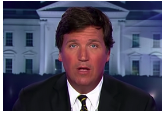
 Tucker Carlson
| Traducir—Translate! | |
| Make fonts bigger>>> | [wpavefrsz-resizer] |

| Editor’s Note: John Mearsheimer may be a “realist” and a professor, but he sees nothing inherently wrong with the idea of American imperialism. (Neither does Tucker, for that matter). As in Vietnam and other imperial crimes, he is “loyal opposition”, a “dissident” chiefly in pragmatic terms: criticising the US government in charge for its “misguided” and frequently counterproductive policies that fail to yield the desired result—the maintenance of US hegemony—but rarely from a simple, fair and moral standpoint. So watch and read this material with that fact in mind. That said, in this discussion, Mearsheimer perhaps goes furthest in insinuating the need for Washington to incorporate at least ethical standards in its global policies affecting friend and foe. |
SUMMARY
The conversation provides a deep and critical analysis of contemporary global conflicts, focusing primarily on the Ukraine war, U.S. foreign policy, NATO expansion, and the Israel-Palestine crisis. The guest, an experienced professor and analyst, argues that Ukraine is losing the war against Russia due to overwhelming Russian military advantage and Western support limitations. He explains that Russia’s core demands for peace—neutrality of Ukraine, demilitarization, and recognition of Russia’s annexation of territories—are unacceptable to Ukraine and the West, making diplomatic resolution impossible and likely resulting in a frozen conflict with an eventual Russian victory.
The discussion critiques Western policies, especially NATO’s eastward expansion after the Cold War, which the guest asserts provoked Russia and sparked the Ukraine conflict. The U.S. and Europe’s refusal to acknowledge Russia’s security concerns is highlighted as a major miscalculation. The guest also reflects on U.S. foreign policy’s emotional and ideological biases against Russia, which have overshadowed strategic interests.
Turning to the Middle East, the professor provides a historical and strategic overview of Israel’s policies toward Palestinians, labeling Israeli actions in Gaza as genocidal and part of a broader strategy of ethnic cleansing aimed at establishing a “Greater Israel.” He explores the profound influence of the Israel lobby on U.S. foreign policy, arguing that U.S. support for Israel often contradicts American strategic and moral interests, driven largely by this lobby and certain religious groups such as Christian Zionists. The conversation also touches on the consequences of this relationship for U.S. domestic politics and international standing.
Finally, the guest offers a long-term geopolitical forecast, predicting continued dominance of the international system by the U.S., China, and Russia, with China emerging as the main competitor to the U.S. due to its population and wealth growth. He believes the U.S. will remain powerful but cautions about the risks of misguided foreign policy decisions. The interview closes with reflections on the potential for future conflicts, including over Taiwan, and the importance of nuclear deterrence in preventing major wars.

Key Insights
-
⚖️ The Impossibility of a Diplomatic Settlement in Ukraine: The professor highlights that Russia’s three core demands—neutrality, demilitarization, and territorial concessions—are fundamentally incompatible with Ukrainian sovereignty and Western interests. This creates a stalemate where only military outcomes can resolve the conflict. The insight reveals the tragic reality that wars today, particularly this one, are less about negotiations and more about brute force and strategic dominance, which leads to a prolonged frozen conflict with ongoing instability.
-
️ NATO Expansion as a Catalyst for Conflict: NATO’s expansion eastward is likened to a violation of Russia’s sphere of influence, triggering a reaction comparable to the U.S. Monroe Doctrine stance in the Western Hemisphere. The guest’s perspective challenges mainstream Western narratives that frame NATO as purely defensive, exposing the geopolitical underpinnings that have pushed Russia into confrontation. This insight emphasizes the importance of understanding adversaries’ security perceptions in international relations to avoid unintended escalations.
-
Emotional and Ideological Biases in U.S. Foreign Policy: The discussion reveals that U.S. policy toward Russia is less about rational strategic calculation and more about an entrenched emotional antipathy—“Russophobia”—among Western elites. This explains why rational compromises are rejected even when they might serve national interests better. This insight critiques the flaws in foreign policy formation, where ideology and identity politics can override pragmatic statecraft, often to the detriment of national security.
-
The Israel-Palestine Conflict as a Case of Ethnic Cleansing: The professor’s detailed historical account frames Israeli policy in Gaza and the occupied territories as a systematic effort to ethnically cleanse Palestinians to establish a Jewish majority state. This insight is crucial in understanding the current humanitarian crisis not as a random conflict but as a continuation of long-term strategic goals rooted in Zionist ideology. It also underscores the moral and legal implications, including accusations of genocide, that resonate globally.
-
️ The Influence of the Israel Lobby on U.S. Policy: The conversation exposes the Israel lobby’s unparalleled power in shaping U.S. Middle East policy, often overriding American national interests and moral considerations. This insight explains why U.S. foreign policy in the region often diverges from objective strategic calculations and moral standards, leading to problematic alliances and policies that exacerbate conflicts and global instability. It also addresses the complex interplay of domestic politics, religious ideology, and international relations.
-
The Rise of China and the End of the Unipolar Moment: The guest traces how U.S. engagement policies from the 1990s inadvertently fueled China’s rise into a peer competitor, altering the global balance of power. This insight highlights a major strategic miscalculation by the U.S. foreign policy establishment, which underestimated China’s ambitions and capabilities. It illustrates the dangers of economic interdependence without adequate strategic foresight, which now complicates U.S. efforts to maintain global primacy.
-
⚠️ Future Risks and the Importance of Nuclear Deterrence: The professor’s forecast about future conflicts, especially over Taiwan, reflects the complexities of modern great power competition. While immediate war seems unlikely due to military and nuclear deterrence factors, the possibility remains, underscoring the fragile balance of power. This insight stresses the need for cautious diplomacy and strategic patience in managing rivalries to prevent catastrophic conflict in an increasingly multipolar world.
Conclusion
This extensive conversation offers a sobering critique of current global conflicts and U.S. foreign policy. It challenges dominant narratives about Ukraine, Russia, NATO, and the Middle East by presenting grounded, historically informed perspectives that question the efficacy and morality of prevailing strategies. The professor’s insights into the geopolitical dynamics, the influence of powerful lobbies, and the dangers of ideological rigidity provide a valuable framework for understanding the complex challenges facing international peace and security in the 21st century. The forecast for the coming decades underscores the enduring importance of power, strategic prudence, and the risks inherent in great power competition.
[/su_spoiler]
Print this article [bws_pdfprint display=’print’]
[su_note note_color=”#f1efef” radius=”0″]The views expressed herein are solely those of the author and may or may not reflect those of The Greanville Post, although, if we publish them, we obviously find them noteworthy and valuable. [/su_note]
 This work is licensed under a Creative Commons Attribution-NonCommercial 4.0 International License •
ALL CAPTIONS AND PULL QUOTES BY THE EDITORS NOT THE AUTHORS

