
[su_spoiler title=”Please make sure these dispatches reach as many readers as possible. Share with kin, friends and workmates and ask them to do likewise. ” open=”yes” style=”fancy” icon=”arrow-circle-1″]

 Due Dissidence
RUSSELL DOBULAR • KEATON WEISS
| Traducir—Translate! | |
| Make fonts bigger>>> | [wpavefrsz-resizer] |
Tucker SHREDS “Useless” Republican Party in New Interview

Summary
The video presents a detailed discussion centering on Tucker Carlson’s evolving political stance and the broader fracturing within the conservative movement, particularly the MAGA coalition. Carlson is depicted as increasingly disillusioned with the Republican Party, criticizing its leadership for betraying core conservative values, especially opposing censorship and identity politics. The conversation highlights Carlson’s surprising embrace of populist and socialist-leaning critiques, such as opposition to unchecked capitalism’s commodification of individuals, exemplified by platforms like OnlyFans. The dialogue also explores the decline of traditional MAGA figures and the rise of new fault lines on the right, noting the marginalization of extremist elements and the potential emergence of a more populist conservative core.
Furthermore, the discussion touches on the interplay of censorship, identity politics, and political loyalty, emphasizing that many young conservatives feel alienated by party leadership’s embrace of those issues. Carlson’s critique extends to wealthy elites, like Jeffrey Epstein, whom he describes as mediocre but amoral individuals exploiting the system. The conversation also warns about the dangers of expanding domestic policing powers under the guise of immigration enforcement, predicting these forces could be turned against right-wing activists themselves.
Ultimately, the video portrays a conservative movement in flux—fractured, searching for direction, and grappling with internal contradictions about ideology, strategy, and leadership. The analysis underscores the shifting political landscape on the right, the erosion of the GOP’s traditional base, and the rise of new populist critiques that challenge both the party establishment and the excesses of capitalism.
Key Insights
-
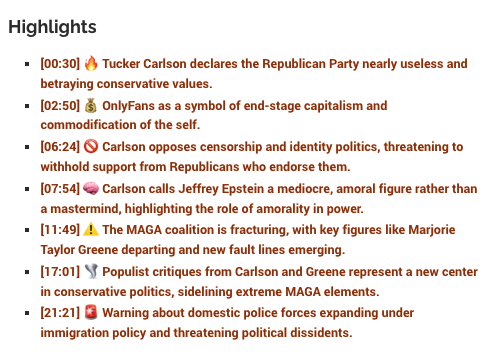
[00:30] Republican Party’s Decline: Carlson’s Disillusionment
Tucker Carlson’s vocal disapproval of the GOP as “useless” and “betraying” its base signals a critical realignment within conservative ranks. His readiness to oppose the party he once championed highlights deep fractures, suggesting a broader crisis in conservative identity and leadership. The erosion of trust in the party’s commitment to its principles could catalyze further splintering or the rise of a new conservative movement. -
[02:50] OnlyFans as a Metaphor for Capitalism’s Failures
Carlson’s critique of OnlyFans users commodifying their bodies reveals a nuanced socialist-leaning perspective rare on the right. This phenomenon symbolizes how capitalism, in its “end stage,” strips individuals of all assets except their own flesh, forcing commodification as a survival tactic. This insight challenges traditional right-wing economic narratives and points to a rising populist critique linking economic desperation to cultural decay. -
[06:24] Opposition to Censorship and Identity Politics as a Political Litmus Test
Carlson’s refusal to support any Republican who endorses censorship or identity politics exposes a key ideological divide within the GOP. His stance reflects a broader conservative backlash against what many perceive as authoritarian tendencies and cultural overreach within their own party. This divide risks alienating moderate conservatives and young voters, creating a volatile dynamic that could reshape future electoral coalitions. -
[07:54] Amorality Over Intelligence in Power Structures
The discussion about Jeffrey Epstein as a “mediocre” yet “amoral” individual underscores a critical insight into power dynamics: success often depends less on intellect and more on ruthlessness and lack of moral boundaries. This observation applies broadly to capitalism and political elites, suggesting that the system rewards unscrupulous behavior, which perpetuates corruption and inequality. -
[11:49] ⚠️ Fragmentation of the MAGA Coalition and Conservative Realignment
The departure of key figures like Marjorie Taylor Greene and Carlson’s rejection of censorship-supporting Republicans depict a collapsing MAGA coalition. This fragmentation reveals that the movement lacks a sustainable consensus, with internal disputes over ideology, strategy, and leadership. The consequence is a realignment where populist conservatives may redefine the right-wing agenda, leaving behind extremist factions. -
[17:01] ️ Emergence of a New Conservative Populism
Carlson and Greene’s brand of populist conservatism, focused on protecting traditional communities from cultural and economic degradation, appears to be the emerging center of gravity on the right. This approach contrasts with more extreme or laissez-faire economic conservatives, suggesting a movement toward a more culturally defensive and economically interventionist conservatism that resonates with grassroots voters. -
[21:21] Domestic Policing and the Risk of Political Repression
The analysis warns that the expansion of domestic policing powers under immigration enforcement could be weaponized against political dissidents, particularly right-wing activists. This insight highlights a paradox where voters supporting such policies may ultimately become targets themselves. It underscores the dangers of unchecked state authority and the fragility of civil liberties in the current political climate.
Additional Analysis
[bg_collapse view=”button-orange” color=”#4a4949″ expand_text=”Read it here” collapse_text=”Show Less” ]
The video’s exploration of Tucker Carlson’s critique provides a window into the broader ideological upheaval within American conservatism. Carlson’s willingness to adopt populist economic critiques traditionally associated with the left, combined with his cultural conservatism, signals a blurring of ideological lines. This hybrid position challenges the GOP establishment and forces a reconsideration of what conservative politics means in a post-Trump era.
Moreover, the fragmentation of the MAGA movement reflects the unsustainability of a coalition largely built on opposition rather than coherent policy or ideology. The departure of prominent figures and the marginalization of extremist voices suggest a recalibration toward a more pragmatic, albeit still culturally combative, conservatism.
Finally, the discussion about the expansion of domestic policing and political censorship highlights a critical tension in American democracy: the balance between security and freedom. Carlson’s warnings resonate with a growing concern among conservatives that the very institutions meant to protect them could be repurposed to suppress dissent, illustrating the complex and often contradictory dynamics at play in contemporary US politics.
This multifaceted analysis affirms that the right-wing political landscape is undergoing a significant transformation, driven by ideological conflicts, shifting demographics, and evolving cultural and economic anxieties. The outcome of this realignment will likely shape American politics for years to come.
[/bg_collapse]

Vivek and Dinesh D’Souza Realize They Joined a Racist Movement
Due DissidenceSummary
This video segment critically examines the fraught relationship between racial identity, political affiliation, and white supremacy in America, focusing on how certain minority groups, particularly Indians, navigate the boundaries of whiteness and acceptance within the Republican Party. The discussion begins by contextualizing the historical shift of ethnic groups like Jews, Irish, and Italians, who were once not considered white (!) but gradually assimilated into whiteness through suburbanization and redlining policies. It highlights the contemporary parallels with Latino and Indian communities aspiring to be recognized as white, albeit with more difficulty for Indians due to overt racial distinctions.
Central to the narrative is the experience of Indian-American political figures such as Vivek Ramaswami and Desh D’Souza, who align themselves with the Republican Party and attempt to assimilate into its white majority. The segment recounts Ramaswami’s humiliating encounter with Anne Coulter, who openly admits she cannot support him because of his Indian heritage, reflecting the party’s underlying racial exclusivity. Despite this, these figures often participate in and amplify racially charged rhetoric against other minority groups, such as African Americans and Latinos, revealing the complex dynamics of race and political loyalty.
The video also explores the backlash Indian Republicans face from within the party, including racist abuse and exclusion, exposing the limits of their acceptance. This is juxtaposed with the increasing overt racism in the Republican Party, which has shed its previous “mask” of subtlety since the rise of Trump, embracing more explicit white supremacist and ethnonationalist ideologies. The removal of displays honoring Black troops from a WWII cemetery and reports on missing Native American women are cited as examples of this racist shift, signaling a political base that is hostile to racial justice initiatives.
The segment critiques Indian and other non-white conservatives who defend this party, arguing that they are being used as tools or tokens to legitimize a fundamentally racist movement that ultimately rejects them. It underscores the alienation of non-white voters from the Republican Party as a direct consequence of its racial politics and warns that such exclusion will lead to political decline. The discussion closes with a reflection on how the party’s embrace of overt racism has rendered token minority figures ineffective and exposed the true nature of the party’s white supremacist core, ending with an acknowledgment that this reality is now undeniable.
[bg_collapse view=”button-orange” color=”#4a4949″ expand_text=”Show More” collapse_text=”Show Less” ]
Key Insights
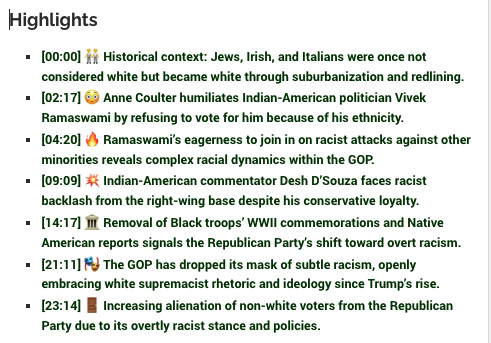
- [00:33] ️ Assimilation through Suburbanization: The historical process of ethnic whites (Jews, Irish, Italians) achieving “whiteness” involved geographic and social mobility facilitated by policies like redlining, which excluded Black and Brown communities. This reveals how race is constructed and maintained through spatial and political means, not just biology or culture.
- [02:48] ♂️ Racial Gatekeeping in Politics: Anne Coulter’s blunt rejection of Vivek Ramaswami because of his Indian heritage illustrates how whiteness remains a gatekeeping factor in American politics, particularly within the Republican Party. This incident exposes the persistent racial boundaries that minority Republicans face despite their efforts to assimilate.
- [04:53] Minority Participation in Racist Rhetoric: Ramaswami’s willingness to join in derogatory remarks about other minorities (e.g., Mexican enclaves) reflects a phenomenon where marginalized individuals sometimes adopt and perpetuate the dominant group’s prejudices to gain acceptance or political capital, reinforcing racial hierarchies rather than dismantling them.
- [09:56] The Double Bind of Indian-American Conservatives: Indian-American conservatives like Desh D’Souza face a dilemma—they are used as symbols of diversity by the GOP but still subject to racist attacks, revealing the party’s instrumentalization of minority figures as tokens rather than genuine inclusion. Their loyalty does not protect them from exclusion or abuse.
- [14:57] ️ Erasure of Minority Contributions: The removal of commemorations for Black troops and reports on Native American issues by the Trump administration signifies an active effort to erase minority histories and struggles from the national narrative, reinforcing a white-centric view of American identity and history.
- [21:11] Unmasking of Republican Racism: The GOP’s shift from coded or subtle racism to open white supremacist rhetoric marks a significant ideological realignment. This “mask off” approach alienates non-white supporters and reveals the party’s core as fundamentally exclusionary and ethnonationalist.
- [23:14] Political Consequences of Racism: The alienation of non-white voters from the Republican Party due to its overt racism threatens the party’s future viability. Non-white communities are returning to Democratic coalitions, and the GOP’s refusal to moderate its racial politics risks long-term political marginalization.
This analysis underscores how race, identity, and political power intersect in contemporary America, highlighting the fraught position of minority Republicans who face systemic exclusion despite their efforts to assimilate, and the broader implications for American democracy as racial politics intensify.
[/bg_collapse]
|
|


[t4b-ticker id=”1″]
[/su_spoiler]
Print this article [bws_pdfprint display=’print’]
[su_note note_color=”#f1efef” radius=”0″]The views expressed herein are solely those of the author and may or may not reflect those of The Greanville Post, although, if we publish them, we obviously find them noteworthy and valuable. [/su_note]
 This work is licensed under a Creative Commons Attribution-NonCommercial 4.0 International License •
ALL CAPTIONS, insults, AND PULL QUOTES BY THE EDITORS NOT THE AUTHORS

