
[su_spoiler title=”Please make sure these dispatches reach as many readers as possible. Share with kin, friends and workmates and ask them to do likewise. ” open=”yes” style=”fancy” icon=”arrow-circle-1″]

 Due Dissidence
RUSSELL DOBULAR • KEATON WEISS
| Traducir—Translate! | |
| Make fonts bigger>>> | [wpavefrsz-resizer] |
Bari Weiss Taps COMICALLY EXTREME ZIONIST To Anchor CBS Evening News

Streamed Dec 13, 2025
Summary
This video provides a detailed and critical analysis of the recent appointment of Tony Dokoupil as the new anchor of CBS Evening News under the leadership of Barry Weiss, CBS News’ editor-in-chief, and Larry Ellison, the billionaire financier backing the network. The discussion is steeped in controversy, focusing heavily on Dokoupil’s personal history, journalistic style, and the broader political and ideological battles shaping CBS News and the American media landscape.
Tony Dokoupil’s background, including his 2014 conversion to Judaism and adult circumcision, is highlighted as emblematic of the extreme lengths Dokoupil allegedly went to align himself with a particular worldview. The transcript humorously and critically explores these personal details to question the merit behind his selection as CBS’s leading news anchor. It also delves into Dokoupil’s aggressive interview style, notably his controversial interrogation of Ta-Nehisi Coates regarding Israel and Palestine, which sparked internal disputes within CBS News. While CBS executives initially criticized the interview, Shari Redstone, a powerful media executive and pro-Israel activist, defended Dokoupil’s approach.
The transcript provides a broader critique of American mainstream media’s handling of Israel-Palestine coverage. It points to an imbalance and perceived bias favoring Israel, with Palestinian voices and perspectives marginalized or excluded. The discussion highlights how media organizations, influenced by Zionist interests and billionaire backers, shape narratives that suppress critical or dissenting viewpoints on Israel’s policies and actions.
Barry Weiss’s tenure and vision for CBS News are scrutinized, particularly her push for “centrist” news that still incorporates charismatic and passionate debates, such as those involving polarizing figures like Alan Dershowitz and Dana Lash on gun control. However, the transcript questions the effectiveness of this approach, citing low viewer engagement and skepticism about whether such programming can restore public trust in mainstream media.
|
CONTROVERSY |
The role of oligarch funding and political agendas in shaping media content is a recurring theme. The transcript argues that CBS News and similar outlets are increasingly functioning as propaganda arms for specific ideological causes, particularly pro-Israel and pro-oligarch interests, rather than serving as independent journalistic institutions. (Well, they never were. They have long—for well over a century, represented oligarchic interests and certainly the US imperialist viewpoint.—Ed). It also touches on efforts to control social media and online platforms to influence public discourse, highlighting the challenges posed by technological resistance such as VPNs and alternative platforms.
Finally, the transcript reflects on the broader media crisis in America, noting the collapse of traditional trust in news institutions and the failure of legacy media to attract younger audiences. It suggests that despite the substantial financial backing from billionaires like Larry Ellison, these attempts to “save” CBS News through ideological realignment and controversial anchors like Dokoupil are unlikely to succeed. The discussion ends by warning about the dangers of fascism emerging under capitalist pressures and the potential for increased repression as elites struggle to control narrative and public opinion.
Key Insights
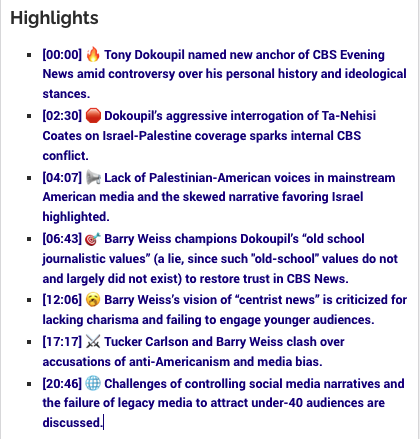
- [00:00] 🩺 Personal Extremes as Professional Symbolism: Tony Dokoupil’s adult circumcision after converting to Judaism is used not just as a personal anecdote but as a metaphor for extreme ideological conformity required to succeed in elite media circles. This signals how personal identity politics and ideological loyalty can overshadow journalistic merit in mainstream media hiring decisions.
- [02:30] 🔥 Media’s Israel-Palestine Narrative Battle: The transcript exposes how mainstream American media often suppresses or marginalizes Palestinian perspectives, creating a lopsided discourse that treats Israel as an unquestioned victim despite ongoing conflicts and violence. Dokoupil’s hostile interrogation of Ta-Nehisi Coates exemplifies how dissenting or critical views on Israel are delegitimized or branded as extremist.
- [04:07] 🤐 Silencing Palestinian Voices: The lack of Palestinian-American correspondents with editorial influence in major U.S. newsrooms perpetuates an incomplete and biased narrative, undermining journalistic objectivity and contributing to the erasure of Palestinian experiences from mainstream discourse.
- [06:43] 🎭 “Old School” Journalism as a Cover for Partisanship: Barry Weiss champions Dokoupil’s journalistic approach as a return to “old school values,” but the transcript reveals that such claims often mask overt ideological agendas, particularly pro-Israel stances, under the guise of “hard questions” and “fact-following.” This complicates claims of impartiality.
- [12:06] 🥱 Failure of Centrist News to Engage: Attempts to create “centrist” news programming that avoids strong positions tend to lack charisma and fail to attract audiences, especially younger viewers who seek more dynamic, direct, and diverse perspectives. The low viewership of Barry Weiss’s curated debates underscores mainstream media’s disconnect from contemporary audience preferences.
- [17:17] ⚔️ Political Weaponization of Media Figures: The clash between Tucker Carlson and Barry Weiss highlights how media personalities become proxies in ideological battles, with accusations of anti-Americanism and foreign allegiance used to delegitimize opposing viewpoints, further polarizing public discourse.
- [20:46] 🌍 Ineffectiveness of Media Control in the Digital Age: Despite billionaires’ investments and attempts to regulate social media content, the transcript argues that the global, decentralized nature of digital media makes it impossible to fully control narratives. Audiences increasingly turn to alternative platforms and international sources, diluting the influence of traditional media gatekeepers.
This transcript reveals the complex intersection of ideology, personal identity, media ownership, and public trust in contemporary American journalism, especially within the context of the Israel-Palestine conflict and the broader crisis of mainstream news institutions.
|
|


[t4b-ticker id=”1″]
[/su_spoiler]
Print this article [bws_pdfprint display=’print’]
[su_note note_color=”#f1efef” radius=”0″]The views expressed herein are solely those of the author and may or may not reflect those of The Greanville Post, although, if we publish them, we obviously find them noteworthy and valuable. [/su_note]
 This work is licensed under a Creative Commons Attribution-NonCommercial 4.0 International License •
ALL CAPTIONS, insults, AND PULL QUOTES BY THE EDITORS NOT THE AUTHORS

