
[su_spoiler title=”Please make sure these dispatches reach as many readers as possible. Share with kin, friends and workmates and ask them to do likewise. ” open=”yes” style=”fancy” icon=”arrow-circle-1″]

 Ron Unz
UNZ REVIEW
| Traducir—Translate! | |
| Make fonts bigger>>> | [wpavefrsz-resizer] |

Donald Trump and His American Empire


Just after New Year’s Day, President Donald Trump ordered a successful raid on Venezuela that abducted President Nicolas Maduro and his wife. Many of his angry critics denounced this as a return to the notorious Gunboat Diplomacy of President Theodore Roosevelt and others in the early years of the twentieth century. Trump had allegedly now adopted a similar policy, proclaiming his corollary to the Monroe Doctrine, which his supporters hailed as “the Donroe Doctrine.”
But this really isn’t correct.
TR never did anything like that, nor did any of the leading advocates of European imperialism, such as Disraeli, Palmerston, or Kaiser Wilhelm. The notion of attacking a weaker but sovereign country without any fig-leaf of legal justification and seizing its ruler would have been unthinkable during all the centuries since the Peace of Westphalia in 1648 ended the Thirty Years’ War and established our modern respect for national sovereignty.
However, many aspects of Trump’s boastful statements did indeed hark back to that era of high imperialism. He explained that since Venezuela was in the Western Hemisphere—“our own backyard”—it had no right to trade or conduct normal business relationships with whomever it wished, including China and Russia. Instead, Venezuela must market all its oil through America, only purchase American products, and only allow investment by American corporations or by those that America approved.
All of this was exactly the way that colonies of a century or more ago were treated, with their economic activity under the tight control of their distant colonial masters such as Britain or France. But although those imperial powers did regularly try to expand their holdings in the unclaimed portions of Africa and other backward regions, world leaders would have been utterly scandalized if a more powerful nation of that era had used its superior military power to subdue a weaker one and reduce it to the status of a mere colony.
Stephen Miller is one of Trump’s most influential advisors and in a very telling CNNinterview just after our attack on Venezuela, he argued that as a consequence of unmatched American military power, we could and should do exactly that. I’m not sure that I’d ever heard any American official declare that “Might Makes Right” in such totally brazen terms. His statements would have completely shocked and outraged all the Christian presidents, prime ministers, and monarchs of the nineteenth century Age of Imperialism.
JUST IN: CNN’s Jake Tapper ends interview after fiery clash with Stephen Miller over the future of Venezuela.
Tapper: “We went into the country, and we seized the leader of Venezuela…”
Miller: “D*mn straight we did!! We’re not going to let tin-pot communist dictators send… pic.twitter.com/aU5frDnvGN
— Collin Rugg (@CollinRugg) January 5, 2026
Around the same time, Trump himself gave a wide-ranging two-hour interviewto four New York Times journalists, and his own statements were of similar boldness. He declared that he had no regard whatsoever for international legal niceties or normative traditions and was only restricted by his own personal morality, as he chose to interpret it:
And he said that he did not feel constrained by any international laws, norms, checks or balances.
Asked by my colleagues if there were any limits on his ability to use American military might, he said: “Yeah, there is one thing. My own morality. My own mind. It’s the only thing that can stop me.”
This seemed an alarming expression of megalomania, far beyond anything I’d ever seen expressed by any petty Third World despot, let alone by the elected leader of a top world superpower.

A few days later I’d seen a facetious posting in which Trump had declared himself “the Acting President of Venezuela.” I had been absolutely sure that it was merely satirical, only wondering whether it had been concocted by his supporters or by his opponents. But it turned out to be absolutely true.
During the heyday of Western imperialism, I think that any national leader who publicly exhibited such delusional pretenses would have been immediately thrown out of office or even dispatched to a lunatic asylum. Henceforth, I will be reluctant to ever assume that anything regarding Trump is a joke.
There are many larger implications to all of these dramatic developments. Venezuela has been Trump’s current target but his arguments about “the Donroe Doctrine” seemed fully applicable to every other country in the Western hemisphere. Although he has not yet tried to implement that policy, Trump had effectively declared that all the once-sovereign nations of North and South America would be reduced to becoming our colonies, merely components of a vast American Empire.
Little Denmark had been a staunch American friend and NATO ally for more than three generations. So Trump’s announcement that he intended to seize its Greenland territory because he was much more powerful would certainly have horrified all the Western imperialists of that bygone era, and his past statements about annexing Canada fell into that same category.
I’d discussed all of these shocking developments in my article last week, with my title summarizing my own interpretation of what actually constituted “the Donroe Doctrine:”
- The Trump Doctrine: “They Have It. We Want It. We Take It.”
Ron Unz • The Unz Review • January 12, 2026 • 7,200 Words
According to all our school textbooks, the American constitutional system has been based upon a system of checks-and-balances maintained by our three co-equal branches of government. But so far at least, Trump’s appalling actions have provoked no substantial push-back from Congress or the courts, with Trump actually boasting that he hadn’t even bothered informing the Congressional leadership of his plans to attack Venezuela and seize its president.
One of the small number of Congressmen expressing his outrage over this illegal behavior has been Republican Rep. Thomas Massie (R-KY), and Trump and his billionaire donor allies have therefore targeted Massie for removal. Former Rep. Marjorie Taylor Greene (R-GA) had spent years as one of Trump’s staunchest MAGA loyalists, but when she began expressing serious doubts about some of his recent decisions, she was quickly driven from office by a wave of death threats directed against both herself and her family members.
Trump’s domestic and economic policies have been implemented in just as shockingly high-handed a fashion as those involving foreign affairs.
Tariffs are just the name that we give to taxes on imported goods, and according to our Constitution, all changes in tax law must be made by legislation originating in the House of Representatives. But in total disregard of centuries of these legal precedents, last year Trump began issuing a very long series of executive orders drastically changing tariff tax rates at weekly or sometimes even daily intervals, based solely upon his personal will or personal whim. I’m not sure whether any major country in the entire history of the world has ever enacted so many large, rapid-fire changes in its tax, financial, and economic policies.
- Donald Trump’s Looney Tunes Trade Policy
Ron Unz • The Unz Review • April 14, 2025 • 3,800 Words
Having freely gotten away with such an extreme aggrandizement of presidential authority, Trump then took matters even further. Growing dissatisfied with the performance of some leading defense contractors, he issued an executive order severely restricting all their financial activity:
An executive order posted Wednesday evening said companies “are not permitted in any way, shape, or form to pay dividends or buy back stock, until such time as they are able to produce a superior product, on time and on budget.”
Earlier Wednesday, Trump said in a Truth Social post that he would limit executive pay to $5 million, but the dollar figure wasn’t included in the executive order.
Thus, our president has now apparently asserted his right to issue executive orders setting the terms and conditions of all corporate dividends, buybacks, salaries, and bonuses as he sees fit. These are surely economic powers as sweeping as those enjoyed by any absolute monarch in human history.
For many months, Trump has been acting in these astonishingly high-handed ways, totally disregarding all American laws and Constitutional restrictions. He has been doing so without any significant reaction from the Congressional leadership, which has apparently been intimidated into such silence that they have seemingly disappeared from the American political landscape. This obviously represents a dramatic, almost unprecedented change in our form of government, and quite a number of prominent individuals have taken note of what has been happening.
With a career stretching back six decades, former Ambassador Chas Freeman ranks as one of our most distinguished diplomats and he had also served as an assistant secretary of defense. In numerous interviews, he has suggested that America had essentially become a presidential dictatorship in all but name, and that since Congress seemed no longer to play any role in our foreign or domestic policies, perhaps it should just be abolished.
Prof. Jeffrey Sachs of Columbia University has taken much the same position, arguing that unless the Supreme Court very soon took decisive action to curb Trump’s outrageous aggrandizement of political power, we should no longer be considered a republic, but had instead followed ancient Rome down the path towards becoming a monarchy that retained some vestigial republican institutions.
Tucker Carlson ranks as the most popular figure in the world of conservative media and he has spent years as a crucial Trump ally. But in the wake of our president’s unilateral attack on Venezuela and his boasts that he had seized control of that Latin American country, Carlson concurred with Sachs that America had made the transition from a republican to an imperial form of government, though he carefully stated those conclusions without rancor, in merely descriptive terms.
Freeman and Sachs greatly lamented these developments and Carlson sought to maintain his neutrality. But success succeeds, and the near-flawless execution of Trump’s Delta Force commando raid on Venezuela’s presidential palace has gained him strong support in some other quarters. Quite a number of right-wing pundits have become wildly enthusiastic over what they regard as Trump’s striking victories on the international stage.
Over the last few years and especially the last few months, right-wing podcaster Nick Fuentes has become one of the most popular rising stars on the Internet, attracting a huge audience among younger Americans because of his perceived willingness to shatter so many widespread taboos, notably those involving any candid discussion of Jewish power.
During most of this period, he has often been very critical of Trump and he certainly didn’t endorse him during the 2024 presidential campaign. But he later became enthusiastic over the sweeping worldwide tariffs that Trump had unilaterally imposed during his “Liberation Day” declaration of April 2nd, and he has become even more gleeful over Trump’s attack on Venezuela and our president’s boasts that he now controlled that country’s oil.
The podcaster’s recent shows have included many such dramatic statements, and quite a number of these were collected together by Brad Griffin, a right-wing blogger, who argued that these demonstrated that Fuentes had now gone “full Neocon imperialist.” Considering all those clips, one can hardly dispute that assessment.
Nick Fuentes GOES FULL ZIONIST/NEOCON and says the United States should “dominate the world” and believes massacring millions will be good for the American People.
Nick will do anything for a SHEKEL! pic.twitter.com/OLoQpC2AOO
— RTSG (@RTSG_Main) January 13, 2026
The Difficulties Russia Faces in Confronting the West
A few days ago, Chinese President Xi Jinping warned that the world might be returning to “the law of the jungle.” But I doubt that Trump or his advisors take such verbal complaints very seriously, instead probably viewing these as a sign of weakness. And unless Russia or China or some other powerful nation delivers a sufficiently strong blow to American arrogance, our provocations will probably escalate without limit, until the world is finally brought to the edge of global war.
Although Trump seems to have now pulled back a little from his recent promises to launch military strikes against Iran, aimed at overthrowing its government, he has dispatched one of our large carrier groups to that region, so it is possible that the intended attack has merely been delayed.
Meanwhile, although he originally came into office promising to quickly end the Ukraine war with Russia, he has long since backed away from that pledge and instead he and his administration have begun greatly escalating their military provocations against that latter country.
For example, a few days before Trump raided Venezuela, a huge wave of 90-odd explosive drones attacked the personal Novgorod residence of Russian President Vladimir Putin in an apparent assassination attempt. Although our president casually accepted the denials of the CIA, the Russians passed along hard, physical evidence of what had happened and independent intelligence experts were convinced that the story was true, with American support almost certainly involved in the strike.
Nearly as serious has been our willingness to seize oil tankers on the high seas in total violation of all international laws, actions that amounted to blatant piracy.
We began by capturing tankers carrying Venezuelan oil in order to enforce our illegal blockade of that country, including those bound for China with oil that country had already purchased, and we recently extended this to even include Russian-flagged vessels.
Trump and his top advisors have been steadily pushing the envelope of what actions they can take without drawing strong Russian military reprisals.
Since the beginning of the Ukraine war, Russia has successfully evaded Western economic sanctions on its oil sales by transporting that commodity in a large fleet of third-party tankers, and anti-Russian strategists have argued that these should be seized at sea, thereby eliminating one of Russia’s main sources of revenue. The successful recent capture of that Russian-flagged vessel near Iceland may have emboldened these advocates, and a wider pattern of tanker seizures may soon begin.
Trump and his more aggressive advisors such as Stephen Miller seem to have proclaimed unilateral American authority over all the world’s seas, and our mainstream media appears to have tacitly endorsed their declarations.
For example, I’ve noticed that articles in such leading publications as the New York Times and the Wall Street Journal usually explained that the oil tankers that we seized in international waters were “sanctioned,” strongly suggesting that our actions were legitimate rather than criminal. However, that merely referred to the illegal, unilateral sanctions imposed by America, sometimes joined by its Western allies, and these had no validity under international law. The basis for those seizures was clearly the view of Miller and others that American military power was so enormous that no other country on earth would be willing to challenge such actions.
If Russia or China or Iran unilaterally “sanctioned” vessels carrying American goods, I doubt that our media would describe the situation in the same way.
Back in the 18th century and earlier, European countries often resorted to what amounted to legalized piracy against their wartime adversaries, authorizing the seizure of the latter’s vessels by “privateers.” Interestingly enough, a prize-winning 2024 essay published by the U.S. Naval Institute argued that a return to such measures could be a useful tool in defeating China in a future war, a conflict that was coincidentally set in our current calendar year. That article opened with the following couple of paragraphs:
The War of 2026 scenario portrays a dangerous possible future: The United States and China go to war over Taiwan, and all signs point to it being anything but a “short, sharp war.”[1] But the longer the war drags on, the greater the toll in blood and treasure—and the larger the specter of nuclear escalation will loom. To escape this quagmire, the United States must craft an adroit theory of victory—a “causal story” about how it will defeat its adversary—that preserves Taiwan’s freedom and quickly brings the war to a favorable end without producing a nuclear exchange.[2]
Such lofty ends and such challenging circumstances demand the United States carefully choose the right means. In that vein, the United States should consider invoking prize law. Though it has not been exercised since World War II, the concept provides a legal framework for the United States and its partners to seize Chinese-affiliated merchant vessels and redeploy them in support of coalition operations.[3]
- Prize Law Can Help the United States Win the War of 2026
Seizing Chinese-affiliated vessels and redeploying them to support U.S. operations could provide an additional path to victory.
Major Ryan Ratcliffe • Proceedings of the U.S. Naval Institute • September 2024 • 2,500 Words
Although no such war has yet broken out, the Trump Administration has been increasingly pressing ahead with those measures in peacetime, apparently assuming that it will face no serious retaliation.
All of this places the Russians in a difficult quandary. They hardly have sufficient warships to escort every tanker on the high seas, and although they could probably use their missiles to strike American or NATO ships attempting to seize such vessels, that would initiate a full shooting war with the West. Russia has done its utmost to avoid such a situation over the last few years, recognizing that although its nuclear and conventional military power is quite strong compared to that of NATO, it is merely a mid-size country, with its population and economy totally dwarfed by those prospective antagonists.
I’ve emphasized these facts on numerous occasions, most recently a couple of weeks ago:
Russia currently has the world’s largest nuclear arsenal, with the estimated number of its warheads somewhat outnumbering America’s total. Much more importantly, it also deploys a very powerful suite of unstoppable hypersonic missiles as either conventional or nuclear delivery systems. Despite our own gargantuan annual military budget, comparable in size to that of the rest of the world combined and many times greater than what Russia spends, all American efforts to develop these same sorts of advanced missile systems have been marked by years of repeated, embarrassing failure…
Every objective observer recognizes that the current conflict amounts to a NATO proxy-war against Russia, with NATO supplying the massive financial support, advanced weaponry, training, targeting intelligence, and even key personnel that have allowed Ukraine to give Russia so much trouble. With such full NATO backing, the Ukrainians have frequently inflicted stinging losses upon Russia’s far superior forces. Indeed, by the standards of international law, NATO had long since already become a co-belligerent in the conflict, though for geopolitical reasons the very cautious Russians have refused to publicly declare that reality and take retaliatory measures.
Such caution is not unwarranted. Taken together, the countries of the NATO alliance have a combined population of nearly one billion, their recent annual military spending is 54% of the world’s total or about $1.3 trillion, and their aggregate GDP is nearly $50 trillion. By contrast, Russia’s population is only 138 million, its military spending is $145 billion, and its total GDP is $2 trillion. So Russia seems outmatched roughly 7-to-1 in population, 9-to-1 in military spending, and 25-to-1 in GDP. All these financial figures were given in nominal dollars and use of much more realistic PPP dollars would shrink these ratios by a factor of two or more, but a huge imbalance would still remain…
Given that NATO’s total population and industrial base is so many times greater than that of Russia, if the alliance holds firm, Russia might eventually be ground down over time. What was originally intended as a very limited punitive attack against Ukraine lasting just a few weeks has now gone on for well over three years, producing huge causalities on both sides, and it must be brought to an end. Meanwhile, the lack of any sufficiently strong Russian retaliation against NATO has merely emboldened the Western leaders to take more and more reckless and provocative actions, actions that at some point might result in a catastrophe for the world.
One strange aspect of this current conflict is that Russia has essentially been fighting NATO with both hands tied behind its back. NATO missiles using NATO targeting intelligence and key NATO personnel—legally laundered through the fig-leaf of its Ukrainian proxy—have regularly struck deep inside Russia, inflicting many serious blows, including sinking the flagship and other vessels of Russia’s Black Sea fleet, but Russia has refused to respond in kind. So in effect, the NATO countries have constituted a safe haven for producing and assembling the military hardware and systems used to equip Ukraine’s forces without suffering any risk of Russian retaliation. Russian cities have been struck by NATO missiles but NATO cities and their populations have not faced any similar threat…
If Western warships do begin routinely seizing tankers carrying Russian oil, President Putin will be confronted with a very difficult dilemma. If he responded militarily, the dominant Western global media would portray the Russians as having fired the first shot in an outright war with NATO, and they will face a fully mobilized alliance that outweighs them by roughly an order-of-magnitude. But if he does not act, Russia will look very weak, and it will also begin losing the oil revenue upon which it heavily depends.
[su_note note_color=”#ebf1f7″ radius=”17″]For the last couple of years, I have argued that the least-bad option would be for Russia to demonstrate the strategic superiority of its hypersonic missiles and the weakness of NATO air defenses by announcing in advance that it will strike and destroy the NATO HQ in Brussels, Belgium as proof of its power and resolve. I have repeated this same suggestion on numerous occasions, including earlier this month.[/su_note]
Such a successful strike would demonstrate Europe’s total vulnerability to a Russian attack. If Trump failed to respond effectively, it might bring down NATO’s political house of cards, thereby completely transforming the strategic landscape in Europe, while severely damaging our president’s own political credibility, both abroad and at home.
But Russia’s cautious national leadership has remained unwilling to take this sort of bold step, and I see no other good options for that country, no action sufficiently strong to deter growing American aggression but without being almost certain to trigger a full-scale global war.
- Puncturing the Propaganda-Bubble of the USSA and Its EUSSR Vassals
Ron Unz • The Unz Review • January 5, 2026 • 4,400 Words
Trump’s Geopolitical Strategy of Destroying Our Alliances
Venezuela originally gained its independence more than two centuries ago under Simon Bolivar in 1821, and the nation is located well over a thousand miles from our shores. Trump has asserted that the combination of our continuing naval blockade, our seizure of its oil tankers, and our abduction of its president had essentially reduced that oil-rich country of roughly 30 million to the status of merely being an American colony. If so, this would constitute a very large step towards the establishment of an outright American Empire spanning major portions of the globe.
Moreover, Trump quickly followed up these statements with other threats directed against Cuba, Colombia, and Mexico, as well as his very serious declaration that he intended to seize and annex the large island of Greenland from Denmark.
Given such behavior, it is hardly surprising that some of our closest allies have reacted with considerable alarm and seem to have begun shifting their international loyalties in other directions.
For example, Denmark, Germany, France, Norway, and some of our other NATO allies have dispatched small numbers of their combat troops to Greenland in hopes that their presence would deter Trump from attempting to seize the island, and EU officials have expressed huge concerns about the broader implications of Trump’s behavior. A right-wing German Substacker summarized the latest developments.
Soon after Trump’s 2025 inauguration, he had begun raising the issue of annexing Greenland and making similar remarks about Canada, our large but lightly populated northern neighbor. Now that the Greenland issue has been revived in such forceful fashion, it’s hardly surprising that Canadian Prime Minister Mark Carney may have grown worried that his own country might be next on the menu of conquest. Our newspapers reported his recent visit to China, seeking to reestablish full and friendly relations with that country.
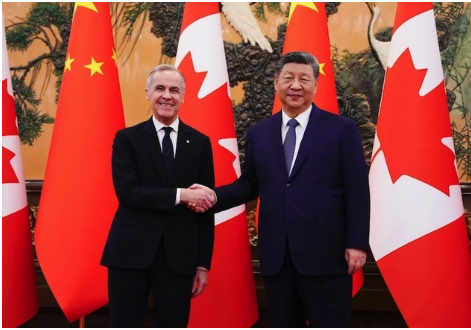 Furthermore, as I discussed last week, one of our most important global allies has suddenly taken an even more dramatic shift in a similar direction.
South Korea has one of the world’s largest, best-equipped militaries as well as some of its leading industrial corporations, including a microchip industry twice as large as America’s own. Given the combination of all these factors, that country could plausibly be ranked as first among equals, along with our other top global allies such as Japan, Germany, Britain, and France. Therefore, some recent developments that I noted last week were especially striking:
Although the American newspapers largely ignored it, I discovered that the South Korean president recently paid a very friendly four day visit to China, bringing with him an enormous delegation of 200 officials and business executives, surely one of the largest such contingents in his country’s history. And in an important statement, the media outlets of both countries reported that the South Korean leader fully affirmed the One China policy, under which Taiwan is regarded as a temporarily separated province of a unified China. Moreover, by a wide margin China is already South Korea’s largest trading partner.

According to the knowledgeable East Asian commenter who brought that story to my attention, the photograph contained some subtle but important clues:
There is likely a symbolic undertone to the dresses the respective First Ladies chose to wear…The Chinese First Lady decided to wear something from their early Republic circa 1920s, before the Chinese Civil War…The Korean First Lady chose to wear something even more traditional dating to centuries ago when Korea was considered a fraternal relation of China.
[Dealing with a gangster]
If South Korea has now taken a dramatic turn towards China, a number of contributing factors may have gone into that decision. Last year, Trump suddenly imposed very heavy tariffs on that country, and also made an outrageous, extortionist demand for an immediate payment of $350 billion, a sum that the prime minister declared would wreck its national budget.
Then last September I’d noted that that South Korea had been totally humiliated by a brutal ICE raid on its nationals working in America, and I’d even suggested at the time that this might have potentially important consequences:
Aside from Japan, South Korea is our most important remaining Asian ally, a major economic and technological power, but late last week our relations may have suffered a severe blow.
For the last several years, our government leaders have pressured the South Koreans to invest billions of dollars establishing new American factories, but on Friday our immigration service staged a huge raid on the Hyundai-LG plant in Georgia, arresting hundreds of its South Korean nationals as illegal immigrants, with their harsh treatment producing waves of public outrage in that country…incidents such as this may result in drastic changes in South Korean attitudes towards America.
An American War With China, Then and Now
Although these diplomatic moves by Canada and South Korea may be developments of considerable long-term significance, it is unclear whether they are regarded as such by Trump and his top advisors. Those latter individuals seem to have become positively giddy from what they regard as their very successful use of raw military power, probably believing that if necessary such similar force could be employed to completely sweep aside any shifts in international alignment that they find overly disagreeable. Once you have kidnapped your first foreign leader, doing so a second or a third time becomes much easier.
The American government seems to only recognize the language of military power and if Russia is unwilling to risk a direct clash with a Western alliance that so enormously outweighs it in population and economy, our only remaining serious global opponent would be China.
China is certainly regarded as an economic colossus, but probably few Westerners consider it a great military power. Indeed, the Chinese have never emphasized their martial virtues, and their foreign policy has always been circumspect, defensive, and cautious.
America has been almost continually at war somewhere or other for the past two or three generations, while across those same seventy-odd years, China has only fought two very short border wars, a clash with India in 1962 and one with Vietnam in 1979, with each of those small conflicts lasting only about one month and the more recent one not going particularly well. Probably few if any Chinese military commanders have ever actually seen combat.
Given such sharply contrasting histories of warfare, I suspect that many of the arrogant, highly militaristic members of the Trump Administration view the Chinese armed forces in rather dismissive terms, including our Secretary of War Pete Hegseth, a notoriously pugnacious veteran of our Iraq and Afghanistan wars.
Yet although few Americans are probably aware of it, the worst military defeat we ever suffered in our entire national history was inflicted by the Chinese during the Korean War. In 1950 Gen. Douglas MacArthur’s victorious army was rapidly advancing across North Korea, heading towards the Chinese border, and we completely disregarded the Chinese warnings to stay away. The Chinese then intervened with the consequences I discussed in a 2021 article:
One crucial point they properly emphasize is the terrible scale of the American defeat at the hands of the intervening Chinese ground forces during late 1950. They quote from Disaster in Korea, the definitive military account of that conflict by Lt. Col. Roy E. Appleman, who characterizes the situation in extreme terms: “…a series of disasters unequaled in our country’s history…a massive retreat, without parallel in U.S. military history.” As a consequence, both President Truman and the Joint Chiefs of Staff agreed that atomic bombs should be used if necessary to avert total defeat.
The Chinese forces that attacked us were a poorly-equipped army, consisting almost entirely of peasant infantry and lacking any air support. But the defeat they inflicted upon our military forces was so severe that Truman desperately considered using atomic bombs to salvage the situation and he almost certainly did deploy illegal biological weapons against the Chinese [and Koreans].
Although nearly all Americans have forgotten that history, it should be firmly kept in mind as we consider the growing provocations of the Trump Administration against China.
China was a leading importer of Venezuelan oil, and one of the tankers Trump seized was carrying crude that it had already purchased, with our president boasting that he had confiscated the contents and would either add the oil to our own strategic reserve or else auction it off on the open market. Around that same time he announced that he would be selling an additional $11 billion of advanced weaponry to Taiwan, including missiles able to hit Chinese cities. Adding insult to injury, Trump’s abduction of President Maduro came just hours after the latter had held extensive meetings with a high-level visiting Chinese delegation, and this must have surely been a major embarrassment to the Chinese government.
I doubt that China will appreciate the prospect of having its cities placed within missile range of the new weapons systems that Trump will be delivering to Taiwan. [The usual arrogant, exceptionalist double-standard]
Although Trump and Miller have declared that the entire Western Hemisphere is our own sphere of influence and they are seeking to eliminate all of China’s past economic inroads into Latin America, they have been absolutely unwilling to grant China the same privileges. They would violently oppose Chinese military bases or troops in Mexico or the Chinese sale to Cuba of powerful missiles that could hit American cities, but see nothing wrong in doing similar things in China’s own backyard.
So far, the Chinese have failed to take any strong actions in response to these numerous provocations, nor have they indulged in the heated public rhetoric that our own government regularly spouts. Trump probably regards this as further evidence of Chinese weakness, but he may be seriously mistaken.
More than a century ago, racialism dominated Western intellectual life and the books of that era reflected this tradition. One of our greatest early sociologists was E.A. Ross, and in 1911 he published The Changing Chinese, a short but fascinating book with a chapter entitled “The Race Mind of the Chinese” containing the following passage:
The more cheaply gotten-up races of men have a short mental circuit and respond promptly to stimulus…But the races of the higher destiny are not so easily set in motion…
We like to think of the Anglo-Saxons as of this stable type and feel that such an endowment makes up to our race for its lack of the quick mobile feeling, the social tact and the sensitiveness to beauty so characteristic of South Europeans. Now, of this massive unswerving type are the Chinese. Fiery or headlong action is the last thing to be expected of yellow men. They command their feelings and know how to bide their time. They are not hot to-day, cold to-morrow. Hard are they to move, but once in motion they have momentum. Slow are they to promise, but once they have promised for a consideration they “stick.”
Much like his own Anglo-Saxons, Ross regarded the Chinese as a people often slow to decide upon an undertaking but then very swift, firm, and decisive when they finally did so. The Chinese had exhibited exactly those characteristics in 1950 when they smashed the American army in Korea.
EDITOR’S ADDENDUM.
|


And after decades of patiently biding their time and silently enduring countless American provocations, they may finally be ready to take action against America in their own East Asian backyard.
In late 2024 we began republishing the Substack columns of an astute retired Chinese technology executive named Hua Bin, and one of his most recent pieces bore a highly provocative title.
- China to Get Ready for War with the US in 2026
Hua Bin • Substack • January 13, 2026 • 1,900 Words
The wife of former New York Times Beijing Bureau Chief Nicholas Kristof is Chinese and together they have written several books on that country. Just a couple of days ago he published a long piece with a similar title: “How War With China Begins.”
China’s Overwhelming Military Superiority Near Its Home Waters
In considering the likely course and contours of a war between China and America, the military histories of our two countries could not be more dissimilar. The last extended war that China fought was in Korea nearly three generations ago, while America has fought numerous very long wars since then and has been continually at war since 9/11. Since practice makes perfect, a naive analyst might assume that we would enjoy a major advantage in combat. But I think that the exact opposite is much more likely to be true, with the analogous early history of the First World War suggesting the reason.
When the Guns of August began firing in 1914, peace-loving Imperial Germany had not fought a major war in over 40 years, while the British Empire had been almost constantly at war during those same decades. But all of Britain’s many wars had been colonial conflicts, with British riflemen generally facing the assegai spears of Zulus or similar foemen. British officers had comfortably settled into tactics and strategies that were totally unsuited to combat against an industrialized adversary such as Germany, whose artillery and machine-guns were as good or better than their own. As a consequence, they suffered horrendous losses, with some 20,000 British troops being killed on the first day of the Battle of the Somme.
Similarly, for generations American commanders have spent their entire careers fighting foes who could not effectively fight back, deploying their helicopter gunships against goatherds armed with AK-47s, and their weapons and mental habits could prove extremely counter-productive under different circumstances. Indeed, the main reason that we made no effort to develop effective air defenses was that our opponents lacked any missiles or bombers, and for similar reasons, our cruise missile arsenal still largely consists of elderly Tomahawks, based upon technology that is now a half-century old and obviously obsolescent.
We have certainly become extremely skilled at particular types of warfare, notably commando raids, assassinations, and government destabilizations, with our flawless recent strike against Caracas being a perfect example of this. But I doubt that much of this special forces toolkit would prove very useful in the waters of the South China Sea or the Straits of Taiwan.
For more than a century, America’s military strength has always been based upon the massive superiority of its industrial power, but these days the potential of even a fully reindustrialized America would be totally dwarfed by that of our Chinese opponent. As I’ve discussed on a number of occasions, the best simple metric of industrial power is probably the size of the real productive economy, and by that standard China’s economic capacity is more than three times larger than our own. Indeed, China already outweighs the combined total for the entire America-led bloc—the United States, the rest of the Anglosphere, the European Union, and Japan. Thus, while Russia would have been hugely outmatched in any long-term military conflict with the West, China’s situation is entirely different.
Very early in his career, former Ambassador Chas Freeman served as the young interpreter for President Richard Nixon during the historic 1972 trip to China, and he is widely regarded as one of our leading China experts. In a 2023 public lecture, he suggested that America’s new Cold War against China bore many similarities to our previous conflict against the USSR, except that this time we were playing the role of our old vanquished adversary, an analogy I had also frequently expressed:
In international affairs, as in physics, for every action there is an equal and opposite reaction. Our actions have stimulated China to mirror, meet, and match our military hostility to it. We are now in an arms race with China, and it is far from clear that we are holding our own…
Despite China’s remarkable military buildup, Beijing has so far kept defense spending well below two percent of GDP. Meanwhile, cost control continues to elude the Pentagon. DoD has never passed an audit and is infamous for the waste, fraud, and mismanagement that result from its reliance on cost-plus procurement from the U.S. equivalent of profit-driven state-owned enterprises – military-industrial corporate bureaucracies whose revenues (and profits) come entirely from the government. The U.S. defense budget is out of control in terms of our ability to pay for it.
Four decades ago, the United States bankrupted the Soviet Union by forcing it to devote ever more of its economy to defense while neglecting the welfare of its citizens. Now we Americans are diverting ever more borrowed and taxpayer dollars to our military even as our human and physical infrastructure decays. In some ways, in relation to China, we are now in the position of the USSR in the Cold War. Our fiscal trajectory is injurious to the general welfare of Americans. That, along with our liberties, is, however, what our armed forces are meant to defend.
- Ambassador Chas Freeman on Our Cold War Against China
Ron Unz • The Unz Review • December 9, 2024 • 7,500 Words
In January 2025, I’d published a very long and comprehensive comparative review of China and America, drawing substantially upon Hua Bin’s posts and articles, with much of my analysis focused upon a possible military conflict, summarizing those same issues a couple of weeks later in an interview with Mike Whitney.
In his writing, Hua noted that over the last decade the mainstream American media had regularly emphasized the likelihood of a war with China in the near future, with a recent example being a lengthy late October 2024 article in the New York Timescarrying the headline “The U.S. Army Prepares for War with China.”
Given Hua’s technological background, it was hardly surprising that he provided a great deal of detailed information on the weapons systems that China would be likely to use, and I quoted much of his material at length:
– China test launched its DF31AG ICBM successfully last month, making it the only country with a successful recent test performance in long-range (12,000 kilometre) nuclear attack capability. China also has DF41 in its arsenal, a Mach 25 18,000 km hypersonic ballistic missile that carries 6 times more nuclear warheads than DF31. These, together with submarine-launched JL-3, serve as a strong deterrent to US nuclear blackmail
– China 5th-gen stealth heavy fighter J20 has upgraded its engine with WS15. It now outperforms F22 (let alone the smaller F35) in speed, manoeuvrability, and longer beyond-visual-range air to air missile (PL17). Its stealth, avionics, radar, EW capability, speed, range, and firepower far exceeds F35, a medium-size jack-of-all-trades cheaper fighter which is now the main aerial combat platform for the US. China produces 100 J20s a year and the US has stopped producing F22 due to its high cost. There is also a two-seat version of J20 – the J20S – which has unmanned loyal wingman swarming capability. China has started production of its own medium-size stealth fighter J35 as a cheaper, high volume 5-th gen figher.
– China has fielded multiple hypersonic missile systems such as DF17, DF26, DF100, YJ21, while US has yet to field any, falling behind not just China and Russia but also Iran in this critical future military technology. Russia shocked the west with its hypersonic HGV missile Oreshnik in Ukraine just the other week. While the Oreshnik is still an experimental weapon, China’s DF17 or DF26 are mature systems tested many times over the years and have been deployed in the Rocket Force for half a decade. According to the US DoD, China has conducted twice more hypersonic missile tests in the past decade than all other countries combined.
– On the naval front, US Navy openly acknowledges China’s ship building capacity is 230 times of that of the US. The US Navy is now resorting to outsourcing navy ship building and maintenance to Korea and India, against US own laws
– China can produce conventional precision-guided rockets at the same unit cost (USD4-5000) as US builds dumb artillery ammos like the 155mm shells. The US DoD head of procurement warned in 2023 that China’s defence budget has a 3 or 4 to 1 advantage against the US in procurement value for money. Given its industrial base, China can not only produce more cheaply but in much larger volume as well. As we can see in Ukraine and the Middle East, quantity has a quality of its own when it comes to high intensity modern warfare. In a hot war, the cost exchange and quantity exchange will heavily favor China.
– China is the only country in the world that can mass produce CL-20, the most destructive non-nuclear explosives. Imagine CL-20 explosive warhead on DF17 in an attack on US aircraft carrier – a hit translates into 5000+ KIAs and $14 billion capital asset excluding aircrafts on board. The much-acclaimed “mother of all bombs” that the US dropped on the hapless Afghanis will fale next to that meteorite strike.
– China’s PHL16 multiple launcher rocket system is a high mobility high precision attack platform similar to HIMARS but it has a range of 500 KMs vs 300 km for HIMARS with higher payloads and higher precision (guided by the Beidou satellite system, which is itself far superior to the outdated GPS system the US military relies on). Unlike the HIMARS system which is treated as a scare miracle weapon by the west, China has deployed the PHL16 system to more than 40 army battalions in 4 provinces close to Taiwan. PHL16 alone can conduct blanket precision strikes on any point in Taiwan on road-mobile TELs. The Chinese call such cheap saturation strike weapon as “all-you-can-eat buffet” in a Taiwan pre-landing bombing campaign.
- American Pravda: China vs. America
The Chinese Military and the Prospects of a War with America
Ron Unz • The Unz Review January 13, 2025 • 14,100 Words
Hua emphasized the obvious fact that a military clash between China and America near Taiwan or in the South China Sea would be occurring within a couple of hundred miles or so of the Chinese mainland while American forces would be operating at the end of a resupply chain that stretched some 6,000 miles. This was one of the many reasons he has expected China to win an easy victory in any such conflict.
My own verdict was very similar. In an article a couple of weeks ago, I’d pointed out that although we boasted that our unequaled navy controlled the waters of that region, the dramatic changes in military technology over the last couple of decades that Hua was describing had radically shifted that balance of power.
Using its huge industrial base, China had amassed an enormous arsenal of both conventional and hypersonic missiles while our own air-defense systems were quite ineffective. Therefore, in any full conventional war I couldn’t see anything that would prevent the Chinese from using waves of those missiles to immediately sink every American aircraft carrier and other warship in the region, while destroying all our airbases within many hundreds of miles, thereby winning the war within the first 24 hours.
In that same article, a seemingly knowledgeable commenter had laid out his estimate of the likely balance of forces:
It’s baffling how people still think that US v China in the South China Sea would be a serious fight, or anything other than a one-sided massacre of US forces.
The US can assemble at most three carrier strike groups in the South China Sea, from which it can deploy 144-180 Super Hornets and F-35Cs.
China, meanwhile, is next door and can assemble 300+ J-20s, 300+ J-16s, and up to 1,000 more capable 4th-generation aircraft.
Add to that being able to deploy heavy AWACS and tankers. And being able to call upon strategic bombers carrying ALBMs.
And add to that its fleet of over 45 modern submarines, and vast stocks of land based anti ship misisle[sic] batteries.
Indeed, the notion that America would be decisively defeated after just a day or so of combat might even be an overly cautious assessment.
Our top military leadership would obviously be loath to see so much of their hugely expensive navy quickly annihilated and they have probably grown alarmed by Trump’s very provocative behavior. Therefore, they may have been responsible for the December leak of a Pentagon report indicating that the Chinese could destroy our largest aircraft carriers “within minutes.” So according to the Pentagon’s own wargames, America might suffer a crushing military defeat within the first hour or two.
Applying the Venezuela Precedent to Blockading Taiwan
Although it seems clear that China would easily win a conventional war against America’s forces near its own home waters, wars often have dangerous, unforeseen consequences, and this is especially true in a world containing nuclear weapons. If we suffered an overwhelming military defeat with very heavy casualties, Trump and some of those around him might be sufficiently irrational that they would take escalatory steps that could set the entire world on a path to destruction. I’m sure that China’s own cautious, pragmatic leaders recognize those dangers and seek to minimize such risks.
Also, as discussed above, Trump’s atrocious behavior has recently caused some of our most important allies such as South Korea and Canada to begin shifting in China’s direction. If China were seen to have provoked a major war let alone actually begun it, these important diplomatic advances might be halted or lost.
Therefore, I think that China’s optimal strategy would be to restrict its actions to peaceful ones, but do so in a manner that may deal a very serious, even crippling blow to its American adversary.
The Chinese Civil War ended more than three generations ago and since that time, the Communist government of mainland China has been absolutely committed to its One China Policy, under which Taiwan is regarded as merely a temporarily separated province of a single, unified Chinese homeland. Indeed, the Nationalist Chinese KMT party that ruled the island during most of those decades took exactly that same position. The American government and nearly all other nations around the world have always affirmed that same legal framework.
With a recorded history thousands of years long, the Chinese are a very patient people, and the political leaders in Beijing have regularly emphasized that they are in no great hurry to achieve reunification with Taiwan and would certainly prefer to do so by entirely peaceful means. However, they have also declared their willingness to use military force if the separatist-leaning DPP party that has intermittently governed Taiwan since 2000 were to move towards independence.
Following Nixon’s historic opening to China in 1972 and for decades afterward, it was understood that America would steadily reduce all of its arms shipments to Taiwan and also support eventual reunification. However, in recent years, our own country has increasingly back-tracked on those past commitments and Trump may have now completely abandoned them.
His recent announcement of a huge $11 billion sale of advanced arms to Taiwan was not only far larger than anything previously provided, but it even included missiles capable of hitting Chinese cities, which would surely cross a bright red line. This quickly prompted some extremely serious Chinese saber-rattlingat the end of December, with Beijing threatening to impose a “chokehold” on what it has always regarded as a rebellious, breakaway province.
But if Trump has created a major problem for China, he has also provided that country with the obvious solution.
Venezuela is located more than a thousand miles from the U.S. and has little if any cultural or historical connection to our own country. Yet because Trump strongly disliked the policies of its government, he imposed an oil blockade against that nation, while also declaring a No Fly Zone over its airspace. He enforced that blockade by military force, seizing any tankers that were trying to transport the oil it produced to those countries that had purchased it, notably including China.
Over the last couple of weeks, I have repeatedly pointed out that if Trump can declare a blockade of the independent country of Venezuela based upon no legal justification, China can certainly claim that it has an equal right to do so with regard to an island that the U.S. government and nearly the entire world have long recognized as an inalienable part of a single, unified China. Not only can China cite the undeniable legal precedent of Venezuela, but that precedent is drastically skewed in China’s own favor.
China could impose that temporary air and sea blockade to enforce certain strong but very reasonable demands. It could require that Taiwan’s government agree to immediately cancel the huge arms deal that it had recently signed with America and that it also make a solemn commitment against ever seeking independence from China. Perhaps the Taiwanese might also be required to disgorge themselves of some of the more powerful weaponry they had previously received under the first Trump and the Biden Administrations.
These are hardly unreasonable requests. Would Trump be willing to have China sell missiles to Cuba that were capable of hitting American cities?
I think that such a full blockade would be extremely effective in very quickly bringing Taiwan’s government to heel. As Kristof explained a couple of days ago in his New York Times column:
Taiwan’s economy depends on imported petroleum products, and it has only two or three weeks’ worth of natural gas on hand. Taiwan’s future might then depend on whether President Trump was willing to order the U.S. Navy to escort ships to Taiwan to break the blockade.
Based that leaked Pentagon report, it would be absolutely suicidal for America to challenge China’s military forces in the region, and if we did not, the Taiwanese would be forced to completely submit within just a few weeks. The Chinese would probably not need to fire a single shot.
The internal politics of Taiwan would considerably assist that result. I’ve heard that the Chinese Nationalists of the KMT still heavily dominate Taiwan’s officer corps, especially its top ranks, and they deeply despise the ruling DPP as national traitors, with such sentiments hardly helped by the latter’s warm embrace of Western cultural practices that most Chinese regard as abhorrent. For example, in November 2018, the Taiwanese electorate overwhelmingly rejected Gay Marriage at the polls, but the DPP nonetheless enacted that policy into law six months later, with Taiwan becoming the first country in Asia to do so.
Based upon this very sharp political division between the KMT and the DPP, some knowledgeable people have told me that faced with sufficient external pressure, the KMT-led armed forces might stage a military coup and quickly come to an amicable agreement with their cousins on the mainland, with whom they generally enjoy friendly relations. I would think that a Chinese blockade of vital oil and gas supplies and America’s unwillingness to challenge that blockade would facilitate such an outcome.
Whether America did attempt to break the Chinese blockade by military means and saw its forces quickly annihilated, or much more likely, avoided any conflict and allowed Taiwan’s submission, the cost to American global prestige would be enormous. We would have demonstrated to the entire world that despite our trillion-dollar defense budgets, in East Asia we were merely a paper tiger. We would have conceded that the Chinese navy now controlled the sea lanes of that region, sea lanes that are among the busiest and most important in the world. A large fraction of all industrial products and its consumer goods are produced in East Asia, and China would dominate those waters.
Under past circumstances, a Chinese blockade of Taiwan might have been viewed with great disfavor by much of the world, especially given the negative way it would be portrayed by the powerful Western global media. But over the last year Trump’s outrageous behavior has alienated so many major countries that this situation would be much less the case today.
In any event, the blockade of Taiwan would probably last only a few weeks, involve no bloodshed, and soon be forgotten. Taiwan’s status might not have been drastically changed, but its government would have had its wings sharply clipped and be set much more firmly on the course of future reunification with the rest of China. The total political humiliation of the DPP might lead to a sharp drop in popular support for that party, with the KMT or similarly aligned parties gaining long-term control over the local government.
The AI Tech Bubble and Maximum American Vulnerability
Trump declared his coercive blockade of Venezuela in mid-December, and although I began emphasizing its obvious implications for China’s policy towards Taiwan in a January 5th article, I’ve been surprised that so few others have done the same, at least if the results returned by my casual Googling of “Trump Venezuela Taiwan blockade” are any indication.
Instead, the overwhelming focus seemed to be whether our commando raid on Caracas might embolden the Chinese to launch a full-scale invasion of Taiwan or at least attempt a similar operation to abduct Taiwan’s current president, with a short piece published on the website of the Council on Foreign Relations being a typical example of this.
A Chinese invasion of Taiwan would involve massive loss of life and be totally disastrous, while an attempt to kidnap the Taiwanese president would probably accomplish little if successful and could easily fail. Taking such violent actions would make little sense if a simple air-sea blockade would probably cause Taiwan’s surrender within just a few weeks.
As it happens, the author of the CFR piece was a Fellow for Asia Studies named David Sacks, but when I saw the byline I initially confused the author with David O. Sacks, the billionaire who serves as the Technology Czar of in the Trump Administration. I actually think that latter individual would have a far better understanding of the enormous potential leverage that China currently enjoyed over both Taiwan and America.
According to what I’ve read, the military strategy that the Pentagon had formulated in the event of a war with China was to enforce a distant blockade of that country, intercepting shipments of oil and raw materials so as to inflict serious damage upon the Chinese economy. This blockade would be maintained by carrier task forces and other warships operating at a distance far beyond the range of China’s powerful anti-ship missiles. I had earlier discussed the prize winning 2024 essay published by the U.S. Naval Institute, which envisioned using exactly this sort of maritime interdiction strategy to weaken and ultimately defeat China in a conventional war.
Under past circumstances, such a plan may or may not have been partially successful. Over the last couple of decades, this exact perceived vulnerability had led China to shift towards the very heavy use of EVs, thereby drastically reducing its oil consumption, while the government had also built up a large strategic oil reserve. Russia is the world’s greatest treasure-chest of raw materials, oil included, and over time it could certainly increase its land shipments of those vital commodities to its Chinese ally.
But other current considerations render all these past Pentagon military strategy documents completely moot.
Over the last few years, the gigantic AI boom has driven the market values of major tech companies to unprecedented heights. There have been very widespread claims that we are experiencing an obvious AI Bubble, with trillions of dollars being budgeted for capital expenditures in that sector. Indeed, by some estimates America would probably have already fallen into a recession during 2025 if not for the enormous spending on data centers and other AI related projects, with AI accounting for 40% of all American GDP growth last year. Our economy has also been propped up by the consumer “wealth effect” produced by the huge rise in Tech stocks, almost all of that driven by the AI boom.
The seven largest corporations by market value are all Tech companies, largely boosted by their AI prospects, and their total value is over $20 trillion. Other Tech companies, whether public or private, add many trillions of dollars in additional market value.
But Taiwan is the world’s largest producer of microchips and especially dominates the manufacturing of the most advanced such chips, such as those used for AI. China holds the second spot and South Korea is in third place while America’s market share is merely 6%. Although the U.S. has been making major efforts to increase its domestic production, that project will take years to bear fruit. As of today, nearly all of Nvidia’s cutting-edge AI chips are still manufactured at the TMSC factories in Taiwan.
Thus, America’s entire AI boom, including trillions of dollars of planned investment and tens of trillions of dollars in market value, depends upon the steady, uninterrupted supply of AI microchips from Taiwan.
A Chinese blockade would cause an immediate end to those shipments of AI microchips and puncture that bubble.
I could easily imagine the largest, most heavily over-valued Tech stocks dropping by 50% or more, erasing many, many trillions of dollars in investor wealth. Over-leveraged hedge funds would surely go under, worsening the pain. Wall Street might see one of the worst collapses in its entire history.
However, if Taiwan merely submitted to China and the American government blessed that political outcome, all those AI shipments could immediately resume. I think that every major Tech executive and wealthy investor would apply enormous pressure on the American and Taiwanese governments to surrender to China’s reasonable demands on those issues.
The American government would have no other possible options.
Over the years there has been widespread speculation that the American government had prepared contingency plans to destroy the Taiwanese chip factories if China invaded, thus preventing them from falling into Chinese hands. But doing so under these circumstances would eliminate any hope of a quick resumption of AI chip exports, and ensure the permanent collapse of all those Tech stocks.
In six months or a year, the Tech and AI Bubbles might have anyway burst, greatly diminishing the importance of AI chips. Within another two years or three, America might have built up its domestic chip manufacturing facilities to the point that it could partially replace a loss of supply from Taiwan.
But at this particular moment in time, a Chinese blockade of Taiwan would amount to placing its hands around the windpipe of the all the West’s leading technology companies, all of Wall Street’s wealthy investors, and to a considerable extent the entire American economy.
So now is the right time for China to strike and burst the bubble of President Donald Trump’s American Empire.
Related Reading:
- The Trump Doctrine: “They Have It. We Want It. We Take It.”
- Puncturing the Propaganda-Bubble of the USSA and Its EUSSR Vassals
- American Pravda: China vs. America
- Ambassador Chas Freeman on Our Cold War Against China
- Donald Trump as Our President Caligula
- President Donald Trump as Founding Father of the Newer World Order
BEFORE you leave, PLEASE pay attention to this alert.
[t4b-ticker id=”1″]
[/su_spoiler]
Print this article [bws_pdfprint display=’print’]
[su_note note_color=”#f1efef” radius=”0″]The views expressed herein are solely those of the author and may or may not reflect those of The Greanville Post, although, if we publish them, we obviously find them noteworthy and valuable. [/su_note]
 This work is licensed under a Creative Commons Attribution-NonCommercial 4.0 International License •
ALL CAPTIONS AND PULL QUOTES BY THE EDITORS NOT THE AUTHORS


3 comments
Ron Unz’s approach has all the subtlety of a bull in a China shop.
China’s approach to collapsing the US bullshit shop is much better thought out and less likely to bring about WW3.
https://www.youtube.com/watch?v=8DWWO6QCKLA
Eric: The vide link has been blocked/ suppressed by Google I think.
Link I posted did not work, try this…
“Ron Unz’s approach has all the subtlety of a bull in a China shop.
China’s approach to collapsing the US bullshit shop is much better thought out and less likely to bring about WW3.”
https://youtu.be/8dwWo6QckLA?si=5uPqC5KIDnunoV27