[su_spoiler title=”Please make sure these dispatches reach as many readers as possible. Share with kin, friends and workmates and ask them to do likewise. ” open=”yes” style=”fancy” icon=”arrow-circle-1″]
 Nima R. Alkhorshid
DIALOGUE WORKS

Nima chats with
Profs. Richard D. Wolff & Michael Hudson
| Traducir—Translate! | |
| Make fonts bigger>>> | [wpavefrsz-resizer] |

Streamed live on Jan 1, 2026
Summary
The video discussion centers on the complex political, economic, and social challenges currently facing France and Europe, particularly in the context of the ongoing Ukraine conflict, the strained relationship with Russia, and the broader geopolitical tension involving the United States. Richard, with deep personal and historical ties to France, paints a bleak picture of the French government’s alienation from its populace, especially under President Emmanuel Macron’s leadership. The French social welfare system, renowned for its comprehensiveness, is under attack through austerity measures and pension reforms, fueling public discontent and protest movements like the Yellow Vests. Macron’s support for Ukraine and efforts to seize Russian assets have failed spectacularly, damaging Europe’s credibility and economic standing.
The dialogue expands to the broader European context, where the United States’ Cold War–driven strategy dominates, forcing Europe to isolate Russia and China economically while subordinating its own industrial and trade interests to US demands. This results in Europe’s deindustrialization, economic decline, and political instability, as governments struggle to maintain social welfare amid budget constraints and growing opposition from left-wing and labor movements. The attempt to relocate European industry to the US is met with practical challenges due to America’s unstable socio-political environment and high costs.
The speakers underscore the profound structural economic transformations underway, marking the decline of industrial capitalism in the West and a rise in finance capitalism in the US, contrasting with China’s state-managed developmental model. They also highlight the ideological rigidity of the European elite, whose anti-Russian stance is used to justify austerity and political repression, despite its harmful consequences. The discussion closes with reflections on the broader systemic crisis of Western capitalism, the loss of Europe’s global economic centrality, and the social and political ramifications for cities like New York and London, emblematic of capitalist decline.
Key Insights
-
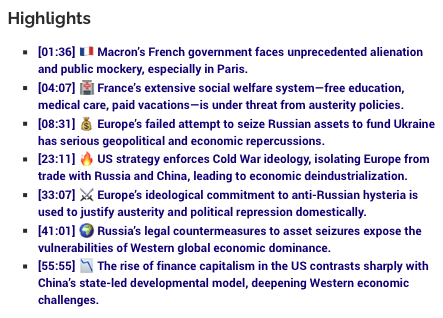
[01:36] 🇫🇷 Alienation of French society from Macron’s government: Macron’s leadership is profoundly disconnected from the French populace, especially in Paris, which holds cultural and political significance. This alienation manifests in widespread public disdain and mockery, underscoring a legitimacy crisis that threatens political stability. The erosion of trust in leadership is symptomatic of deeper social fractures exacerbated by austerity and global geopolitical pressures.
-
[04:07] 🏥 The resilience and vulnerability of France’s social welfare system: France’s social welfare system is a cornerstone of its societal model, providing universal healthcare, free or low-cost education, paid vacations, and affordable childcare. Macron’s attempts to cut back on these benefits, particularly pensions, have sparked public outrage, revealing the deep social contract between the state and its citizens. The welfare system’s gradual defunding signals a shift toward neoliberal austerity, threatening social cohesion.
-
[08:31] 💰 Failure to seize Russian assets undermines Europe’s war effort and economic standing: Europe’s effort to confiscate up to $200-300 billion in Russian assets to finance Ukraine’s war efforts backfired due to legal and political resistance within the EU and Russia’s counter-threats. This failure not only deprived Ukraine of crucial resources but also damaged Europe’s credibility and accelerated the diversification of global central bank reserves away from the euro and dollar, weakening Europe’s financial influence.
-
[23:11] 🔥 US-imposed Cold War strategy isolates Europe economically and politically: The US has pushed Europe into an ideological and economic Cold War stance against Russia and China, forcing European economies to sever natural trade ties with these countries. This strategy demands Europe’s deindustrialization and relocation of industries to the US, undermining European economic sovereignty. The policy’s contradictions have created severe economic strains and political backlash within Europe.
-
[33:07] ⚔️ Anti-Russian hysteria as a political tool to justify austerity: European governments use the specter of a Russian threat to maintain political power and justify austerity measures that cut social welfare. This ideological framing suppresses dissent and exacerbates social tensions by prioritizing military and geopolitical objectives over domestic welfare, fueling movements like the Yellow Vests and increasing political polarization.
-
[41:01] 🌍 Russia’s strategic legal defense highlights the limits of Western economic power: By threatening reciprocal asset seizures and pursuing legal action globally, Russia exposed the vulnerabilities in Western attempts to weaponize financial systems. This dynamic reflects the interdependence and fragility of the global economy, where attempts to dominate through economic coercion can provoke destabilizing counter-moves. It signals a breakdown in unilateral Western economic dominance.
-
[55:55] 📉 The transition from industrial to finance capitalism deepens Western economic malaise: The US and Europe’s economic systems have shifted from industrial production to financialization, characterized by monopolies, high living costs, and debt dependency. In contrast, China’s state-controlled model supports industrial growth and social welfare, presenting a competitive and more sustainable alternative. This divergence exacerbates Western economic decline and social inequality, limiting policy options for recovery.
Conclusion
The video presents a comprehensive and sobering analysis of the intertwined crises facing France, Europe, and the broader Western world. It reveals how geopolitical conflicts, particularly the war in Ukraine and the US-led Cold War revival, are accelerating economic decline, social unrest, and political instability. The failure to adapt industrial and social policies to new global realities, combined with ideological rigidity and the rise of finance capitalism, is eroding the foundations of Western democratic capitalism. The discussion highlights the urgent need for Europe to rethink its economic and political strategies while grappling with the social consequences of austerity and deindustrialization. At the same time, it suggests that the old world order centered on Western dominance is fading, with emerging powers like China reshaping the global economic landscape.
[su_box title=”About Prof. Wolff” style=”bubbles” box_color=”#0778d1″ radius=”18″]  Richard David Wolff (born 1942) is an American Marxian economist known for his work on economic methodology and class analysis. He is a professor emeritus of economics at the University of Massachusetts Amherst and a visiting professor in the graduate program in international affairs at The New School.Wikipedia [/su_box]
BEFORE you leave, PLEASE pay attention to this alert.
[t4b-ticker id=”1″]
[/su_spoiler]
Print this article [bws_pdfprint display=’print’]
[su_note note_color=”#f1efef” radius=”0″]The views expressed herein are solely those of the author and may or may not reflect those of The Greanville Post, although, if we publish them, we obviously find them noteworthy and valuable. [/su_note]
 This work is licensed under a Creative Commons Attribution-NonCommercial 4.0 International License •
ALL CAPTIONS AND PULL QUOTES BY THE EDITORS NOT THE AUTHORS