
 Garland Nixon
 CHATS WITH
Caleb Maupin


| [gtranslate] Resize text-+= |
BREAKING NEWS W/CALEB MAUPIN - HEGSETH SPEECH - KAMALA REBOOT? - LDS CHURCH SHOOTING
 Garland Nixon

Summary
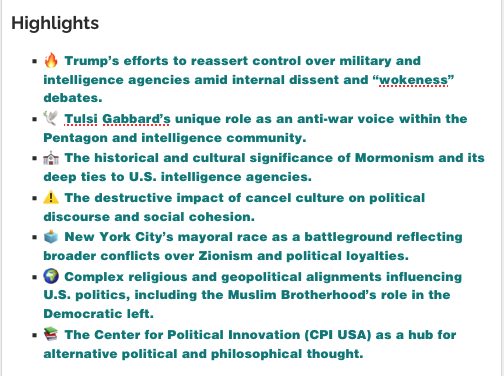
The video features a detailed and wide-ranging conversation with Caleb Maupin, founder of the Center for Political Innovation (CPI USA), discussing a variety of current political, social, and cultural topics. The dialogue begins with analysis of U.S. military and intelligence dynamics, highlighting internal power struggles, particularly under the Trump administration, with emphasis on the politicization of military leadership and intelligence agencies. The discussion covers Trump’s efforts to assert control over federal agencies such as ICE and the military, countering what is described as “wokeness” and internal dissent. Tulsi Gabbard’s role as director of national intelligence and her anti-war stance are examined, alongside the influence of neoconservative factions within the U.S. intelligence community and their role in events like Russia Gate and the Ukraine conflict.
The conversation then shifts to the religious and cultural influence of Mormonism, especially its ties to the FBI and CIA. Caleb provides a historical overview of Mormonism, its origins, anti-slavery roots, persecution, and eventual evolution into a predominantly white, Utah-based religion with quasi-socialist economic practices. The church’s infiltration into U.S. intelligence agencies is linked with its cultural discipline and missionary work, contrasting it with other religious groups like Jehovah’s Witnesses.
The participants also discuss cancel culture and political polarization, using the example of reactions to the murder of Charlie Kirk and the subsequent social media fallout. The toxicity of cancel culture on both sides of the political spectrum is criticized for fostering entrenched divisions.
Attention then turns to New York City politics, particularly the mayoral race featuring candidates like Mandate “Mom” Donnie, with skepticism expressed about his background and political alliances. The influence of Zionism and Israel in New York politics is a key point, with discussions about the city’s Orthodox Jewish community and the power dynamics involved. The conversation critiques Andrew Cuomo’s political legacy, including his handling of the pandemic and controversial release of a convicted criminal before leaving office.
The dialogue explores broader geopolitical and religious alignments, including the Muslim Brotherhood’s unexpected relationship with the Democratic Socialists of America (DSA) and the contrasting alignments of Saudi-backed Islam with the Republican Party. This complex web of religion, politics, and imperialism is tied back to ongoing U.S. domestic and foreign policy struggles.
The video closes with promotion of Caleb Maupin’s organization, CPI USA, and encouragement for viewers to engage with their work, emphasizing the evolving and strange nature of contemporary politics.
Key Insights
Military and Intelligence as Political Battlegrounds: The video underscores the ongoing struggle for control within the U.S. military and intelligence agencies, particularly under the Trump administration. The renaming of the Department of Defense to the Department of War, and public speeches criticizing “wokeness” and demanding physical fitness, signal efforts by leaders like Pete Hegseth to reassert traditional discipline and loyalty. This reflects broader tensions between progressive cultural shifts and conservative military leadership, with implications for U.S. national security policy and internal cohesion.
️ Tulsi Gabbard as a Bridge Figure: Gabbard’s position as director of national intelligence, her military background, and her outspoken anti-war stance highlight the complexity within the U.S. security apparatus. Her pushback against neoconservative elements accused of fomenting conflicts like the Ukraine war reveals fractures in the so-called “deep state.” This suggests that not all parts of the establishment are aligned on foreign policy, opening space for alternative approaches to diplomacy and conflict resolution.
⛪ Mormonism’s Unique Role in U.S. Power Structures: The historical overview of Mormonism demonstrates how this religious group evolved from anti-slavery roots to a whites-only, quasi-socialist community in Utah, before becoming deeply embedded in U.S. intelligence agencies. The church’s culture of discipline, missionary work, and social cohesion makes its members ideal candidates for agencies like the FBI and CIA. This religious-political nexus is an underexplored factor in understanding the composition and culture of America’s security state.
⚠️ Cancel Culture’s Polarizing Effects: The discussion of the aftermath of Charlie Kirk’s murder and the social media reactions illustrates how cancel culture exacerbates political polarization. The tendency to punish individuals for expressing unpopular opinions on social media, regardless of context or severity, entrenches divisions and discourages open dialogue. This phenomenon undermines democratic discourse and encourages entrenchment rather than openness and change.
️ New York City Politics as a Microcosm of Larger Conflicts: The mayoral race involving candidates like Mandate Donnie reveals the intense intersection of local politics with global issues such as Zionism and Israel’s influence. The power of Orthodox Jewish communities, the role of real estate speculation, and the legacy of politicians like Andrew Cuomo showcase how identity, economics, and geopolitics intertwine in urban governance. The election becomes a referendum not just on local issues but on broader ideological and ethnic alliances.
Religious and Geopolitical Alignments Shape Political Coalitions: The contrast between the Saudi-aligned Wahhabi Islam supporting Republicans and the Muslim Brotherhood-influenced Democratic left highlights the complex ways religion intersects with U.S. political parties. The Muslim Brotherhood’s alignment with capitalism and imperialism, despite its Islamist roots, challenges simplistic assumptions about political affiliations. This insight reveals that religious identity groups adapt and evolve according to geopolitical and domestic political strategies.
CPI USA as a Platform for Alternative Political Thought: The Center for Political Innovation, led by Caleb Maupin, represents an effort to rethink mainstream political narratives and explore philosophical and political innovations. This institution serves as a hub for critical analysis of current events and ideological trends, encouraging a more nuanced understanding of power, culture, and policy in an era of rapid change and division. Its work reflects the need for new frameworks to navigate today’s complex political landscape.
This comprehensive conversation offers a multi-faceted exploration of contemporary American political, military, religious, and cultural dynamics, revealing deep divisions, hidden alliances, and evolving power structures shaping the country’s present and future.
SPECIAL:
Anti-Imperialist Chat with Garland Nixon
 Caleb Maupin
Streamed live on Sep 18, 2025
Summary
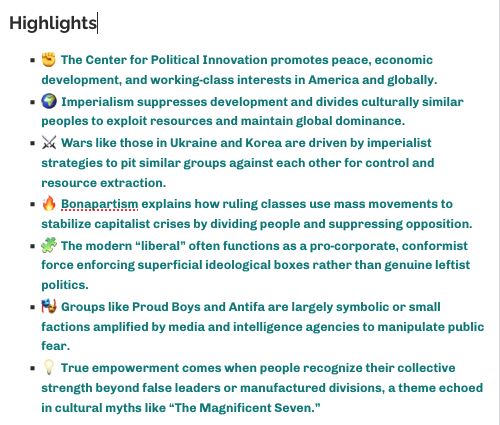
In this in-depth conversation, Garland Nixon interviews Caleb Maupin of the Center for Political Innovation (CPI), exploring themes of imperialism, political division, cultural conflicts, and the manipulation of working-class people in the United States and globally. They discuss how imperialist powers, particularly the U.S. and its allies, maintain control by fomenting divisions among culturally and ethnically similar groups while exploiting resources. The dialogue covers the historical and economic realities of imperialism, highlighting how it suppresses development rather than promoting it, using examples like British colonial rule in India and U.S. influence in Central America.
Caleb emphasizes the potential for unity among Americans around common interests such as ending foreign wars, improving the economy, and protecting constitutional freedoms, but laments that divisive cultural issues prevent this. The conversation dives into historical examples of political strategies like Bonapartism, a Marxist concept describing how factions within ruling classes consolidate power during crises by manipulating mass movements.
They also critique modern political identities, particularly the transformation of the “liberal” from a working-class ally to a pro-corporate, socially superficial group that enforces ideological conformity without deeper analysis or principled opposition to imperialism. The interview touches on media manipulation, the role of intelligence agencies in stoking divisions and violence, and the use of symbolic groups like the Proud Boys and Antifa as scare tactics. The discussion further explores how political violence and societal fear are exploited to control populations.
Caleb and Garland conclude by reflecting on the psychological and cultural dynamics behind political movements, using examples from history and popular culture (such as the movie “The Magnificent Seven” and the Superman myth) to illustrate how mass empowerment is often obscured by false leaders or manipulated narratives. They stress the importance of building genuine grassroots movements focused on shared interests rather than divisive identity politics, and encourage awareness of deeper political and economic structures shaping current events.
 Key Insights
Imperialism as a Tool of Underdevelopment and Division: Imperialism is not about bringing progress or democracy; it is designed to keep nations underdeveloped and divided by reinforcing ethnic, religious, and cultural differences. This division serves economic interests in Wall Street and London by preventing unified opposition and ensuring continued exploitation. Examples include British colonial policies in India and U.S. control in Central America, contrasted with revolutionary Nicaragua’s approach to indigenous sovereignty and development.
⚖️ Potential for Unity Around Shared Interests: Despite sharp political and cultural divisions in the U.S., there are foundational issues that nearly all Americans could agree on: ending endless foreign wars that don’t serve the public, reviving the domestic economy, and protecting constitutional freedoms such as speech and privacy. However, ruling elites benefit from keeping people divided over cultural “hot button” issues like transgender rights, guns, and abortion, which are less likely to be resolved and serve as distractions from systemic problems.
️ Bonapartism and Elite Power Struggles: The Marxist concept of Bonapartism elucidates how ruling classes use the state to suppress both workers and rival elites during crises, often creating populist or authoritarian figures who stabilize the capitalist system temporarily. Historical examples range from Napoleon III’s coup in 1851 France to Roosevelt’s New Deal and Hitler’s rise, showing that political upheaval often begins with factional battles within elites, providing openings for mass movements and social change.
The Liberal Identity Crisis: The contemporary liberal movement has shifted away from its traditional working-class, union-supporting roots toward a socially liberal but economically conservative stance aligned with corporate and finance interests. This shift has resulted in ideological rigidity focused on symbolic “box-checking” (e.g., pro-trans rights, pro-Ukraine) rather than substantive critique of imperialism or economic justice. This creates a conformist atmosphere where dissenting views are dismissed by association with “bad” political figures, undermining genuine debate and solidarity.
️ Media and Intelligence Manipulation of Political Violence: Groups like the Proud Boys and Antifa are far smaller and less organized than portrayed, often inflated by media and intelligence agencies to stoke fear and division among the public. There is evidence of intelligence operations manipulating political violence and public perception, as seen historically in Italy with Operation Gladio and more recently in the U.S. This fosters an atmosphere of fear and control, distracting from structural issues and preventing unified political movements.
Psychology of Political Allegiance and Myth: Political movements tap into deep psychological and cultural archetypes. The discussion references Joseph Campbell’s hero’s myth and the communist appeal to emotions such as anger and justice versus fascist appeals to patriotism and family values. Recognizing these emotional dynamics is key to building movements that resonate authentically with people’s identities and aspirations rather than relying on fear or false heroes.
Grassroots Empowerment Over False Leadership: Drawing from the story of “The Magnificent Seven” and its cultural variants, the conversation highlights the importance of people recognizing their own collective power rather than relying on self-proclaimed leaders or external “heroes.” The masses have the capacity to organize and resist oppression once they become aware of their strength, but elite manipulation often keeps them fragmented and dependent on false saviors.
Conclusion
The interview between Garland Nixon and Caleb Maupin is a rich exploration of how imperialism functions both internationally and domestically to maintain elite control by dividing working people and suppressing development. By understanding concepts like Bonapartism and the psychological underpinnings of political movements, individuals can better navigate the complexities of modern politics. The conversation calls for building broad coalitions around shared economic and civil rights issues, rejecting divisive cultural battles, and fostering grassroots awareness of collective power to challenge imperialism and create a more equitable future.
For those interested in following Caleb Maupin’s work or learning more about the Center for Political Innovation, their website is CPIUSA.org, where ongoing initiatives and videos, including coverage of United Nations actions and global peace efforts, are available.
BEFORE YOU LEAVE:
People's journalism can't survive without your active support.
Because YouTube (Google) is a heavily (and capriciously) censored platform aggressively enforcing the Empire of Lies' official narrative, dissident, anti-imperialist voices like Garland Nixon's are constantly harassed via demonetization, shadowbanning and outright deletion. This forces such voices—all of us, actually—to seek alternative platforms that still respect the right of free speech, such as Rumble.com, Rofkin.com, etc. Garland has now alternative archives on Rofkin, Rumble, etc. Should YouTube pull the plug, be sure to find him there. Also, please consider a donation to keep his work as vibrant as ever.
GARLAND'S ROFKIN & RUMBLE PLATFORMS:
ROFKIN: https://www.rokfin.com/garlandnixon
RUMBLE: https://rumble.com/user/garlandnixon/videos
DONATIONS:
BUY ME A COFFEE • https://www.buymeacoffee.com/garlandnh
PayPal - garlandn@gmail.com  / garlandnixon
 BEFORE you leave, PLEASE pay attention to this alert. INDISPENSABLE information!
[t4b-ticker id="1"]
Print this article [bws_pdfprint display=’print’]
The views expressed herein are solely those of the author and may or may not reflect those of The Greanville Post.
Unfortunately, most people take this site for granted.
DONATIONS HAVE ALMOST DRIED UP…
PLEASE send what you can today!
JUST USE THE BUTTON BELOW
 This work is licensed under a Creative Commons Attribution-NonCommercial 4.0 International License

