
[su_spoiler title=”Please make sure these dispatches reach as many readers as possible. Share with kin, friends and workmates and ask them to do likewise. ” open=”yes” style=”fancy” icon=”arrow-circle-1″]

 Clare Daly
Ireland’s Gift to Humanity
| Traducir—Translate! | |
| Make fonts bigger>>> | [wpavefrsz-resizer] |

THEY CALLED ME A RUSSIAN PROPAGANDIST — for telling the truth – CLARE DALY Former MEP Clare Daly back in the European Parliament discussing how free speech, even in the EU context, is under increasing pressure, especially when dissenting voices challenge mainstream narratives. ‘The two reasons why I’m a Russian propagandist are, I said two things:
1: that the war in Ukraine was a NATO proxy war; 2: that the people of Europe were suffering more than the Russian economy from the sanctions that Europe had imposed on Russia’ #FreeSpeech #UkraineWar #NATO #ClareDaly
Summary
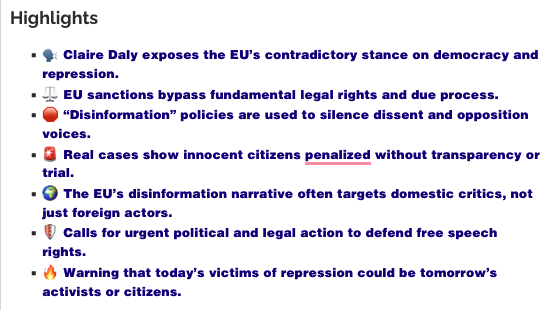
Clare Daly, an Irish activist, former local councillor, and Member of the European Parliament (MEP), delivers a compelling critique of the European Union’s (EU) approach to democracy, freedom of expression, and its disinformation policies. Daly highlights a disturbing contradiction between the EU’s official proclamations about protecting democratic values and the reality of increasing authoritarian measures within the Union. She explains how the EU uses the pretext of combating foreign disinformation—especially from Russia—to silence dissenting voices and legitimate political opposition, often through opaque and punitive sanctions mechanisms. Daly reveals that these so-called “hybrid sanctions” bypass fundamental legal protections such as due process, fair trial, and transparency, resulting in severe consequences for individuals accused of spreading “disinformation” without clear evidence or opportunity for defence. She provides real-life examples, including the sanctioning of a pro-Palestinian journalist in Germany, illustrating the EU’s readiness to suppress controversial but legitimate political speech under the guise of defending democracy. Daly warns that this trend threatens the fundamental right to freedom of expression across Europe and urges coordinated political and legal resistance to challenge these authoritarian practices before democratic space is irreversibly eroded.
Key Insights
-
️ The EU’s Official Rhetoric vs. Reality: While EU leaders publicly champion democracy, rule of law, and fundamental rights, their actions reveal a starkly different reality. The EU’s disinformation policies and sanction regimes are being used to suppress political dissent rather than genuinely protect democratic discourse. This contradiction undermines trust in the EU’s institutions and their proclaimed values. Daly’s insider perspective as a former MEP adds credibility to this claim, showing that rhetoric is often a façade covering authoritarian tendencies.
-
Disinformation as a Tool to Control Speech: The EU’s obsession with “disinformation” is less about fact-checking or protecting citizens and more about controlling narratives that challenge the political status quo. The label “disinformation” is weaponized to delegitimize and silence voices critical of EU policies, especially regarding contentious issues like the war in Ukraine or Palestine. This approach conflates dissent with foreign interference, thereby narrowing the space for legitimate political debate.
-
⚖️ Erosion of Legal Due Process: Daly reveals that the EU’s hybrid sanctions operate outside of established legal norms, including the absence of formal charges, trials, or access to evidence. People targeted by these sanctions face asset freezes, travel bans, and severe restrictions without any opportunity to defend themselves. This undermines the very notion of justice and rule of law that the EU claims to uphold, creating a “guilty until proven innocent” environment where accusations and secret dossiers suffice for punishment.
-
Domestic Narratives, Not Foreign Influence, Are the Real Concern: According to Daly’s experience on the EU’s committee investigating foreign interference, the primary target of EU disinformation policies has been domestic political narratives that the establishment disfavors, rather than actual foreign propaganda campaigns. This reveals a political motive behind the crackdown—protecting the ruling elite from criticism rather than shielding citizens from external threats.
-
Case Study of Political Repression: The example of the German-based pro-Palestinian journalist sanctioned by the EU illustrates how the disinformation and sanction policy extends beyond Russia to include European citizens expressing politically sensitive views. The journalist’s account of how sanctions froze his access to basic necessities and financial transactions without due process humanizes the often abstract discussions about sanctions and repression. It exposes the real human cost of these policies and their chilling effect on free speech.
-
The Danger of Normalizing Authoritarian Measures in Democracies: Daly warns that the EU’s actions represent a dangerous slide toward authoritarianism under the guise of protecting democracy. The normalization and institutionalization of sanctions without due process, and the framing of ideas and words as “weapons,” create a toxic environment where dissent is criminalized. This threatens the fundamental democratic principle that citizens have a right to challenge their governments and advocate for change.
-
Urgent Call for Collective Resistance: Daly emphasizes the necessity of coordinated political, legal, and grassroots resistance to counter these authoritarian trends. She calls on MEPs, civil society, and citizens to organize, spread awareness, and explore legal avenues to challenge the EU’s disinformation policies and sanction mechanisms. The window for effective action is narrow, and without intervention, the suppression of fundamental rights will deepen, undermining the democratic fabric of the EU.
Additional Analysis
Clare Daly’s speech is a powerful indictment of how European democratic institutions risk betraying their founding principles. She shows that the EU’s response to complex geopolitical challenges—such as Russian aggression and information warfare—has led to overreach that threatens civil liberties within its own borders. The conflation of dissent with foreign subversion is a classic authoritarian strategy, and by adopting it, the EU risks eroding its legitimacy and alienating its citizens.
Moreover, Daly’s critique highlights an important tension in contemporary democracies: balancing national security and democratic freedoms. Her detailed account calls for greater transparency, accountability, and adherence to the rule of law within the EU’s mechanisms. Without these safeguards, the fight against disinformation could easily become a cover for political repression, stifling pluralism and democratic participation rather than protecting them.
Finally, Daly’s emphasis on grassroots mobilization and legal challenges is a reminder that democracy is not only defended in parliaments and courts but also in public spaces and communities. Her call to action underscores the urgency of reasserting democratic norms in Europe before the “window closes,” making the protection of free speech and political dissent a collective responsibility.
In sum, this speech serves both as a warning and a rallying cry, urging vigilance against creeping authoritarianism (“LIBERAL FASCISM”) disguised as democratic defence and encouraging proactive efforts to safeguard fundamental rights in Europe.
BEFORE you leave, PLEASE pay attention to this alert.
[t4b-ticker id=”1″]
[/su_spoiler]
Print this article [bws_pdfprint display=’print’]
[su_note note_color=”#f1efef” radius=”0″]The views expressed herein are solely those of the author and may or may not reflect those of The Greanville Post, although, if we publish them, we obviously find them noteworthy and valuable. [/su_note]
 This work is licensed under a Creative Commons Attribution-NonCommercial 4.0 International License •
ALL CAPTIONS AND PULL QUOTES BY THE EDITORS NOT THE AUTHORS


2 comments
Absolutely brilliant indictment of the war on free speech, right of assembly, right of dissent. In the U.S. we likewise have to unite and rally against this authoritarianism, this brutal assault by our self-anointed rulers on our right to challenge and oppose their malevolent, destructive policies.
John Rachel is a leader in the movement to defend the First Amendment and the rights of free speech everywhere.