
[su_spoiler title=”Please make sure these dispatches reach as many readers as possible. Share with kin, friends and workmates and ask them to do likewise. ” open=”yes” style=”fancy” icon=”arrow-circle-1″]
 Oliver Boyd-Barrett

| Traducir—Translate! | |
| Make fonts bigger>>> | [wpavefrsz-resizer] |
Now They’re Getting It
As I was saying, whatever promise Putin may have read into the prospect of a meeting with Trump in Budapest will by now have been converted into the certainty of realisation that Trump and the official USA machinery of State is existentially committed to the destruction of Russia. Any other impressions are mere theatrics. Between where we are now and the US realization of that objective lies only World War 3, or the collective climbdown of the Russian oligarch class, or that of its US equivalent. Of those three possibilities the first is most likely, the third is the least likely.
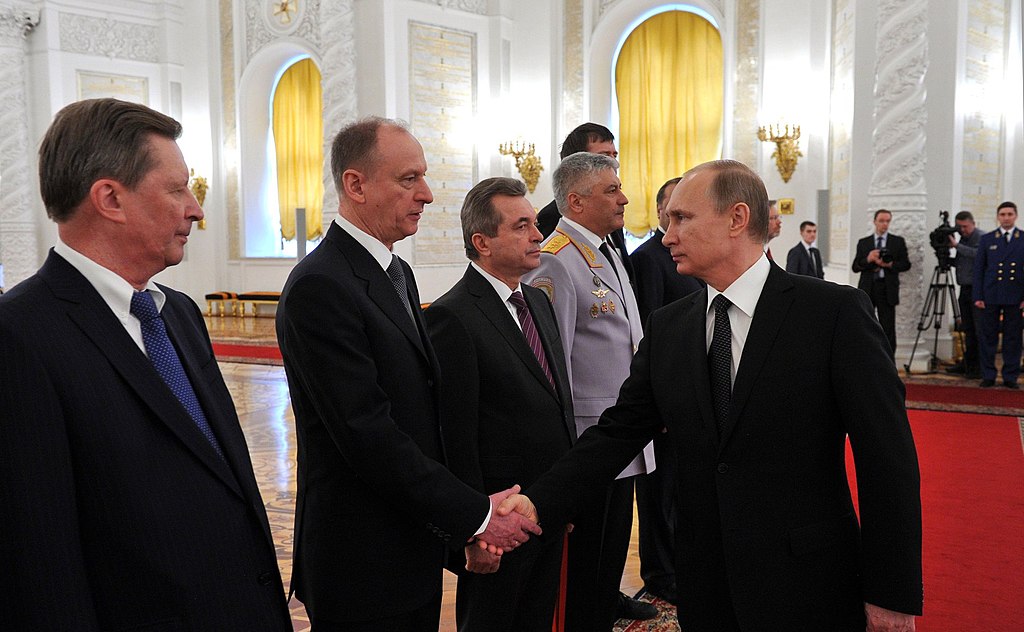
Pres. Putin welcoming Siloviki, among the most loyal men in the service of Russia and her defence from foreign and domestic enemies.
In place of a possible negotiation to resume the trajectory of what Putin imagined was a breakthrough in Anchorage what we have is a US inability to respond to whatever peace initiatives Putin proposed in Anchorage; US unwillingness to escalate to Tomahawks coupled with British willingness to allow use of Storm Shadow missiles (using US intelligence and in the wake of US lifting of restrictions on the use of Western long-range missile) into the heart of Russia (as in the partial destruction of a major chemical factory two nights ago in Bryansk): and Trump adding new sanctions on Russian oil corps Rosneft and Lukoil (which will make absolutely no difference to Russian military capacity). Russia responded to the use of Storm Shadows (I thought production of these was supposed to have been suspended – are we dealing with stocks remnants?) with a massive attack across Ukraine, but should now have formulated plans for the extension of the war into those countries that use weapons that recklessly escalate with impunity.
To talk to or even to game Trump with flattery, even to sign up to a “let’s all flatter Don” campaign, is now palpably useless and can never succeed. The President claims he likes deals, but he likes only deals that he can betray. He is otherwise too preoccupied with building ugly ballrooms on the corpse of US heritage, ordering masked gangs to kidnap foreign US workers and troops to occupy non-Republican cities, to bother himself unduly about nuclear annihilation.
If Putin persists in playing along with the succession of bids for negotiation with the critically and credibility bankrupted West – in place of the demonstration of significant and urgent force against the prime sources of aggression – then he and Russia have already lost. Does that mean nuclear war? Only if Europe and the US are stupid enough to respond to Russian oreshniks with nuclear missiles, and they’re not quite that stupid.
Are they?
In Gaza, Israel’s project of murder and starvation continues barely uninterrupted, with little or no actual progress towards a new system of governance for Gaza, and in the West Bank, attacks on Palestinians by settlers have spiked. The fanatical cabinet minister Ben Gvir continues to promise the total expulsion of Palestinians from Gaza. In Venezuela, Trump openly threatens to expand his policy of murdering people on small boats to murdering Venezuelans on land, all in the name of a war against fictitious narcotics gangs. In Iran, there are high-level talks between Russia and Iran in preparation for the next Israeli-US war on Iran, for which Iran is increasingly preparing itself. There are unconfirmed rumours of Qatari and Omani pressure on Tehran for a change to Iranian nuclear policy and to build a nuclear weapon as the pathway to a stabilisation of Middle Eastern tensions, similar to that achieved by North Korea in East Asia in the wake of its own nuclear weaponisation.
Noon at the OK Corral
We enter the weekend on a very dangerous note. Regardless of a certain bravado among alternative media commentators and even by Putin himself one senses, for the moment, a relatively weak pushback from the Kremlin on the latest Trump-Zelenskiy-European aggressions against their common enemy-of-choice, the Russian Federation, whose wealth they so desperately seem to need, perhaps to buy a few more decades’ protection against the long-term ravages of climate change or, perhaps more simply, because these are countries led by vain, nasty little people.
Be that as it may, I think that complacency on behalf of Russia is badly misjudged. So far as the intensifying sanctions on Rosneft and Lukoil are concerned, these may not matter much in themselves. They seem to specify trade via US financial institutions, and Russia’s trade with China and Russia does not, so far as I am aware, pass through US financial institutions. But they do add up to persistent pressure, through secondary sanctions and tariffs, on India in particular and on some other members of the BRICS.
China doesn’t care: it doesn’t need sales revenue from the US, and it can wield the big stick of prohibition on sales of rare earths to the US to extremely punitive effect. So it will continue to take around half of Russian energy exports, mostly by pipeline, and up to a half of Iran’s as well, which of course is part of the calculus of US-Israeli aggression on Iran. Russian State dependence on oil imports is around 25%. India will very likely maintain its imports of Russian oil, but not to the same degree as it did. Yes, we should assume that India and Russia in partnership with other nations will find plenty of workarounds. But India will both want to assert its independence from the US and at the same to reduce the damage to it of more extensive US tariffs by increasing its imports of US LNG. This could ultimately lead to a reduction in oil revenue to the Russian Treasury by, say, a third, or 17% of the total. Bear in mind also that the Europeans seem set on reducing still further their imports of Russian oil and gas from 13% of their total supply to zero (and will likely face down opposition to this policy from Hungary and Slovakia which depend on Russian energy more than the rest of the Union).
At the same time, Europe is applying its 19th sanctions package on Russia, and continues to move to seizure of Russian assets. If so, and it seems likely, then this may prolong the war by three years or so. If Russia chooses to respond to that simply by continuing its current campaign of attritional war, then, yes, we may still end up with the end of the entirety of Ukraine or Ukraine being sliced up between Russia, Poland, Romania and Germany. Even though the end of his country seems a plausible outcome the great paradox is that Zelenskiy needs escalation, more war, because that is the only way, in his eyes, that he can secure continuing European and US involvement and he is, in any case, likely to be a Western intelligence asset serving Western not Ukrainian agendas.
More war will also be very expensive for Russia in terms of wealth and of lives. And it will give time for NATO to re-arm so that the war can be pursued over an even longer period (although Russia will likely have re-armed at an equivalent or faster pace from a stronger baseline). So the current escalation provides a strong motivation for a very hard pushback on the West by Russia, a motivation that so far has not seemed as major a driver on Putin’s thinking as it has on that of some of his colleagues.
Then there are all kinds of noises about Europe making life difficult for Russian vessels or Russian “shadow fleet” boats in the Baltic and a loosening of the rules of air engagement that has been prompted by fictitious or false flag operations in Poland and Latvia and the like. And whether or not Trump sends Tomahawk missiles, it is certain that Britain has resumed the supply of Storm Shadow missiles (which require US approval of their use) for the purpose of “Ukrainian” strikes on Russian energy and other facilities. Where there are Tomahawks or Storm Shadows, German Taurus cannot be far behind.
Russia is well able to respond in devastating kind, but so far it has chosen not to do so. By that, I mean it has refrained from a decapitation strike on Kiev. It has refrained from taking out European or NATO elements in Odessa and marching on the city to take it once and for all. It has refrained from firing non-nuclear oreshniks and nuclear zinzhals and the like on Brussels, London, Paris and Berlin even though we are told by Russia that NATO members like Britain have had a part to play in the striking of Russian nuclear infrastructure and other reckless gambits. It also seems to believe that it has a faithful ally in China, first and foremost, and in some other quarters such as North Korea. And it may well do so, because sooner or later, of course, if Russia succumbs, China is next in NATO’s sights.
For the time being, in a context of overall restraint, it is nonetheless true that NATO/Ukrainian drone and missile strikes are bringing the war home to ordinary citizens across Russia (even if this is less evident in Moscow than in Saint Petersburg and elsewhere) in the form of falling debris from targeted drones, airport shutdowns, refinery fires, interrupted Internet communications. These inconveniences contribute to a sharpening criticism of Putin’s commitment to sobriety and sanity which many Russians now regard as dangerously weak.
Yes, of course, the US-Ukraine-Europe bombast is theatrical to a significant degree. The UK, France and Germany each have economic problems that may yet turn out to be crippling. But it is precisely such problems that help keep the Europeans hungering for some kind of a magical solution that will return them to their imperial glory days. Indeed, what is the European Union other than a collection of zombie empires whose elites, propped up for the most part by finance capital, would like to be resuscitated?
A large portion of the current impasse is competing bluster and some of us have been inclined to see the greatest share of this bluster emanating from NATO. Now we wonder more about Putin’s restraint not so much because it is the equivalent to the coil that is about to spring, but because there are elements to the calculus of this conflict about which the Kremlin is not levelling or because, for Russia’s new capitalist class, the struggle just isn’t worth the risk of nuclear annihilation and the end of their privileged status. Others might argue that the war is one of Europe’s choosing, through provocation, and that in the OK Corral it has to be Europe that holsters its pistols, and that it is Russia’s historic mission to eyeball its opponents out of the game at the gateway to a multipolar or multicentric order.
BEFORE you leave, PLEASE pay attention to this alert.
[t4b-ticker id=”1″]
[/su_spoiler]
Print this article [bws_pdfprint display=’print’]
[su_note note_color=”#f1efef” radius=”0″]The views expressed herein are solely those of the author and may or may not reflect those of The Greanville Post, although, if we publish them, we obviously find them noteworthy and valuable. [/su_note]
 This work is licensed under a Creative Commons Attribution-NonCommercial 4.0 International License •
ALL CAPTIONS AND PULL QUOTES BY THE EDITORS NOT THE AUTHORS


2 comments
Russia delenda est. It is the only goal of the Western bloc. Not for ideological reasons, but for Russia’s riches.
As for declining Europe one can always quote what was said of the Bourbons in France:”They have learnt nothing and forgotten nothing”. Imperialism is a heavy drug.
“[…] we may still end up with the end of the entirety of Ukraine or Ukraine being sliced up between Russia, Poland, Romania and Germany.”
It seems “Germany” is actually “Hungary”
If anybody asked, I don’t think peoples in any of these countries have been told why USSR “sliced” pieces of their countries after WWII, nor do they say the Russian Empire acquired territories from such countries by (for instance) defeating the Ottomans in wars of 18th century.
We certainly don’t know.
I also understand “it’s not a good time for such questions”, although it may have cast some light on local enmities.