By Oliver Boyd-Barrett

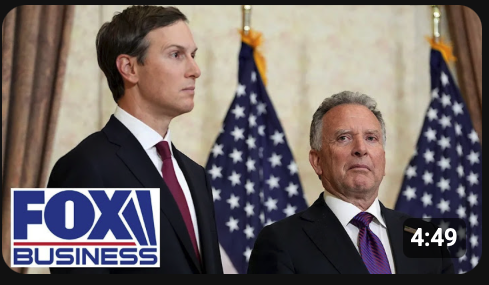
Kushner and Witkoff: "They are great negotiators".— Donald Trump
Timing may be all important today, and this posting can be no more than a draft.
US envoys Steve Witkoff and Jared Kushner landed in Moscow earlier today, September 5th, with a reported aim of reviving negotiations over Ukraine. The envoys were met at the airport on Saturday by the Russian presidential envoy Kirill Dmitriev, a businessman best known for his participation in talks on potential US-Russian economic and business opportunities (none of which, so far as I am aware, have made headway). According to the Guardian, Trump yesterday claimed that he had a new proposal to end the war, without providing any details on what his new plan might be.
The tempation to yawn is all but irresistible, but you never know.
There are conflicting accounts as to whether both sides have declared a pause in their airstrikes. For Military Summary Channel earlier today the situation was that Zelenskiy had unilaterally declared a ceasefire along front lines while reserving the right to respond to Russian “violations” of a ceasefire to which it has not agreed. It is not clear - to me, at any rate, even if we accept this is accurate - whether this is separate from Zelenskiy’s declaration that he would stop its airstrikes on Moscow during the visit of Kushner and Witkoff. According to the Guardian, the Kremlin spokesperson, Dmitry Peskov, said on Saturday that Putin had ordered a 72-hour pause in its strikes on Kyiv, given that Kushner and Witkoff are expected to proceed to visit Kiev on Sunday after they have met with Russian President Putin today.
Overnight there was a major Russian drone and missile attack across Ukraine. Zelenskoy accused Russia of trying to disrupt the envoys’ visit to Ukraine with strikes on Kyiv’s two airports overnight. Officials visiting Ukraine have largely done so by train, as Ukrainian airspace has been closed since 2022 due to the war. Zelenskiy has this week attempted to persuade commercial airlines not to fly in Russian airspace on the grounds that Ukrainian drones are making Russian airports and airspace unsafe. Zelenskiy has also pleaded with the UN to close Russian airspace.
More precisely, on September 1, 2026, Zelenskyy stated that Russian airspace would be “de facto closed” and unsafe for civilian carriers as Ukraine ramps up its drone strikes on Russian logistics and military infrastructure. While Western commercial airlines stopped flying over Russia after the 2022 invasion, carriers from countries like China, Turkey, and various Gulf states still use Russian skies. Some foreign airlines have begun suspending flights following the warning.
Ukraine formally notified the UN and its civil aviation agency, the International Civil Aviation Organization (ICAO), regarding the risks to civilian aviation. Zelenskiy emphasized that Ukraine does not target civilian aircraft (mmm - MH17?) but noted that the sheer scale of upcoming drone activity means air traffic must account for the danger.
Russian President Vladimir Putin strongly condemned the announcement, labeling it a “declaration of state terrorism” and an unlawful interference with civil aviation, while filing a formal protest with the ICAO. One option that Russia has by way of retaliating against Ukrainian efforts to shut its airspace is to continue bombardment of Kiev’s major railway station and network, the usual port of entry for visiting Western diplomats, politicians, military advisers and the like, a process that is apparently already under way.
It is too early to say anything assertive about the Kushner and Witkoff visit and its likelihood of “success.” Almost certainly the visit, like CIA director Ratcliffe’s visit a week ago, and like the US pressure on Putin’s “allies” within the SCO/BRICS (notably India, Turkiye and Brazil) is intended to push Putin into somehow ending the war.
It is inconceivable to me that the US can come up with terms that would be acceptable to Russia, to Ukraine, to Europe and to the US neocon-dominated Congress.
In my view, Russia is already making a mistake in allowing Witkoff and Kushner into the country. Indeed, I find Putin’s ability to flatter the two “envoys” nauseous. Putin has showered praise on Witkoff and Kushner, describing them as “sincere people” who are trying to give “concrete substance” to the negotiation process. He stated that they are “always welcome guests” in Moscow and noted that Russia finds it highly “convenient to work with them”. Putin highlighted that because U.S. President Donald Trump deeply trusts these two envoys, it gives their interactions true meaning. He noted that agreements would be useless if the top official disregarded their input.
Such sentiments, in my view, are unacceptable in application to two men who have no elected legitimacy other than Trump likes them; are not professional diplomats; whose interests seemingly align more with business aspirations than geopolitical agreements; who are known to have contributed to the weaponization of diplomacy with a view to inducing Washington’s opponents to lower their guard in advance of unprovoked and murderous attacks by Washington and Israel. They are icons of malignancy, bad faith, and incompetence. And they are committed Zionists.
I do not find Putin’s tolerance for these ghouls remotely amusing or clever or “diplomatic.” It is, instead, an insult to Russian honor, to the honor of those whom Kushner and Witkoff have previously betrayed - as in the case of Iran - and to the honor of the Global South in general.
Most important of all, it is because of them and because of the actions of their master, Trump, that the US has become agreement incapable and is recognized throughout much of the world as being so. In short, there is no agreement possible with these gentlemen that could be worth its salt and in which there can be any sane reason for investing trust and hope.
I understand that Putin thinks he needs to meet with them so as to show his critics within the SCO/BRICS, and to show the people of Ukraine and Europe, that he has done his best to seek a reasonable agreement, no matter how unreasonable and untrustworthy his interlocutors are.
He can do that without odious flattery, although I think he is better off not doing it at all.
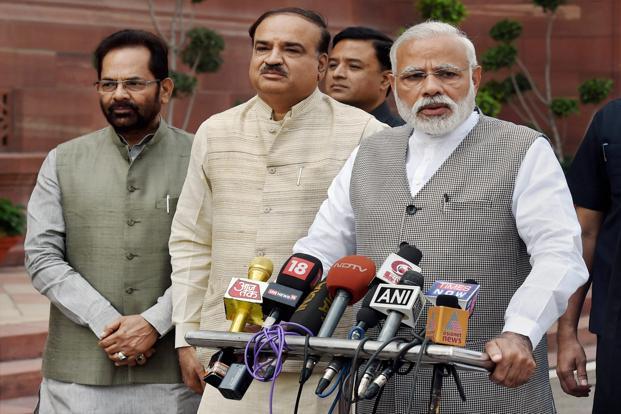
Right-winger Modi continues with his treacherous flim-flam.
He has got no reason to respect or to put on a performance for Zelenskiy, who lacks all legitimacy and whose ouster (by neo-Nazi Azov regiment leader Andriy Biletsky?) will be universally unlamented. Nor for India’s Modi, whose pious waffling represents a tired and shameful refusal to commit whole-heartedly to the goals of multipolarity in resistance to US bullying. Nor for Brazil’s Lula, whose status as a pro-democracy man of the people is now stripped naked by the dismal scandal of the power of corrupt Supreme Court justice Alexandre de Moraes and pay-offs from disgraced banker Daniel Vorcaro, a scandal that will quite likely shoe the son of jailed former leader Bolsonaro into power and complete the delivery of almost all of Latin America into the hands of a Zionist-loving clique of rightwing oligarchs, and perhaps spell the end of the BRICS as anything more than a convenient forum for non-dollar trading alliances, devoid of any genuine political or moral vision for the world.
I don’t think it likely that Kushner and Witkoff will walk away with anything resembling a diplomatic coup; a nothing-burger is more plausible.
Russia is winning on the battlefields and Ukrainian defenses are crumbling - as in Odessa and along what remains of Ukraine’s Black Sea coast, in the Slavyansk-Kramatorsk conurbation in Donbass, in Orekihiv in Zapporizhzhia and soon in the city of Zapporizhzhia itself, in northeast Kharkiv and around the city of Kharkiv, in northern Chernihiv and Sumy and their eponymous capitals so close to Kiev.
There are increasing signs of panic in Kiev, represented by the shoot-out this week in public in Kiev between the nation’s two foremost intelligence agencies and by Zelenskiy’s irritable blaming of Europeans for not providing him more money and more interceptors, indications that Kiev is sorely lacking in the funding necessary for its survival beyond the end of this year and confirmation of the dwindling availability of air defenses and other weaponry, and the declining volume and efficacy of Ukrainian drone and missile attacks on Russia.
My own expectations at this point are that Russia will continue with this struggle until it has taken control over the entirety of Ukraine east of the Dnieper together with the Odessa oblast and the remainder of Ukraine’s Black Sea coast.
It will leave behind a rump state, based in Kiev (unless Russia decides to take that, too, and it might well) or in Lvov in the far west that, under the terms of an unconditional surrender that Russia will impose, will subscribe to all of Russia’s key demands including that of Ukrainian neutrality.
That rump state may or may not seek territorial alignments with Poland and Romania and Hungary, although I am now downgrading the plausibility of such a development as it would occasion possibly fatal ripple effects across the entirety of the European Union. The neo-Nazi forces represented by Zelenskiy, who may well have been a western agent from the beginning, will likely receive European support in setting up a government-in-exile somewhere pleasant in Europe, perhaps Paris and which will be the go-to entity if Germany is successful in leading the rest of Europe into a wholescale war with Russia and needs a plausible new regime in power in Ukraine. While we can expect Germany to be persistent in this ambition and to find many allies across Europe, I do not think that it will actually be successful in such an endeavor. Here are my main reasons:
(1) Following the demise of Trump and MAGA irrationality, even under a Democratic government still deeply corrupted by lunatic neocons from within, the US will begin to reacquire a thirst for rationality, morality, freedom from the bonds of imperial overreach, and content with a more moderate, realistic status as a collective of a mere 349 million on a planet that hosts 8.3 billion human beings. It will want nothing to do with the emergence of a European neofascist hate fest against Russia that pits one system of moderate capitalism against another and serves the best interests, ultimately, of the US system of extreme capitalism. In short, a European assault on Russia will have to do without the US, and if Europe is too successful (improbable), then the US may feel moved to enter (or threaten to enter) the war on Russia’s side as it cannot defeat Russia and China combined.
(2) Germany faces a long, uphill climb to begin to mobilize forces that are sufficient to pose an obstacle to Russia and that will allow themselves to be so mobilized, or to re-arm to the extent that would be necessary, given that Russian weapons production capacity well exceeds that of Germany and of NATO generally, is expanding every year, and will have the additional support, hardly trivial, of China, North Korea and Iran.
Not only is Germany actually de-industrializing but, like virtually all of its fellow members within NATO, it is saddling itself with runaway debt costs that may very well finish off the collective West long before the opening salvos of a a suicidal war of global annihilation. Besides, there are also gathering forces of resistance within Germany (AfD) and France (Marine le Pen) and Italy (League) - the UK, to its shame, not so much - that may yet stop the warmongers in their tracks.
However, there is no room for complacency. The conflict will not disappear. It will likely linger for decades in the form of guerrilla warfare and low intensity conflict, a constant headache both for NATO and for Russia, whose final end point is difficult to predict.

Murdering Wedding Guests as a Ritual of US Imperial War
So many atrocities, so many related stories each day, it is impossible to keep up with them, least of all to make sense of all them, impossible even to find sufficient time to write up more than a small fraction, and even more difficult to do so with due attention to spelling and syntax - though that, at least, is something that (generally) remains well within the province of the imperial propaganda machines that have coopted our mainstream mediascape, attempting to reassure us through near perfect typography and diction that their lies are true.
The ongoing war has resulted in a significant and heavily disputed loss of life, with estimated Iranian deaths ranging between 3,400 and 6,000 people since the conflict erupted. Official tracking is highly inconsistent because conflicting figures are released by military entities, humanitarian groups, and state media.
The above figures are probably an underestimate, in my view, and to that underestimate we also have to factor in all the deaths through the Gulf region, including in Lebanon, and deaths of US servicemen and women.
All because the Trump administration, a largely supine Congress in tow, and a lethargic, brainwashed US public not much further behind, claims that Israel persuaded it to launch two entirely unprovoked wars against the sovereign nation of Iran on the totally false pretext that Iran represented a nuclear “threat” (readers here will fully understand why I call this pretext entirely false).
Then, added to the overall evil and stupidity of this, not to mention incompetence, and its assault on the consciousness of most decent people, are the individual horrors - the bombing, the repeated US bombing, to kill over 160 schoolgirls in Minab on the first day of the current phase of the conflict, and the bombing of a wedding party in Kuhestak in southern Iran just this week.
In Kuhestak there were hundreds of guests. Four people were killed instantly: they were four-year-old Amir Ali Karimi, 16-year old Mohammad Mallahi, 43-year-old Kolsoom Mallahi Nezhadnia, and 50-year-old Zarkhatoun Taheri. Two days later, 22-year-old Asieh Molaeinezhad, who had been critically wounded and placed in intensive care, died, bringing the death toll to five. At least 60 others were wounded (Salehi). A local source told Drop Site News - which also cites a Reuters report to the effect that the explosions were the result of US munitions - that this happened in a completely residential area. There were no military facilities around the house.
The US acts as though it has an obsessive, murderous impulse to attack wedding parties. Here is the toll from its previous 20-year long, agonizing imperial fallacy in Afghanistan, according to a Nation report:
July 2002 (Uruzgan Province): An American AC-130 gunship and other aircraft bombed a wedding celebration in Kakrak village, killing roughly 40 to 50 civilians (mostly women and children) and injuring over 100. The Pentagon initially claimed they targeted anti-aircraft fire, and a later investigation cleared the crew. [
November 2007 (Paktika Province): A U.S.-led airstrike hit a wedding party, reported to have killed dozens of civilians, though details were heavily contested by coalition forces.
July 2008 (Nangarhar Province): The Haska Meyna wedding party airstrike killed 47 civilians - mostly women and children - who were escorting a bride to a ceremony. The U.S. initially denied civilian deaths, but an Afghan government investigation confirmed the toll.
November 2008 (Kandahar Province): The Wech Baghtu wedding party airstrike killed about 37 civilians and injured 27 others when a U.S. airstrike hit a housing complex hosting a wedding celebration.
June 2012 (Logar Province): An operation in the Baraki Barak district resulted in airstrikes that local officials stated killed up to 18 civilians, including women and children attending a post-wedding gathering, which the ISAF later claimed targeted armed insurgents.
September 2019 (Helmand Province): At least 40 civilians attending a wedding party were killed during a joint U.S.-backed Afghan government raid and airstrike targeting a nearby Taliban hideout in the Musa Qala district.
In total, these documented incidents in Afghanistan resulted in well over 200 civilian deaths during wedding celebrations. The numbers in themselves perhaps pale in comparison with the total number of Afghanis who were killed by the US in the period 2001-2021. Between 43,000 and 47,000 Afghan civilians were killed directly by the war though exact figures specifically attributed to US forces alone are difficult to isolate completely.
But it is their symbolic importance that most stuns our sensibilities. Weddings are about celebration of love, family, trust in a future, community, generational renewal. Of course, no intelligent person cedes even remote credibility to announcements that the US is “investigating” the evils which it perpetrates. After six months it still has to report on the atrocity in Minab, and you can be sure in advance of a whitewash, if ever something does appear, which seems unlikely.
(We are told that the US is taking 27 years to bring the alleged self-proclaimed "mastermind" of the 9/11 attacks to trial in June 2028, a man who has been in US custody for 25 of those years. We know that the official investigations into 9/11 are totally inadequate, and can be sure their weaknesses will never be remedied by the State).
These are the things, surely, which history will most remember about American empire and the support given it by former-imperial vasssals like the UK, France, Germany, Belgium and the Netherlands - their cruel contempt for humanity itself, for all humanity, their own included.
Their responsibility for and complicity in the ghastly, genocidal horrors of Gaza and the West Bank, and in the Israeli invasions and aggresions in Lebanon, Syria and north Africa bring us to yet another level of callousness, about which I do not have time to write today.
Russia and the SCO
I want, instead, to turn my attention to the NATO war against Russia over NATO-proxy (not a NATO member), Ukraine. I want, first of all, with the help of an article for Popular Resistance by Ahmed Rahman (Rahman), to focus on the outcomes of the recent meeting in Bishkek of the Shanghai Cooperation Organization SCO). The SCO was formed in 2001 and has grown from its original six members in 2001 to 10 permanent members in 2026 (China, Russia, India, Pakistan, Iran, Uzbekistan, Tajikistan, Kazakhstan, Kyrgyzstan, and Belarus). There are 15 other countries who participated in the Bishkek summit as “dialogue partners,” including Türkiye, Saudi Arabia, and Sri Lanka. The member states of the SCO along with their dialogue partners represent around 50% of the world’s population and around 25% of the global economy.
Then I will turn to an episode during that meeting where certain members (notably, no surprise, India and Turkiye) appear to have ganged up against Russian President Vladimir Putin to pressure him to concede a ceasefire in Ukraine. I want to emphasize how this exposes the weak, hedging, vassal mentality of too many SCO/BRICS members at that very moment of history when their victory would be assured if only they were not so damned pathetic, while paradoxically consolidating the de facto alliances between Russia and China.
Rahman summarizes the main outcome, which was the Bishkek Declaration in which member countries criticized the US and other countries for repeatedly using economic coercion or sanctions, in violation of the UN charter and international law, for their geopolitical goals. The Declaration reiterated the common resolve of the SCO to work against all forms of hegemonic practices in world politics and create a truly democratic and equitable world order. It condemned the growing use of unilateral coercive measures or sanctions by certain countries to achieve their geopolitical goals at the cost of the global economy and nations’ right to development. It demanded an equitable and democratic international financial system and envisaged the reduction of its dependence on the US dollar and other such currencies as a move towards creating a truly independent global financial order.
Prime Minister Narendra Modi pressed Russian President Vladimir Putin by publicly urging him to end the conflict in Ukraine “for the sake of humanity”. During a joint press appearance at the Shanghai Cooperation Organization (SCO) summit, Modi stated that “every day that the war continues, humanity is, in effect, set back a step”. Modi emphasized that the world must shift away from an “endless war” and move toward an immediate cessation of hostilities and a peaceful resolution through diplomacy. He highlighted how prolonged fighting continues to negatively affect the global economy and developing nations, reinforcing India’s consistent stance that “this is not an era of war”.
Modi’s position is untenable on many counts. His statement follows within days the visit of CIA director, John Ratcliffe (aka “the Rat” in this post) to Moscow - which was almost certainly an attempt, fruitless, to stop Russia from pressing home its advantages in the conflict - alongside US Treasury Secretary Bessent’s declaration of an economic war with Iran (even as the US military has reignited the hot war).
While India stood alongside Russia and China in the thoroughly anti-colonialist sentiments of the Bishkek Declaration, Modi’s stance with Putin - supported by others, including Turkiye’s Erdogan and the president of Kyrgyzstan, Sadyr Japarov - betrayed a thoroughly discreditable, intellectually and morally weak inclination to kow-tow to Washington upon request against their own countries’ best interests, the best interests of the SCO and of the BRICS alliance, and of the world in general.
Modi will or should have known, first of all, that the proper audience for his hypocritical plea for peace should have been the US and its European vassals, not Putin. These are the ones who provoked or, more accurately, coerced Russia into an invasion of eastern Ukraine in 2022 and who prevent Ukraine from coming to an early settlement with Ukraine in April 2022 that would have kept Donbass within a more federalized Ukraine. These are the ones who (as in their behavior both at and in the period following the Anchorage summit between Trump and Putin in August 2025) who have sabotaged any meaningful attempts by Russia to find common ground with them, and who keep coming up with demands for ceasefires along current front lines, where Russia is already winning the war, and insisting upon having NATO “peacekeepers” on the ground in Ukraine to make sure that the war will indeed be ever lasting. At no point have they conceded Russia’s principal demand, which is that Ukraine should be neutral.
Modi should by now know that the US will never be India’s friend. Friends dont unilaterally impose 50% tariffs upon their allies and try to coerce them into paying double for expensive US LNG and into foregoing cheap Russian crude. Russia, on the other hand, has been a consistent friend to India since its Independence and for a long time after the beginning of hostilities with Ukraine and US-European attempts to destroy trade in Russian oil, humored India by agreeing to accept rupees in payment for its oil in place of dollars, even though Russia couldn’t work out what exactly it could buy with all those rupees.
Today, India pays for Russian oil primarily using rupees and Russian rubles, alongside alternative non-dollar currencies like the Chinese yuan and UAE dirham. India needs China and Russia as counterpoints to the erratic, highly dangerous form of global dominance exercised by the US.
Modi would have done well to listen to the voices of the thousands who took to the streets of Kolkata and other cities in the eastern state of West Bengal on September 1st to denounce ongoing wars in Gaza, Lebanon, and Iran, as a part of the celebration marking International Day for Peace and Solidarity against Imperialism and War. (See (Rahman)).
Their banners expressed solidarity with people facing imperialist wars in West Asia, criticized the government of India for failing to stand against imperialism, and demanding immediate corrections in its approach towards rising geopolitical conflicts in the world. In addressing the crowd, secretary of the West Bengal CPI (M) Mohammed Salim underlined how the so-called distant wars are affecting the lives of millions of people in India, driving the energy crisis and raising the prices of essential commodities, such as cooking gas and oil. Salim noted how India under its current government has moved closer to Zionist and imperialist powers such as Israel and the US.
India, like Turkiye and others of these middle-range economic powers, can see what happens to US vassals when they drop their guard and effectively subject their necks to the US boot or have the US implant its boot on their necks regardless. They need to work furiously to contain US hegemonic power.
They have only to look in the direction of Venezuela for motivation.
Why don’t they? Because the hegomonic phase of imperial “globalization” in the 1990s - that “cosmopolitan” era so beloved by Western bourgeous liberals (would Gloria Steinem have stood among them?) - planted countless Trojan horses throughout the Global South in the form of Western, mainly US, corporations, that were allowed by the deregulatory ideology of the WTO kind to establish their businesses wherever they wished and, through the cooption of local capital, return to their form imperial expropriation of local wealth, this time mainly on behalf of US-dominated extreme capitalism hegemony.
So what of the Venezuelan case and Trump’s triumphant “biggest oil deal in history?” I turn to today’s analysis by Mision Verdad in the Orinoco Tribune ((Mision Verdad)):
The overall deal may not appear so dissadvantageous to Venezuela as might have been expected but only if one agrees that a country can be forced into sharing its natural wealth on terms that are advantageous to an aggressor and forgets how US sanctions imperialism impoverished and punished the people of Venezuela to the point that the country folded before military threat and the kidnapping of its president.
To clear up common misunderstandings, the deal grants favorable concessions to US companies in 17 oil fields. According to acting President Delcy Rodríguez, the treaty will be for 25 years (not 100 as commonly reported). The total reserves in the 17 fields reach 65 billion barrels of oil. The transaction will take months to produce its first barrels, and the cumulative production target of 1.5 million bpd could take years. Over 25 years, the target for recoverable crude oil production will be approximately 11 billion, not 65 billion barrels.
The transaction promises a US $100 billion investment for its development and this is certainly not mythical. The Venezuelan government has indicated that it expects to collect “at least” some US $209 billion in tax revenue, based on a price of 65 dollars per barrel on the international market. This source does not find such calculations implausible.
As stated in the reformed Organic Hydrocarbons Law (LOH) Venezuelan reserves are non-transferable and remain the property of the nation. Estimated revenues are justified by the royalty regime that the law imposes, comprising a 32% income tax (ISLR) applies, along with at least 16% royalties, depending on the complexity of the field.
Mision Verdad notes that the law’s weakness is in respect to new fields:
“Investing in oil fields is extremely expensive, technically complex, and in many cases, a company can invest in exploration and production processes that could take years before extracting its first barrels…
“New oil developments involving large investments and subject to significant technical complexity are being approved worldwide. Looking at the continent, there are notable cases in Colombia, Argentina, Canada, and the United States, countries that, like Venezuela, are developing investments in unconventional crude oil based on porous rock (shale oil) and heavy crude…
“ Venezuela obtains similar advantages in terms of taxes, royalties, and government take (state revenue from resource ownership or rent). That said, Venezuelan revenues from the 17 fields to be granted are within the international standard for profits applied to upstream investment in new unconventional crude oil developments…
“Although Venezuelan heavy and extra-heavy crude is very dense and complex to extract, the investment costs for each barrel remain manageable and can be comparatively much lower than those of other fields in the United States or Argentina…
“The agreement between Venezuela and the United States is neither exceptional nor particularly lucrative for either party. It falls squarely within the norm for upstream investment and new developments of unconventional crudes worldwide”.
The pact announced by President Rodríguez is, from the Venezuelan perspective, “clearly practical, viable, and advantageous”. But it is the result of asymmetric US coercion on Venezuela, while the Venezuelan government has employed strategic adaptation to navigate the context.
The results of the deal were always possible on the basis of what could have been normal relations between sovereign powers, and in a context in which the benefits were much more likely to percolate down to the masses of the people under a Bolivarian administration than under the yoke of a neo-colonial subservient relation.
In short, US sanctions policy and other aggressions have so blighted the Venezuelan economy for so long that an entire people has been punished and impoverished for decades, for no real benefit to anybody until now - the US threatened by a changing world order and, as a result of its two illegal wars against Iran, by collapsing global oil trade and rapidly diminishing oil reserves - when there is to be a return to a “normalcy” in which the interests of international and local elites will once again have primacy over those of ordinary citizens.
Wars of attrition, as the saying goes, are like processes of bankruptcy or insolvency: very slow at first and then very fast.
When a State’s two intelligence agencies start shooting it out in public in the country’s capital city, it’s a pretty good bet that the pace of decline is gathering towards the “very fast” phase.
The battle that took place yesterday in Kiev is just such a symptom: the collapse of internal discipline, probably a turf battle for probably corrupt gains as realization of the coming end dawns.
And that is on top of all the other things that I have mentioned in recent posts: Russia’s disproportionate retaliation in kind against Ukraine for Ukraine’s drone offensives on Russian oil refineries, grain cargo ships and ecommerce warehouses; the virtual isolation of Odessa with Russia’s effective shutting down of its ports and other gates of entry (including Danube ports on Ukraine’s borders with Romania and Moldova) for western weapons to get into Ukraine and gates of export for Ukraine’s grains to reach world markets (principally European, these, but also in the global South which desperately needs them); Ukraine’s manpower shortages; Ukraine’s desperate shortages of air defenses interceptor missiles and other weapons; the shriveling of Western stockpiles on which Ukraine has depended; the shriveling of Western financial aid.
On this latter topic, incidentally, the situation is significantly worse for Ukraine than I have previously appreciated. In my overall view I, in common with other commentators, had assumed that the EU’s 90 billion (euro) loan confirmed earlier this year, and was hardly surprised to read that in a recent meeting steps had been taken towards the furnishing of a further 40 billion. I had suspected that Ukraine was quick to burning up most of the original loan (which had been intended to last two years) and now looking for yet more. The reality, it appears, is that the original 90 billion was in large measure: it was a target goal for money to be raised in the sale of bonds to investors. But the investors, put off very possibly by the fact that the “loan” had no repayment date and would very likely have to be paid in the end not by Ukraine but by Europe itself, have not been found in sufficient numbers. Money going to Ukraine is going in dribs and drabs, most recently in the form of a 6.1 billion euro defense funding package approved by the European Commission just over a week ago on August 24. This is insufficient, it seems, for the Commission to satisfy Zelenskiy’s constant demands for more Pac 3 interceptor missiles, inspiring the Commission’s “foreign minister” Kadja Kallas to ask members to send Ukraine their own remaining interceptor missiles. These latter would actually be Pac 2s, approaching their expiry dates, possibly even dangerous and incapable of shooting down Russian Iskander M ballistic missiles.
These considerations suggest that desperate rhetoric coming out of Kiev is likely just that: desperate, as I mentioned yesterday with reference to Zelenskiy’s comments that civilian airlines would henceforward be in danger from Ukrainian drones and missiles when passing through Russian skies. Perhaps he was thinking of the wholly fallacious Ukrainian-European war propaganda, based largely on Ukrainian “intelligence,” over the downing of MH17 on July 17, 2014, which almost within hours of it happening that summer was being pinned by European media and by Ukraine on Russia - which had absolutely no motive nor interest in such an act of terrorism, and which I suspect was the result of Ukrainian negligence or worse. I, John Helmer and others have written very critically on the MH17 incident. I find the contrary conclusions of a Dutch court and of the European Court of Human Rights uncompelling as this is another case of European institutions declaring their own side innocent and Russia guilty of all things Europe flings at it.
Then yesterday we learnt of the very dubious allegations coming from Germany over the Leipzig incident. On August 4, an explosives-laden drone (carrying about 600–800 grams of Semtex) was found parked near a Ukrainian cargo plane at the Leipzig/Halle Airport, though it failed to detonate due to a faulty detonator. German Interior Minister Alexander Dobrindt and Foreign Minister Johann Wadephul stated that intelligence and forensic evidence (including matching database tracks and DNA links to operatives in Lithuania) proved Russian state responsibility. Berlin characterized the operation as a targeted act of hybrid warfare and state-sponsored sabotage meant to disrupt logistics lines supporting Ukraine. In response, Germany announced the closure of a Russian consulate and placed tighter entry controls on Russian nationals.
In his piece for World Socialist Web Site today, Peter Schwarz calls all this “a political provocation,” whose aim (like that of MH17) is to further escalate the war in Ukraine (a war whose first round started in 2014 and was won by the independent oblasts of Donbass, with aid from Russia, in 2015), rally the other European powers behind the war effort and prepare public opinion for a direct war with Russia, a nuclear-armed power.
Every day more, the Germany government under the leadership of the son of a senior Nazi appears determined to instigate this war, in the absence of any evidence that Russia is remotely interested in going to war with NATO (Ukraine, don’t forget, is not a member of NATO).
I anticipate that there is a very good chance that there will be such war. Many signs are indicative of a desire by the Deep States of the Collective West and of the oligarchic forces of finance capitalism that drive their agenda.
Schwarz points to the date of the Leipzig false flag: September 1, the day Hitler launched World War II. The Nazis staged a fake attack on the radio station at Gleiwitz (now Gliwice) to justify the invasion of Poland.
German ministers, notes Schwarz, did not present a single piece of credible evidence for Russia’s alleged involvement.
“Dobrindt spoke only in general terms of police and intelligence findings that the “means of commission”—the drone’s configuration, components, explosives and detonator technology—matched those of other Russian hybrid operations. He claimed that the technology was “professional” and the planning effort “considerable,” contradicting his own statement that the act had been carried out by “low-level agents,” i.e., amateurs.
The discovery of the drone at Leipzig Airport—which, in addition to civilian traffic, also serves as a hub for cargo and weapons shipments—raises numerous questions.
A bus driver found the small drone on the ground late on the night of August 4, near an Antonov heavy-lift aircraft belonging to the Ukrainian airline of the same name, which has operated out of Leipzig since the war began. Investigators later found 600 grams of high explosives nearby, which had allegedly come loose from the drone. There was no explosion or damage.”
Ordinary citizens around the world and throughout the world are in very grave danger at the hands of an enormously privileged and grotesquely entitled elite class that recklessly ignores the havoc already being wrought by climate change, thinks only in extremely short-term considerations, that has to all intents and purposes penetrated and bought out global mainstream media and most of academe, acts as though it is entirely lacking in moral compass, and appears to consider reason, learning and compassion to be merely signs of weakness and irrelevance.
We can and we should look to alternative futures as are suggested by terms such as “multipolarity” and “multi-nodality” and the like, but these are merely theoretical expressions that in themselves are not guarantees of greater security and greater rationality. In the first place, we should be concerned that although China has shown every good faith indication of willingness to partner in the building of a new order, the divisive behavior of US elites in trying to fend off the impacts of imperial decline on their own class and family fortunes and prospects, may force China, or both Russia and China, to arm and in other ways prepare their own defense in such a way that they are obliged to fall back on the same old, same old imperial rule-books that have governed and immiserated humanity to this point in history.
If we are to live in a multipolar world we have to work out and agree the terms on which that world is to be run and while the obvious location for any such groundbreaking and momentous act of rationality is the United Nations and the UN Charter, that institution is fatally crippled by constitutional weaknesses, the wholly outdated role and composition of the UNSC, its corruption by the US, and by efforts through the Collective West to work around the UN in their own selfish alliances and clusters.
This is going to be very, very hard work. How much do you love humanity? How much do you love the planet?