
[su_spoiler title=”Please make sure these dispatches reach as many readers as possible. Share with kin, friends and workmates and ask them to do likewise. ” open=”yes” style=”fancy” icon=”arrow-circle-1″]
 Mearsheimer Responds
Prof. John Mearsheimer

| Traducir—Translate! | |
| Make fonts bigger>>> | [wpavefrsz-resizer] |

Summary
The video discusses the relative power status of India and China within the global geopolitical landscape, particularly comparing their trajectories since the Cold War era. It highlights that during the Cold War, China was not considered a great power primarily because, despite its large population, it lacked the wealth necessary to project significant military or economic influence. The dominant global powers then were the United States and the Soviet Union. Since the early 1990s, however, China has experienced rapid economic growth, transforming it into a recognized great power. India, although currently the most populous country in the world and an aspiring great power, still lacks the wealth to be ranked among the great powers. India is growing economically but has yet to reach the level necessary to match China’s global influence. The video emphasizes the importance of cautious diplomacy: India should carefully navigate its relationship with China, avoiding unnecessary provocations while also asserting its own strength. It draws a parallel to Taiwan and the U.S., advocating prudence in international relations with China to prevent conflict. Still, it stresses that India is in a better position relative to China than Ukraine is relative to Russia and can stand up more effectively, though a war with China would be detrimental and is best avoided.
Key Insights
-
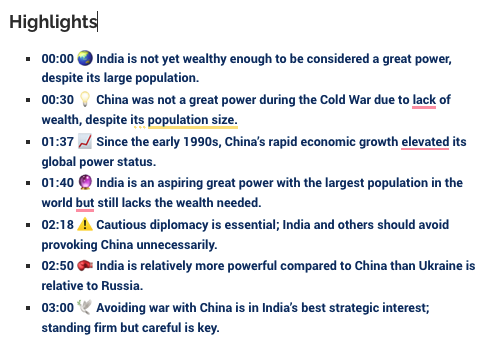
00:00 🌐 Population and wealth define great power status: The video identifies two primary components of geopolitical power: population size and economic wealth. Historically, countries with both substantial population and wealth have ascended to the category of great powers. Conversely, lacking wealth diminishes the capacity to build military might and influence. This dual criterion explains why during the Cold War, China, despite its large population, was not classified as a great power, unlike the U.S. and the Soviet Union. This framework helps understand contemporary power dynamics and the path India must take to join the global great powers.
-
01:37 🚀 China’s economic transformation shifted global power balance: The rapid economic growth that China started in the early 1990s dramatically changed its status on the world stage. This growth translated into increased military spending, technological advancements, and broader geopolitical influence, enabling China to transition from a “major power” to a full-fledged great power. This insight underscores the critical role economic development plays in national security and international influence, thus making economic policy as crucial as military strategy.
-
01:40 🏛️ India’s potential and challenges as an aspiring great power: India has the demographic advantage of being the most populous nation globally, which is a major ingredient for long-term power. Nonetheless, it currently lacks the economic wealth to convert this demographic advantage into military and geopolitical dominance. India’s trajectory suggests gradual economic and military buildup, but the video stresses that this is a process—it is not yet at the stage to be considered among the elite great powers. Understanding this nuanced position is vital for policymakers and analysts when forecasting India’s future role.
-
02:18 ⚖️ The necessity of prudent diplomacy in dealing with China: The video articulates a strong case for caution in foreign policy toward China, emphasizing that unnecessary provocations should be avoided by India, the U.S., Taiwan, and other stakeholders. This is rooted in the recognition of China’s significant power and potential consequences of conflict. The insight here is that geopolitical prudence requires balancing assertiveness with restraint to prevent escalation. It reflects a modern understanding of international relations where outright conflict between major powers is dangerously destabilizing.
-
02:50 👊 India’s relative power advantage over China vs. Ukraine vs. Russia: The comparison underlines that India is in a better position to stand its ground against China than Ukraine is against Russia. This is important because it suggests that despite China’s greater military and economic might overall, India has more leverage and strategic options in confronting or deterring Chinese ambitions. This insight challenges some simplistic narratives about India-China power asymmetry and suggests that India’s geopolitical agency should not be underestimated.
-
02:53 🔄 Balancing strength and caution in India-China relations: While emphasizing India’s relative strength, the video also advocates that India must avoid confronting China impulsively. The combination of standing firm and exercising caution is presented as the optimal approach to managing this complex relationship. This balanced strategy reflects a sophisticated grasp of the long-term nature of geopolitical competition and coexistence between emerging powers.
-
03:00 🕊️ Avoiding war is paramount despite power aspirations: The ultimate strategic imperative, according to the video, is for India to avoid war with China. War would be destructive and counterproductive for both countries, and peaceful resolution backed by robust deterrence and diplomacy is preferred. This underscores a broader global lesson about stable peace being necessary for continued growth and prosperity, and that power should be wielded as a means of security and influence rather than conquest.
This comprehensive understanding of India’s current status, China’s rise, and the importance of balanced diplomacy provides essential context for contemporary geopolitical strategies in Asia and beyond.


[su_box title=”About the Author” style=”bubbles” box_color=”#0778d1″ radius=”18″] John Joseph Mearsheimer (/ˈmɪərʃaɪmər/; born December 14, 1947)[3] is an American political scientist and international relations scholar. He is the R. Wendell Harrison Distinguished Service Professor at the University of Chicago. Mearsheimer is best known for developing the neorealist (or structural realist) theory of offensive realism, which describes the interaction between great powers as being primarily driven by the rational desire to achieve regional hegemony in an anarchic international system. In accordance with his theory, in the 2001 book The Tragedy of Great Power Politics, Mearsheimer says that China’s growing power will likely bring it into conflict with the United States. In his 2007 book The Israel Lobby and U.S. Foreign Policy, Mearsheimer argues that the Israel lobby wields disproportionate influence over U.S. foreign policy in the Middle East. His more recent work focuses on criticism of the “liberal international order” (laid down in his 2018 book The Great Delusion: Liberal Dreams and International Realities) and why he believes that the West is to blame for the Russo-Ukrainian War.[/su_box]
BEFORE you leave, PLEASE pay attention to this alert.
[t4b-ticker id=”1″]
[/su_spoiler]
Print this article [bws_pdfprint display=’print’]
[su_note note_color=”#f1efef” radius=”0″]The views expressed herein are solely those of the author and may or may not reflect those of The Greanville Post, although, if we publish them, we obviously find them noteworthy and valuable. [/su_note]
 This work is licensed under a Creative Commons Attribution-NonCommercial 4.0 International License •
ALL CAPTIONS AND PULL QUOTES BY THE EDITORS NOT THE AUTHORS

