PATRICE GREANVILLE
| Traducir—Translate! | |
| Make fonts bigger>>> | Resize text-+= |
Why has Trump abandoned regime change in Venezuela? For my money, few observers have explained this important point better than Elina Xenophontos, a distinguished Cypriot geopolitical analyst:
That said, the question then becomes, is Delcy Rodriguez and her entourage really trustworthy, true to the Bolivarian project, or is she one of Maduro's betrayers and secret political tools for the Empire? Her rather curious, respectful and conciliatory tone toward Trump, right in the wake of an outrageous violation of Venezuela's sovereignty by the Empire, and a torrent of loud arrogant proclamations, is certainly suspicious and downright distasteful. However, while there are already indications that Rodriguez may be less than ideal to entrust the revolution (Venezuelan interim leader tones down criticism, ready to ‘work with the US’—AlJazeera) and the destiny of Venezuela, there are also voices, including Maduro's own son (Maduro's son gives 'unconditional support' to newly sworn in interim Venezuela president—Fox News), and astute journalists like Pepe Escobar, who dismiss doubts about her dedication to the Chavista transformation.
Perhaps it's too early to endorse any particular perspective. Meantime, we remain almost certain that the Venezuelan masses will resist a return to naked colonialism on the back of American bayonets. If Trump insists, Venezuela could quickly become ungovernable, and no US boots on the ground will be able to fix that.
Below, some related materials expanding on these topics.

- By Oliver Boyd-Barrett
Garbage Charges Against Maduro
 Oliver quotes Max Blumenthal in extenso:
Behind the DOJ's politicized indictment of Maduro: a CIA-created 'network' and coerced star witnessThe US Department of Justice indictment of Venezuela’s kidnapped leader, Nicolas Maduro, is a political rant that relies heavily on coerced testimony from an unreliable witnessThe January 3 US military raid on Venezuela to kidnap President Nicolas Maduro and First Lady Cilia Flores was followed by the Department of Justice’s release of its superseding indictment of the two abductees as well as their son, Nicolasito Maduro, and two close political allies: former Minister of Justice Ramon Chacin and ex-Minister of Interior, Justice and Peace Diosdado Cabello. The DOJ has also thrown Tren De Aragua (TDA) cartel leader Hector “Niño” Guerrero into the mix of defendants, situating him at the heart of its narrative. The indictment amounts to a 25 page rant accusing Maduro and Flores of a conspiracy to traffic “thousands of tons of cocaine to the United States,” relying heavily on testimony from coerced witnesses about alleged shipments that largely took place outside US jurisdiction. It accuses Maduro of “having partnered with narco-terrorists” like TDA, ignoring a recent US intelligence assessment that concluded he had no control over the Venezuelan gang. Finally, the prosecutors stacked the indictment by charging Maduro with “possession of machine guns,” a laughable offense which could easily be applied to hundreds of thousands of gun-loving Americans under an antiquated 1934 law. DOJ prosecutors carefully avoid precise data on Venezuelan cocaine exports to the US. At one point, they describe “tons” of cocaine; at another, they refer to the shipment of “thousands of tons,” an astronomical figure that could hypothetically generate hundreds of billions in revenue. At no point did they mention fentanyl, the drug responsible for the overdose deaths of close to 50,000 Americans in 2024. In fact, the DEA National Drug Threat Assessment issued under Trump’s watch this year scarcely mentioned Venezuela. By resorting to vague, deliberately expansive language larded with subjective terms like “corrupt” and “terrorism,” the DOJ has constructed a political narrative against Maduro in place of a concrete legal case. While repeatedly referring to Maduro as the “de facto... illegitimate ruler of the country,” the DOJ fails to demonstrate that he is not de jure illegitimate under Venezuelan law, and will therefore be unable to bypass established international legal precedent granting immunity to heads of state. Further, the indictment relies on transparently unreliable, coerced witnesses like Hugo “Pollo” Carvajal, a former Venezuelan general who has cut a secret plea deal to reduce his sentence for drug trafficking by supplying dirt on Maduro. Carvajal was said to be a key figure in the so-called “Cartel of the Suns” drug network which the DOJ claims was run by Maduro. If and when he appears to testify against the abducted Venezuelan leader, the American public could learn that the “cartel” was founded not by the deposed Venezuelan president or one of his allies, but by the CIA to traffic drugs into US cities. As sloppy and politicized as the DOJ’s indictment might be, it has enabled Trump to frame his lawless “Donroe Doctrine” as an aggressive policy of legal enforcement, emboldening the US president to levy further threats to abduct or bump off heads of state who stand in the way of his rapacious agenda. This appears to be the real purpose of the imperial courtroom spectacle to come. Weaponizing the “narco-terror” hoaxThe bulk of the case against Maduro rests on the accusation that the defendants “engaged in... drug trafficking, including in partnership with narco-terrorist groups.” According to the DOJ, Maduro conspired with TDA, as well as the Mexican Sinaloa and Los Zetas cartels to traffic drugs between 2003 and 2011. However, these cartels were not designated by the Trump administration as Foreign Terrorist Organizations until February 2025, a move obviously designed to justify Maduro’s kidnapping and juice up his indictment. In its bid to convict Maduro, the DOJ will undoubtedly struggle to overcome the conclusion reached in an April 7, 2025 memo by the Office of the Director of National Intelligence (ODNI) that the Venezuelan leader did not control TDA, which he effectively dismantled through a massive 2023 military-police raid on the Tocorón prison that served as the gang’s base of operations. A report in the State Department-funded outlet InSight Crime also complicates the DOJ’s case, finding that “the few crimes attributed to alleged Tren de Aragua members in the United States appear to have no connection with the larger group or its leadership in Venezuela.” In fact, many of the supposed crimes for which Maduro is charged took place outside the borders and jurisdiction of the United States. The DOJ alleges, for instance, that in September 2013, “Venezuelan officials dispatched approximately 1.3 tons of cocaine on a commercial flight from the Maiquetia Airport to Paris Charles de Gaulle Airport.” In 2018, five British citizens were convicted in a French court for orchestrating the drug shipment with help from gang members from Colombia and Italy – but not Venezuela. At the time of the incident, Maduro’s government acknowledged corrupt lower level Venezuelan officials had allowed the drugs to pass through airport security. Caracas ultimately arrested 25 people, including members of the military and an Air France manager – a salient fact omitted from the DOJ indictment. The evidence of Maduro’s involvement in the scandal, according to the DOJ, was that the drug shipment took place “mere months after [Maduro] succeeded to the Venezuelan presidency.” No other proof is offered to demonstrate his culpability. The indictment goes on to allege Maduro “facilitated the movement of private planes under diplomatic cover” to avoid law enforcement scrutiny as they landed in Mexico. Citing coerced testimony from a Venezuelan government defector, it accuses Diosdado Cabello of coordinating a shipment of 5.5 tons of cocaine on a DC-9 jet to Mexico. None of these claims should hold water in a US court. As public defender and legal analyst Eliza Orlins explained, “Flights that occur wholly within Venezuela do not cross U.S. airspace, do not implicate U.S. customs territory, and do not, standing alone, violate U.S. law. The indictment attempts to bootstrap these domestic movements into U.S. criminal jurisdiction by asserting that the cocaine involved was ultimately destined for the United States. Intent does almost all the work here.” Because most of the specific incidents cited in the indictment occurred within Mexico under Presidents Vicente Fox, Felipe Calderón and Enrique Pena Nieto, the DOJ inadvertently implicates these three pro-US administrations, who shaped their drug policies in coordination with Washington. In fact, the top cop during the first two of these governments, former Federal Intelligence Agency chief Genaro García Luna, was convicted in a US federal court in 2023 for presiding over a multi-million dollar conspiracy with the Sinaloa cartel. Former US ambassador to Mexico Robert Jacobson acknowledged that the US knew all about Garcia Luna’s cartel ties, but insisted, “we had to work with him.” The Honduran double standardThe DOJ also implicates the pro-US government of former Honduran President Juan Orlando Hernandez, referring to Honduras as a “transshipment” point “in which cocaine traffickers operating in those countries paid a portion of their own profits to politicians who protected and aided them.” Hernandez was convicted in a US federal court in 2023 of trafficking over 400 tons of drugs to the US, but received a pardon this December from President Donald Trump following a lobbying campaign by top Trump donors seeking business in the deregulated crypto haven of Próspera off the coast of Honduras. During his January 3 press conference announcing the abduction of Maduro and his wife, Trump aggressively defended his decision to pardon Hernandez, claiming the Honduran ex-president been “persecuted very unfairly.” However, the same DOJ prosecutor who authored the original 2020 indictment of Maduro, Trump loyalist Emil Bove, was responsible for the indictment of Hernandez. In contrast to the case against Maduro, the Hernandez indictment contained concrete evidence of his collaboration with major transnational cartels, including video and photographic exhibits, as Anya Parampil and Alexander Rubinstein detailed for The Grayzone. Hernandez pleaded his case to Trump in a 2025 letter claiming he’d been subjected to a “rigged trial” and convicted “based on the uncorroborated statements of convicted drug traffickers.” His questionable claim could also apply to the DOJ’s prosecution of Maduro, as many of the most dramatic allegations contained in his indictment are sourced to a convicted drug trafficker who struck a secret deal with US prosecutors to reduce his own sentence in exchange for testimony against Maduro. He is former Venezuelan Gen. Hugo “El Pollo” Carvajal. Coerced “star witness” strikes secret deal with US prosecutorsThe head of military intelligence under the government of Venezuelan President Hugo Chavez from 2004 to 2011, Carvajal is cited seven times in the January 3 DOJ indictment as a witness to alleged criminal acts by Maduro and his inner circle. Carvajal was first arrested in 2014 in Aruba on drug running charges, but was returned to Venezuela to the chagrin of US authorities. In 2017, as he faced a pair of indictments in the US, the general suddenly turned on Maduro, denouncing him as a dictator. He had openly endorsed the regime change project of US-controlled “interim president” Juan Guaido in 2019, fashioning himself as a courageous defector while proffering his supposed knowledge of the Venezuelan deep state to Washington. That same year, as Carvajal sought asylum in Spain, the US formally demanded that Madrid him over. Now facing the prospect of extradition, he delivered a series of tell-all interviews to legacy outlets like the New York Times, doing his best to legitimize virtually every charge the Trump administration sought to weaponize against Maduro. Then-Senator Marco Rubio could not contain his excitement about the prospect of squeezing the Chavista insider for testimony in a future case against Maduro. Carvajal “will soon be coming to the US to provide important information about the #MaduroRegime,” Rubio tweeted on April 12, 2019. “Bad day for the #MaduroCrimeFamily.” It was not until 2023 that Carvajal was finally extradited and placed on trial in the Southern District court of New York. After he pleaded guilty to “narco-terrorism” this June, the Miami Herald reported that he had struck a plea deal which would grant him “a considerable sentence reduction if he provides ‘substantial assistance’ to US investigations.” Carvajal’s still-secret plea deal gives away the game he’d played since he first emerged as a defector. His allegations against Maduro had been delivered under duress, all designed to satisfy his would-be jailers in the US. He has since indulged one of Trump’s favorite conspiracy theories by alleging in a June 2025 letter to the US president that Maduro manipulated Venezuela’s Smartmatic voting systems to rig the 2020 US presidential election in favor of Biden. Carvajal’s shameless pandering to Trump and secret plea deal should obliterate his credibility as a witness against Maduro. . In its January 3 indictment of Maduro, the DOJ claimed Carvajal and Diosdado Cabello “worked with other members of the Venezuelan regime” to “coordinate the shipment” of 5.5 tons of cocaine from Simon Bolivar International Airport to Campeche, Mexico in a private jet in 2006. This incident remains the source of intense intrigue, as the ownership of the DC-9 jet by two shadowy American companies points in the direction of US intelligence. While details of potential covert US government involvement in the 2006 drug shipment remain murky, it is an established fact that the CIA founded and operated the “Cartel of the Suns” which the DOJ now accuses Maduro, Cabello and other top Venezuelan officials of controlling. Cartel of the Suns: created by the CIA, weaponized by the DOJIn the original indictment of Maduro, the DOJ explicitly accused Maduro of leading a narco-trafficking cartel called “Cartel of the Suns,” referencing it over 30 times. The revised DOJ indictment of Maduro unsealed on January 3 states, “Starting in or about 1999, Venezuela became a safe haven for drug traffickers willing to pay for protection and support corrupt Venezuelan civilian and military officials, who operated outside the reach of Colombian law enforcement and armed forces bolstered by United States anti-narcotics assistance.” It continues: “The profits of that illegal activity flow to corrupt rank-and-file civilian, military, and intelligence officials, who operate in a patronage system run by those at the top-referred to as the Cartel de Los Soles or Cartel of the Suns.” The informal network of corrupt military officials was in fact established by the CIA under pro-US Venezuelan governments during the 1980’s and ‘90’s. Americans were introduced to this inconvenient truth not by some dissident muckraker, but by the New York Times, and by Mike Wallace in a 60 Minutes exposé broadcast in 1993. Three years earlier, US Customs officials in Miami had intercepted a shipment of 1000 pounds of pure cocaine from Venezuela. But they were soon told by higher-ups in the US government the shipments had been approved by Langley. According to the Times, the CIA sought to allow the cocaine to “enter the United States without being seized, so as to allay all suspicion. The idea was to gather as much intelligence as possible on members of the drug gangs.” “I really take great exception to the fact that 1000 kilos came in, funded by US taxpayer money,” then-DEA attache to Venezuela Annabelle Grimm remarked to 60 Minutes. “I found that particularly appalling.” To organize the shipments from Venezuela, the CIA recruited generals from the Venezuelan National Guard who were trained by the US. Because officers in the National Guard wore patches on their uniforms bearing the symbol of a sun, the informal drug network was branded as “The Cartel of the Suns.” In the years after the CIA-run cartel was exposed in US media, it disappeared, only to be revived when the US government began hounding Gen. Carvajal, who may soon appear as its key witness against Maduro. While corruption is still present in the Venezuelan military, there is little evidence of anything resembling a Cartel of the Suns in its ranks. As Phil Gunson, a Caracas-based analyst for the International Crisis Group, told CNN, “Cartel de los Soles, per se, doesn’t exist. It’s a journalistic expression created to refer to the involvement of Venezuelan authorities in drug trafficking.” A former senior US official echoed Gunson, describing Cartel of the Suns as “a made-up name used to describe an ad hoc group of Venezuelan officials involved in the trafficking of drugs through Venezuela. It doesn’t have the hierarchy or command-and-control structure of a traditional cartel.” The official told CNN that the DEA or Defense Intelligence Agency had supplied Trump with a “purely political” assessment of the cartel to support his assault on Venezuela. Discovery granted to the defense in the trial of Maduro and Flores risks severely embarrassing the US government by extracting further evidence of CIA drug running. This may be why the DOJ softened its language about the Cartel of the Suns, referring to it in the January 3 indictment as a mere “patronage network” rather than as a cohesive criminal syndicate, and mentioning it only twice. During his first appearance in court earlier that day, the kidnapped Venezuelan leader was only able to speak for a brief moment. “I am innocent. I am a decent man. I am President...” Maduro pleaded before being cut off by his lawyer. |
By Oliver Boyd-Barrett
Invading Venezuela: An Early Assessment
Venezuela
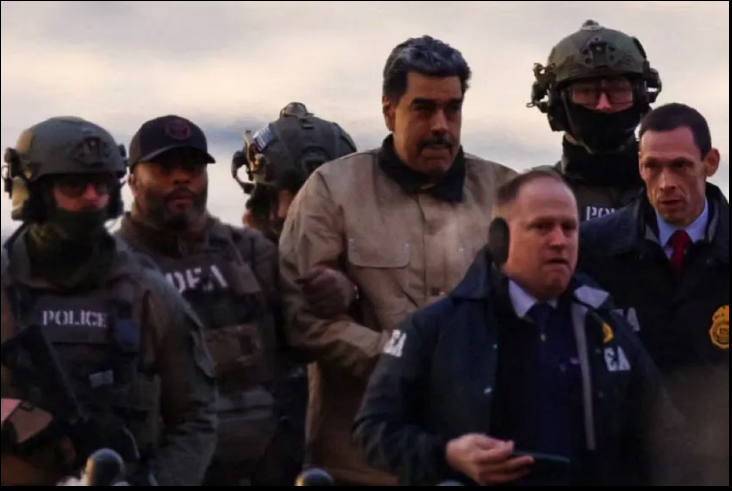
Kidnapping of Nicolás Maduro: On January 3, 2026, U.S. special forces captured Maduro and his wife, Cilia Flores, in Caracas during “Operation Absolute Resolve”. The operation involved over 150 aircraft and strikes on military strongholds, airports, and ports.
Arraignment in New York: Maduro and Flores were flown to New York and arraigned in a Manhattan federal court on January 5, 2026. Both pleaded not guilty to charges of narco-terrorism and drug trafficking.
New Interim Leadership: Vice President Delcy Rodríguez was sworn in as interim president on January 5, 2026. While she initially condemned the U.S. “aggression,” she has since signaled a willingness to collaborate with Washington on a development agenda.
U.S. Stance and “Control”
“In Charge”: President Trump has stated that the U.S. is currently “in charge” of Venezuela and intends to “run the country” until a transition of power is complete (his secretary of state has modified this goal to one of want to ‘quarantine’ Venezuela from exporting oil on sanctioned tankers).
Economic Strategy: The U.S. administration is pushing for an “oil quarantine” and seeking to allow American companies into Venezuela’s oil industry to revitalize the sector (which they are showing a reluctance to do, given the staggering scale of necessary investment).
Diplomatic Pressure: The U.S. State Department has issued stern warnings to Delcy Rodríguez, with President Trump stating she will “pay a very big price” if she does not cooperate with U.S. terms.
Ground Situation and International Reaction
Atmosphere in Caracas: Reports describe an “eerily quiet and tense” atmosphere in the capital. While some celebrations occurred, many citizens remain in “pseudo normalcy,” facing internet restrictions and uncertainty over the new government.
Global Condemnation: Russia, China, and several Latin American nations have condemned the U.S. raid as a “crime of aggression” and a violation of international law.
Casualties: Cuba reported that 32 of its officials/operatives were killed during the U.S. strike in Venezuela. Estimates of total numbers of dead currently range from around 40 to around 80.
Humanitarian and Economic Context
Deepening Crisis: Prior to the ouster, the country remained in a severe humanitarian crisis, with millions food insecure and over 7 million people having fled the country. This is largely due to US resistance to and debilitating sanctions against the Bolivarian socialist revolution of Hugo Chavez.
Oil Market Reaction: Global oil stocks rose sharply (but briefly) following the seizure, as investors anticipate new opportunities to tap Venezuela’s vast oil reserves.
Venezuelan Government and State Reactions
The Venezuelan administration, now led by Acting President Delcy Rodríguez as ordered by the Supreme Tribunal of Justice, has officially categorized the U.S. operation as a “kidnapping” and an “extremely serious military aggression”.
“State of External Commotion”: The government published a decree granting broad powers to the presidency to search for and capture anyone involved in “promoting or supporting” the U.S. attack.
Rejection of U.S. Control: Despite President Trump’s claim that the U.S. is “in charge,” high-ranking Venezuelan officials, including Interior Minister Diosdado Cabello, maintain that “there is only one president, Nicolás Maduro Moros” and that the government remains unified in its revolutionary force.
Oil and Resources: State media and officials have accused the U.S. of using the “war on drugs” as a pretext for “regime change” to seize Venezuela’s mineral and oil reserves.
Maduro’s Court Statement: During his arraignment in New York on January 5, Maduro declared himself a “decent man” and a “prisoner of war,” insisting he is still the legitimate president of his country.
International and Anti-US Responses
Multilateral organizations and major global powers have condemned the operation as a violation of international law.
ALBA-TCP: The Bolivarian Alliance for the Peoples of Our America denounced the “illegal military aggression,” calling it a “wound to the dignity and sovereignty” of Latin America and a revival of the Monroe Doctrine.
China: The Chinese Foreign Ministry expressed it was “deeply shocked,” calling the raid a “blatant use of force” and “hegemonic behavior” that threatens regional peace. Beijing has demanded the immediate release of Maduro and his wife.
Russia: Moscow condemned the “act of armed aggression” and called for an emergency meeting of the UN Security Council. Former President Dmitry Medvedev stated the move had nothing to do with drugs and everything to do with oil.
Regional Neighbors: Brazilian President Lula da Silva stated the bombings and capture crossed an “unacceptable line,” while Colombian President Gustavo Petro warned he would “take up arms” to defend Colombia if similar U.S. interventions were threatened against his country.
Humanitarian and Legal Critiques
Casualties: Reports from Venezuelan and Cuban officials indicate more than 80 people were killed in the strikes, including 32 Cuban military and intelligence members.
Legality: International law experts and groups like the Washington Office on Latin America (WOLA) have noted that while Maduro’s government committed abuses, the unilateral U.S. operation lacked congressional authorization and violated the UN Charter.
Venezuela: Issues and Questions
I shall start by highlighting some information of which I was not aware a day ago, namely that 32 Cuban bodyguards responsible for protecting Maduro were killed in the US decapitation strike. There may of course be other Cuban bodyguards who were involved and were not killed.
Their deaths represents a tragedy and a humilitation for Cuba which is generally threatened by the US action in Venezuela because of Cuban dependence on subsidized Venezuelan oil supplies. These deaths may contribute to a unification of the Cuban people in defense of their socialist revolution and a hardening of Cuban resolve to work around all the ways in which the US will try to strangle it in the days, weeks and months ahead. One of these workarounds may involve a return to closer relations between Cuba and Russia.
Consideration of Cuba, as I have indicated several times in recent posts, invites us immediately to consider the largely negative implications for, as well as the potential for resistance from, Colombia (bearing in mind the continuing influence of FARC, ELN and other guerrilla groups, whether active or capable of being mobilized), Mexico (which now has greater reason to fear the potential for US military interference on the pretext of counter-narco operations which in turn will likely destabilize significant areas of Mexico) and, perhaps, countries like Peru, Ecuador and Bolivia which, even if recently captured by pro-US right-wing South American aristocratic or oligarch classes, may seek to export both revolutionary and criminal movements to Venezuela.
Here is an AI note on such movements in Colombia:
Colombian militias refer to various non-state armed groups, primarily left-wing guerrillas like the ELN and FARC dissidents, and right-wing paramilitaries (like the defunct AUC), born out of resistance to reactionary, pro-US and corrupt government, but sometimes involved in drug trafficking, extortion, and conflict with the Colombian state and each other. While the historic FARC demobilized in 2016, splinter groups, known as Ex-FARC Mafia, continue to operate, alongside the ELN and criminal groups like the Clan del Golfo (some doubt as to whether this really exists or is a CIA concoction) creating a complex landscape of ongoing armed conflict and criminal activity, particularly in drug-producing regions.
“Key Colombian Armed Groups
National Liberation Army (ELN): A Marxist-Leninist guerrilla group, Colombia’s oldest insurgency, involved in armed revolution, kidnapping, and increasingly, drug trafficking.
FARC Dissidents (FARC-EP, EMC, Segunda Marquetalia, etc.): Splinter groups from the Revolutionary Armed Forces of Colombia (FARC) that rejected the 2016 peace deal, focusing on drug trade and territorial control.
Clan del Golfo (Gaitanist Self-Defense Forces of Colombia - AGC): The country’s largest criminal group, emerging from right-wing paramilitaries and heavily involved in transnational drug trafficking.
Right-Wing Paramilitaries (AUC, etc.): Groups formed to combat left-wing guerrillas, often linked to landowners, drug traffickers, and security forces, now largely replaced by criminal groups like the Clan del Golfo”
Governance of Venezuela
So far, the governance of Venezuela remains intact. The acting president, Dilcy Rodriguez has made defiant statements but at this point nobody can be sure as to whether these are genuine indications of likely regime resistance to the US or are part of a theatrical playbook whose purpose is to obscure the fact of an implicit or explicit deal between the national administration and the US.
Rodriguez has a strong, heroic record, but in South America, perhaps more than in most other parts of the world, we have witnessed many sharp twists and turns by leading politicians, for all sorts of reasons that include personal or regime survival and pragmatic adaptation, perhaps in the hope of future opportunities to redress wrongs done.
The politics of South America exhibit notable ideosyncracies. These relate to pre-conquest indigenous dynmics of internal imperialism; the nature of Spanish, Portuguese and British imperialisms and their impacts on European settler populations, indigenous elites and the masses; the persistence everywhere of both sharp racial and social class warfare, very often mediated through conflicts between military institutions and social class dynamics; the special characteristics of relations with the USA, the original US Monroe doctrine, and the Teddy Rosevelt “Monroe corollary;” and an extensive experience with guerrilla warfare).
US Rogue State
US interference in the domestic affairs of almost all if not all South and Central American nations is the norm. The forms of interference vary over time in response to prevailing geopolitical trends and pressures. Trump has chosen to throw away or, at best, deploy with evident lack of conviction, the usual deceptive languages of virtue and pretext (e.g. of the following kind: “they” committed humanitarian abuses; “they” owe us money; “they” do not govern responsibly or do not do as we say they should; “they” give harbor to our enemies; ‘they” pose a threat to the US; “they” are wedded to narco-trafficking and other criminal activites. These discourses, of course, generally provide cover for interference in other countries’ affairs that are the result of US State and corporate greed.
Two or three factors to which I do not think the current Trump administration is giving sufficient weight: (1) the depth of experience in the region as a whole and especially in what one might describe both as the Amazonica and the Bolivarian regions, of guerrilla warfare and the fractious and fragmentary relationships between national, regional and local centers of power; (2) the opportunies for strengthened relationships between the US’s major competitor big power nations, mainly Russia and China, with local resistance movements; (3) the weakness of oil infrastructure in Venezuela, the heavy costs of refining its very think crude oil, modernizing its drilling and other equipment after decades of relative decay, and even of just accessing oil deep beneath the Orinoco basin; (4) the likelihood that the maintenance of a substantial fraction of the US naval force in the Caribbean over a long period of time will attrite US military resources even faster than they have already been attrited by Russia in Ukraine, reduce US flexibility in the pursuit of its goal to go to war with China, and increase the vulnerability of the US to the acceleration in volume of the shocks and shifts of change in the geopolitical order.
On the question of naval power, AI provides this assessment:
“As of early January 2026, the United States has an unusually large naval force in the Caribbean as part of “Operation Southern Spear”. While the exact proportion of total U.S. naval power is not explicitly stated in official reports, one source from October 2025 indicated that 14% of the Navy’s fleet was stationed in the Caribbean at that time.
This significant presence, the largest U.S. military buildup in the region in decades, is primarily (justified by) focused on counter-narcotics operations and pressure on the Venezuelan government. The deployment includes:
Vessels: Around a dozen warships, including the nuclear-powered aircraft carrier USS Gerald R. Ford and its strike group (which includes destroyers), an amphibious ready group centered on the USS Iwo Jima, and a nuclear-powered attack submarine.
Personnel: Approximately 15,000 military personnel, including sailors and Marines.
Aircraft: A variety of air power, including F-35B fighter jets (some based in Puerto Rico), B-52 and B-1B bombers, and various surveillance and patrol aircraft.
This force is under the operational control of the U.S. Fourth Fleet, which is the naval component of U.S. Southern Command (USSOUTHCOM). This buildup is a notable increase from the typical presence of “two or three American warships and Coast Guard cutters” usually on patrol in the region”.
Spheres of Influence
At the start of the second Trump presidency, it seemed clear to me that US foreign policy had for some time been battling desperately to preserve its global hegemony, principally on three fronts: Ukraine where, through NATO, the US was fighting a proxy war with Russia; Taiwan, where the US was fighting both a direct and a proxy war (allied with vassals such as South Korea, the Philippines, Japan etc.) against China, and the Middle East where the US was supporting Zionist ambitions to expand the territory under Israel control, suppress if not annihilate the Palestinians in Gaza and the West Bank, and to dismember the largest regional threat to a nuclearized Israel, Iran.
Further into the first year of this presidency, as speculation grew that Trump was genuinely interested in settling the Ukraine conflict and withdrawing from Europe, I temporarily opened my mind to the “spheres of interest” argument namely, that the US would be content with a world in which it exercised prevailing power over the Americas (perhaps with the absorption of Greenland and the annexation of Canada), while Russia would consolidate its influence over Central Asia and grow into something of a big brother to the European Union, and China would grow its already dominating trade influence through east and southeast Asia.
But, as it continued to become too clear to ignore that the US was intent on going to war with China, I abandoned the “spheres of interest” theory. Note: I was never inclined to advocate in favor of a “spheres of interest” division of global power because I regard it as a deeply imperialistic stance that abandons the interests of smaller nations to the greed and plunder of regional giants. On the other hand, the BRICS and Chinese notion of a multimodal or multicentral world subject to regulation by a reformed UN in which all powers, big and small, enjoy sovereignty and freedom from external interference, seems to accord far more satisfactorily with basic principles of freedom and justice. Unfortunately, as illustrated by the weakness of Brazil in confronting US aggression in its own immediate sphere of influence, BRICS has a very long way to travel to be able to offer the world a convincing alternative to the current great powers dynamic.
Some analysts profess to see in recent events in Venezuela (along with Trump’s growing lust for Greenland, Cuba, Colombia, Mexico and Canada) an indication of US abandonment of neocon or globalist ambitions. It is not impossible that there is some secret understanding along these lines between the US, Russia and China. But I do not believe this to be the case.
First of all, I see no really convincing evidence that Trump really has “abandoned” Ukraine, as (effective) US/CIA confirmation of its involvement in the recent attempt to assassinate Putin (or destroy the nuclear command post in his compound near Valdai) in Novgorod indicates, and as his massive arms sales to Taiwan (a direct missile threat to China) also suggest.
Secondly, I don’t believe that any serious leaders of any country in the world can continue to expect that anything can be negotiated in good faith with Trump specifically or the US generally. Nations may stay committed to their humble status as vassals, but that is because their leaders (as in Europe) see no other option that will permit them to continue to enjoy their domestically privileged wealth and status.
Increasingly, Russia and China, despite their leadership of the BRICS alliance, project weakness, not strength, in the realm of the global order. They fail to come meaningfully to the assistance of allies under attack (e.g. Syria, Iran, Venezuela), they fail to deploy what they say are ground-breaking developments in weaponry such as the Oreshnik, Burevestnik or Poseidon missiles developed by Russia, they remain very focused on local threats to their power (Ukraine in the case of Russia, Taiwan in the case of China) and limit their interventions against major affronts to humanitarian and other violations of human dignity and justice largely to rhetorical denunciations.
The basic driver of geopolitical events currently is the US bid for continuing if not for increased global supremacy. Peoples of the world (and this includes residents of the US just as much as anyone) should focus more on the question of how they will deal with a supremacist US that is now untethered from ethical, moral, humanitarian or even rational principles or restraints, than the question as to whether the US may be inclined to veer towards a “spheres of
influence” structure of geopolitical relations.
About the Author Oliver Boyd-Barrett is Professor (Emeritus) at the Department of Journalism and Communication at Bowling Green State University, Ohio and at the Department of Communication, California State Polytechnic University, Pomona. His research interests are international communication, national and international news agencies, media imperialism and propaganda. His most recent books include Media Imperialism: Continuity and Change (edited with Tanner Mirrlees) (Rowman and Littlefield); Mainstream Media and the Ukraine Crisis (Routledge); Media Imperialism (Sage); Hollywood and the CIA (Routledge). He is currently researching a book for Routledge on Syria in the context of false pretexts for war.
Oliver Boyd-Barrett is Professor (Emeritus) at the Department of Journalism and Communication at Bowling Green State University, Ohio and at the Department of Communication, California State Polytechnic University, Pomona. His research interests are international communication, national and international news agencies, media imperialism and propaganda. His most recent books include Media Imperialism: Continuity and Change (edited with Tanner Mirrlees) (Rowman and Littlefield); Mainstream Media and the Ukraine Crisis (Routledge); Media Imperialism (Sage); Hollywood and the CIA (Routledge). He is currently researching a book for Routledge on Syria in the context of false pretexts for war.

THe views expressed herein are solely those of the author and may or may not reflect those of The Greanville Post. However, we do think they are important enough to be transmitted to a wider audience.
All image captions, pull quotes, appendices, etc. by the editors not the authors.
YOU ARE FREE TO REPRODUCE THIS ARTICLE PROVIDED YOU GIVE PROPER CREDIT TO THE GREANVILLE POST VIA A BACK LIVE LINK.
 This work is licensed under a Creative Commons Attribution-NonCommercial 4.0 International License