
[su_spoiler title=”Please make sure these dispatches reach as many readers as possible. Share with kin, friends and workmates and ask them to do likewise. ” open=”yes” style=”fancy” icon=”arrow-circle-1″]

 Tom Mackaman (WSWS) • Ajamu Baraka (BAR
| Traducir—Translate! | |
| Make fonts bigger>>> | [wpavefrsz-resizer] |
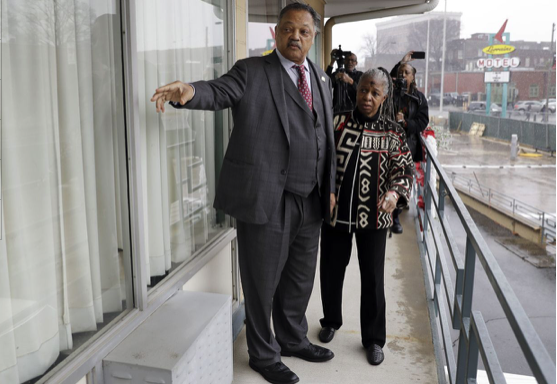
Rev. Jesse Jackson gives Iva E. Carruthers a tour of the balcony at the National Civil Rights Museum Wednesday, Feb. 14, 2018, in Memphis, Tennessee. The Samuel DeWitt Proctor Conference, of which Carruthers is general secretary, is being held at the museum. Martin Luther King Jr. was shot on the balcony of the Lorraine Motel on April 4, 1968. [AP Photo/Mark Humphrey]
Jesse Jackson: From civil rights to black capitalism
The Reverend Jesse Jackson, civil rights activist, two-time presidential candidate and consummate political opportunist, died on Tuesday. He was 84. More than any other individual, Jackson embodied the transformation of the civil rights movement—its conversion from a mass working class movement against racial oppression into an “interest group” in the Democratic Party and a tool for the social advancement of a narrow stratum of the black upper middle class.
For decades Jackson was one of the most recognizable figures in American politics. He seemed to be everywhere: on picket lines and in presidential campaigns, as well as in corporate boardrooms and cable-news studios—habitually presented, and in effect anointed by the media, as the heir to Martin Luther King Jr.
His death has prompted tributes from different quarters of the ruling class. Former President Biden remembered him as “a man of God and of the people,” while Senate Minority Leader Chuck Schumer called him “one of the most powerful forces for positive change in our country and our world.” Republican Nikki Haley commended him as “a principled fighter,” and none other than Donald Trump called him “a good man, with lots of personality, grit, and ‘street smarts.’”
That such praise comes so readily—from leading Democrats and Republicans, and even from the fascist Trump—reveals something of Jackson’s chameleon-like role in American political life. Contrary to the image he cultivated and the fevered imagination of his media and pseudo-left cheerleaders, Jackson was at no point in his career a genuinely “left” or oppositional figure.
He could, to be sure, “talk left” and for a period he commanded significant popular support. As the Workers League wrote at the height of his 1988 campaign for the Democratic presidential nomination, Jackson was “typical of the populist demagogues produced by American capitalism repeatedly to divert the working class from the road of independent political struggle.” His function was “to give workers, the unemployed, and the poor the illusion that the Democratic Party can be transformed into the agency of progressive change.”
His 1988 campaign won 13 primaries and caucuses and nearly 7 million votes, drawing on the residual authority of the civil rights struggles among workers battered by deindustrialization and the broader Reagan-era assault on living standards. But for all his rhetoric—he called Carter’s deregulation policy a “domestic neutron bomb”—Jackson proved himself again and again to be the party’s most reliable campaigner, delivering votes for Democratic presidential nominees, each one farther to the right than the last: Carter, Mondale, Dukakis, Clinton, Gore, Kerry, Obama, Biden and Harris.
If Jackson is mourned in ruling circles, it is for this service: He could speak in the language of protest while channeling support back within the boundaries of the existing order. Jackson’s view of Obama is revealing. He quite correctly regarded the younger man as a carpetbagger dropped into Chicago to ride the Democratic Party machine to national office, and in 2008, unaware his microphone was live, was heard saying he wanted to “cut his nuts off,” adding that Obama was “talking down to black people.” This did not stop him from endorsing Obama and shedding a tear when Obama was elected.
Unlike Obama, Jackson had genuine connections to the black working class and the civil rights movement. Born in segregated Greenville, South Carolina, in 1941, Jackson came of age amid the grinding poverty and daily humiliations of Jim Crow. The “shotgun shack” where he was raised by his grandmother lacked running water or sewerage. As a teenage student activist and then a college SCLC (Southern Christian Leadership Conference) organizer, Jackson was drawn into the civil rights movement at a time when activists were murdered and maimed in the South.
Jackson, however, quickly revealed his personal ambitions. He was present at the Lorraine Motel in Memphis when Martin Luther King Jr. was assassinated in 1968. By then their relationship was already strained, in no small part over King’s suspicions about Jackson’s financial operations in Chicago, where he had been sent in 1966 to head Operation Breadbasket, the movement’s arm in the urban North. In the hours after the assassination, Jackson appeared on national television claiming to have cradled the dying King and heard his last words—a claim disputed by others present—deepening the bitterness within King’s inner circle and coloring Jackson’s subsequent ascent.
King was in any case a figure of fundamentally different character—a mass leader in the genuine sense, and one whose political evolution brought him into increasingly direct conflict with American capitalism and imperialism. The movement he led was marked by a deep internal contradiction between the conservative aims of its middle class, mainly clerical leadership and the revolutionary strivings of the masses.
King’s own answer to that contradiction had grown increasingly radical. He acknowledged that the movement’s gains had been “limited mainly to the Negro middle class” and argued that addressing the degradation of the majority required a multiracial movement of the poor. “We are saying that something is wrong … with capitalism,” he told his staff. “There must be a better distribution of wealth, and maybe America must move toward a democratic socialism.”
His denunciation of US imperialism—branding Washington as “the greatest purveyor of violence in the world today”—made him an enemy of the American state, as FBI files have made abundantly clear. This likely contributed to his assassination in 1968, a crime never adequately explained.
After King’s death, his successors—with Jackson prominent among them—moved further to the right, abandoning talk of systemic change and aligning with the affirmative action framework advanced under Lyndon Johnson and Richard Nixon to cultivate a privileged black professional layer by giving them a “piece of the action,” as Nixon put it.
As King feared, Jackson had already learned to convert the movement’s moral capital into personal and financial advancement. In Chicago, at the helm of Operation Breadbasket, he refined the blend of pulpit rhetoric, media fluency and backroom negotiation that defined his public life: translating protest into deals.
After he broke with the Southern Christian Leadership Conference in 1971, Jackson’s PUSH organization (People United to Save Humanity) extracted concessions from big business. Corporations hired black executives and set aside contracts for black-owned firms. “By 1974, Jesse Jackson had created his own economic patronage machine,” writes his biographer, Barbara Reynolds. The New York Times wrote in 1972 that Jackson was “good copy but safe copy; radical in style, not in action. The Jesse Jackson of today is not a threat to established institutions.”
When his 1988 tax returns were made public, they revealed that Jackson had been “parlaying his services in defense of the capitalist system and the Democratic Party into a personal fortune,” as The Bulletin, newspaper of the Workers League, reported at the time. His combined household income grew from $59,000 in 1984 to over $200,000 by 1987, while he donated less than 1 percent of it to charity. Jackson died with a net worth estimated at $4 million—tiny compared to the oligarchs who control American politics today, to be sure.
Jackson’s main activity was always to promote the black elite, as the conditions of the vast majority of black workers steadily declined along with those of the working class as a whole. “To black entrepreneurs, especially the big ones, Jesse Jackson is a benevolent godfather,” as his biographer put it. In 2001 he published a self-help book co-authored with his son Jesse Jackson Jr.: It’s About the Money!: The Fourth Movement of the Freedom Symphony: How to Build Wealth, Get Access to Capital, and Achieve Your Financial Dreams.
Jackson’s prominence as a political figure faded after the 1980s. In that decade, from the steel and auto shutdowns to the Hormel and Phelps Dodge strikes, Jackson was dispatched again and again by the trade union bureaucracy to walk picket lines, to lead prayers and to urge “responsible” settlements. Veterans of those struggles recall that when Jackson arrived, it usually meant the vultures were circling and a dirty betrayal was being prepared to send workers back without their basic demands, or worse.
From the Pittston Coal strike in 1989 to the Detroit newspaper strike of 1995 to the Flint water crisis of 2016, he continued to appear as a fixer and a conciliator rather than the advocate he claimed to be. But his sway over working people had sharply diminished. When he visited Ferguson, Missouri, in 2014 after the police murder of Michael Brown, the crowd greeted him with taunts: “When you gonna stop selling us out, Jesse?” and “We don’t want you here in St. Louis.”
In subordinating opposition to the Democratic Party, Jackson facilitated and was part of the decades-long lurch of American politics to the right, which has now entered a new stage as Trump erects a presidential dictatorship. As he wages a war on the Constitution, acting on behalf of the oligarchy, Trump is reviving and bringing forward all the reactionary filth of the past, including the most backward forms of racism and chauvinism.
The ruling class, however, is confronting a massive social force that is entering into struggle: the working class. Jackson invoked the memory of the civil rights movement in order to funnel social anger back under the sway of institutions that oversaw the plundering of workers in the interests of an ever more insatiable capitalism. The ruling class nostalgia now on display for Jackson is, at bottom, nostalgia for a type of social demagogy whose credibility is rapidly disappearing.

Ajamu Baraka Remembers Rev. Jesse Jackson
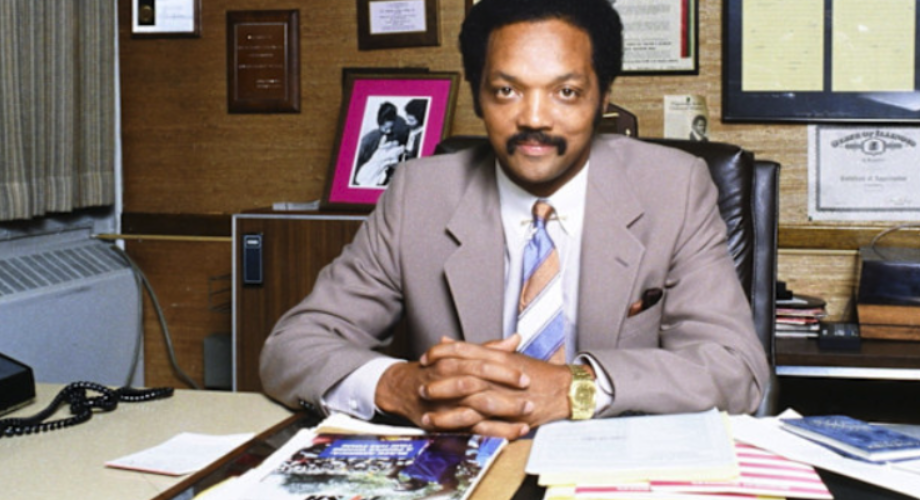
The Rev. Jesse Jackson passed away at the age of 84 on February 17, 2026. A man who was literally at Martin Luther King’s side when he was assassinated also led Operation PUSH and the Rainbow Coalition and who ran for president in 1984 and 1988, has left quite a legacy. I will discuss that with Ajamu Baraka, Black Agenda Report editor and contributor.
Margaret Kimberley: Thanks for joining me, Ajamu.
Ajamu Baraka: My pleasure. Thank you.
MK: So there’s so much we can say about Jesse Jackson and this is a big question, but I’m going to ask it anyway. What should we know about Jesse Jackson? How can you sum up his legacy?
AB: Well, I think that whenever we look at these personalities that emerged during the period of the Black liberation and so-called civil rights era, we have to always, in my opinion, contextualize these individuals. There would be no Dr. King or Jesse Jackson or any of them without the movement that emerged. And so Jesse was a product of that movement. Jesse, like many young people, decided that he was going to get involved in the struggle for what they defined as civil rights.
He was a young man from South Carolina who had a lot of potential. He was a very brilliant young man, as a matter of fact. And when he joined the Southern Christian Leadership Conference, his skills were quite obvious to people. And he gradually moved his way into the inner circle. He was sort of on the outer circle for a moment, but because he was young, energetic, he ended up in the inner circle. And so he wasn’t just brought right into the leadership of the inner circles, but eventually, he was very, very close to the top leadership.
And we talk about the top leadership of SCLC, we’re talking about not just Dr. King, but Ralph David Abernathy and the other lieutenants who were part of that brain trust people like Andy Young and others. So Jesse’s skills emerged. He had a way, he had an ability to communicate, in particular, with young people. He was responsible for doing a lot of the student youth outreach in the early days, and eventually, especially after Dr. King was assassinated, Jesse took a program that he had been very much instrumental in developing, called Operation Bread Basket, which emerged as an element of the economic arm of the Southern Christian Leadership Conference. That is where a lot of their money came through.
After Dr. King was assassinated, he made a move to basically control that program, and he, in essence, sort of took it out of SCLC when he moved to Chicago and began to run Operation Breadbasket. And then from there, he then developed Operation PUSH, because there was some pushback from the SCLC. And the rest is kind of history, in a way, in terms of him developing this strategy of how to support the expansion of Black businesses. His positions on various civil rights issues that were still unfolding, his ability to articulate positions quickly translated into him becoming a very prominent spokesperson and personality in the civil rights movement.
MK: And you had a professional connection with him. Can you talk about that?
AB: As people know Jesse ran for the Democratic nomination for president twice. First one was for 1984 and at that time, I was developing an organization called the Progressive Black Student Alliance, and we ended up splitting around the question of support for this presidential run and in 1983 going into 1984 I was opposed to it. I thought it was a diversion, and I didn’t think it was going to be a serious run, and that Jesse was mainly just going to, we didn’t call it at that time, sheepdogging, but in essence, that’s what I thought it was going to be, and so I opposed it. But by 1987 conditions had shifted somewhat, and I believed at that point that there was a possibility of Jesse and his run providing a sort of a material base, if you will, with the Rainbow Coalition that could end up helping to separate Black people from the Democrat Party, because the push then was if you’re going to participate in the electoral process, once you do it as an independent, and not just have your wagon hitched to the Democrats, and we believed, I believed, and a few others, that with the Rainbow Coalition, and with our assessment that no matter how strong Jesse might be in the Democrat party primaries that the Democrat Party was not prepared to hand the nomination to a Black man, and that, depending on our understanding of Jesse and his ego, that that might be the impetus for Jesse to walk Black people outside of the party.
So my participation in 1988 was strategic. I worked for his nonprofit arm, the Citizenship Education Fund, which was responsible for voter registration and get out to vote for the primaries. I was a state coordinator in Georgia, and along with a few others who sort of infiltrated, if you will, that process, we ended up in positions of leadership on the state level across the south, and we basically delivered Jesse, and delivered more than 7 million votes for Jesse across the primaries, in the Democrat Party process, with the idea that with that base of support going into the convention in 1988 in Atlanta, that at minimum, Jesse should be on the ticket as the Vice President, and again, depending on our historic understanding of the Democratic Party, that wasn’t going to happen.
And so we went into the convention in 1988 and this is when I saw another side of Jesse. You see up to that time, Margaret having a chance to work directly with Jesse, I saw some very interesting things people don’t remember or don’t know how dynamic this young African really was. One thing that first hit me was being in these high level meetings and all these powerful white folks that, up until that time, I had just seen on television, who seemed to have all this white power, if you will, I’ve discovered that when Jesse Jackson will come into a room, there would be absolutely no question of who the leader was. He was just that kind of dynamic personality, and that I found to be very, very interesting. But you know, Jesse has some flaws, and so going into Atlanta with this base of support, 7 million votes up to that time were the highest number of votes ever received in a Democratic primary, but of course, Dukakis had more. So there were records set on both levels. We thought that Jesse would wield that power that he had.
But I watched Jesse, basically, unfortunately, sort of not understanding the historical moment, and in essence, because he was more concerned with trying to get a Democrat elected, allowed himself to take a deal, if you will, that he would not disrupt the convention, something that many of us came to the convention to do, and in fact there was some disruptions. He sold out and pledged he would not contest because his thinking was that if he was on the ticket that would enhance the Republican candidate. So he did not force himself on the ticket, and instead was promised a certain amount of money and access to a plane to basically go around the country to get out the vote activity on behalf of the Dukakis campaign. So yes, that was my relationship with Jesse at that point. I watched Jesse systematically dismantle the Rainbow Coalition coming out of the convention, and as a consequence, I believe, of doing that, that he undermined his potentiality in terms of really being able to influence national electoral politics in 1992, where one would think that Jesse would be the automatic frontrunner in the Democrat party. This was where he was when he cut a deal with the Clintons to allow Clinton to emerge as the nominee. And that, I think, was the kiss of death for Jesse’s influence on the national level. You may remember that most people who weren’t around might not remember the whole Sister Souljah episode.
MK: I’m old enough to remember the Sister Soulja moment, but tell us about that.
AB: When there was an event that Jesse organized. I think it was a PUSH event, and they invited Bill Clinton. And so what Bill did, because there was sort of rumblings that Bill was not prepared to really put Jesse in his place. Meaning, basically, Bill had to demonstrate he knew how to handle Black folks. And so he gave a speech in which he attacked Sister Souljah who, at that time was a young activist, very popular and very “militant,” if you will. And so in Jesse’s house at the PUSH event, it was said that he basically attempted to humiliate Jesse in order to demonstrate to his white supporters that he was not afraid of and knew how to handle Black folks and be able to put them in their place. So that was like the culmination of what people needed to see in order to get completely behind Bill Clinton.
MK: Yes, I remember that he misquoted Sister Souljah, a comment she made. He gave the impression that she said Black people should kill white people, or something like that. It was a lie. He twisted her words, and Jesse Jackson, of course, had been sucker punched, and he just sat there and took it, but it was a terrible moment, and told us a lot about Bill Clinton and what we could expect from him. But I also think that this moment was pivotal for Jackson. Am I correct?
AB: I think it was, I mean, in the sense that it was, it demonstrated the length that he would take in his loyalty to the Democrat party and that and with the Rainbow Coalition just about eviscerated at that moment, his base had narrowed significantly. Of course, he still had his base in Chicago, he still was a very important instrument that was used by the still expanding new Black petty bourgeois and bourgeoisie. Jesse was the one that people would get in contact with who would go into these corporate headquarters and basically bully them into coming up with so-called agreements that forced them to hire more Black folks into executive positions or to provide direct contracts to Black businesses, sometimes both. So he became one of the most effective shakedown artists, some people might argue in the country, and something that as a consequence, many, many members of this expanding new class were very much beholden to their positions based on what Jesse did for them.
Remember now this is the period still of Black folks who captured these local elected offices of mayors and other places where they were in a position to have set asides and all of this. So this was still a very important era, even after the Ronald Reagan era, of still expanding class politics in terms of an expanding petty bourgeoisie and an expanding bourgeoisie. Now we didn’t talk about great numbers, but significant numbers in terms of the roles that they were playing in providing a rationale, a justification for believing in the possibilities of the system, a very, very important role.
MK: You mentioned this phrase sheepdogging and our own Bruce Dixon used that phrase regarding Bernie Sanders, and you said you were concerned Jesse Jackson would do the same thing. And you turned out to be right. What does this mean about politics, electoral politics in the US? Is running as a Democrat always going to end up being sheepdogging for those on the left, said to be progressive or left, can we assume that that is always going to end up as sheepdogging for that party?
AB: You know, Margaret, that’s a very important and complicated question. I take a nuanced position on that and not a blanket one. That is to say that because of the monopoly of these two parties, and the fact of the matter is that we have elections on every level of government, from the national down to the very local, that it really depends on the strategy that is deployed. For example, I still believe that there have been opportunities. We’ve seen places like Jackson, Mississippi, with the election of Chokwe Lumumba, in which there was an opportunity, or that created an opportunity for progressive forces, very progressive forces, as a matter of fact, to be able to take charge of this third tier city in Jackson, Mississippi.
And the strategy was basically to provide just sort of base, if you will, to consolidate some degree of power to be able to address some of the material contradictions that the local Black community face and others face there in Jackson. And so it really depends, for me, on a case by case basis. If you have a principled position, if you have a grassroots movement in which participating in this bourgeois electoral process, which is one aspect of a broader strategy that you are involved in, then basically, you know, I come from a tradition that says that we contest in various spaces, and we contest where the masses are, and that the biggest challenge that we have is getting access to the masses, to large numbers of the people. If the people are participating in the electoral process, then we have a responsibility to, in fact, engage that to the and contest it to the extent that we can. So, you know, I have a nuanced position,
I think it is a questionable position to basically just to deny any importance to participating in this bourgeois process. Of course, you always have that possibility of corruption, being corrupted, co-opted. Okay, there’s no question about that. But again, it depends on the particular organizations. And when I say organizations, meaning that the participation has to come from the bottom up, from an organized process, and not these candidate centered kinds of campaigns. If you have a petty bourgeois person who wants to run for office that he goes to the masses saying, “Elect me and I’lll set you free,” that’s not what I’m talking about. We have to be, and should be, very suspicious of those kinds of individuals, especially when you understand the kind of money that has been raised in order to run for elected office.
So these are some of the questions though, Margaret that the whole Jesse phenomenon sparked, and I would argue that what was happening in the 1980s was a new dispensation of power and strategy in terms of how one confronts and deals with the state that basically the full consequence of the intensive counter revolutionary politics that emerged in the 1970s directed at the Black community had not really completely taken hold yet. There were still questions around what type of formation should we be attempting to build independent Black organizations that will contest in the electoral process or not contest. Should the focus be on the national level, or should it be strictly the local level? These are all the kinds of things that we were still somewhat debating in the 1980s.
And interestingly enough that debate was also taking place on the “right,” and what the right had determined was that, in order to consolidate and expand their control over the state, that they were going to engage in a similar kind of process. As a matter of fact, I argue that the kind of bottom up politics that Jesse articulated even more specifically in 1987 and 1988, building from the bottom up, contesting city councils, the boards of education, regulatory boards, etc., is exactly what the right was engaged in. And I know that to be a fact Margaret, because at that point, too, in the 1980s I was working with the last of the institutions that came out of the Mississippi Freedom Summer project that would, that is the Southern based voter education project. And our responsibility was developing and organizing in rural Black communities where the people are still contesting the local electoral processes, training candidates, helping people to understand how to fundraise, etc.
And while we were doing that with very meager resources, we are watching the political right with enormous resources doing the same, culminating, in my opinion, and when they finally consolidated using all kinds of innovative techniques with direct mail at that time, and they emerged in 1994 with Newt Gingrich and so-called Contract with America. Some of us said it was a contract on America, but they had consolidated themselves, and through that consolidated power, that’s when putting pressure on the Bill Clinton forces, and with the capitulation of the Democratic Leadership Council, the right wing of the Democrat Party, that’s when they began to put into place all of these fundamental changes in terms of legislation, including the Crime Bill, the legislation that made it very difficult to take the authorities to court with prisons. That’s when, of course, we remember, that was the attack on so called welfare as we knew it. So this, coalition, if you will, this convergence of right wing politics represented by the Gingrich forces and the Democratic Leadership Council is the one that helped shape the politics in the 1990s and with the collapse of the Soviet Union, that’s why you had [Francis] Fukuyama and others, saying that we had arrived at the “end of history,” that basically the liberal, bourgeois, capitalist project had won out. So yes, all of these things were connected to one another.
The one thing that we can say to this with the separation between a Jesse Jackson and a charlatan like an Al Sharpton, that Jesse was a traditional liberal, no question about that, at a time where even the Congressional Black Caucus had a liberal radical politics, and part of that orientation, it manifested itself in taking critical positions vis a vis US imperialism. The Congressional Black Caucus were champions of African liberation, the anti apartheid movement, the situation in Haiti, but this crop of opportunist Negroes who are seen as so called Black leadership, if you will, they are right wingers, including Al Sharpton, that basically they don’t have any critical analysis, any critical positions, vis a vis the immorality, the barbarity of US imperialist policies.
So there’s no voices to defend the processes in Haiti anymore. There’s no voices criticizing the continuation of a US presence on the African continent. There’s no voices opposing the gangsterism in Venezuela and the impact it will have, not only on the Venezuelan people, but what about the Afro Venezuelans that people forget about, same thing with this siege now being imposed on Cuba. The current moment, I think, reflects the rightist character of Black politics in the US. And it’s important for people to understand that even Jesse Jackson, and many people will point to, you know, some of the obvious contradictions that at least that tradition that he came out of was a tradition that was way further to the left than the current position of these criminals like Al Sharpton, Hakeem Jeffries, Gregory Meeks and the rest of these opportunists. It’s important to make that distinction, I believe.
MK: Thank you. Thank you very much. Ajamu
AB: My pleasure.
Margaret Kimberley is the author of Prejudential: Black America and the Presidents. You can support her work on Patreon and also find it on Twitter, Bluesky, and Telegram platforms. She can be reached via email at margaret.kimberley@blackagendareport.com.
BEFORE you leave, PLEASE pay attention to this alert.
[t4b-ticker id=”1″]
[/su_spoiler]
Print this article [bws_pdfprint display=’print’]
[su_note note_color=”#f1efef” radius=”0″]The views expressed herein are solely those of the author and may or may not reflect those of The Greanville Post, although, if we publish them, we obviously find them noteworthy and valuable. [/su_note]
 This work is licensed under a Creative Commons Attribution-NonCommercial 4.0 International License •
ALL CAPTIONS AND PULL QUOTES BY THE EDITORS NOT THE AUTHORS


2 comments
The Poor People’s Campaign of 1968 set out demands for nothing less than the eradication of poverty. Yet, nearly 60 years later, ‘..the richest 1% own half the entire stock market (49.9%), while the bottom half of the U.S. owns just 1.1%. And as of 2024, over 40% of the U.S. population—including 48.9% of children—is considered poor or low income’ (Oxfam, 3 November 2025). ‘Few Americans say there has been significant progress over the last 50 years in achieving equal treatment for African Americans’ (NORC, 15 March 2022).
Oscar Wilde saw the futility of reformist measures, such as those advocated by the PPC, of which Jesse Jackson was an early leader, as ineffective at best: ‘their remedies do not cure the disease: they merely prolong it. Indeed, their remedies are part of the disease. They try to solve the problem of poverty, for instance, by keeping the poor alive; or, in the case of a very advanced school, by amusing the poor. But this is not a solution: it is an aggravation of the difficulty. The proper aim is to try and reconstruct society on such a basis that poverty will be impossible’ (The Soul of Man under Socialism, 1891).
Clearly, what is needed is not a re-launch but rather a rethink. Rosa Luxemburg explains why: ‘…people who pronounce themselves in favour of the method of legislative reform in place of and in contradistinction to the conquest of political power and social revolution, do not really choose a more tranquil, calmer and slower road to the same goal, but a different goal. Instead of taking a stand for the establishment of a new society they take a stand for surface modifications of the old society” (Reform or Revolution, 1900).
This is a great and necessary article. I first became suspicious of Jackson when he was on stage to speak at a Palestinian event in Chicago in the late 80s. As TV cameras were getting ready to roll, Palestinian women placed a kafiya around his shoulders. When the cameras came on, he very smoothly and sneakily removed the kafiya, so that any real affiliation with the Palestinian cause went undocumented. I was shocked, as were the Palestinian women on stage with him.
Since then, Jackson was the voice clambering for usage of the term “Afro American” to replace “Black”. After all the effort and determination and pride that the term Black represented. It was a divisive blow to Black people around the world.