Nima R. Alkhorshid
DIALOGUE WORKS
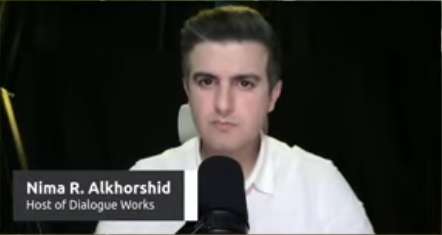
Nima chats with Laith Marouf
| Traducir—Translate! | |
| Make fonts bigger>>> | Resize text-+= |


Summary
The video features an in-depth discussion with Laith Marouf, a commentator from Beirut, on the escalating conflict involving Lebanon, Israel, Iran, and their regional proxies as of early March 2026. Laith outlines the current military developments primarily focusing on the southern Lebanon front where Hezbollah has entered the war alongside Iranian forces. He explains the strategic dynamics of the conflict, emphasizing Hezbollah’s successful resistance against Israeli incursions despite Israeli attempts to declare South Lebanon a military zone and forcibly evacuate civilians. The conversation highlights the coordinated missile and drone attacks launched by Iran and Hezbollah targeting northern and central Israel, including key military command centers and surveillance bases.
Laith further analyzes the geopolitical implications, discussing the role of Gulf Arab states, their lack of sovereignty due to American and Zionist influence, and their limited military capabilities despite propaganda about joining the war. He stresses that these regimes have been complicit in oppression and war efforts against Iran and the resistance axis. The discussion also touches on the internal unrest in Arab countries such as Bahrain, Lebanon, and Jordan, which are vulnerable to collapse amid ongoing tensions.
A significant portion of the dialogue is devoted to the broader strategic context, including economic impacts on global energy markets due to disruptions in the Strait of Hormuz and Bab el-Mandeb, potential Chinese involvement, and the existential threat posed by the possibility of nuclear escalation. Laith warns against the delusions of supremacy held by Western and Israeli leadership, which may drive reckless military decisions. He praises the faith-driven resilience of Iran and Hezbollah compared to other nations like Venezuela.
Finally, the conversation concludes with reflections on the shifting balance of power in the Middle East, the potential for regime changes in Gulf states, and the deepening crisis that threatens global stability. Laith encourages global audiences, especially in the West, to pressure their governments to avert catastrophic escalation.
Highlights
- [01:14] ⚔️ Hezbollah repels Israeli attempts to enter southern Lebanese villages despite heavy destruction and Israeli evacuation orders.
- [04:00] 🚀 Iran and Hezbollah coordinate sustained missile and drone attacks on northern and central Israel, targeting military command centers.
- [07:45] 🛡️ Israel rushed to deploy 100,000 reserve troops to northern borders in anticipation of Hezbollah’s ground intervention.
- [14:05] 🔥 The war is expected to be prolonged, with the Axis of Resistance committed to eradicating the Zionist presence in Palestine and expelling American forces.
- [18:13] 💣 Gulf Arab states are puppet regimes deeply complicit in oppression and war efforts against Iran, lacking real sovereignty.
- [24:10] 🌍 The artificial division of Gulf countries is criticized, advocating for a unified Arab nation to resist imperialism.
- [45:57] ⛽ Global energy markets face severe disruption due to potential closure of strategic maritime chokepoints controlled by resistance forces.
Key Insights
- [01:46] ⚔️ Hezbollah’s military capability remains formidable despite Israeli attempts to dismantle its infrastructure; their resistance is based not only on military strength but ideological and religious motivation, which sustains morale and combat effectiveness. This reflects the asymmetric nature of the conflict where conventional military superiority does not guarantee victory.
- [04:37] 🚀 The collapse of Israel’s northern air defenses, as evidenced by drones and missiles penetrating with ease, signifies a critical vulnerability in Israeli military strategy. This erosion of air superiority could alter the operational calculus for both sides and embolden resistance forces to increase attacks on Israeli urban and strategic centers.
- [07:45] 🛡️ Israel’s massive mobilization of reservists underscores the threat perceived from Hezbollah’s ground operations. This deployment reflects anxiety over losing control of northern borders and the potential for a protracted multi-front war that strains Israeli military logistics and manpower.
- [14:44] 🔥 The war’s duration is projected to be months-long, driven by a profound ideological commitment to dismantle the Zionist state and expel Western influence. This contrasts sharply with Israeli and Western media narratives expecting a short conflict, highlighting a disconnect in understanding the resilience and strategic patience of the Axis of Resistance.
- [18:13] 💣 The Gulf Cooperation Council (GCC) states are portrayed as vassal puppets whose military and political autonomy is compromised by Western and Israeli influence. Their limited direct military role and reliance on mercenaries reveal the fragility and artificial nature of these regimes, which undermines their credibility and longevity.
- [24:10] 🌍 The critique of the constructed nature of Gulf states calls for a historical and tribal realignment into a unified Arab nation. Such unity is proposed as essential for resisting imperial and Zionist domination, emphasizing how colonial legacies continue to shape regional instability.
- [45:57] ⛽ The disruption of global energy supply chains due to control over the Strait of Hormuz and Bab el-Mandeb could trigger economic crises in Europe, Asia, and beyond. This elevates the conflict from a regional war to a global economic threat, potentially drawing in powers like China and escalating the geopolitical stakes.
- [31:45] ☢️ The nuclear threat looms large, with Israeli and American leadership’s ideological delusions increasing the risk of catastrophic escalation. Iran’s restraint in avoiding attacks on nuclear-powered vessels reflects a rational strategic calculus to avoid humanitarian disaster, but the unpredictability of the opposing side’s leadership presents a grave danger.
- [36:03] ⚠️ The vulnerability of pro-Western regimes in Jordan, Bahrain, and Lebanon to collapse under pressure from resistance forces indicates an imminent potential for regime change. This could dramatically reshape the political landscape of the Middle East, effectively ending many puppet governments and altering alliances.
- [41:23] 🎭 The emergence of unexpected cultural and political voices, such as Egyptian actor Amir Wakid, who openly supports the resistance, highlights a widening leadership vacuum in the Arab Sunni world. This social and political vacuum could pave the way for new forms of grassroots leadership aligned with anti-imperialist and anti-Zionist causes.
- [49:37] 💧 Water and food security in Gulf countries are precarious, relying heavily on imports and desalination, which could become targets or suffer collateral damage in the conflict. This adds an additional humanitarian and strategic layer to the war, threatening civilian populations and destabilizing these regimes further.
- [50:12] 🏗️ Iran’s destruction of the causeway between Bahrain and Saudi Arabia aims to disrupt Saudi reinforcements and control over Bahrain, where a majority Shia population resists the ruling Sunni monarchy. This highlights Iran’s strategic use of infrastructure targeting to support allied populations and destabilize hostile regimes.
This comprehensive overview captures the military, political, economic, and social dimensions of the ongoing conflict as explained by Laith Marouf, providing a nuanced understanding of the war’s implications for the Middle East and beyond.
 BEFORE you leave, PLEASE pay attention to this alert.
[t4b-ticker id="1"]
Print this article [bws_pdfprint display=’print’]
 This work is licensed under a Creative Commons Attribution-NonCommercial 4.0 International License •
ALL CAPTIONS AND PULL QUOTES BY THE EDITORS NOT THE AUTHORS