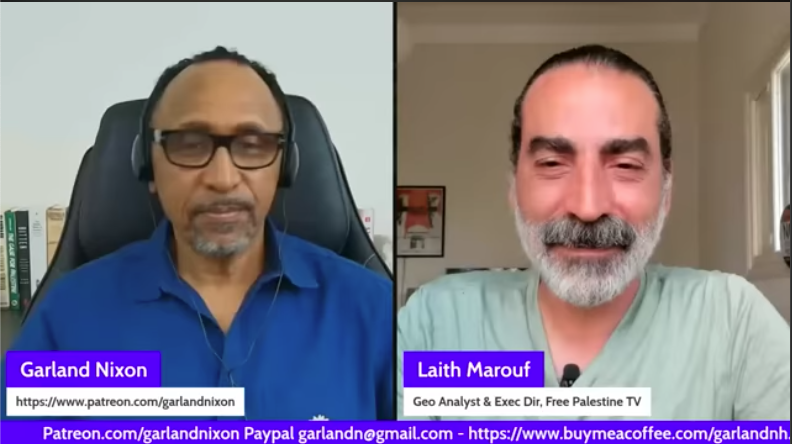
Garland Nixon
CHATS WITH
Laith Marouf

MIDDLE EAST IN DEPTH W/LAITH MAROUF - IRAN STRIKES & SAYS "FULLY PREPARED FOR PROLONGED WAR"
Summary
The video discussion between Garland Nixon and Laith Marouf centers on the ongoing regional conflict in West Asia, focusing on the shifting power dynamics involving Iran, Israel, the United States, and the broader Axis of Resistance. Laith highlights the unprecedented shift in Iran’s military posture since the Islamic Revolution of 1979, with Iran actively and offensively targeting Israel to defend its allies like Lebanon and Yemen. The conflict dynamics reveal that Israel and the U.S. empire’s dominance in the region is declining; Israel is militarily strained, with severe losses in Lebanon due to powerful resistance tactics such as advanced FPV drones and precision targeting of commanders. Iran and its allies are employing an integrated war strategy combining military, economic, and information warfare, creating a multifaceted resistance against Western imperial power. This integration has disoriented Western strategists, who traditionally relied on segmented approaches.
Marouf also discusses the cultural and historical legacies that empower Iran and its allies, citing deep-rooted institutional memory and historical identity that sustain long-term resistance efforts. The Axis of Resistance has innovated militarily and technologically, overcoming the West’s formidable projection of air and naval power, notably through hypersonic missiles, drones, and naval blockades.
The wider geopolitical implications extend beyond the battlefield. The conflict exposes the imperial propaganda’s failure and is shifting public opinion globally, increasing sympathy for Palestine and resistance forces. Economically, Iran’s strategic moves such as closing strategic waterways impose costs not just regionally but also globally, potentially fueling dissent within Western populations. These internal crises in Western societies challenge the sustainability of the empire’s interventions and support for Israel.
Finally, Garland and Laith emphasize the importance of independent media like freepalestine.video, which provides uncensored frontline reports to a global audience, countering the dominant narratives often presented by mainstream media. The discussion concludes on an acknowledgement that this protracted conflict will likely persist as a low-intensity but sustained “hot ceasefire” with periodic escalations, reflective of the new power realities in the region.
Highlights
- [04:14] 🔥 Iran’s first offensive attack since 1979 marks a strategic shift in using force beyond self-defense.
- [06:15] ⚔️ The power balance in West Asia is reversing; Iran now deters attacks rather than merely responding.
- [10:17] 🚀 Israeli air defenses are overstretched and ineffective against Iranian missile salvos and FPV drones.
- [16:43] 🛡️ Hegemony relies on narrative backed by real power; Iran’s defiance undermines Western dominance.
- [22:20] 💥 The Axis of Resistance’s innovative military tactics have disrupted 600 years of Western power projection.
- [38:15] 🎯 Hezbollah’s precision targeting of Israeli commanders highlights advanced intelligence and battlefield control.
- [50:37] 🌍 Integrated Iranian strategy blends military, economic, and informational warfare to destabilize Western powers.
Key Insights
[04:14] 🔥 Iran’s Offensive Breakthrough: Since the 1979 Islamic Revolution, Iran had strictly engaged in defensive warfare. This recent offensive attack against Israel, aimed at defending Lebanon, signals a profound shift in Iranian military doctrine. It indicates Iran’s confidence in power projection and its willingness to escalate proactively rather than reactively. This alters the strategic calculus for all actors in the region, transitioning from reactive conflict management to preemptive deterrence.
[06:15] ⚔️ Shift in Regional Power Dynamics: The dialogue illustrates a reversal in deterrence mechanisms: Iran now openly warns that any attack will lead to a credible, forceful response, marking a departure from the pre-2010 era where the U.S. and Israel assumed near-immunity from retaliatory strikes. This power shift is not just military but symbolic, undermining decades of Western and Israeli psychological dominance in the region. It instills new regional norms where Iran and its allies exercise unprecedented freedom of action.
[10:17] 🚀 Critical Weakness in Israeli Air Defense: Despite rhetorically boasting about missile interception capabilities, Israel’s Iron Dome and related systems are unable to neutralize massed missile salvos effectively, especially against sophisticated Iranian ballistic missiles and drones. This exposes a significant vulnerability that curtails Israel’s ability to conduct large-scale offensive operations or maintain prolonged conflict without substantial external support, thereby increasing its dependence on U.S. military resupply and intelligence.
[16:43] 🛡️ Narrative as Foundation of Hegemony: The conversation emphasizes that empire and hegemony rely heavily on the narrative of invincibility enforced by displays of power. Iran’s defiant stance disrupts this narrative, demonstrating that a seemingly weaker nation can resist and even dominate by refusing to submit. This psychological challenge to Western supremacy can inspire other marginalized groups and states, further fracturing imperial influence.
[22:20] 💥 Technological and Tactical Innovation by Resistance: The Axis of Resistance groups have capitalized on innovative tactics like multi-dimensional warfare, hypersonic and multi-warhead missiles, precision FPV drones, and underground combat techniques that neutralize technologically superior but less adaptable Western forces. By integrating asymmetric warfare with advanced technology, these groups undermine Western air and naval dominance, remake battlefield dynamics, and prolong conflict sustainability despite resource imbalances.
[38:15] 🎯 Precision Targeting and Intelligence Superiority: Hezbollah’s ability to pinpoint Israeli commanders and key military assets in real-time indicates a sophisticated intelligence network and battlefield surveillance unmatched on the Israeli side. This technological edge enables targeted assassinations and disruption of command structures, severely degrading Israeli operational effectiveness and morale. It also reflects a broader democratization of advanced warfare technology away from traditional global powers.
[50:37] 🌍 Comprehensive Integrated Warfare Strategy: Iran’s approach melds military action with economic warfare—such as blockading strategic straits—and information warfare, exemplified by cultural and propaganda tools like the LEGO videos addressing Western oppressed classes. This holistic strategy confuses and outmaneuvers traditional Western compartmentalized responses, which tend to separate military, economic, and diplomatic efforts. It portends a new model of resistance warfare with wide-ranging impacts stretching beyond conventional battlefields to political and social spheres worldwide.
Additional Context
Iran’s and the Axis of Resistance’s institutional memory and historic-cultural identity significantly bolster their resilience and long-term strategy. Unlike many post-colonial states fragmented by superpower meddling, Iran benefits from relatively stable institutions developed over decades, enabling accumulated experience and innovation over multi-generational horizons. This institutional robustness supports not only military innovation but also socio-political cohesion critical for sustained conflict engagement.
In the economic realm, closing the Strait of Hormuz and potentially Bab al-Mandeb represents leveraging geographic chokepoints as weapons of economic disruption. This inflicts far-reaching damage on global trade and energy supply lines, thereby exerting pressure not only on regional adversaries but also on Western economies, potentially catalyzing domestic opposition to prolonged conflict.
Culturally, Iran’s narrative invoking the Persian Empire’s legacy and intertwined history with Lebanese Shia demonstrates the deep ideological roots motivating its proxy support and military alliances. This narrative solidifies popular support domestically and regionally, enhancing the legitimacy of the Axis of Resistance beyond mere geopolitical pragmatism.
Conclusion
The discussion between Garland Nixon and Laith Marouf conveys a complex, evolving conflict in West Asia, highlighting a decisive shift away from U.S.-Israeli hegemony toward a multipolar regional balance dominated by the Axis of Resistance led by Iran. The integration of military innovation, strategic economic measures, sophisticated information warfare, and deep historical-cultural legitimacy coalesce to create a resilient and adaptive opposition that has exposed vulnerabilities in Western and Israeli power structures. This recalibration dramatically changes regional security paradigms and carries significant global political and economic implications. The conflict is projected to continue as a “hot ceasefire,” with intermittent escalations, reflecting a new era of protracted asymmetric warfare that challenges traditional notions of empire and dominance.