Sunday, July 5 2026 - Welcome • Bienvenidos • Bienvenu
ABSOLUTE MUST WATCH: Richard Wolff & Michael Hudson: Iran Just Shattered America’s...
Trump’s Great American State Fair is a Potemkin Village for Rubes
Trump’s disastrous speech at Mt. Rushmore
The Wake
Scott Ritter: Iran SMASHES Trump’s Bluff, Putin’s New War SHOCKS NATO
Amb. Chas Freeman: Hezbollah Responds Hard to Israel – IDF NOW Prepares...
Prof. Ted Postol: “It’s Over”: Israel Faces Total Collapse if War Escalates
Europe Continues Self-Harming
Why the US Lost More Than a War Against Iran | Radhika...
IMPERIALISM: DECADENT & DOOMED W/JOTI BRAR EP 58 – EU GOVERNMENTS FIGHT...
  • HOME
  • ESSENTIAL
  • MYTH-FREE HISTORY WITH JACQUES PAUWELS
  • MUST VIDEO
  • BLOWBACK
  • NATURE
The Greanville Post
Money for Crimes? Oh. YEA. Money for the people? Hell NO. That's American democracy for you.
  • HOME
  • ESSENTIAL
  • MYTH-FREE HISTORY WITH JACQUES PAUWELS
  • MUST VIDEO
  • BLOWBACK
  • NATURE
Home Author
Author

Chris Hedges

  • Author Profile
  • Posts by the Author
  • America’s Suicide Pact
  • How Israel Convinced Trump to Wage War Against Iran (w/ Max Blumenthal)
  • Can Israel & the U.S. Sustain Iran’s Military Power? (w/ Alastair Crooke) | The Chris Hedges Report
  • America is a Banana Republic – Read by Eunice Wong
  • Chris Hedges: ‘Requiem for Gaza’ – Edward Said Memorial Lecture 2025
  • It’s Time to Fight Back Against Trump’s Fascist Regime (w/ Ralph Nader)
Chris Hedges

Christopher Lynn Hedges (born September 18, 1956) is an American journalist, author, commentator and Presbyterian minister. He writes a weekly column at Scheerpost and hosts the program The Chris Hedges Report on The Real News Network. In his early career, Hedges worked as a freelance war correspondent in Central America for The Christian Science Monitor, NPR, and Dallas Morning News. Hedges reported for The New York Times from 1990 to 2005,[1] and served as the Times Middle East Bureau Chief and Balkan Bureau Chief during the wars in the former Yugoslavia. In 2001, Hedges contributed to The New York Times staff entry that received the 2002 Pulitzer Prize for Explanatory Reporting for the paper's coverage of global terrorism.Hedges produced a weekly column for Truthdig for 14 years until the outlet's hiatus in 2020. His books include War Is a Force That Gives Us Meaning (2002), a finalist for the National Book Critics Circle Award for Nonfiction; American Fascists: The Christian Right and the War on America (2007); Death of the Liberal Class (2010); and Days of Destruction, Days of Revolt (2012), written with cartoonist Joe Sacco. Since 2022 Hedges had hosted his own topical news commentary program (web series) on The Real News Network, The Chris Hedges Report.

Fire Weather

by Chris Hedges Published: January 23, 2025
written by Chris Hedges 10 minutes read
Please make sure these dispatches reach as many readers as possible. Share with kin, friends and workmates and ask them to do likewise.

Facilitated by Mark Taylor
THE CHRIS HEDGES REPORT
Chris Hedges The Chris Hedges Report

The wildfires in California replicate the massive fire storms in the boreal forest in Canada and Siberia, the lungs of the earth. Our addiction to fossil fuel has ignited an age of fire.


A final toast, by Mr Fish


The apocalyptic wildfires that have erupted in the boreal forest in Siberia, the Russian Far East and Canada, climate scientists repeatedly warned, would inevitably move southwards as rising global temperatures created hotter, more fire-prone landscapes. Now they have. The failures in California, where Los Angeles has had no significant rainfall in eight months, are not only failures of preparedness — the mayor of Los Angeles, Karen Bass, decreased funds for the fire department by $17 million — but a failure globally to halt the extraction of fossil fuel. The only surprise is that we are surprised. Welcome to the age of the “Pyrocene” where cities burn and water does not come out of the hydrants.

The boreal forest is the largest forest system on earth. It circumnavigates the Northern Hemisphere. It stretches across Canada and Alaska. It travels through Russia where it is known as “the taiga.” It reaches into Scandinavia, picks up again in Iceland and Newfoundland, and moves westward across Canada, completing the circle. The boreal forest has more sources of freshwater than any other biome, including the Amazon Rainforest. It is the lungs of the earth, able to store 208 billion tons of carbon, or 11 percent of the world’s total. Yet it has been steadily degraded, assaulted by deforestation and the extraction of the tar sands in Alberta, Canada — which produces 58 percent of Canada’s oil and is the U.S.’s largest source of imported oil — man-made drought and rising temperatures from carbon emissions.

Almost two million acres of boreal forest have been destroyed by extraction industries and timber companies. They have scraped away the topsoil and left behind poisoned wastelands. The production and consumption of one barrel of tar sands crude oil releases between 17 and 21 percent more carbon dioxide than the production and consumption of a standard barrel of oil. The oil is transported thousands of miles to refineries as far away as Houston, through pipelines and in tractor-trailer trucks or railroad cars.

This vast assault, perhaps the largest such project in the world, has accelerated the release of carbon emissions that, unchecked, will render the planet uninhabitable for humans and most other species. There is a direct line from the destruction of the boreal forest and the raging wildfires in California.

The boreal forest system has, for over a decade, seen some of the planet’s worst wildfires, including the 2016 Wood Buffalo (aka Fort McMurray) wildfire, which consumed nearly 1.5 million acres and which was not fully extinguished for 15 months. The monster wildfire, which was, according to journalist John Vaillant, about 950 degrees Fahrenheit — hotter than Venus — destroyed thousands of homes and forced the evacuation of 88,000 people. The fire ripped into Fort McMurray with such ferocity and speed that residents barely escaped in their cars as buildings and houses were instantly vaporized. Flames shot 300 feet into the air. Fireballs rolled up into the smoke column for another 1,000 feet. It was a harbinger of the new normal.

More than 100 climate scientists have called for a moratorium on the extraction of tar sands oil. Former NASA scientist James Hansen warnedover a decade ago that if the tar sands oil is fully exploited, it will be “game over” for the planet. He has also called for the CEOs of fossil fuel companies to be tried for “high crimes against humanity and nature.”

It is hard to get a sense of the scale of the destruction unless you visit, as I did in 2019, the Alberta tar sands. I spent time with the 500 inhabitants of Beaver Lake, the Cree reserve, most of whom are impoverished and live in small, boxy prefabricated houses. They are victims of the latest iteration of colonial exploitation, one centered on the extraction of oil that is poisoning the water, soil and air around them.

Beaver Lake, as I wrote at the time, is surrounded by over 35,000 oil and natural gas wells and thousands of miles of pipelines, access roads and seismic lines. The area also contains the Cold Lake Air Weapons Range, which has appropriated huge tracts of traditional territory from the native inhabitants to test weapons. Giant processing plants, along with gargantuan extraction machines, including bucket wheelers that are over half a mile long and draglines that are several stories high, ravage hundreds of thousands of acres.

“These stygian centers of death belch sulfurous fumes, nonstop, and send fiery flares into the murky sky,” I wrote. “The air has a metallic taste. Outside the processing centers, there are vast toxic lakes known as tailings ponds, filled with billions of gallons of water and chemicals related to the oil extraction, including mercury and other heavy metals, carcinogenic hydrocarbons, arsenic and strychnine. The sludge from the tailings ponds is leaching into the Athabasca River, which flows into the Mackenzie, the largest river system in Canada.”

Nothing in this moonscape, by the end, will support life. “The migrating birds that alight at the tailings ponds die in huge numbers,” I noted. “So many birds have been killed that the Canadian government has ordered extraction companies to use noise cannons at some of the sites to scare away arriving flocks. Around these hellish lakes, there is a steady boom-boom-boom from the explosive devices.”

The water in much of northern Alberta is no longer safe for human consumption. Drinking water has to be trucked in for the Beaver Lake reserve. Cancer and respiratory diseases are rampant.

John Vaillant, author of “Fire Weather: On the Front Lines of a Burning World” describes the tars sands landscape:

…mile upon mile of black and ransacked earth pocked with stadium-swallowing pits and dead, discolored lakes guarded by scarecrows in cast-off rain gear and overseen by flaming stacks and fuming refineries, the whole laced together by circuit board mazes of dirt roads and piping, patrolled by building-sized machines that, enormous as they are, appear dwarfed by the wastelands they have made. The tailings ponds alone cover well over a hundred square miles and contain more than a quarter of a trillion gallons of contaminated water and effluent from the bitumen upgrading process. There is no place for this toxic sludge to go except into the soil, or the air, or, if one of the massive earthen dams should fail, into the Athabasca River. For decades, cancer rates have been abnormally high in the downstream community.

The out-of-control fire storms and blizzard of swirling embers, he chronicles, are what we are witnessing in California, a state which normally experiences wildfires during June, July, and August. Neighborhoods burn “to their foundations beneath a towering pyrocumulus cloud typically found over erupting volcanoes” and fires generate “hurricane-force winds and lightning that ignites fires miles away.”

These cyclone-like fires resemble the firebombing of Hamburg or Dresden during World War Two, rather than forest fires of the past. They are almost impossible to control.

You can see an interview I did with Vaillant here.

“Fire wants to climb,” Vaillan told me. “[W]e all know heat rises. It’s rising up into the treetops and it’s sucking in wind from underneath because it needs oxygen all the time. So the fire, it’s helpful to think of it as a breathing entity. It’s pulling oxygen in from all around and rising into the architecture of the trees and so there’s this rushing chimney-like effect. Where the fire is in a way happiest, most energetic, most charismatic, and dynamic is up in the treetops, and then it’s pulling in wind from down below. As that heat builds, as the whole tree is engaged, you have this increasing heat and increasing wind which then builds on itself so it becomes almost a self-perpetuation machine. If you have hot enough, dry enough, [and] windy enough conditions, those flames will then begin to leap from treetop to treetop.”

The heat releases vapor, hydrocarbons from the fuels around it, which is why we see “explosive fireballs and massive surges of flame coming out of big boreal fires because that’s the superheated vapor rising up and then ignited. Imagine an empty gas can — even though there might not be a lot of liquid in it, it will still explode in a spectacular fashion. Well, that’s really what the fire is enabling in the forest, for all those hydrocarbons to release in this gaseous cloud that then ignites. That’s when you see, especially a boreal fire, in full run. It’s called a Rank 6. It’s comparable to a Category 5 hurricane.”

When houses and buildings become very hot they, like trees, release hydrocarbons. Vaillant calls modern buildings “incendiary devices.” They are packed with petrochemicals and often sheathed with petroleum products like vinyl siding and tar shingles. When fires push temperatures to over 1,400 degrees the vinyl siding, tar shingles, glues and laminates in the plywood vaporize.

“The modern home is in fact more flammable than a log cabin or a 19th-century home that’s made mostly out of wood, mostly furnished with cotton-stuffed furniture or horse hair stuffed furniture, things that we think of as antiques now,” Vaillant said. “But the modern home is really in a way a giant gas can and we don’t think of that when it’s 75 degrees. But when it’s 300 degrees because of the radiant heat coming off a fire, or 1,000 degrees because of the radiant heat coming off a boreal wildfire, it turns into something completely different.”

“All of us alive today have grown up in the petroleum age,” Vaillant said. “It feels normal to us the way I think people smoking on airplanes and in doctors’ waiting rooms felt normal to people in the 1950s. We’re completely habituated to it, to the point that it’s invisible to us. But if you really stop and think about how petroleum is rendered and what it in fact is, it’s literally toxic at every stage of its life. From the moment it’s drawn from the ground through the incredibly polluting refining process, into our cars and where it’s burned…Petroleum will kill you in every form, whether as a liquid, as a toxic spill, as a gas, as an emission. It’s strange to think that we have surrounded ourselves and persuaded ourselves that this profoundly toxic substance is an ally to us and an enabler of this wonderful lifestyle that we live that is now being compromised in measurable and visible ways by that very energy source.”

We have harnessed the concentrated energy of 300 million years and set it alight. We are addicted to fossil fuels. But it is a suicide pact. We ignore the freakish weather patterns and disintegration of the planet, retreating into our electronic hallucinations, pretending the inevitable is not inevitable. This vast cognitive dissonance, fed to us by mass culture, makes us the most self-deluded population in human history. The cost of this self-delusion will be mass death. The devastation in California is the harbinger of the apocalypse.


Go to top
The Chris Hedges Report is a reader-supported publication. To receive new posts and support my work, consider becoming a free or paid subscriber.

Print this article [bws_pdfprint display=’print’]

The views expressed herein are solely those of the author and may or may not reflect those of The Greanville Post, although, if we publish them, we obviously find them noteworthy and valuable. 

Creative Commons LicenseThis work is licensed under a Creative Commons Attribution-NonCommercial 4.0 International License • 
ALL CAPTIONS AND PULL QUOTES BY THE EDITORS NOT THE AUTHORS
Published: January 23, 2025 0 comments
0 FacebookTwitterPinterestEmail

HEDGES: The Ceasefire Charade. Why the new peace may not hold

by Chris Hedges Published: January 16, 2025
written by Chris Hedges 60 Mins • MUST WATCH read
Chris Hedges MIT
Please make sure these dispatches reach as many readers as possible. Share with kin, friends and workmates and ask them to do likewise.

Chris Hedges
THE CHRIS HEDGES REPORT

<• Choose your  language • Elija su idioma
Resize text-+=


America's Academic Gulag (w/ MIT Student Activists) | The Chris Hedges Report

The Chris Hedges YouTube

Jan 15, 2025
“You can't just sit there and build drones and not talk about who it's serving and who does it help,” says Richard Solomon, PhD student at the Massachusetts Institute of Technology and member of the Coalition for Palestine at MIT. On this episode of The Chris Hedges Report, Solomon and fellow MIT PhD student Prahlad Iyengar detail their battle against the historic institution’s active participation in the genocide in Gaza. Their story exemplifies the repression students face across the country who dare question how their work and labor are used to advance the illegal and morally reprehensible goals of the Israeli military.  The students note that while the struggle against Israel may seem hopeless, the crimes of the Zionist leave no room for deserting the effort. Further, Israel is actually a fragile state, unlikely to survive without plenty of outside support. And under conditions of constant warfare, not to mention global condemnation, few Jews may choose to seek a permanent home in the embattled entity.


The question is how to keep MIT and similar institutions from helping the war machine, the Palestine genocide, and similar imperial crimes.


   SPECIAL FEATURE   


The Ceasefire Charade

Israel plays a cynical game. It makes phased agreements with the Palestinians that ensure it immediately gets what it wants. It then violates every subsequent phase and reignites its military assault.

 
CHRIS HEDGES
JAN 16, 2025
Piece Plan - by Mr. Fish

Piece Plan - by Mr. Fish 


Israel, going back decades, has played a duplicitous game. It signs a deal with the Palestinians that is to be implemented in phases. The first phase gives Israel what it wants — in this case the release of the Israeli hostages in Gaza — but Israel habitually fails to implement subsequent phases that would lead to a just and equitable peace. It eventually provokes the Palestinians with indiscriminate armed assaults to retaliate, defines a Palestinian response as a provocation and abrogates the ceasefire deal to reignite the slaughter.

If this latest three-phase ceasefire deal is ratified — and there is no certainty that it will be by Israel — it will, I expect, be little more than a presidential inauguration bombing pause. Israel has no intention of halting its merry-go-round of death.

The Israeli cabinet has delayed a vote on the ceasefire proposal while it continues to pound Gaza. At least 81 Palestinians have been killed in the last 24 hours.

The morning after a ceasefire agreement was announced, Israeli Prime Minister Benjamin Netanyahu accused Hamas of reneging on part of the deal “in an effort to extort last minute concessions.” He warned that his cabinet will not meet “until the mediators notify Israel that Hamas has accepted all elements of the agreement.”

Hamas dismissed Netanyahu’s claims and repeated their commitment to the ceasefire as agreed with the mediators.

The deal includes three phases. The first phase, lasting 42 days, will see a cessation of hostilities. Hamas will release some Israeli hostages – 33 Israelis who were captured on Oct. 7, 2023, including all of the remaining five women, those aged above 50, and those with illnesses – in exchange for up to 1,000 Palestinians imprisoned by Israel.

The Israeli army will pull back from the populated areas of the Gaza Strip on the first day of the ceasefire. On the 7th day, displaced Palestinians will be permitted to return to northern Gaza. Israel will allow 600 aid trucks with food and medical supplies to enter Gaza daily.

The second phase, which begins on the 16th day of the ceasefire, will see the release of the remaining Israeli hostages. Israel will complete its withdrawal from Gaza during the second phase, maintaining a presence in some parts of the Philadelphi corridor, which stretches along the eight-mile border between Gaza and Egypt. It will surrender its control of the Rafah border crossing into Egypt.

The third phase will see negotiations for a permanent end of the war.

But it is Netanyahu’s office that appears to have already reneged on the agreement. It released a statement rejecting Israeli troop withdrawal from the Philadelphi Corridorduring the first 42-day phase of the ceasefire. “In practical terms, Israel will remain in the Philadelphi Corridor until further notice," while claiming the Palestinians are attempting to violate the agreement. Palestinians throughout the numerous ceasefire negotiations have demanded Israeli troops withdraw from Gaza. Egypt has condemned the seizure of its border crossings by Israel.

The deep fissures between Israel and Hamas, even if the Israelis finally accept the agreement, threaten to implode it. Hamas is seeking a permanent ceasefire. But Israeli policy is unequivocal about its “right” to re-engage militarily. There is no consensus about who will govern Gaza. Israel has made it clear the continuance of Hamas in power is unacceptable. There is no mention of the status of the United Nations Relief and Works Agency for Palestine Refugees in the Near East (UNRWA), the U.N. agency that Israel has outlawed and that provides the bulk of the humanitarian aid given to the Palestinians, 95 percent of whom have been displaced. There is no agreement on the reconstruction of Gaza, which lies in rubble. And, of course, there is no route in the agreement to an independent and sovereign Palestinian state.

Israeli mendacity and manipulation is pitifully predictable.

The Camp David Accords, signed in 1979 by Egyptian president Anwar Sadat and Israeli prime minister Menachem Begin, without the participation of the Palestine Liberation Organization (PLO), normalized diplomatic relations between Israel and Egypt. But the subsequent phases, which included a promise by Israel to resolve the Palestinian question along with Jordan and Egypt, permit Palestinian self-governance in the West Bank and Gaza within five years, and end the building of Israeli colonies in the West Bank, including East Jerusalem, were never honored.

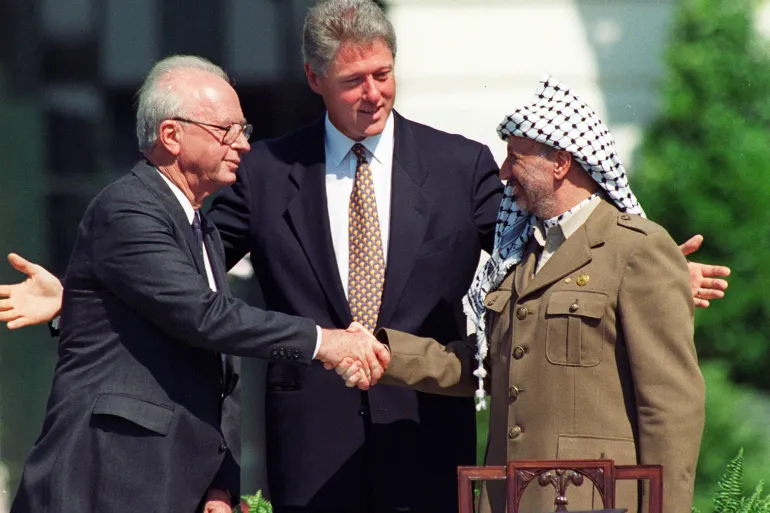
Or take the 1993 Oslo Accords. The agreement, signed in 1993, which saw the PLO recognize Israel’s right to exist and Israel recognize the PLO as the legitimate representatives of the Palestinian people, and Oslo II, signed in 1995, which detailed the process towards peace and a Palestinian state, was stillborn. It stipulated that any discussion of illegal Jewish “settlements” was to be delayed until “final’ status talks, by which time Israeli military withdrawals from the occupied West Bank were to have been completed. Governing authority was to be transferred from Israel to the supposedly temporary Palestinian Authority. The West Bank was carved up into Areas A, B and C. The Palestinian Authority has limited authority in Areas A and B. Israel controls all of Area C, over 60 percent of the West Bank.


Rabin and Arafat shake hands over the "Oslo Accords". A deal that went nowhere, as planned.


The right of Palestinian refugees to return to the historic lands seized from them in 1948 when Israel was created — a right enshrined in international law — was given up by the PLO leader Yasser Arafat, instantly alienating many Palestinians, especially those in Gaza where 75 percent are refugees or the descendants of refugees. Edward Said called the Oslo agreement “an instrument of Palestinian surrender, a Palestinian Versailles” and lambasted Arafat as “the Pétain of the Palestinians.”

The scheduled Israeli military withdrawals under Oslo never took place. There was no provision in the interim agreement to end Jewish colonization, only a prohibition of “unilateral steps.” There were around 250,000 Jewish colonists in the West Bank at the time of the Oslo agreement. They have increased to at least 700,000. No final treaty was ever concluded.

The journalist Robert Fisk called Oslo “a sham, a lie, a trick to entangle Arafat and the PLO into abandonment of all that they had sought and struggled for over a quarter of a century, a method of creating false hope in order to emasculate the aspiration of statehood.”

Israeli prime minister Yitzhak Rabin, who signed the Oslo agreement, was assassinated on Nov. 4, 1995 following a rally in support of the agreement, by Yigal Amir, a far-right Jewish law student. Itamar Ben-Gvir, now Israel’s National Security Minister, was one of many rightwing politicians who issued threats against Rabin. Rabin’s widow, Leah, blamed Netanyahu and his supporters — who distributed leaflets at political rallies depicting Rabin in a Nazi uniform — for her husband’s murder.


OPERATION CAST LEAD—KILLED WHILE "MOWING THE LAWN": Israel has been at it for a long time. This young Gaza girl was killed by Israeli forces on the Gaza Strip on Day 14 of the offensive. (9 January 2009).


Israel has carried out a series of murderous assaults on Gaza ever since, cynically calling the bombardment “mowing the lawn.” These attacks, which leave scores of dead and wounded and further degrade Gaza’s fragile infrastructure, have names such as Operation Rainbow (2004), Operation Days of Penitence (2004), Operation Summer Rains (2006), Operation Autumn Clouds (2006) and Operation Hot Winter (2008).

Israel violated the June 2008 ceasefire agreement with Hamas, brokered by Egypt, by launching a border raid that killed six Hamas members. The raid provoked, as Israel intended, a retaliatory strike by Hamas, which fired crude rockets and mortar shells into Israel. The Hamas barrage provided the pretext for a massive Israeli attack. Israel, as it always does, justified its military strike on the right to defend itself.

Operation Cast Lead (2008-2009), which saw Israel carry out a ground and aerial assault over 22 days, with the Israeli air force dropping over 1,000 tons of explosives on Gaza, killed 1,385 — according to the Israeli human rights group B’Tselem — of whom at least 762 were civilians, including 300 children. Four Israelis were killed over the same period by Hamas rockets and nine Israeli soldiers died in Gaza, four of whom were victims of “friendly fire.” The Israeli newspaper Haaretz would later report that “Operation Cast Lead” had been prepared over the previous six months.

Israeli historian Avi Shlaim, who served in the Israeli military, wrote that:

the brutality of Israel’s soldiers is fully matched by the mendacity of its spokesman…their propaganda is a pack of lies…It was not Hamas but the IDF that broke the ceasefire. It did so by a raid into Gaza on 4 November that killed six Hamas men. Israel’s objective is not just the defense of its population, but the eventual overthrow of the Hamas government in Gaza by turning the people against their rulers.

These series of attacks on Gaza were followed by Israeli assaults in November 2012, known as Operation Pillar of Defense and in July and August 2014 in Operation Protective Edge, a seven week campaign that left 2,251 Palestinians dead, along with 73 Israelis, including 67 soldiers.

These assaults by the Israeli military were followed in 2018 by largely peaceful protests by Palestinians, known as The Great March of Return, along Gaza’s fenced-in barrier. Over 266 Palestinians were gunned down by Israeli soldiers and 30,000 more were injured. In May 2021, Israel killed over 256 Palestinians in Gaza following attacks by Israeli police on Palestinian worshippers at the Al-Aqsa Mosque compound in Jerusalem. Further attacks on worshippers at Al-Aqsa mosque took place in April 2023.

And then the breaching of the security barriers on Oct. 7, 2023 that enclose Gaza, where Palestinians had languished under a blockade for over 16 years in an open air prison. The attacks by Palestinian gunmen left some 1,200 Israeli dead — including hundreds killed by Israel itself — and gave Israel the excuse it had long sought to lay waste to Gaza, in its Swords of Iron War.

This horrific saga is not over. Israel’s goals remain unchanged – the erasure of Palestinians from their land. This proposed ceasefire is one more cynical chapter. There are many ways it can and, I suspect, will fall apart.

But let us pray, at least for the moment, that the mass slaughter will stop.


The Chris Hedges Report is a reader-supported publication. To receive new posts and support my work, consider becoming a free or paid subscriber.

Support my independent journalism at Substack: https://chrishedges.substack.com/ Follow me on social media: https://linktr.ee/chrishedges


A Note by the Editor
There is great and fully understandable joy at the news of a "ceasefire" in Gaza, the West Bank, and other parts where Israel has been viciously and cowardly decimating the Palestinian people. Unfortunately, we cannot join this celebration at this point. Israel—and the handmaidens of this deal, chiefly the US—are utterly dishonest and depraved players in this tragedy (as Chris Hedges carefully documents in the article above). For that reason we will wait for at least a year to break open the champagne. Meanwhile, we will try to keep our eyes open and our hopes alive. May the brave Palestinian people be spared further horrors. When it comes, their well-earned victory will be sweet.

Print this article [bws_pdfprint display=’print’]

The views expressed herein are solely those of the author and may or may not reflect those of The Greanville Post, although, if we publish them, we obviously find them noteworthy and valuable. 

Creative Commons LicenseThis work is licensed under a Creative Commons Attribution-NonCommercial 4.0 International License • 
ALL CAPTIONS AND PULL QUOTES BY THE EDITORS NOT THE AUTHORS

Published: January 16, 2025 0 comments
0 FacebookTwitterPinterestEmail

A Rogue Reporter vs. The American Empire (w/ Matt Kennard) | The Chris Hedges Report

by Chris Hedges Published: January 4, 2025
written by Chris Hedges 60 Mins / Watch • read
Matt Kennard Chis Hedges
Please make sure these dispatches reach as many readers as possible. Share with kin, friends and workmates and ask them to do likewise.

Chris Hedges
CHATS WITH
MATT KENNARD

<• Choose your  language • Elija su idioma
Resize text-+=
 

The LEAST we can do is spread the word—

A Rogue Reporter vs. The American Empire (w/ Matt Kennard) | The Chris Hedges Report

The Chris Hedges YouTube Channel

Dec 4, 2024
Support my independent journalism at Substack: https://chrishedges.substack.com/ Follow me on social media: https://linktr.ee/chrishedges
The American material life is taken for granted. Things just appear. There is no consideration for what country the Empire destroyed to fuel their cars, which people are earning pennies inside sweatshops for their clothes or how many children’s hands touched the lithium in their phone batteries fresh out of the mine. The U.S. Empire makes sure these realities are out of the public consciousness and only the shiny, finished products end up in the public view, no questions asked. Matt Kennard, founder of the independent investigative outlet Declassified UK, joins host Chris Hedges on this episode of The Chris Hedges Report to talk about his book, “The Racket: A Rogue Reporter vs The American Empire.”  What Matt eventually realised and now wishes to share is the ugly, carefully masked reality of the US empire—criminal, depraved, unfixable and morally devious. It takes a brave man indeed to make it his life's mission to expose this massive evil. 


Print this article [bws_pdfprint display=’print’]

The views expressed herein are solely those of the author and may or may not reflect those of The Greanville Post, although, if we publish them, we obviously find them noteworthy and valuable. 

Creative Commons LicenseThis work is licensed under a Creative Commons Attribution-NonCommercial 4.0 International License • 
ALL CAPTIONS AND PULL QUOTES BY THE EDITORS NOT THE AUTHORS

Published: January 4, 2025 0 comments
0 FacebookTwitterPinterestEmail

Don’t Deify Jimmy Carter

by Chris Hedges Published: December 30, 2024
written by Chris Hedges 6 minutes read
Jimmy Carter Mr Fish
Please make sure these dispatches reach as many readers as possible. Share with kin, friends and workmates and ask them to do likewise.

Chris Hedges

<• Choose your  language • Elija su idioma
Resize text-+=
 

Don't Deify Jimmy Carter
 
Jimmy Carter Mr Fish

This, That or the Other Carter - by Mr. Fish


Jimmy Carter, out of office, had the courage to call out the “abominable oppression and persecution” and “strict segregation” of Palestinians in the West Bank and Gaza in his 2006 book “Palestine: Peace Not Apartheid.” He dedicated himself to monitoring elections, including his controversial defense of the 2006 election of Hugo Chavez in Venezuela, and championed human rights around the globe. He lambasted the American political process as an “oligarchy” in which “unlimited political bribery” created “a complete subversion of our political system as a payoff to major contributors.”

But Carter’s years as an ex-president should not mask his dogged service to the empire, penchant for fomenting disastrous proxy wars, betrayal of the Palestinians, embrace of punishing neoliberal policies and his subservience to big business when he was in office.

Carter played a significant role in dismantling New Deal legislation with the deregulation of major industries including airlines, banking, trucking, telecommunications, natural gas and railways. He appointed Paul Volcker to the Federal Reserve, who, in an effort to combat inflation, drove up interest rates and pushed the U.S. into the deepest recession since the Great Depression, a move that saw the start of punishing austerity cuts. Carter is the godfather of the pillage known as neoliberalism, a pillage fellow Democrat Bill Clinton would turbo charge.

Carter fell under the disastrous influence of his Svengali-like national security adviser Zbigniew Brzezinski, a Polish exile, who rejected the Nixon-Kissinger reliance on détente with the Soviet Union. Brzezinski’s life’s mission, one that meant he saw the world in black and white, was to confront and destroy the Soviet Union along with any government or movement he deemed to be under communist influence or sympathetic to it.

Carter, under Brzezinski’s influence, walked away from the Strategic Arms Limitation Talks treaty (SALT II) with the Soviet Union, which sought to curb nuclear weapons deployment. He increased military spending. He sent military aid to the Indonesian New Order government during the Indonesian invasion and occupation of East Timor, which many have characterized as a genocide. He supported, along with the apartheid state of South Africa, the murderous counter revolutionary group, the National Union for the Total Independence of Angola (UNITA), led by Jonas Savimbi. He provided aid to the brutal Zairian dictator Mobutu Sese Seko. He supported the Khmer Rouge.

He instructed the Central Intelligence Agency to back opposition groups and political parties to bring down the Sandinista government in Nicaragua once it took power in 1979, leading under the Reagan administration to the formation of the Contras and a bloody and senseless U.S.-backed insurgency. He provided military aid to the dictatorship in El Salvador, ignoring an appeal from Archbishop Oscar Romero — later assassinated — to cease U.S. arms shipments.

He poisoned U.S. relations with Iran by backing the repressive regime of Shah Mohammad Reza Pahlavi until the last minute and then allowing the deposed Shah to seek medical treatment in New York, triggering the occupation of the U.S. Embassy in Tehran and a 444-day hostage crisis. Carter’s belligerence — he froze Iranian assets, stopped importing oil from Iran and expelled 183 Iranian diplomats from the U.S. — played into Ayatollah Khomeini’s demonization of the U.S. and calls for Islamic rule. He obliterated the credibility of Iran’s secular opposition.

Carter gave Philippine President Ferdinand Marcos, although he ruled under martial law, billions in military aid. He armed the Mujahideen in Afghanistan after the Soviet intervention in 1979, a decision that cost the U.S. $3 billion, saw the deaths of 1.5 million Afghans and led to the creation of the Taliban and Al Qaeda. The blowback from this Carter policy alone is catastrophic.

He backed the South Korean military in 1980 when it laid siege to the city of Gwangju, where protestors had formed a militia, which led to the massacre of some 2,000 people.

Finally, he sold out the Palestinians when he negotiated a separate peace deal, known as the Camp David Accords, in 1979 between Egyptian President Anwar Sadat and Israeli Prime Minister Menachem Begin. The agreement excluded the Palestine Liberation Organization from the talks. Israel never, as promised to Carter, attempted to resolve the Palestine question with Jordan and Egypt’s involvement. It never permitted Palestinian self-government in the West Bank and Gaza within five years. It did not end Israeli settlements — a refusal that led Carter to later claim Begin had lied to him. But since there was no mechanism in the agreement for enforcement, and since Carter was unwilling to defy the Israel lobby to impose sanctions on Israel, the Palestinians found themselves, once again, powerless and abandoned.

Carter, to his credit, did appoint the civil rights activist Patricia Derian as his Assistant Secretary of State for Human Rights and Humanitarian Affairs, leading to the blocking of loans and reduction in military aid to the military junta in Argentina during the Dirty War, restrictions the Reagan administration removed. Derian’s commitment to human rights was genuine. She supported Philippines leader Benigno S. Aquino Jr. and the South Korean dissident and former president Kim Dae-jung. Carter allowed her to anger a few of our most repressive allies. But his human rights policy was primarily designed to back democratic dissidents { CODE! You mean CIA/NED stooges and assets like Lech Walesa} and worker movements in Central and Eastern Europe, especially Poland, in an effort to weaken the Soviet Union.

Carter had a decency most politicians lack, but his moral crusades, which came once he was out of power, seem like a form of penance. His record as president is bloody and dismal, although not as bloody and dismal as the presidents who followed. That’s the best we can say of him.


The Chris Hedges Report is a reader-supported publication. To receive new posts and support my work, consider becoming a free or paid subscriber.


TGP rating 
Let's give this article a B


Print this article [bws_pdfprint display=’print’]

The views expressed herein are solely those of the author and may or may not reflect those of The Greanville Post, although, if we publish them, we obviously find them noteworthy and valuable. 

Creative Commons LicenseThis work is licensed under a Creative Commons Attribution-NonCommercial 4.0 International License • 
ALL CAPTIONS AND PULL QUOTES BY THE EDITORS NOT THE AUTHORS
Published: December 30, 2024 0 comments
0 FacebookTwitterPinterestEmail

How Wokeness Kills Class Politics and Empowers Empire (w/ Christian Parenti) | The Chris Hedges Report

by Chris Hedges Published: October 5, 2024
written by Chris Hedges 75 Mins read
Please make sure these dispatches reach as many readers as possible. Share with kin, friends and workmates and ask them to do likewise.

The Chris Hedges Report


Resize text-+=


The Chris Hedges YouTube Channel

How Wokeness Kills Class Politics and Empowers Empire (w/ Christian Parenti) | The Chris Hedges Report
CHRIS HEDGES
SEP 25, 2024

This interview is also available on Rumble and podcast platforms.

Oftentimes the idea of “wokeness” or “woke” ideology, whether calling it as such or acknowledging its existence, can be thought of as coinage of the right wing. Christian Parenti, professor at John Jay College, journalist and author, joins host Chris Hedges on this episode of The Chris Hedges Report to make the case that what he and many others define as “woke” is actually a weapon used to further suppress marginalized people, prevent the awareness of class politics and class struggle and further divide the working class.

“What a lot of the story comes down to,” Parenti tells Hedges, “[is] detaching class struggle from cultural struggles. And what woke is, is the continuation of all of the goals of the Enlightenment left, but in the realm of culture war, in the realm of cultural struggles, and that material conflict is increasingly elided and erased.”

Although the ideas behind “wokeness” attempt to foster a more egalitarian and inclusive society, it has been corrupted by the system itself and thus weaponized. “Woke ideology, wokeness, serves as an armory, an arsenal for the professional managerial class to draw weaponry and armor from in their increasingly Hobbesian war of all against all for posts,” Parenti remarks. For him, this is crucial to understanding the material incentive behind what wokeness stands for now as it continually appears in corporate and academic sectors. 

“There are real material stakes for people, and one way a professional manager/member of this class can get ahead is by using these tropes to advance themselves and defend themselves,” he argues.

Its prevalence in today’s society, Parenti asserts, has cynically manifested as a reaction to corporations historically having to shell out millions of dollars in lawsuit settlements for discrimination and unethical cultural practices. Nowadays, in contrast, companies are very careful and even promote this ideology to appeal to marginalized groups—and ultimately raise their bottom line. 

Enterprises like the Ford Foundation or the Rockefeller Foundation, Parenti argues, may present themselves as proponents of social justice but in reality “[they] are not established to and are not seeking to overthrow, undo or transform American capitalism. They are fundamentally about legitimizing and perpetuating it,” he says. It turns out that woke ideology is only their latest tool in doing so.


Thanks for reading The Chris Hedges Report! This post is public so feel free to share it.

Share


Host: Chris Hedges
Producer: Max Jones
Intro: Diego Ramos
Crew: Diego Ramos, Sofia Menemenlis and Thomas Hedges
Transcript: Diego Ramos

The Chris Hedges Report is a reader-supported publication. To receive new posts and support my work, consider becoming a free or paid subscriber. 


Transcript

Chris Hedges  

Woke ideology is pervasive in liberal institutions, especially universities, but does it further and hamper the liberal values and inclusiveness it purports to advocate? It seeks to transform society through what Christian Parenti calls the moralizing micropolitics of politicized etiquette. It is fixated on the politics of language and symbols, the sins of cultural appropriation and misnaming and calls for centering historically oppressed groups. It advocates identity politics, prioritizing race, gender, indigeneity, sexual orientation, physical disability, mental health diagnoses, immigration status and socioeconomic status over political content. Woke discourse, Parenti writes, “is imbued with a therapeutic mentality expressed in safety-obsessed incantations about harm, trauma, healing, care and doing the work. Personal struggles take precedent over political struggles. But, as Parenti argues, wokeness is deeply anti-intellectual, endowed with a moralizing that draws a distinction between the politically clean and unclean, friend and enemy, good and evil.  It demands the censoring and cancelling of the politically incorrect, along with books and ideas. Woke culture has displaced old-fashioned universalist class politics – the fundamental struggle over who produces wealth, how and for whom.  It not only divides the working class, but often serves, as Parenti points out, the interests of the ruling class. Joining me to discuss woke culture is Christian Parenti, Professor of Economics at John Jay College, City University of New York, and author of the recent article “The Cargo Cult of Woke.”

Okay, let's begin with the title, Christian. “The Cargo Cult of Woke.” Woke, where participants believe that social justice and perhaps even revolution can be achieved through the performance of safety oriented rituals of political etiquette. So let's define it. What is it?

Christian Parenti  

Well, I mean, your introduction helped kind of define it. So I see it as having basically six key features. It's this, as you said, this micro-politics of etiquette... I mean, it's not going through all six of them. Woke is the dominant subculture of the left now, and it is highly destructive. If you critique it on the left, a lot of people deny its existences. Now, there's no such thing as wokeness or woke culture, or cancel culture, there's only accountability culture. But indeed, wokeness is a real thing, and it's a real problem for the left. So in this article, which was for Catalyst, the journal associated with Jacobin magazine, independent, but sort of a cousin-sister institution, maybe. It's a review essay of several books that came out over the last year about wokeness, some of them from the left, some of them from the right, even far right. And some of them sort of center. And I go through their explanations and try and unpack them, and there's actually a second half of this, which the article in its first draft was too long, and a lot of it was left on the cutting room floor, which I'm currently turning into another article which gets kind of deeper into the history of how the left arrived at this. But the main problem with wokeness is that it effectively purports to offer total transformation of society, even revolution. But it is in reality, it comes at the expense of Universalist class politics that seek to redistribute wealth and seek to change how wealth is created, you know? And does and seeks to grapple the questions of how wealth is produced by whom and for whom, right? Those questions drop away, and frequently, woke ideology purports to want to arrive at the same place many proponents of woke will even claim to be socialists and Marxists, but I argue that in reality, it doesn't add up to class politics, and it really, more often than not, comes at the expense of good old Universalist class politics. And the great irony, one of the greatest ironies in all this, is that it is, in fact, Universalist class politics that delivers the most for whatever hyper-variegated subgroup of the most oppressed there is. That might sound snide, but I don't mean it that way. So as I say in the article, you know if Black trans people suffer disproportionately from unemployment, lack of medical care, lack of adequate housing, etc. The irony is that universal provision of those goods would disproportionately benefit the most marginalized Black trans people, for example, right? We see that logic at work in Social Security. Everyone pays into Social Security, though the rich, of course, stop paying after whatever it is like $170,000, maybe it's $150,000. That's the first 150k you're taxed on. But anyway, the point is, everybody pays into Social Security according to their ability, and then everyone receives Social Security, both millionaires and elders, who otherwise would be homeless. And who benefits disproportionately from the Social Security check? The poor, the poorest benefit disproportionately. For the millionaires and multi-millionaires, whatever social security pays them doesn't have a material impact on their life. It's not that important, but the average working class senior, that check is transformative. If they didn't have that, millions of them would be homeless. So that, I think that's an important thing to keep in mind when arguing for and considering a return to or an amplification of a Universalist class politics, that it is, in fact, very good for all of the ultra-oppressed groups who that woke ideology purports to serve more efficiently and foreground most. And I think, in other words, long story short, is that woke doesn't deliver on its own goals.

Chris Hedges  

Well, as you write in the article, it's even pernicious in the sense that it's become a bludgeon in the hands of the corporate state. You call it authoritarian and profoundly anti-intellectual. You write, others on the left privately bemoan wokeness and its safety obsession, but in public, remain quiet for fear of attack from woke online mobs. I think this is especially true in universities. At Princeton, for instance, that woke culture has banned the great Black novelist Richard Wright as a misogynist, and so they don't teach him. But let's talk about that authoritarianism and anti-intellectualism.

Christian Parenti  

Yes, I mean, I opened the article with a recent example of the anti-intellectual and authoritarian nature of woke ideology. The American and Canadian Anthropological Association at their annual meeting, canceled, unilaterally from the executive committee, canceled a previously approved panel called, "Let's Talk About Sex, Baby: The Enduring Importance of Biological Sex to Anthropology." And their explanation was that, well, this would be, this would cause harm to trans and LBGTQ members of the association. I mean, that is kind of bonkers that the Anthropological Association doesn't want to have a panel discussing, contemplating, grappling with what role should biological sex play in the discipline, right? And they didn't do it by some membership vote, it was done last minute after scheduling the panel, you know, from the top down. So, I mean, that's an example of the woke authoritarianism. But I mean, it's everywhere in that it's one of the preferred strategies these days, this cancel culture of, you know, online mobs targeting a person, going to their employers, their funders, whatever, and trying to get them fired, canceled, etc. I mean, we saw this with countless, countless people, many of whom deserved it but it also can run amok. So that's how it's authoritarian and I mean, it's anti-intellectual in that it has this intolerance, that you are not allowed to explore. If you're going to stay in the good graces of woke ideology, and those who report you, you can't ask difficult questions. You have to sort of assume the right language, etc, etc. I mean, it's also just incredibly divisive. One of the books discussed is Yascha Mounk's book, "The Identity Trap," and he has some really surprising examples of just like racially segregating five-year-old kids in some elite private school. There's a number of examples of this kind of, like, just racist, but in the name of anti-racism, segregation of young people in private schools, but it also examples of this in public schools. You just wonder, like, how could that even be legal? So in that regard, it's incredibly divisive.

Chris Hedges  

You quote Adolph Reed at the end, and he refers to this anti-racism as class politics, I think it explained that idea. And also you note that while woke politics professes concern for the downtrodden, you say it's right in content because it is compatible with economic exploitation.

Christian Parenti  

Yeah, so an example of that, that I cite in the article, is how the CIA had these online ads called "Humans of the CIA." One of them was a Latina who has this amazing, like, flawless woke riff about how...

Chris Hedges  

You got to read it. Do you have it in front of you?

Christian Parenti  

Yeah, it's pretty hilarious. Okay, here we go. Yeah, "Humans of the CIA." So this is what she says. She says,
I am a cisgender millennial who has been diagnosed with generalized anxiety disorder. I'm intersectional, but my existence is not a box checking exercise. I did not sneak into CIA. My employment was not and is not the result of a flute or a slip through the cracks. I used to struggle with imposter syndrome, says this [inaudible]. But at 36, I refuse to internalize misguided, patriarchal ideas of what a woman can or should be, right?


So this is from the CIA, right? An organization that goes around overthrowing governments, assassinating people, and we should say, has a long history of meddling in American politics and American culture in very destructive ways. So if the CIA can try and legitimize itself with wokeness, then you know, that really shows you, kind of, how flexible it is, in terms of its relationship to power. Another thing came to mind, another example, this was Jamie Raskin, a year or so back, talking about how, you know, when ramping up to the war in Ukraine, how Putin was a homophobe and transphobe and all this sort of stuff. This is like, here is woke ideology in the service of a US proxy war. So it is completely compatible with all of that and actually, it's not just compatible, I mean, it's actually pretty useful to the American empire to legitimize it, to return some sort of patina of moral legitimacy to it. And in terms of Adolph Reed, at the end there's a section where I discuss how the professional managerial class embraces wokeness. So you have from the end of World War II to the present, the kind of old, petty bourgeoisie of the small shopkeepers and independent businesses is increasingly absorbed into the corporate structure, structures of universities, corporations, this kind of stuff. And there a class emerges, a class of workers, it should be said, they're fundamentally just workers, but they're a political constituency different from blue collar workers, right? The professional managerial class that has as its task, managing some piece of a hierarchy. No sooner does this class emerge and grow by the '60s and '70s, then does it also start to experience a new kind of precarity? There is, by the end of the '70s, the first experiments in what we would now recognize as neoliberal economic restructuring. Then, beginning with the Volcker shock of 1980 and Reaganomics, there's massive deregulation, tax cuts that facilitate the upward redistribution of wealth, massive deindustrialization, an expansion of the financial sector. And with all of that, the rhythm of the economic cycles of capitalism increases. You have more frequent and more extreme booms and bubbles. And connected to that, all of that, you have an increase in the creative destruction of the capitalist economy throughout the West, but particularly in the United States. And that means that this professional managerial class, pretty much as soon as it sort of reaches its peak form, also finds itself under all sorts of stresses. The company you work for is now likely to be bought out and restructured, and so people are constantly struggling to maintain their position. You see it very clearly in academia. The number of adjuncts has increased massively in academia, while the overall number of faculty has kept up with and matched the number of students, the number of tenured professors has shrunk radically, and the amount of people working on short term contracts is increased enormously. That introduces an intense precarity and fear of falling, as Barbara Ehrenreich put it in her great book by that title. And so woke ideology, wokeness, serves as an armory, an arsenal for the professional managerial class to draw weaponry and armor from in their increasingly Hobbesian war of all against all for posts. And that is an important kind of material incentive for what drives this. There are real material stakes for people, and one way a professional manager/member of this class can get ahead is by using these tropes to advance themselves and defend themselves.

Chris Hedges  

But you say in the process, you say, it erases class politics. ...remarkable.

Christian Parenti  

Yeah, well, it erases the larger class politics of thinking about one's relationship to the means of production. Does your income... is it derived from the ownership of capital, or is your income primarily from the sale of your labor? Be that labor unskilled or highly skilled, it's still fundamentally the same kind of relationship that a worker, be they, a highly trained doctor or a ditch digger, has to the business, right? It's fundamentally different from owning the business and opening your dividend statements once a month and cashing checks. And, of course, there's a hybrid, this is a kind of ideal type, right? Many workers also receive a little bit of income, you know, through ownership of capital, through their 401K's, etc, right? And there are plenty of rich people also work and get high wages as managers and owners of businesses, etc, But that's the fundamental question at the heart of class politics and all that gets erased by wokeness, because all these other questions, which are important, I'm not saying they're not important, but all these other questions then crowd out the class question and purport to be headed in the same direction they promised that they're going to end up improving the material conditions of people, except based on these variegated subsets. And this is fundamentally the logic of Madison's Federalist 10, "divide et impera," right? And he says in Federalist 10 that he's answering elites who are concerned that the Constitution, if ratified, will empower the people too much, right? And Madison says, no, no, don't worry about that. The only danger is if all of the property lists come together and unite, that's when there's a threat, that they could use political democracy. But the good news is that there's always faction, as he calls it, in society. And you know, there's division around religion, around geography, around different types of trade, around class questions, right? The biggest source of faction, he says, is that of property between the haves and the have nots, right? But the solution to preventing the use of the democratic process for class struggle is to divide the majority, what we would call the working class, to divide what he's considering the properties, to divide them in as many subgroups as possible. And a lot of this arises naturally, and when necessary, there could be nudges and there can be the facilitation of deeper division. That's fundamentally what woke politics is about; it continues that kind of divide et impera. And what Adolph Reed means when he talks about, he actually, it should be said, does not like the term "woke" because he thinks it's a coinage of the right. I disagree, obviously, but what he says about identity politics is that it is a class politics, and it's in both those senses. It's a class politics because it obscures the fundamental relationship between the working class and the owning class, the ruling class, the capitalist class, and workers. It obscures that. But it's also a class politics because it's the politics of a class, that is the professional managerial class, sort of mid-level elites, who use these questions to find positions for themselves and accumulate power and then protect those posts. Let's explain to us what Mounk means when he uses the term "identity synthesis," this is his term for the woke mentality. And then also talk about the rise of all these new academic centers and departments that are focused on questions of identity. Well, I mean, Mounk does not, none of these authors discuss, really flesh out what they mean by woke ideology. And so, you know what, what Mounk means is the identity synthesis is kind of intersectionality, to some extent. It's this hyperfocus on the nature of one's identity and then building a politics out from that; that always returns to that. And in terms of these academic centers, you see, I mean, a lot of the books that I discussed are written by academics. And one of my critiques is that these academics perhaps overemphasize the role of academia in all of this. But there has been a rise since the '60s of these academic centers that are not departments, which is important in a number of ways. One thing that Mounk doesn't talk about is that,  traditionally, the university was self-governing, and there has been a change since World War II, where the administration has gotten bigger and bigger. This great book about this by Benjamin Ginsberg, who's a professor emeritus down at John Hopkins, and it's called "The Fall of the Faculty: The Rise of the All Administrative University." But one of the ways that the faculty, who were, who still are, a very privileged group of workers, but much less so as our ranks, you know, as tenure is eliminated or replaced with adjunct labor. But one of the ways that the faculty are weakened is instead of channeling resources to departments, academic departments that are still self governing and often kind of little democracies, contentious, often terrible places to work. Not the one I work at, which is a great place, but these centers dispensed with all that bureaucracy you don't have like faculty voting on hires, faculty voting on curriculum changes. These centers usually are built around one charismatic individual, and they appeal to funders, and the funders have undue influence, direct influence, on the content of what is going to be researched, presented to the public, etc. And what gets funded, surprise, surprise is not working class politics, the class struggle, anti-imperialist organizing, it is this divisive politics of ever more rarefied subsets of identity. And so that's a big part of what helps push wokeness is because those are where the jobs are, and that's where the jobs are because that's where the money from elites is going, right? If you look at the website of the Ford Foundation, or the Rockefeller Brothers Foundation, or any of these foundations, I mean, just look, do keyword search for social justice, right? The modern left in the United States is heavily, heavily dependent on these foundations, which are themselves the tools of the American ruling class, funded by fortunes built on the backs of coal miners and fossil fuel exploitation, etc, etc. And you know, these foundations are not established to and are not seeking to overthrow, undo or transform American capitalism, they are fundamentally about legitimizing and perpetuating it. And they have become very adept at using rhetoric that, at first glance, you hear echoes of the '60s. At first glance, I go, this is quite radical, but you realize it's not. It's totally compatible with the increasingly unequal class hierarchy that is our society here.

Chris Hedges  

No, go ahead.

Christian Parenti  

Well, another material force behind all this is the law. And the last book I discussed is actually by a really, a pretty odious right winger, Richard Hanania, who was a self-admitted former racist. But his book, I must say, makes an interesting point. He says that a lot of what, that essentially woke culture is downstream from the law, specifically 1964 Civil Rights Act, which he doesn't like and would like to get rid of. But this is the interesting part of his argument. He says it's the weakness of the law that sort of perpetuates wokeness. What's he talking about? Well, the Civil Rights Act allows for private sector enforcement in the civil courts, and it has incredibly vague parameters. For example, for some reason that I'm honestly not quite clear on, hiring quotas have always been taboo in the United States. This is, I believe, Eisenhower said, you know, when first being confronted with civil rights legislation that in the military, that there wouldn't... as long as there weren't any quotas, right? Ever since then, maybe it was Truman, ever since then, this idea has stuck. But in fact, there are quotas. There are informal quotas. And so part of how you learn what, part of what you learn in modern academia is this kind of lying and double standards. Anyway, so in the vagueness of this law, and he compares it to some extent, with what's going on in France. In France, for example, there are certain laws against discrimination. For example, French firms have to hire a certain percentage of disabled workers. This is a quota. It's set by the labor ministry, and the labor ministry enforces it, right? In the United States, we don't have anything like that, that would be illegal, but instead, what we have is a law that says you, as a worker or consumer, person, you can sue institutions if you've been discriminated against. And so this leads to, I should interrupt myself for a second. There is also enforcement of civil rights law violations by the federal government, but a lot of the enforcement is left up to the private sector. So what has happened over recent decades is that corporate America has been faced with really expensive lawsuits, you know, $100-200 million at times by basically like, I think it's like 95% of the Fortune 500 firms have had to pay out pretty significant damages for various types of racial and sexist discrimination, right? So what do they do to defend themselves? Well, they start investing in the HR infrastructure and the outsourced HR infrastructure of diversity consultants and trainers, etc, etc. And they do this in hopes that they won't have, that they can, extirpate the racist and sexist managers, or at least the mentality of managers that might have those attitudes, get them to shut their mouths and stop costing the company money. But if that fails, they they also have a defense, because they say, look, to the court they say, look, you know, we invest heavily in trying to create an inclusive workspace. So that's a huge amount of money that goes to people like Ibram X. Kendi and Robin DiAngelo. And there's an entire industry, people make a fairly good living doing this kind of training around these woke ideas. And inculcating, also, it's not just ideas and arguments, it's a whole kind of sensibility, right? That's why it's a subculture. It's like concern with etiquette and aesthetics is absolutely important in it. And that's part of why corporate America, people are like, why does corporate America go into this stuff? To defend themselves against lawsuits because the history of 95% of the Fortune 500 companies having had to pay out large damage settlements because of their bigotry, right? So they invest heavily in this private sector, entrepreneurial infrastructure. And so then this cadre of experts, of course, see the need for their services everywhere. And as a result, you get certain kind of left ideas from social sciences extracted and distorted. For example, the idea of structural racism has become the notion of systemic racism. Structural racism is the idea that there are racist outcomes even when there isn't racist intent, that structures like housing markets, educational funding systems that are partly dependent on property values, how this can lead to, you know, unfair outcomes for different demographic groups, right? Systemic racism is the idea that racism is everywhere and in everyone, and that everything is racist. The two sound similar, structural racism, systemic racism. What's the difference? They're actually very different. So now this cadre that can siphon up money, not just from universities and foundations, but also from the private sector, is constantly pushing these ideas into sensibility, and that's a very important part of where it all comes from. Another part of where it comes from, which I left out of the piece but if I were to do it again and have more time, more space, the Obama administration plays a very important role in this. Mounk notes that the mainstream press turns woke in around 2010 and that all this predates Trump. This is not just a reaction to Trump, but that the use of terms like systemic racism increases by orders of magnitude in the New York Times, usage of it in the New York Times and The Washington Post, etc. And while he doesn't get into this, Laura Kipnis does in her book, which is not one of the books that is reviewed here, called "Unwanted Advances." And she shows how the Obama administration's interpretation of Title IX and the use of what it called "Dear Colleague" letters really kind of set off a kind of sex panic on campuses that she documents in a critical fashion. And that's a very good book, but I think that's a very important part of the kind of explosion of woke. Those Obama administration, "Dear colleague" letters about how Title IX is to be interpreted.

Chris Hedges  

Let's talk about social media...

Christian Parenti  

Lest it be misunderstood. So Hanania, he wants to get rid of civil rights law. That's a terrible idea, but what I argue in this piece is that the evidence he shows can be used for the exact opposite conclusion, which is that actually maybe what we need is a clearer, stronger civil rights law. We need to have a larger role for government and maybe, you know, a discussion about quotas, since we informally have them but we deny it. And to get rid of this whole private sector, entrepreneurial, propulsion system for woke ideology.

Chris Hedges  

I want to talk about social media and you're quoting Mounk, "the rise of a popularized version of the identity synthesis to transform the ideas of serious thinkers," he's probably thinking of [Michel] Foucault, "into simplistic memes and slogans."

Christian Parenti  

Yes, what's the question in that, like, what...

Chris Hedges  

I want to know how that works. I mean, what's happened? So you have figures like Edward Said and [Michel] Foucault and others, but it's the reductionism, that how they're very complex, often, and especially with Edward, nuanced ideas are reduced to a simplistic formula to serve woke culture.

Christian Parenti  

Well, I mean, that happens... I don't think that Mounk's account of that as particularly good. All the academics take up this case against post-structuralism. And I mean, they have a point. I mean, what happens... But the thing they leave out is the following: what happens simultaneously with the arrival of post-structuralism from Europe in the late '70s, early '80s, simultaneously, there is the legacy of McCarthyism, right? In the background of all this has to be understood the impact of the Red Scare. Taft-Hartley, so in the second half of this article, which I'm working on now, it's almost done, I get into the role of Taft-Hartley [Act]. This is very important, since Taft-Hartley doesn't just weaken organized labor in a quantitative sense, but also qualitatively undermines all sorts of practices of solidarity that help build class consciousness.

Chris Hedges  

But let me just interrupt to explain. This is the 1947 Taft-Hartley Act, which essentially prohibits any kind of sympathy strike. It absolutely cripples the ability of striking workers to have any kind of impact.

Christian Parenti  

Right, boycotts, sympathy strikes, these kinds of things. Communists are purged from the CIO. You've got the Smith Act, where socialist politicians are actually prosecuted. You've got McCarthyism and the Red Scare, and this continues on. You've got then the blossoming of this kind of radicalism of the new left, but pretty quickly thereafter, there is very serious red-baiting all the way through, this red-baiting within the universities. And lots of Marxists lose their jobs in university. And so what happens is that this new radical theory from Europe arrives, which is a reaction, for example, from the pen of Foucault. I mean, Foucault is a member of the French Communist Party for a while, but in the '50s, the French Communist Party was hegemonic among intellectuals, and it didn't always have good ideas, and it had a kind of bureaucratized culture, and there's plenty about that project to critique. And so Foucault is a part of a generation of left intellectuals who become increasingly anti-communist while promoting new kinds of radicalism. And so that's what Foucault is taken up for in the US and others, right? And so as a vacuum is created by the continued red-baiting and blacklisting of professors, my father was one of these people. He was Yale educated, PhD, and was treated very well, until, in the '60s, his students started radicalizing him, and he became a radical and a Marxist, and thereafter, found it very, very hard to get and keep jobs. A lot of Marxists had this experience.

Chris Hedges  

And let me just interject there that you're talking about, Michael Parenti, your father, who has also written several great books, but Ellen Schrecker has done, if you want to read about the history of how brutal these purges were, right down to the high school level. Where the FBI would show up at a high school with a list and no questions asked, no evidence, suddenly, not only did all of those teachers lose their jobs, but they couldn't get hired anywhere else. So that's a moment in America that's extremely important. And Ellen Schrecker wrote two good books, "No Ivory Tower," and "[Many Are] the Crimes," I think is the name of the other one, but she's chronicled that history, and I didn't know how pervasive that blacklisting was until I read those books.

Christian Parenti  

Yeah, so that creates an atmosphere of hostility and a vacuum, and then into it come these enticing new ideas about how, well, there's a different kind of revolution and radicalism that focuses on the micropolitics of resistance and the politics of identity, etc, etc. And part of the critique that makes this post-structuralist wave so appealing is that, Foucault's argument is that Marxism is this incredibly powerful theory, and it's essentially the height of the Enlightenment in western metaphysics. And it, nonetheless, in the hands of the Soviet state, produces, helps produce the gulags, right? So the problem is making any kind of sweeping truth claims, and so you have to push back against that and kind of shatter epistemology and knowledge into smaller pieces. And this became very useful and very appealing to academics because it was a way of being radical, a way of being subversive, and also a way of speaking to real problems. There really is racism, there really is sexism, right? Disabled people really are mistreated and shunned, right? So you can talk about real problems and be radical and propose radical transformations without confronting the class hierarchy of the society, which is where the power really lies. It's not that these other issues aren't important. They are, but it's like, in most cases, the solutions to those problems require the redistribution of resources, which only comes when the ruling class, the capitalist class, the owning class, are confronted, right? And so post-structuralism allows academics to pursue a kind of left politics that minimizes, in some cases is even openly hostile to a class analysis and to class struggle, you know? I mean, so what a lot of the story comes down to detaching class struggle from cultural struggles. And what woke is, is the continuation of all of the goals of the Enlightenment left, but in the realm of culture war, in the realm of cultural struggles, and that material conflict is increasingly elided and erased.

Chris Hedges  

And isn't it done through the twin evils of relativism and subjectivity?

Christian Parenti  

Yeah. I mean, I'm not sure I would call them evils. I mean, because, you know... But those are the methods, for sure. It's like, the question becomes subjectivity, and a kind of moral relativism is introduced, which is at first glance, it's about undermining the the bigoted ideologies that had dominated in the West, and say, well, no, it's like there's all sorts of different ways of being. And homosexuality is not a mental illness, right? And everyone deserves full civil rights, right? So there's some important work that's done by relativism. Say, well, just because your worldview is such that you think this is a sin doesn't mean you're right. You just have a point of view, and there are all sorts of other points of view. So I think there's something useful in that, but it is deployed to undermine the Marxist-socialist tradition say, well, it's reductive. It's this meta theory and it's essentialist, and we want to explode things and be more playful than that. And in terms of the subjectivity, yes, that's huge. And another part of that, kind of what goes with subjectivity is the therapeutic turn. And that's something that's in the second part of the essay, right? You have at the end of World War II, most psychologists, psychiatrists, work in institutions, but there's a massive deinstitutionalization of the profession prior to the deinstitutionalization of the patients, that happens in [inaudible] days. But there's a deinstitutionalization of psychology and post war psychology turns away from just dealing with crippling mental illness, and it starts trying to heal regular people and find pathology everywhere, and there's an explosion of this stuff, and you see it taking on a rather maligned form, unfortunately, in the new left. This is the second half of this essay, which is not published yet, but you get the rise of these like politicized therapy groups. There's one I've written about elsewhere, called "reevaluation counseling," which comes out of this guy, Harvey Jackins, who was one of the founders, actually, of Scientology. He was sued by L. Ron Hubbard for stealing a lot of Hubbard's ideas. And reevaluation counseling is still very big on the left, it's associated from 1971 onward, increasingly, with the Movement for a New Society, which is a group [that] comes out of sort of like Quaker movements. And they advocate collective living. And they're very, very involved, the Movement for a New Society is very, very involved in the anti-nuke struggles and the Central American solidarity struggles, and then the anti-globalization struggles, and then they expand. But their influence is still there in this kind of anti-communist, but very radical, quasi-anarchists, but detached from the traditional anarchist theories, and they're all also very influenced by Gene Sharp, who is one of the best known components of revolutionary non-violence. But unlike King and Gandhi, he's secular. He doesn't have a religious cosmology and morality driving him. His approach to revolutionary non-violence is very technocratic, and he actually spends the first 30 years of his career at a Defense Department funded think tank. He is not necessarily directly funded by the Defense Department, but this think tank at Harvard called the Center for International Affairs. When he arrives there, Henry Kissinger is one of the co-directors and the U.S. defense establishment uses Sharp's ideas to basically build out the color revolution toolkit, right? So those same kinds of ideas are increasingly permeating the new left. Reevaluation counseling is just one example of this stuff, these encounter groups like the radical Women's Liberation Movement in the late '60s. Again, these encounter groups and Cesar Chavez famously gets wrapped up with one of these kinds of like, basically cults, Synanon. So subjectivity becomes a battleground for the left, and from the '60s on, it's seen that individual subjectivity is in many ways, the path forward for larger social change. You could argue that it's the other way around. That people's subjectivity changes when the structures they're embedded in change. I mean, of course, it's a bit of both. Anyway, that whole psychological turn within the society and then within the New Left is a very important part of the origins of woke.

Chris Hedges  

There's a small point, but I think an important one. And you talk about the avoidance that causes left intellectuals to brag openly about not reading their political enemies is itself an expression of woke, secular religiosity. The right is haram, do not touch it, lest you, too, become unclean. So there's all sorts of figures who I don't necessarily agree with. Karl Popper, I have huge issues with Reinhold Niebuhr, and yet these intellectuals deeply have informed my own understanding of the world around me, although ideologically, I'm not always in tune with them. And I think that, essentially by bifurcating the world into those who are acceptable and those who are not, it is anti-intellectual, intellectually stunting. It stunts us.

Christian Parenti  

Yes, and anti-intellectualism and authoritarianism are deeply linked. One saw this during Covid, right? There was zero discussion of any dissent from the official line around any of these measures, lockdowns, the use of experimental vaccines. Mandates firing people who didn't want to take these vaccines. There was no discussion on the left about this. Go back and search the pages of Jacobin. Search the pages of Catalyst, in which this article appears. Search any left journalist pages. There was no critical discussion about any of that. And in fact, that facilitated what I consider to be intensely authoritarian and destructive policies, right? That's just one example of how anti-intellectualism facilitates authoritarianism. If you're not allowed to think, if you're not allowed to read certain authors and let your mind wander, you're going to end up in a very sterile, repetitive cul de sac. And I think that, frankly, I think that's where a lot of the left is at these days, that it is cutting itself off for more interesting ideas. And it's one of the ways that the right has gotten a kind of cultural upward hand on the left by, perhaps cynically, but entertaining ideas. And people are, all people, I think, are intellectually hungry. They might not seem intellectually hungry, I'm not saying that everybody wants to read esoteric theory, no. But people have ideas about stuff. People have ideas about reality. I mean, the number of people in this country who are interested in things is enormous, right? And if the left is just offering a set of kind of, "just so" stories and prefabricated pat answers, it becomes intellectually boring and people will turn away. So that's another problem with all this stuff that in shutting down and policing thought and policing speech and policing thought and turning away from the unclean authors and ideas, the left is painting itself into a corner.

Chris Hedges  

You write that millennials, which I think is true, are kind of shaking off a lot of this woke culture.

Christian Parenti  

Yeah, I definitely see that. Probably, you know, because for them, it's the establishment. It's not edgy. It's the guidance counselors and the principles that are pushing the trans club, right? Nothing against trans rights, right? I support all of that. But don't be surprised if there's a backlash when that becomes the official ideology, and everyone is supposed to just like accept the preconceived arguments of that lobby, essentially. And so yeah, you get younger people who are turning away from that. Unfortunately, sometimes, into some pretty destructive directions, but also, I think they're just getting over this stuff. And there was certainly a blossoming of a kind of socialist politics in the last 20 years, and a revivification of Marxism. I mean my generation, Gen X scholars, when we got hammered by this post-structuralist moment and the anti-communism, anti-Marxism, that was central to that stuff. And so you learned, perhaps even without knowing it, that you were not supposed to get too into those ideas, you can sort of assume their existence and utility, and you don't want to dig into that too much. I mean, I was explicitly told such things by a British socialist criminologist, Ian Taylor. Great guy, passed away, but he said he once, I think it's important you don't identify as a Marxist. And he had identified as a Marxist for the first half of his career, but he was telling me this in the mid '90s, and he was saying, it's like because you're not going to get a job if you do that, they're going to red-bait you. He didn't say that part, but that was implicit, right? But the younger folks have have thrown that off, and we got... for not being critical in relation to Covid. You know, Jacobin is a great example of this, of a kind of young millennial and Zoomers who are digging into the fundamental class questions and all of the literatures that have accumulated over the last 150 years that help the class struggle and the politics of class struggle.

Chris Hedges  

Well, because this generation's hammered, economically. They have been completely betrayed by the system.

Christian Parenti  

Yep, a friend of mine out west who was in DSA when it was blossoming, I asked him, so what's like, why are all these people into DSA? He recounted how they were in some meaning, like everybody went around and told the story of what happened to their families in the 2008 crash. And a lot of these people, like 70% of people in the room, like, yeah, you know, my parents, like, got divorced because we lost the house. Or it was just like, you know, stories of real suffering among middle class people. But there was this, like, economic trauma. I think that's actually the key rupture that helps explain the revival of socialist politics and kind of Marxist thinking. Not that that socialist politics and that Marxist thinking always has everything right, no. Not that it's just complete in of itself, no. But it is absolutely important to focus our intellectual efforts and our political organizing on the core class questions about who produces wealth, how and for whom, you know? And to think about ourselves in relationship to those material questions, because the vast majority of us make our living by selling our labor, and the way life is going to improve is if everybody comes together and struggles for what they all need in common, against the few, the increasing few, who are hoarding more and more, and in the process, in fact, creating bubbles and crashes that damage all of us and even freak out some of those owners of capital.

Chris Hedges  

Well, we haven't seen an oligarchy. I mean, you know, figures like Bezos, are they worth $180 billion? I mean, you probably have to go back to Pharaonic Egypt to find this kind of disparity and then a system that they have distorted to essentially impoverish the rest of us and funnel wealth upwards, and that makes you ask the right questions.  Yeah.  Great. That was Christian Parenti, a professor at John Jay College, and we were discussing his article "The Cargo Cult of Woke." I want to thank Diego [Ramos] and Sofia [Menemenlis], Thomas [Hedges] and Max [Jones], who produced the show. You can find me at Chrisedges.substack.com


Subscribe to The Chris Hedges Report

Thousands of paid subscribersCovering US foreign policy, economic realities, and civil liberties in American society.
 

[t4b-ticker id=”6″]


[DISPLAY_ULTIMATE_SOCIAL_ICONS]


Print this article [bws_pdfprint display=’print’]

The views expressed herein are solely those of the author and may or may not reflect those of The Greanville Post.

Creative Commons LicenseThis work is licensed under a Creative Commons Attribution-NonCommercial 4.0 International License • 
ALL CAPTIONS AND PULL QUOTES BY THE EDITORS NOT THE AUTHORS

Published: October 5, 2024 0 comments
0 FacebookTwitterPinterestEmail
  • 1
  • 2
  • 3
  • 4
  • 5

Choose your language

Recent Posts

  • ABSOLUTE MUST WATCH: Richard Wolff & Michael Hudson: Iran Just Shattered America’s Strategic Advantage

    Published: July 4, 2026
  • Trump’s Great American State Fair is a Potemkin Village for Rubes

    Published: July 4, 2026
  • Trump’s disastrous speech at Mt. Rushmore

    Published: July 4, 2026
  • The Wake

    Published: July 4, 2026
  • Scott Ritter: Iran SMASHES Trump’s Bluff, Putin’s New War SHOCKS NATO

    Published: July 3, 2026

Search

Speaking for the suppressed is our mission

IF YOU THINK THE WARMONGERING MEDIA ARE A DISGRACE AND A HUGE OBSTACLE TO REAL CHANGE IN AMERICA…
why haven’t you sent at least a few dollars to The Greanville Post (or a similar anti-imperialist citizen’s media)?. Think about it.  Without educating and organizing our ranks our cause is DOA. That’s why our citizens’ media need your support.  
Click anywhere on the image.

Gateway

  • Log in
  • Entries feed
  • Comments feed
  • WordPress.org

Most Important Info Sources


Most Trusted:
Andrei Martyanov
Black Agenda Report
Caitlin Johnstone
Caleb Maupin
China Rising/Jeff J. Brown
Consortium News
Danny Haiphong
Don Hank
Free PalestineTV–Laith Marouf

Garland Nixon
George Galloway
George Hazim
Gilbert Doctorow —Armageddon
Glenn Greenwald
Godfree Roberts / Here Comes China
Information Clearinghouse
In Defense of Communism
Jim Kavanagh/The Polemicist
Jonathan Cook Blog
Julian Macfarlane
Michael Roberts
Mondoweiss
Moon of Alabama
Multipolarista
Oliver Boyd-Barrett
Orinoco Tribune
Revolutionary Blackout Network/ Nick Cruse
Richard Medhurst
Roger Boyd
Sabby Sabs
Scott Ritter/AskThe Inspector
Seek Truth From Fact Foundation (STFF)
Simplicius the Thinker
Sonar21/Larry C Johnson
The Cradle
The Electronic Intifada
The Grayzone
The Jimmy Dore Show
The New Atlas/ Brian Berletic
The Vineyard of the Saker
Thomas Fazi Dispatches
Voltairenet.org
William Schryver / imetatronink

DONATE to The Greanville Post! It’s your media.


“Nothin’ tougher than cat herding!”

NOW IN THE TOP 1% OF AMAZON’S ASIA TITLES. WITH A SPECIAL FOREWORD BY PEPE ESCOBAR. 568 PP, ILLUSTRATED.

About Us

Kitty studious philosopherTHE GREANVILLE POST (TGP) is an antidote to and refuge from the ubiquitous brainwash long afflicting most people in the United States and the rest of the collective West. TGP is an independent, (barely) reader-supported, non-dogmatic publication dedicated to seeking the truth wherever it may be found. Thus, we publish voices from any point in the political spectrum, left, right, up, down, except shitlibs, professional disinformers, media whores, and demagogues of the extreme right. TGP is already heavily shadowbanned; it could be gone tomorrow. That’s the lousy, uber-hypocritical times we inhabit, so read it while you can, and do pass its carefully selected articles to others: friends, kin and workmates. Incidentally, if you can send a donation, do so. For obvious reasons, we do not operate behind a paywall. Defeating the Big Lie is too important and urgent to subject the truth to the test of wallet power.

He does not believe in Western “objectivity”.

bandido no stinking badge

Legalities: Disclaimer, etc.


Disclaimer Notice
  • Facebook
  • Twitter

@2021 - All Right Reserved. Designed and Developed by PenciDesign


Back To Top
The Greanville Post
  • HOME
  • ESSENTIAL
  • MYTH-FREE HISTORY WITH JACQUES PAUWELS
  • MUST VIDEO
  • BLOWBACK
  • NATURE