
[su_spoiler title=”Please make sure these dispatches reach as many readers as possible. Share with kin, friends and workmates and ask them to do likewise. ” open=”yes” style=”fancy” icon=”arrow-circle-1″]

 Danny Haiphong
with
PROF. MOHAMMED MARANDI • RAMZY BAROUD


| Traducir—Translate! | [gtranslate] |
| Make fonts bigger>>> | [wpavefrsz-resizer] |

Sep 27, 2025#netanyahu#israel#speech
Summary
The video transcript details the dramatic walkout by over 50 countries at the United Nations General Assembly (UNGA) during Israeli Prime Minister Benjamin Netanyahu’s speech. This unprecedented act symbolized Israel’s growing international isolation amid its ongoing military campaign in Gaza and the broader West Asian region. Netanyahu’s 40-minute address was characterized by a vehement denial of the war crimes and alleged genocide committed by Israel, coupled with aggressive rhetoric framing Israel as a victim and justifying its military actions as self-defense against Hamas and other regional adversaries.
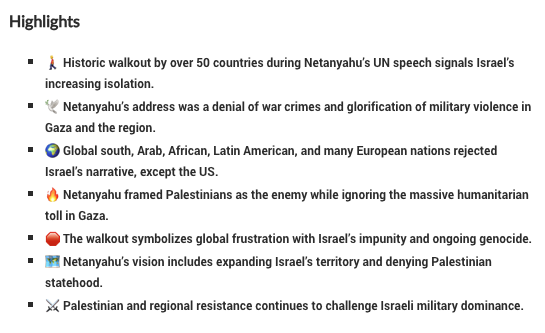

Netanyahu’s speech was widely criticized as war propaganda, glorifying violence and extrajudicial assassinations while dismissing credible reports of civilian casualties and humanitarian crises in Gaza. The walkout reflected a collective rejection of Netanyahu’s narrative by the global south, Arab nations, African countries, Latin America, and much of Western Europe, leaving only the United States visibly supportive. The video highlights the stark contrast between Netanyahu’s claims and the harsh realities on the ground, including the devastating humanitarian impact in Gaza, the weaponization of international law, and the persistent resistance by Palestinian and regional actors.
The transcript also explores Netanyahu’s broader geopolitical agenda, including his opposition to Palestinian statehood, his alliances with far-right figures like Donald Trump, and his vision for “Greater Israel,” which entails territorial expansion beyond current borders. It underscores the deepening crisis for Israel, with increasing international delegitimization, growing resistance, and the failure of Israel’s military strategy to suppress opposition. The video concludes by emphasizing the significance of the UNGA walkout as a historic repudiation of Israel’s policies and an affirmation of the ongoing Palestinian resistance and global solidarity against the Israeli regime’s actions.
Key Insights
-
Walkout as a Political Statement: The coordinated exit of over 50 countries from Netanyahu’s speech was not merely a protest but a significant political repudiation of Israel’s actions and narratives. This act manifested the international community’s frustration and the delegitimization of Israel’s claims at a global institution meant to uphold peace and international law. The exclusion of the US from the walkout highlights the persistent geopolitical alliances that complicate global consensus on Israel’s conduct.
-
Propaganda vs. Reality: Netanyahu’s speech exemplified the use of propaganda to mask the brutal realities of the Gaza conflict. By portraying Hamas as the sole aggressor and Israel as the victim, Netanyahu attempted to rationalize mass civilian casualties and obliterate Palestinian resistance as terrorism. This narrative ignores extensive independent reports and media coverage that document the scale of civilian suffering and potential war crimes under Israeli military operations.
-
⚖️ Weaponization of International Law: Netanyahu’s rhetoric reflects a broader strategy to weaponize international law selectively. While Israel claims to minimize civilian casualties and provide humanitarian aid, the reality is a systematic siege and infrastructure destruction that exacerbate famine and suffering. The denial of aid convoys and attacks on humanitarian efforts reveal a calculated policy that contradicts Israel’s official statements and international humanitarian norms.
-
Global South and Regional Solidarity: The walkout underscored the shift in global alliances wherein countries from the global south, Arab nations, and others increasingly distance themselves from Israel. This reflects a growing awareness of Palestinian rights and resistance, challenging the historically Western-dominated narrative that often favors Israel. This solidarity also signals a potential realignment in international politics concerning West Asia and colonial legacies.
-
Endless War and Resistance Dynamics: Israel’s ongoing military campaigns, including operations against Hamas, Hezbollah, and other groups, have failed to suppress resistance movements. Instead, they have fueled further opposition locally and regionally, with groups like Ansar Allah in Yemen and Iranian-backed forces continuing to challenge Israeli dominance. The persistence of these conflicts underscores the limits of military power in resolving deep-rooted political and territorial disputes.
-
Political Alliances and Expansionism: Netanyahu’s alliance with figures like Donald Trump and his advocacy for the “Greater Israel” project reveal an agenda that extends beyond immediate military concerns to a broader territorial and ideological vision. His dismissal of Palestinian statehood and vilification of international diplomatic efforts highlight the entrenched obstacles to peace and a two-state solution, increasing tensions and instability in the region.
-
⚠️ Implications for International Institutions: The walkout and the broader crisis spotlight the challenges faced by the United Nations and international law in addressing conflicts involving powerful state actors. The failure to hold Israel accountable or to enforce resolutions undermines the credibility of these institutions and calls for renewed efforts to uphold international legal standards and human rights protections. The historic walkout may serve as a catalyst for further actions demanding justice and accountability.
This transcript and analysis reveal a deeply polarized and complex conflict with significant humanitarian, political, and geopolitical implications. The UNGA walkout represents a critical moment in the global discourse on Israel and Palestine, marking a potential turning point in international engagement and resistance to ongoing violence and occupation.

Streamed live on Sep 24, 2025 #netanyahu #israel #iran
Summary
The video features a comprehensive discussion hosted by Danny Hiong, with returning guest Professor Muhammad Morandi and first-time guest Ramsay Bar Bude, focusing on the ongoing conflict involving Israel, Palestine, Yemen, and broader Middle Eastern dynamics. Central to the conversation is the recent breakthrough by Yemeni forces, particularly Ansar Allah (Houthi movement), in penetrating Israeli air defenses to strike the strategic Israeli port city of Eilat. This event is framed within a wider context of resistance against Israel’s military operations and siege tactics, especially in Gaza. The guests detail the humanitarian catastrophe inflicted by Israel on Palestinians, emphasizing the relentless daily bombings, destruction, and mass casualties, especially among children and families. The Israeli regime is characterized as committing a genocidal campaign, with Western complicity through political, military, and media support.
The discussion highlights Yemen’s strategic role as a moral compass in the region, using drone and missile strikes to challenge Israeli control and blockade, impacting critical infrastructure like ports and airports. The Israeli military’s repeated investigations (“probes”) into failures of air defense systems underscore a broader narrative of Israeli vulnerability and declining power, both militarily and economically. The ongoing resistance in Gaza, Lebanon, West Bank, and Yemen form an axis of defiance that challenges Israeli dominance and the West’s political narrative.
The panel also analyzes Israel’s relationship with Iran, noting Israel’s failure in its attempts to militarily weaken Iran despite its considerable arsenal and U.S. backing. Iranian missile tests and military readiness are seen as a strong deterrent, signaling Iran’s preparation to defend itself decisively. The conversation underscores the psychological dimension of the conflict, where Israel’s prior aura of invincibility and deterrence is eroding due to persistent resistance and strategic setbacks.
Furthermore, the guests discuss the global shift in public opinion. They note increased solidarity with Palestinians worldwide, including mass protests in Europe and growing delegitimization of Israel’s policies internationally. The recognition of Palestine by some Western governments is viewed as a superficial measure intended to pacify public dissent rather than a substantive change in policy.
The Palestinian resistance in Gaza is underscored as remarkably resilient and innovative, despite years of brutal occupation and siege. The resistance continues guerrilla warfare tactics that have inflicted significant damage on Israeli military assets, disproving narratives of Palestinian defeat. The discussion ends on a cautiously optimistic note, emphasizing the need for continued activism and pressure to support Palestinian liberation and anticipating the eventual collapse of the Israeli regime’s oppressive system.
 Key Insights

-
Yemen’s Strategic Role as a Regional Resistance Hub: Yemen’s Ansar Allah has emerged as a significant player in challenging Israeli military capabilities. By targeting vital Israeli ports and infrastructure with advanced drones and missiles, Yemen not only disrupts Israeli logistics but also symbolizes a broader resistance beyond Palestine. This multi-front pressure complicates Israel’s military calculus and reveals vulnerabilities often masked by its military reputation. Yemen’s position as a “moral compass” reflects a shift toward regional actors asserting themselves against Western-backed Israeli policies.
-
The Humanitarian Catastrophe in Gaza as Genocide: Professor Morandi’s detailed account of the daily bombings, destruction of families, hospitals, and basic infrastructure paints a grim picture of systematic violence amounting to genocide. The discussion stresses that official casualty figures are underreported, excluding many indirect deaths from disease and starvation caused by siege conditions. This framing demands international accountability and paints Israel’s actions as crimes against humanity, supported tacitly by Western governments and media complicity.
-
Systemic Failures Within Israeli Military and Political Structures: The frequent “probes” into Israeli defense failures represent more than technical glitches; they reveal deeper systemic issues affecting Israeli military effectiveness. These repeated failures, alongside economic strain, undermine Israel’s self-portrayed image of invincibility and deterrence. This erosion of military competence and psychological dominance weakens Israel’s strategic position in ongoing conflicts and undermines its capacity to control occupied territories.
-
Global Public Opinion Shifting Against Israel: Rampant protests across Europe, rising recognition of Palestine, and increased activism indicate a growing global awareness and rejection of Israeli policies. While some governments use symbolic moves like recognizing Palestine as a pressure valve, grassroots movements continue to push for real change. This dynamic shows the power of civil society in influencing international discourse and challenging entrenched geopolitical alliances.
-
️ Iran’s Military Resilience and Deterrence: Iran’s ability to withstand Israeli attacks, maintain and upgrade its missile capabilities, and mobilize popular support has fundamentally changed the regional power balance. Israel’s inability to conduct unchecked strikes inside Iran contrasts sharply with its aggressive posture in Gaza and Lebanon. Iran’s preparedness and willingness to respond decisively deter further Israeli military adventurism and complicate U.S.-Israel strategic plans in the region.
-
The Psychological Dimension of the Conflict: Beyond material military losses, Israel suffers from a loss of psychological deterrence. Statements from Israeli figures reveal that fear was a key component of their strategy, which is now compromised as Muslims and regional actors no longer fear Israeli military might. This loss of fear undermines Israel’s ability to project power and control narratives and fuels continued resistance.
-
✊ Palestinian Resistance Innovation and Resilience: Despite severe oppression, the Palestinian resistance in Gaza has demonstrated remarkable ingenuity by repurposing unexploded Israeli ordnance into effective weapons and employing guerrilla tactics that have caused significant Israeli military losses. This resilience disproves narratives of Palestinian defeat and highlights the deep-rooted determination of Palestinians to resist occupation and genocide. The resistance is supported regionally and globally, making the conflict more complex and difficult for Israel to resolve militarily.
-
️ Western Complicity and the Illusion of Change: The Western political establishment’s continued military and financial support for Israel, despite public gestures like Palestine recognition, reveals a cynical approach to the conflict. These measures are often designed to quell public dissent rather than effect policy change. The West’s complicity prolongs the conflict and undermines its own claims to human rights and democracy, further fueling global discontent.
-
Implications for the Global South and Decolonization: The discussion situates this conflict within a broader context of global power shifts. The defeat of Israeli military ambitions against Iran and the resilience of resistance forces symbolize a gradual erosion of Western dominance and colonial mentalities. This inspires other struggles in the Global South and signals a growing challenge to Western hegemony and its proxy conflicts.
-
⚠️ The Imperative for Sustained Activism: Both guests emphasize the critical role of global civil society, media, and activists in sustaining pressure on governments and raising awareness. The collapse of the Israeli regime is seen as inevitable but requires continued grassroots mobilization, exposing the limitations of diplomatic gestures and the necessity of persistent, informed activism.
BEFORE you leave, PLEASE pay attention to this alert.
[t4b-ticker id=”1″]
[/su_spoiler]
Print this article [bws_pdfprint display=’print’]
[su_note note_color=”#f1efef” radius=”0″]The views expressed herein are solely those of the author and may or may not reflect those of The Greanville Post, although, if we publish them, we obviously find them noteworthy and valuable. [/su_note]
 This work is licensed under a Creative Commons Attribution-NonCommercial 4.0 International License •
ALL CAPTIONS AND PULL QUOTES BY THE EDITORS NOT THE AUTHORS

