

 Julian Macfarlane
NEWS FORENSICS




| Traducir—Translate! | |
| Make fonts bigger>>> | Resize text-+= |
In the 21st Century we do not have “total war”, in the sense that history books describe it -except for Israel’s genocide of Palestine and Lebanon;
Rather we have a hybrid form of “total war” blending conventional military force with covert attacks and various non-military tactics—such as cyberattacks, disinformation, economic coercion, and proxy operations—to destabilize adversaries and make them vulnerable to final destruction. It blurs all boundaries to exploit societal vulnerabilities For the West it is a war without rules.
That’s what we see now in the Middle East. But Iran is not fighting that kind of war/ It has rules. In Islam there is no real “total war” as there is in the West.
Still, Iran is winning.
In the video VO I did for SouthFront, I talked about the Israeli attack on the South Pars field, which resulted in Iran attacking LNG ‘trains” in Qatar and a refinery in Haifa.
The Israelis and Americans are calling the attack on Iran a “win”. But it isn’t. That F-35 that the Iranians shot down is somehow symbolic of the Western inversion of reality. Missing the forest for the trees. Missing the trees for the forest.
Iran typically uses large-scale refineries rather than export-oriented LNG ”trains” at South Pars and the strikes caused significant destruction to its production infrastructure. Initial assessments indicate the damage wiped out approximately 12% of Iran’s total gas production.
Several parts of the production network had to be shut down to contain massive fires sparked by the drones and missiles and reduce toxic emissions.
However, the damage was not as serious as would be the case if Iran had been using “trains”, which are independent, integrated hi-tech production units within a liquefaction plant used to convert natural gas into Liquefied Natural Gas (LNG) by cooling it . This requires a continuous processing “line” containing compressors, purification systems, and heat exchangers and other components that condense gas.

Iran’s counterstrike on Qatar was far more serious.
The Qatar 2 Ras Laffan refinery and trains 4 and 5, which were severely damaged were operated by a Japanese-British joint venture, and are the world’s largest LNG trains. All 14 of the Middle East’s trains are in Qatar, with two planned for the UAE and two more for Oman. Striking such production facilities has consequences far beyond the Middle East, affecting the entire global energy market.
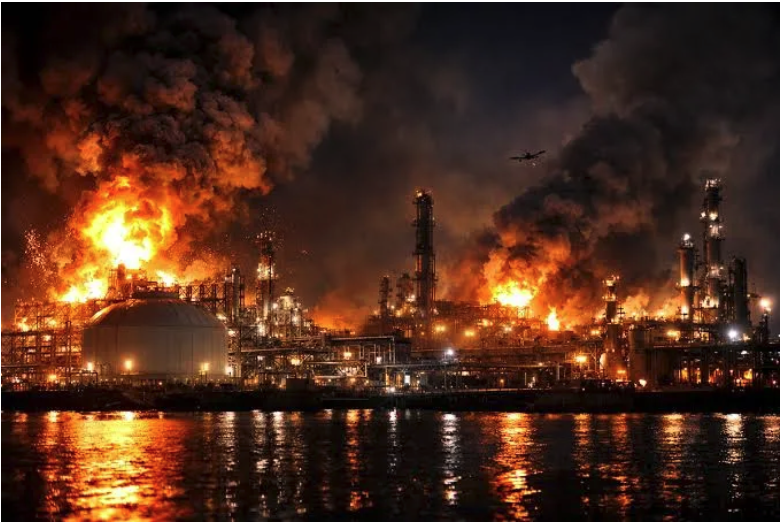
Iran also damaged an oil refinery in Haifa. Israel has only two and Haifa is its largest.
You might think that this benefits the US LNG industry. Maybe yes. Also less than you think.
For example, Japan is hugely dependent on LNG. If it can’t get it from the ME, it must get it elsewhere . It already gets some from Russia. And has contracts with the US, but it has shifted its focus to Canada.
The LNG Canada Project in British Columbia in Kitimat, is partially funded by Mitsubishi Corporation (15% stake) shipping 2.1 million metric tons of LNG annually to Japan since 2025. The project aims to add 14 million tons of capacity annually, expanding over time. And there are other projects under construction.
Japan and other Asian countries prefer Canadian LNG because it offers a shorter transit time (approx. 10 days) compared to Middle Eastern or US Gulf routes. This makes its economically competitive, despite higher production costs than, say, Qatar or even the US.
Lower Shipping Costs and other benefits:
Canada to Japan: ~$0.96 - $1.09 per MMBtu (approx. 10–11 days).
U.S. Gulf to Japan: ~$2.22 - $2.45 per MMBtu (approx. 24–30 days via Panama Canal).
British Columbia’s cold climate also makes the cooling process roughly 26% to 34% more energy-efficient than Qatar or the US.
Other Projects: Additional projects like Cedar LNG and Woodfibre LNG under construction are also contributing to increasing Canada’s LNG export capabilities for Asia.

MoA strikes again...
The remarkable B. at Moon of Alabama writes.
The damage from the continuing U.S. and Israeli bombing campaign in Iran is also quite considerable. The Israeli plan is to destroy all of Iran’s capabilities to the extent that rebuilding will become excessively expensive But Iran has already planned for this. It has found a way to pay for rebuilding its state. As it is, and will likely stay, in control of the Strait of Hormuz it can ask for payments in exchange for providing safe passage.
AT LEAST one tanker operator is understood to have paid a fee to Iran to transit the Strait of Hormuz while several other tankers have passed following Iranian vetting and diplomatic interventions, according to several well-placed sources with direct knowledge of the transits.
Multiple governments including India, Pakistan, Iraq, Malaysia and China are all understood to be discussing vessel transit plans directly with Tehran, where officials within the Islamic Revolutionary Guard Corps have established a nascent ship registration system for “approved” vessels to agree safe passage.
At least nine ships have now exited the strait via the “safe” corridor that routes ships through Iranian territorial waters via Iran’s Larak Island, which is used by the IRGC Navy and port authority to assess visual confirmation of the vessels.
Without the war and without the blockade of the Strait crude oil prices would hover around $60 bbl instead of the current $100-120 bbl (soon to be $200 bbl). When Iran will finally agree to an end of the war – months if not years from now – one of its conditions might be a surcharge of $10 bbl for any tanker passing the Strait. This would come, for a limited time, on top of the $60 bbl peace-level market price.A moderate toll when one considers the cost of today’s barrels. This while providing a significant income of some $50-100 million per day for Iran. It would help to recuperate the money needed to repair any war damage.
As you can see, the US war on Iran has created worldwide “system shock”, requiring entirely new geopolitical-economic systems globally. That “toll” has to be paid in yuan, which bolsters BRICS, and ushers in the Age of the PetroYuan.
It means systemic change at all levels . The oil states’ oligarchies will break and you may see new nations emerging in West Asia.
Will Bahrain and Iraq and Iran form autonomous states in a Shiite federation? Will Lebanon break into Sunni and Shi’a states? Will Israel be replaced by a Palestinian federation of all faiths? What about one or two Kurdish states? Do the Druze get their own state? What happens to Turkey and Azerbaijan and Armenia?
Nobody knows what the map will look like in a few years.
Maps change….


But it is unlikely that US bases will remain or Israel will exist in its present form. One must also ask if the US will exist in its present from five years from now. I hope not!
Peace in West Asia can only come through community — not through the machinations of Empire. Peace in the world can only come the same way.
Harmony and balance in today's world can only be achieved through a joint, common effort... that respects the rights of all nations. Vladimir Putin

We need help in getting new subscribers. Please crosspost, and feel free to post urls on other blogs or X or other platforms. Every time someone does that, I get a new subscriber.
Why can’t we be more animal?
BEFORE you leave, PLEASE pay attention to this alert. INDISPENSABLE information!
[t4b-ticker id="1"]
Print this article [bws_pdfprint display=’print’]
 This work is licensed under a Creative Commons Attribution-NonCommercial 4.0 International License •
ALL CAPTIONS AND PULL QUOTES BY THE EDITORS NOT THE AUTHORS

