
[su_spoiler title=”Please make sure these dispatches reach as many readers as possible. Share with kin, friends and workmates and ask them to do likewise. ” open=”yes” style=”fancy” icon=”arrow-circle-1″]
 Mearsheimer Responds
Prof. John Mearsheimer

| Traducir—Translate! | |
| Make fonts bigger>>> | [wpavefrsz-resizer] |

Summary
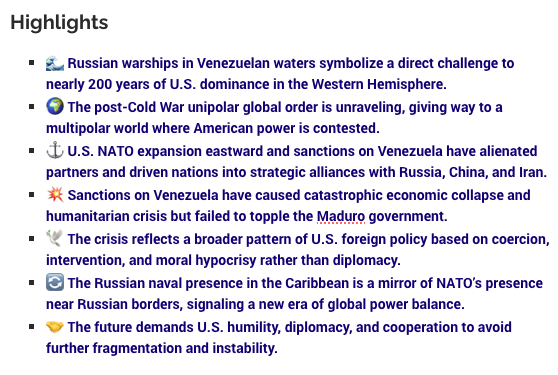
The video provides a comprehensive analysis of the geopolitical dynamics unfolding in the Caribbean, focusing on the arrival of Russian warships in Venezuelan waters as a significant act of geopolitical signaling. This event challenges nearly two centuries of American dominance in the Western Hemisphere, directly confronting the Monroe Doctrine and reflecting the erosion of the unipolar global order established after the Cold War. The presence of Russia in Venezuela is not merely about military power projection; it is a response to decades of U.S. policies that have alienated Russia and other nations through NATO expansion, economic sanctions, and diplomatic isolation.
The transcript traces the origins of the current crisis back to the post-Soviet era when the United States, instead of integrating Russia into a cooperative security framework, pursued NATO expansion eastward, fueling Russian resentment and suspicion. This policy of dominance rather than partnership set the stage for the confrontations seen today in both Europe and the Americas. Similarly, in Latin America, Venezuela’s political trajectory—beginning with Hugo Chavez’s democratic rise and challenge to U.S. influence—triggered increasingly hostile U.S. responses, including economic sanctions that devastated the Venezuelan economy and caused widespread humanitarian suffering.
Despite these pressures, Venezuela deepened its strategic ties with Russia, China, and Iran, creating a multipolar resistance network united by opposition to Western coercion. Russian naval deployments to Venezuelan waters are symbolic of this new reality: the decline of unipolar U.S. global dominance and the rise of a world where power is contested and influence must be negotiated. The transcript critiques U.S. foreign policy for its arrogance, moral hypocrisy, and failure to adapt to global shifts, arguing that the current situation was avoidable had diplomacy and humility prevailed over coercion and unilateralism.
Looking forward, the video calls for a fundamental rethinking of U.S. foreign policy—one rooted in engagement, respect for sovereignty, and cooperation rather than sanctions and intervention. It advocates lifting sanctions on Venezuela, pursuing political reform through dialogue, and embracing a multipolar world order where leadership is earned through example and responsible governance rather than imposed by force. The Russian presence in Venezuela serves as a stark warning and an opportunity for the United States to learn from its past mistakes or risk accelerating its decline as a global power.

Key Insights
-
Geopolitical Signaling Beyond Military Posturing: The deployment of Russian warships +to Venezuelan waters transcends traditional naval maneuvers and symbolizes a strategic message challenging the Monroe Doctrine and U.S. hegemony in the Americas. This act reflects Moscow’s intent to assert itself in a region long considered an American sphere of influence, signaling that global power is no longer unipolar and uncontested. It is a direct response to perceived Western encirclement and NATO expansion, illustrating how actions in one region reverberate globally.
-
️ Failure of Post-Cold War U.S. Strategy: Instead of integrating Russia into the post-Soviet international order, the U.S. pursued NATO expansion right up to Russia’s borders, disregarding warnings from experts like George Kennan. This decision entrenched Russian insecurity and antagonism, leading to the confrontations seen today in Europe and the Americas. The transcript highlights how U.S. hubris and the belief in inevitable dominance blinded policymakers to the consequences of their choices, ultimately destabilizing the global order.
-
️ Venezuela as a Geopolitical Flashpoint: Venezuela’s vast oil reserves made it a critical prize and a focal point of U.S.-Russia rivalry. Chavez’s populist, redistributive policies challenged U.S. economic interests, prompting efforts to isolate and destabilize the country through sanctions and covert support for opposition. The sanctions, rather than fostering democracy, precipitated economic collapse and humanitarian disaster, illustrating the human cost of economic warfare used as a foreign policy tool.
-
Emergence of a Multipolar Resistance Network: Venezuela’s alliances with Russia, China, and Iran represent a broader pattern where nations targeted by Western sanctions and coercion band together out of necessity, not ideology. This network challenges U.S. dominance by providing mutual support in finance, military cooperation, and political legitimacy. It reflects the erosion of the U.S.-led international order and the rise of competing centers of power that demand recognition and respect.
-
Moral Hypocrisy Undermining U.S. Credibility: The transcript exposes the contradictions in U.S. foreign policy—maintaining a vast global military presence while condemning similar actions by rivals, supporting authoritarian regimes while preaching democracy, and selectively applying principles of sovereignty and human rights. This hypocrisy fuels global resentment, undermines America’s moral authority, and diminishes its ability to lead effectively in the international arena.
-
The Cost of Coercion Over Diplomacy: The persistent reliance on sanctions, threats, and military interventions has repeatedly failed to achieve long-term stability or democratic outcomes. Instead, it has created cycles of resistance and escalation, pushing nations closer to adversaries and fragmenting the global order. The Venezuelan crisis is emblematic of this failure, demonstrating that coercive tactics often produce the opposite of their intended effect.
-
The Imperative of Adapting to a Multipolar World: The era of uncontested American global dominance is over. The transcript argues that U.S. foreign policy must shift from dominance to diplomacy, embracing humility and cooperation. This includes lifting sanctions, engaging adversaries respectfully, and strengthening democratic institutions at home to rebuild credibility abroad. The future of global stability depends on America’s willingness to learn from its mistakes and lead by example rather than force.
This detailed analysis underscores the complexity of contemporary geopolitical challenges and highlights the urgent need for a transformative approach to international relations—one that prioritizes engagement, respect, and shared responsibility over unilateral control.
[su_box title=”About the Author” style=”bubbles” box_color=”#0778d1″ radius=”18″]John Joseph Mearsheimer (/ˈmɪərʃaɪmər/; born December 14, 1947)[3] is an American political scientist and international relations scholar. He is the R. Wendell Harrison Distinguished Service Professor at the University of Chicago. Mearsheimer is best known for developing the neorealist (or structural realist) theory of offensive realism, which describes the interaction between great powers as being primarily driven by the rational desire to achieve regional hegemony in an anarchic international system. In accordance with his theory, in the 2001 book The Tragedy of Great Power Politics, Mearsheimer says that China’s growing power will likely bring it into conflict with the United States. In his 2007 book The Israel Lobby and U.S. Foreign Policy, Mearsheimer argues that the Israel lobby wields disproportionate influence over U.S. foreign policy in the Middle East. His more recent work focuses on criticism of the “liberal international order” (laid down in his 2018 book The Great Delusion: Liberal Dreams and International Realities) and why he believes that the West is to blame for the Russo-Ukrainian War.[/su_box]
BEFORE you leave, PLEASE pay attention to this alert.
[t4b-ticker id=”1″]
[/su_spoiler]
Print this article [bws_pdfprint display=’print’]
[su_note note_color=”#f1efef” radius=”0″]The views expressed herein are solely those of the author and may or may not reflect those of The Greanville Post, although, if we publish them, we obviously find them noteworthy and valuable. [/su_note]
 This work is licensed under a Creative Commons Attribution-NonCommercial 4.0 International License •
ALL CAPTIONS AND PULL QUOTES BY THE EDITORS NOT THE AUTHORS

