
[su_spoiler title=”Please make sure these dispatches reach as many readers as possible. Share with kin, friends and workmates and ask them to do likewise. ” open=”yes” style=”fancy” icon=”arrow-circle-1″]
 60 Minutes
CBS NEWS
| Traducir—Translate! | |
| Make fonts bigger>>> | [wpavefrsz-resizer] |

Summary
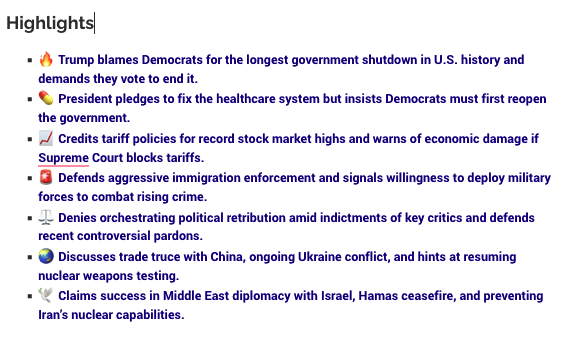
In a nearly 90-minute exclusive interview at his Mar-a-Lago estate, President Donald Trump addressed a broad range of pressing national and international issues amid the ongoing government shutdown, economic concerns, immigration policies, foreign relations, and recent legal controversies. Trump blamed Democrats for the government shutdown, asserting that Republicans have voted repeatedly to end it, but the opposition refuses to cooperate unless demands related to Obamacare subsidies are met. He reiterated his commitment to fixing the healthcare system, criticizing Obamacare as expensive and ineffective, and emphasized his willingness to work with Democrats only if the government reopens.
On economic matters, Trump highlighted the stock market’s record highs and credited his tariff policies for strengthening the U.S. economy, warning that a Supreme Court decision against his tariffs would severely damage the country’s financial standing. On immigration, he defended aggressive enforcement tactics, including raids and deportations, emphasizing his administration’s focus on removing criminals and restoring order while criticizing judicial constraints imposed by liberal judges. He also mentioned the potential use of military force under the Insurrection Act to combat crime in U.S. cities if necessary.
Trump addressed allegations of political retribution linked to recent indictments of his critics, denying any involvement and framing them as consequences of their own misconduct. He discussed his recent pardons, including a controversial crypto figure, dismissing accusations of pay-for-play as baseless and distancing himself from the details.
The president touched on significant foreign policy issues, including his recent trip to Asia, a temporary trade truce with China, and the ongoing conflict in Ukraine. He defended his tough stance on China, praised his personal diplomacy with Vladimir Putin and Xi Jinping, and hinted at nuclear weapons testing to maintain U.S. deterrence amid global threats. Trump declined to publicly disclose his exact stance on defending Taiwan but signaled readiness to act if necessary.
On Middle East affairs, Trump claimed credit for securing the release of Israeli hostages and negotiating a ceasefire with Hamas, while expressing confidence in further expanding the Abraham Accords. He criticized the handling of Iran, asserting that his policies prevented them from obtaining nuclear weapons.
Concluding the interview, Trump dismissed speculation about a 2028 presidential run, expressing confidence in the Republican bench and his desire to continue delivering strong results during his current term.
Key Insights
-
⚖️ Government Shutdown as a Political Stalemate: Trump frames the shutdown as entirely the Democrats’ fault, emphasizing that Republicans have voted to end it multiple times. This reflects a deeply entrenched partisan impasse where political posturing outweighs legislative problem-solving. His demand for Democrats to “raise five hands” to end the shutdown suggests a strategy of shifting responsibility onto the opposition, while offering a conditional willingness to negotiate on healthcare reforms.
-
Healthcare Reform Remains Elusive: Despite repeated promises since 2015, Trump admits that comprehensive healthcare reform has stalled, largely due to political opposition and a narrow Senate vote in 2017. His critique of Obamacare as expensive and ineffective resonates with a significant portion of the electorate, but his vague commitment to “fixing” healthcare without detailed plans underscores the complexity and difficulty of healthcare policy reform.
-
Tariffs as a Pillar of Economic Policy: Trump’s steadfast defense of tariffs as crucial to economic growth highlights his protectionist approach to trade. By linking tariffs to record stock market highs and 401(k) performance, he appeals directly to middle-class Americans invested in the market. However, the ongoing Supreme Court challenge introduces significant legal uncertainty that could undermine this signature policy, potentially destabilizing markets if tariffs are invalidated.
-
Immigration Enforcement and Law-and-Order Focus: Trump’s unapologetic defense of aggressive immigration raids and deportations, including non-violent undocumented immigrants, exemplifies his administration’s hardline stance. His readiness to invoke the Insurrection Act and deploy military forces in U.S. cities signals a prioritization of law-and-order narratives, appealing to voters concerned with rising crime but raising questions about civil liberties and federal overreach.
-
⚖️ Legal Controversies and Political Retribution Claims: The president’s dismissive attitude toward indictments of his critics and his emphasis on his own exonerations suggest a narrative of victimization and vindication. His denial of directing the Department of Justice in these cases contrasts with social media posts endorsing prosecution, indicating a complex interplay between public messaging and official legal processes.
-
Foreign Policy Balancing Act with China and Russia: Trump’s discussion of a temporary trade truce with China and personal diplomacy with Putin and Xi Jinping reflects a transactional approach to foreign relations. His assertion that China and Russia are testing nuclear weapons, despite conflicting official reports, underscores his intent to position the U.S. as equally assertive in military readiness, justifying potential nuclear testing to maintain strategic parity.
-
️ Middle East Diplomacy and Security Claims: Trump’s claims of brokering the release of Israeli hostages and achieving a ceasefire with Hamas reinforce his “peace president” branding. However, his blunt dismissal of Hamas as an immediate threat and confidence in expanding the Abraham Accords may oversimplify enduring regional tensions. His assertion that Iran currently lacks nuclear capability contrasts with ongoing international concerns, reflecting a narrative intended to validate his past policies.
-
Political Future and Republican Bench Strength: By downplaying speculation about a 2028 presidential run and praising the GOP’s bench strength, Trump signals a potential shift toward kingmaker status within the party. His positive references to figures like JD Vance and Marco Rubio suggest an interest in influencing the next generation of Republican leadership while maintaining his own political relevance.
-
Communication Style and Strategic Ambiguity: Throughout the interview, Trump employs a mix of direct assertions, deflections, and ambiguous statements—particularly on sensitive issues like Taiwan’s defense and nuclear testing. This style maintains leverage over adversaries by keeping strategic intentions opaque, while energizing his base through bold, sometimes controversial claims.
-
Economic Disparities and Inflation Debate: Trump counters criticism about inflation and rising grocery prices by framing them as a Biden-era problem and emphasizing stock market gains and 401(k) growth. However, this overlooks the lived realities of many Americans not invested in the market, highlighting a disconnect between economic indicators and everyday financial hardship faced by lower- and middle-income families.
-
️ National Security Emphasis Amid Global Tensions: The interview underscores Trump’s focus on strengthening U.S. national security through military readiness, strict immigration enforcement, and assertive diplomacy. His readiness to use military force domestically and internationally reflects an administration prioritizing strength and deterrence, though it raises concerns about potential escalations and civil rights implications.
In sum, the interview reveals President Trump’s consistent positioning as a tough, deal-making leader who blames political opponents for current crises, champions protectionist economic policies, adopts a hardline stance on immigration and law enforcement, and pursues an assertive, if sometimes controversial, foreign policy agenda. His communication style combines directness with strategic ambiguity, reinforcing his image as a disruptive yet determined political force.

BEFORE you leave, PLEASE pay attention to this alert.
[t4b-ticker id=”1″]
[/su_spoiler]
Print this article [bws_pdfprint display=’print’]
[su_note note_color=”#f1efef” radius=”0″]The views expressed herein are solely those of the author and may or may not reflect those of The Greanville Post, although, if we publish them, we obviously find them noteworthy and valuable. [/su_note]
 This work is licensed under a Creative Commons Attribution-NonCommercial 4.0 International License •
ALL CAPTIONS AND PULL QUOTES BY THE EDITORS NOT THE AUTHORS


1 comment
Nu, so what else is new? Nuclear energy is expensive and is not entirely safe. Until that is tamed to be inserted in daily life, oil will be our basic energy provider (windmills, sun energy will never be sufficient). So wars are about energy, i.e. oil supplies. This becomes even more stringent a demand with the AI development. Before this is even evolved, there is enough criticism to predict it may be a fluke. Strenuous attempts to outdo China. Good luck !