By Hua Bin

The US War Machine Underwhelms – Part 2

The aircraft carrier USS Nimitz (CVN 68) participates in a replenishment at sea while the guided-missile destroyers USS Momsen (DDG 92) and USS Preble (DDG 88) are seen underway in formation. That was 13 years ago. Today this battle group would be forced to stay out of Iran's missile/drone strike perimeter. Carriers are 20th century war platforms rendered obsolete by 21st century weapons.
In my last article, I detailed the battlefield damage Iran has inflicted upon the US during the first month of the war.
The scale and scope of high-value asset losses by the US is astonishing, in contrast to the “victory” narrative spun by the Trump regime.
The depletion of its offensive and defensive munitions is unprecedented, especially since this is merely a “medium intensity” conflict in the grand scheme of things.
Although Iran is the most technically sophisticated adversary the US has fought directly since the Cold War, the country is a middling power suffocated by decades of sanctions.
For illustration, Iran’s 2025 GDP and defence budget were $356 billion and ~$9 billion. In comparison, Singapore’s 2025 GDP and defence budget is $604 billion and $17 billion.
Iran doesn’t have a real air force or navy. It doesn’t have a modern integrated air defense network (IADN) or significant space assets.
Iran’s battlefield achievements are the result of asymmetrical warfare with low-cost drones and short-range ballistic missiles.
These are clear indications that the US is militarily incapable to have a “great power” war with its dated technologies, low magazine depth, and high-cost low-density weaponry, which I’ll dive into in detail.
To support this conclusion, in the second part of my article, I’ll discuss the military lessons from the Iran war.
Then, I will dissect the US weapon platforms and show that China has already reached technical parity or lead in most major categories.
Furthermore, China has moved away from the traditional platform-centric combat doctrine of the US military to a new system-of-systems doctrine.
The new doctrine emphasizes high-attrition, high-tech, low-cost unmanned systems powered by artificial intelligence to complement high-value manned platforms.
The doctrine is supported by deep supply chains, civil-military fusion, superior industrial scale, and surge capacity that are lacking in the US’s private, profit-driven, just-in-time boutique military industrial complex.
Military lessons from the Iran war
Iran clearly understands that its limited air defenses make it hard to prevent aerial bombardment.
So Iranian forces have focused on inflicting reciprocal damages to US and Israeli assets rather than avoiding the blows.
On Feb 28, the first day of the war, Iran neutralized the US ability to “see” and control the battlefield by using drone swarms and hypersonic missiles to take out the US ground-based strategic early warning radar (SEWR) (AN/FPS-132 Block 5) at the Al Udeid Air Base in Qatar.
On March 17, an Iranian Shahed-136 kamikaze drone directly hit the radome and phased array antenna of an AN/FPS-117 long-range early warning radar in the Al-Qaysumah Airport in Saudi Arabia.
On March 20, Iran used drone swarm and low-flying cruise missiles to exhaust the interceptors of the THAAD system in Prince Sultan Air Base in Saudi Arabia, then followed with a Fattah-2 hypersonic missile strike to destroy the THAAD.
On March 23, a Shahed-136 and Fattah-2 joint strike took out another AN/FPS-117 radar in the Rafha Region of Saudi Arabia.
The destruction of the long-range early warning radars and THAAD batteries resulted in a gap in US mid/long-range air defense.
This exposed terminal-phase defense platforms such as Patriot to Iranian attacks.
A Patriot system can track over 100 targets at the same time but can only guide 18 interceptors simultaneously, opening a window for swarming drones and missiles too numerous to be shot down in one engagement.
Other drones/missiles were able to penetrate its defense during reloading, destroying the Patriot platform which cost over $1 billion.
At least 3 Patriot batteries were destroyed in the UAE, Qatar, and Saudi Arabia.
Losses of Patriots led to gaps in terminal defense for key assets and air bases, resulting in Iranian destruction of one E-3 Sentry AWACS and at least 5 KC-135 Stratotanker refuelling planes on the airfield tarmacs in Saudi Arabia.
This, in turn, led to a lower sortie rate of combat jets.
Iran’s successful implementation of coordinated drone swarm and ballistic missile attacks created a flywheel of cascading impact on US defenses.
By destroying these critical air defense nodes, Iran “blinded” US defense and reduced the interception rate of Iran’s missiles
By weakening the US’s ability to “see” and “intercept”, Iran paved the way for its drones and missiles to eliminate high-value assets such as the E-3 AWACS and the KC-135 tankers
Without such “force multipliers”, the US ability to generate sorties into the Iranian airspace is truncated.
As a result, carrier-based air sorties were also reduced as the average “strike reach” of Lincoln’s air wing is only 450 to 600 nautical miles.
Lincoln’s primary combat jets are F-35C Lightning II, whose max combat radius is approximately 600 nm, and F/A-18E/F Super Hornet with a combat radius of about 390 to 450 nm. Neither can carry out missions inside Iran without air refueling.
Saturation attacks by drones and missiles have also disabled all 13 US bases in the Gulf, rendering them uninhabitable.
This forced the ~50,000 US personnel stationed in the region to hide in civilian buildings and stay in civilian hotels, which were defenceless and further targeted by Iran.
Iran has proven low-cost and mass-produced weapons can effectively overwhelm the most expensive air defenses.
Joseph Stalin said, “Quantity has a quality of its own”. This stands true 80 years later.
In fact, the US itself was a model of using overwhelming industrial capacity to arm itself and its allies in WW2 to defeat the technically superior Germans.
Another lesson from Iran is that innovative low-tech solutions can be used to defeat expensive high-tech platforms.
On March 19, Iran used its indigenous 358 missile (also known as the SA-67) to shoot down an F-35A stealth fighter over central Iran.
CENTCOM confirmed the jet was damaged but claimed the pilot was safe and the wounded F-35A landed in Kuwait.
This marked the first combat shoot-down of the vaunted F-35 stealth fighter, which carries the dubious honor of “history’s most expensive weapon system” – some $2 trillion according to US Congressional Budget Office.
The 358 missile is an inexpensive “loitering surface-to-air missile” (costing $30,000 to $90,000) – a hybrid between a drone and a traditional missile, similar to China’s ASN-301 anti-radiation drone/missile (more on this later).
Iran used passive tracking rather than traditional active radar to bypass F-35’s stealth.
Stealth aircraft are designed to be invisible to radar, but they still produce significant heat from their engines visible to infrared detection.
Iran used passive infrared sensors to track the jet’s heat signature without alerting the pilot’s radar warning receivers.
A 358 loitering drone/missile was launched into the combat zone, flied slowly, waited for its optical and infrared sensors to detect the F-35’s thermal signature, and then launched a “silent attack”.
Unlike standard anti-aircraft missiles that flies directly to its target at Mach 2 or 3, the 358 flies at subsonic speed with a micro-turbojet engine.
It uses infrared (IR) and optical sensors to find its target. Because it does not emit a radar signal, it is “silent” – it doesn’t trigger the Radar Warning Receivers (RWR) on aircraft like the F-35.
While the 358’s slow speed makes it less effective against a pilot who is actively performing high-G evasive maneuvers, its passive nature means many targets don’t realize they are being hunted until it is too late.
The 358 missile can also be used in combination with traditional short-range missiles such as the Majid and serves as a low-cost threat to high-value ariel targets such as F-35 ($80 to 100 mil) or MQ-9 Reaper ($30 mil).
The 358 is responsible for taking down most of the 24 MQ-9 Reapers the US lost so far.
Despite Trump and Hegseth’s fake assurance of “air dominance” over Iran, the Iranian airspace is hardly safe for even the most advanced US jets, forcing them to consume expensive stand-off munitions.
And the threat is posed by weapons that cost a small fraction of the US jets and missiles.
Iran has imposed a disproportionate cost exchange ratio on the US through asymmetrical warfare.
Obviously the American military industrial complex is eager to hide this from the public at home and its potential buyers in other countries.
Iran can achieve such cost advantages because it utilizes a civilian supply chain to produce its weapons. Iran doesn’t have to access military supply chains that are under US sanctions.
The Shahed-136 uses civilian motors, runs on standard gasoline instead of aviation fuel. It uses composite materials for air frame, a wooden propeller, and civilian Beidou GNSS guidance.
Shahed-136 exploits blind spots of advanced US air defense systems designed for intercepting sophisticated ballistic missiles and fighters.
It flies low, slows, and has a tiny radar cross section (RCS). Modern air defense is not designed to deal with such threats. Even upon detection, the cost of the US interceptors could be as high as 100 times or more over the $30,000 drones.
The Iran War is also showing that modern wars are moving away from technological superiority to industrial capacity.
For example, thousand-dollar drones are deployed in the thousands while million-dollar interceptors can only be made in the dozens. Their respective production cycles are measured in days vs. months, even years.
The high-cost low-density long-lead-time weapon platforms deployed by the US military, at great profit for Lockheed Martin, Boeing, and RTX, are fragile against saturation attacks such as drone swarms and missile salvos.
In addition to “quantity is a quality of its own”, cost asymmetry is a weapon in itself.
Facing swarms of cheap weaponry, interception success rate is irrelevant. When a $4 mil Patriot PAC-3 interceptor is used to shoot down a $30,000 drone, the shooter loses regardless.
China has long appreciated the importance of cost asymmetry and the value of mass/quantity in modern warfare.
Norinco, a major defense contractor, has mass produced and exported Feilong-300D drone at $10,000, which has a range of 1,000 – 2,000 km and a speed of 220 km/h with a delta-wing configuration and a piston engine, similar to the Shahed-136.
Hundreds of Feilong-300D can be used in a single, AI-powered swarm attack.
Another example is the YKJ-1000 hypersonic missile (Mach 5 to Mach 7) made by Beijing-based private space firm Linkong Tianxing.
It is priced at $99,000, the same price as a US JDAM-LR, which is basically a dumb gravity bomb strapped with a guidance kit and dropped by planes flying overhead.
YKJ-1000 has a range of up to 1,300 km and can be launched from standard commercial shipping containers, allowing it to be concealed in civilian trucks or ships.
YKJ-1000 is nicknamed “cement missile” because it uses non-traditional, civilian-grade materials—including foamed concrete—as a heat coating to survive the extreme temperatures of hypersonic flight.
It uses automotive-grade chips, mass-market drone optics, and die-cast structural parts to slash costs.
Lingkong-Tianxing is also developing an AI-enabled swarm version of the YKJ-1000.
While the basic YKJ-1000 focuses on low-cost mass production, this new variant aims to transform the missile from a “blind” projectile into a cooperative hunter.
It uses embedded machine learning algorithms to achieve autonomous target selection, cluster collaboration, and adaptive evasive maneuvers.
Much of this AI logic is adapted from China’s dominant commercial drone industry, using mass-market chipsets and power-management components that are significantly cheaper than bespoke military hardware.
YKJ-1000 is much less sophisticated than the mainstream Chinese hypersonic missiles such as DF-17, DF-21D, DF-27, JY-19, YJ-20, and CJ-1000, state-of-the-art products of the public defense sector.
However, its extremely low cost makes the YKL-1000 perfect candidate for saturation attacks and as strategic decoys to exhaust enemy air defense interceptors before the high-end arsenal delivers the final punch.
Read more about YKL-1000 here. https://interestingengineering.com/military/chinas-cement-coated-hypersonic-missile
China leads the world in hypersonic missiles both in technological sophistication and cost efficiency. We’ll discuss it more later in the article.
Analysis of US weapon platforms
In my last week’s article, I pointed out the US has taken the best weapons in its entire conventional arsenal to the Iran war.
This includes attack platforms including the USS Gerald Ford carrier strike group, F-22 and F-35 stealth fighters, F-15E Strike Eagle, F/A-18 Super Hornet, A-10 Warthog, B-2 and B-52 bombers, E-3 Sentry AWACS, KC-135 tanker, MQ-4C Triton and MQ-9 Reaper drones, and more.
The US military has also deployed its most advanced defence systems including ground-based THAAD and Patriot, and ship-borne Aegis systems.
In terms of firepower, the US has deployed all primary precision stand-off munitions in its offensive and defensive arsenal including Tomahawk, JASSM-ER, SM-3/SM-6 interceptors, THAAD and Patriot PAC-3 interceptors, HIMARS-launched ATACMS, and the very latest long-range Precision Strike Missiles (PrSM).
To adapt to the new world of low-cost suicide drones, the US has developed and deployed a copycat of the Shahed-136, named LUCAS.
While these weapons delivered massive firepower over an adversary with limited air defense, there are multiple vulnerabilities.
The most noticeable vulnerability is the low-density and low magazine depth, meaning the US simply doesn’t have enough hardware to prosecute the war, even a medium-intensity one, beyond a few weeks. https://militarywatchmagazine.com/article/us-extreme-depletion-missile-stockpiles-iran
Every loss of key weapons and munitions will take months, even years, to replenish and replace. This makes the US military essentially a force that punches hard at first but without no stamina or resilience.
In boxing, such players are called “glass cannons”. They are known for having tremendous early punches but poor staying power.
The most prominent examples include Earnie Shavers and Julian Jackson. Both are famous for being hard punchers who can “dish out” but cannot take a long fight.
Muhammad Ali was the very opposite, who could “dance” around for 15 rounds without slowing down with endless stamina and win matches in late rounds.
What is the record for Ali? And who remember Shavers or Jackson?
The US military has turned into a “glass cannon” power.
And it is irreversible. Because the current platform-centric weapon procurement system benefits the private profit-driven and politically powerful military industrial complex.
The US solution to this vulnerability is not to innovate and build low-cost and massed modern weaponry, but rather to double down on buying more of the same.
The $1.5 trillion war budget proposed by the Trump regime is an affirmation of that corrupt system.
Another less talked-about aspect of the exposed US vulnerabilities in the Iran War is the outdated technology and weapons the US military still relies on today.
Many primary weapons used in the war, still considered the best in the US arsenal, were actually developed decades ago in the Cold War.
They are limited, by definition, by the technologies of the time, especially in sensor, radar, and data links.
They also suffer from wear and tear of decades-long high-frequency deployments, maintenance deficits, and astronomical operating costs as parts & components are often no longer produced.
The KC-135 Stratotanker took first flight in 1956 and most of the tankers flying today have airframes over 60 years old. Production has long stopped and maintenance is done through cannibalization of older planes kept in boneyards.
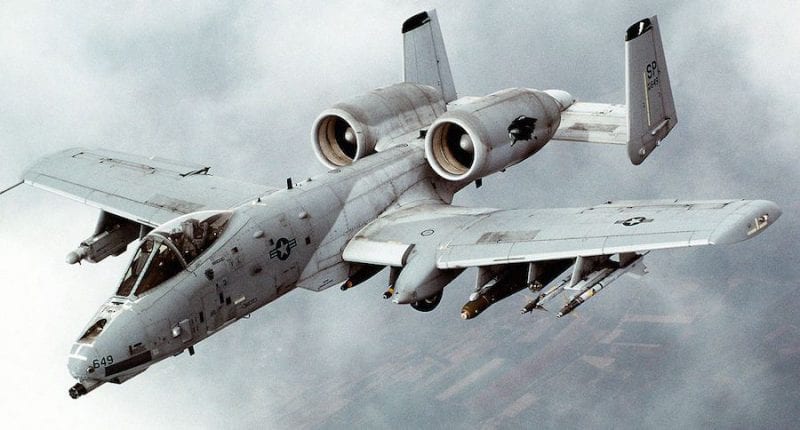
A-10 Warthog (above) took first flight in 1972, designed to take on Soviet Red Army tanks in western Europe with a cannon gun. The jet flies low and slow with no survivability against modern air defense system, even basic MANPADs (man-portable-air-defense systems).
It was scheduled for retirement by 2026, but the USAF announced this week it will extend the service to 2030 as there is no ready replacements.
The F-15 Strike Eagle took first flight also in 1972, created for “air superiority” after the Vietnam War. The fighter has a lot of raw power as a heavy twin-engine jet but suffers from antiquated radar, sensor fusion, and networking.
The Tomahawk cruise missile was developed in the 70s and entered service in 1983. The latest Block V versions being fired today have to squeeze modern electronics into a 1970s-designed frame.
The Patriot air defense missile was developed in the 1960s. Although it is constantly upgraded (PAC-3 is the latest version), it suffers from “physical ceiling” of the original hardware – the airframe, power systems, internal cooling, and data bus were never built for 21st century technology.
The 1970s design philosophy for the Patriot was to fly “near” a target and explode (“Blast-Fragment”). However, to stop a modern hardened ballistic missile, you need to hit it directly (“Hit-to-Kill”), which is beyond Patriot interceptors.
E-3 Sentry AWACS entered service first in 1977, and production also long stopped. Still highly valued as the primary Air Battle Manager (ABM) of the USAF, the E-3 is incredibly expensive to maintain, and its 50-old airframe is long scheduled for retirement by now.
However, the E-3 Sentry’s successor – the E-7 Wedgetail – won’t be ready for at least 2 to 3 years. If it arrives at all. Read here how Pentagon left E-7 out of the 2027 budget. https://www.airandspaceforces.com/pentagon-leaves-e-7-out-of-budget-2027/
The US had a total fleet of 16 E-3 Sentry with only 7 or 8 in operational condition before the war. One was lost on the tarmac of the Prince Sultan Air Base after being struck by an Iranian drone. The loss cannot be replaced.
The E-3 destruction in Saudi Arabia shows that even if these aircraft stay far back, they are vulnerable on the ground to hypersonic missile and drone strikes.
Comparing with China
One main challenge in any Pacific conflict is the “tyranny of distance.” To provide meaningful command and control, a US AWACS must fly close enough to the front lines to detect China’s low-observable threats like the J-20 or GJ-11.
However, China’s development of “AWACS-killer” missiles, such as the 400 km PL-17 and the 6,000 km scramjet-powered CJ-1000, has created a “no-go zone” that extends thousands of kilometers.
On the other hand, China’s AWACS, including KJ-3000, KJ-700, and KJ-600, can safely operate within the A2AD bubble protected by a fully integrated air defense network (IADN).
The network includes land- and ship-based mid/long-range defence interceptors (HQ-29, HQ-19, HQ-9B, HHQ-9) and terminal defence (HQ-11, HQ-20, Bullet Curtain barrage gun, and Hurricane-3000 anti-drone microwave weapon).
Norinco has developed two world-first anti drone swarm weapons
Feb 10
Drones are heralding a new era of warfare in the Ukraine battlefield. As much as 70% of all casualties are reportedly caused by drones.
Since the US has long relied on stealth as the “tip of the spear” to establish air superiority, China has built an anti-stealth network of radars.
China has moved beyond single-radar detection to a distributed sensor fusion model that combines multiple specialized technologies into a unified “kill web”.
This system includes –
1. Meter-Wave & ultra-high frequency (UHF) “Stealth Killers”
Long-wavelength radars that can bypass the geometric shaping of stealth aircraft like the F-22 and F-35.
JY-27V: A mobile meter-wave AESA radar unveiled at the 11th World Radar Expo in 2025. It is designed to detect stealth targets at long ranges and can be deployed in under 10 minutes.
YLC-8E: Often called the “flagship” of Chinese anti-stealth radar, it operates on UHF bands and can track stealth targets at ranges exceeding 500 km.
SLC-7: A 4th-generation “intelligence radar” that can simultaneously track stealth jets, drones, and even incoming artillery shells.
2. Advanced Passive & Quantum Sensing
To remain undetected while tracking targets, China has heavily invested in sensors that do not emit detectable signals themselves.
- Quantum Radar: In January 2026, China had begun mass production of single-photon detectors, a critical component for quantum radar. These systems use entangled photons to reveal stealth aircraft by identifying tiny electromagnetic disturbances.
- Passive Detection: These networks “listen” for disturbances in existing background signals (like TV or radio waves) caused by an aircraft’s movement, making them nearly impossible for a stealth jet to jam or locate.
3. Integrated Airborne & Space-Based Nodes
Detection data is instantly shared between ground stations, aircraft, and satellites to provide a 360-degree view.
- KJ-series AWACS: Acts as the “all-seeing” hub of the network. They provide offboard targeting data to Chinese fighters (like the J-20), allowing them to fire missiles at stealth targets without ever turning on their own radars.
- Satellite Constellations: Use optical, radar, and infrared sensors to provide near-continuous surveillance of stealth assets from orbit.
- Innovative Illumination: Recent research experiments have even explored using the signals from Starlink satellite networks to “illuminate” and track stealth targets.
4. AI and Signal Processing
The biggest challenge for counter-stealth radar is “clutter” (noise). To solve this, China’s 2026-era systems use AI pattern recognition to filter through environmental noise and confirm the subtle signature of a stealth fighter in real time.
Chinese AWACS already have achieved a generational lead over US technology.
The KJ-3000 uses GaN active electronically scanned array (AESA) radar in its rotodome – two generations ahead of E-3 Sentry, which uses passive electronically scanned array (PESA).
PESA technology has long been replaced by gallium arsenide (GaAs) AESA tech, which in turn has been succeeded by the gallium nitride (GaN) AESA.
KJ-3000 also has passive sensing and strong anti-jamming capability and is the world’s first AWACS to use digital radar.
KJ-700 features fixed 3-sided GaN AESA rotodome with side-looking AESA arrays and unique electro-optical/infrared (EO/IR) sensor.
China has blocked the upgrade path of its adversaries to the GaN technology as it monopolizes the production of high-grade gallium used in the gallium-nitride semiconductors.
In drone tech, China’s lead is even wider.
Compared with Iran’s low-cost suicide drones, China fields the world’s most diverse and advanced military drone fleet.
China’s unmanned combat and ISR UAVs include high-altitude long-endurance (HALE) drones (WZ-7, WZ-9, CH-7, and WZ-10), “loyal wingman” drones (GJ-11/21, Anjie, FH-97), and the world’s only hypersonic ISR drones (WZ-8 at Mach 6 and MD-22 at Mach 7).
China has already operationalized and fielded the manned-unmanned pairing (“loyal wingman”) between J-20 and GJ-11 and between J-35 and GJ-21 (for carrier operation), while the US’s collaboration combat aircraft (CCA) program is only at prototyping stage.
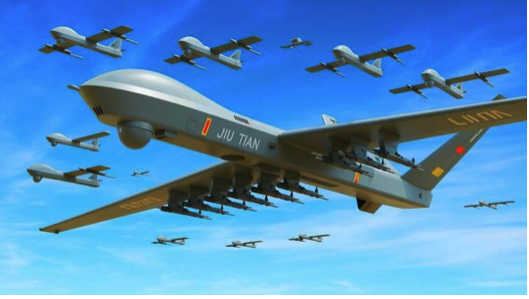
China has also deployed the world’s first drone mothership – the Jiu Tian drone carrier – a UAV that can release 100 smaller drones or loitering munitions.
Introducing Jiutian drone swarm carrier – a sci-fi level engineering marvel
June 7, 2025
The surprise Ukrainian attack on Russia strategic airfields caused quite a bit social media discussions in China. Two take-aways stand out –
Read full story IN PART 3 OF THIS SERIES.
For readers interested in Chinese military drones, you can refer to my many articles on the subject.