Home ACTIVISTS & HEROESViolence, Revolution, and Structural Change in Latin America (Revised and expanded)

Violence, Revolution, and Structural Change in Latin America (Revised and expanded)

Understand US imperialism once and for all • From our Virtual University archives • Edited and expanded by Patrice Greanville

by Main Desk Editors
2 comments 15 minutes read
Text A+Text A-
Reset
Be sure to share these materials with friends, kin, and workmates.

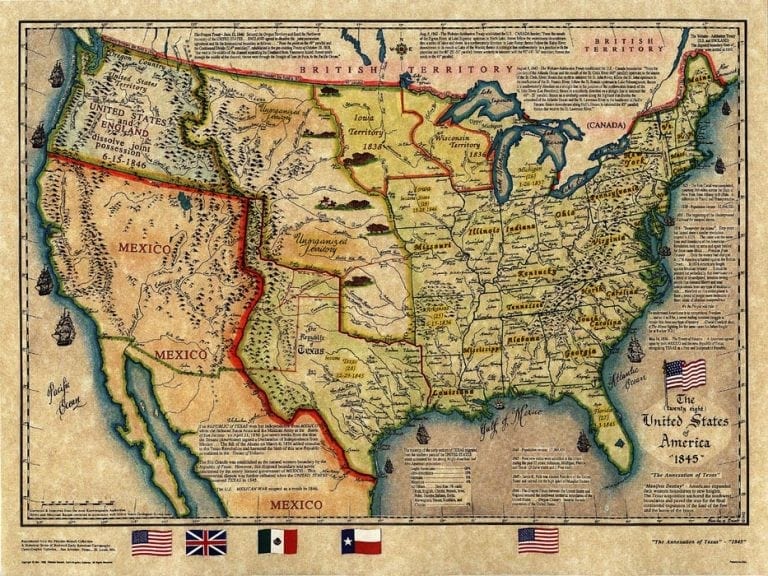
This map of USA and Mexico as of 1845 is eloquent. Note the map does not yet include Texas, which was also acquired from Mexico via internal Yankee agitation and subterfuge.


Originally posted on June 6, 2013 • Revised 29 June 2019

Well, plus que ça change...here we are in 2013 and the imperial monster is as ravenous and vicious as ever, threatening wars in all latitudes, while its formal democracy rapidly dissolves into a badly concealed "friendly fascism" behind a bipartisan presidential façade. Though now four decades old, this overview of hemispheric conditions by John Gerassi (and the dialectics of US foreign policy chiefly afflicting Latin America in the 1960s) is disturbingly prescient for what it says about America itself, and in particular the role of American liberals.  While his call for immediate action may sound outdated or premature to some, if not downright uncomfortable to many, his narrative attests to the fact that we face not so much passing personalities—no matter how despicable— but a system that produces them. Despite these caveats, this essay remains one of the finest lessons in US history likely to be found anywhere. And do not miss the superb comment by our globetrotting senior editor Gaither Stewart, who knows the Latin continent well.
—Patrice Greanville


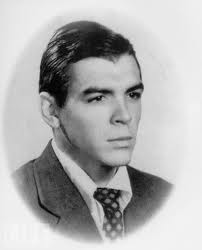
Ernesto "Che" Guevara, as a young medical student, in Argentina. "One Vietnam, Two Vietnams..Many Vietnams..."

By John Gerassi (first published in 1969)

A great deal is being written in America these days about Pax Americana and American hegemony in the underdeveloped world. No longer able to blot out the obvious, even calm, rational, conscientious academicians are publicly lamenting America’s increasingly bellicose policies from Vietnam to the Dominican Republic. Suddenly, as if awakened from a technicolor dream, intellectuals are discovering such words as “imperialism” and “expansionism.” And they are asking: Why? Who’s to blame? What can be done to stop all this? 

The questions are childish, the assumptions false, the implications naïve. They reflect a liberal point of view, one that claims that there is a qualitative difference between U.S. policies today and yesterday. In fact, American foreign policy has varied only in degree, not in kind. It has been cohesive, coherent, and consistent. What has varied has been its strength—and its critics.

The basic difference between American imperialism today and American imperialism a century ago is that it is more violent, more far-reaching, and more carefully planned today. But American foreign policy, at least since 1823, has always been assertive, always expansionist, always imperialist. Of course, it has rarely been pushed beyond America’s capabilities. Thus, when the United States was weak, its interventions abroad were mild. When its strength grew, so did its daring. Today, as the most powerful nation on earth, with a technological advance over other countries of mammoth proportions, the United States can be imperialistic on all continents with relative security.

The main reason why we have not had the opportunity to discuss this imperialism frankly and openly within the United States—in its journals, in academia, and on other platforms—is because Americans’ interpretation of history has been dominated by liberal historians whose basic view of life is characterized by their inability or unwillingness to connect events. Thus, when viewing Latin America, where American policy has always been crystal clear, Americans historians will admit, indeed will detail, U.S. interventions in specific countries of Central America or the Caribbean, will sometimes even posit an imperialist explanation for a whole period of American history, but will never draw overall conclusions, will never connect events, economics, and politics to arrive at a basic tradition or characteristic. To such historians, for example, there is little if any correlation between the events and policies of 1823 and those of 1845, or between 1898 and 1961.



A word on James K. Polk, one of the earliest and most successful "internal imperialists"
By Patrice Greanville


IMAGE: Gen. Santa Ana surrenders to a wounded Sam Houston after the battle of San Jacinto.

Victory over Santa Anna at San Jacinto

Texian leader Sam Houston's victory over Gen. Santa Anna at the battle of San Jacinto on April 21, 1836 sealed the dismemberment of Mexico and the acquisition of an enormous territory almost as large as Western Europe. In the immediate aftermath of the war, some prominent Mexicans wrote that the war had resulted in "the state of degradation and ruin" in Mexico, further claiming, for "the true origin of the war, it is sufficient to say that the insatiable ambition of the United States, favored by our weakness, caused it."


The Mexicans certainly didn't know it, all gringoes looking more or less the same to them, basically pale, tallish Northern Europeans, but the specific plague that hit Mexico in the 1840s was one of Scots-Irish origin. Most of the Texian heroes and agitators for Texas independence, and later absorption into the newly-minted United States were of Scots-Irish descent: Sam Houston, James Polk, William Walker, James Bowie, the legendary Andrew Jackson, and so on, themselves offshoots of the great Scots-Irish migration flowing out of the Ulster Plantation in the 1700s, and Scotland itself. Most of of the Scots-Irish had emigrated to the Ulster Plantation fleeing the almost constant wars —practically 800 years—on the Scottish-English border and later Charles I's pressures to adopt the Episcopal faith over their fanatical Presbyterian allegiances. As the Wiki summary reminds us:


James K Polk, Mexico's nemesis, in a 1849 daguerrotype. A protege of Jackson, his main legacy was one of immense territorial expansion at the expense of a much weaker nation, a land grab impossible to resist by White America's pervasive racism and inherited anglo hatred for all things Spanish.

Most of these emigres (to America) from Ireland had been recent settlers, or the descendants of settlers, from the Kingdom of England or the Kingdom of Scotland who had gone to Ireland to seek economic opportunities and freedom from the control of the episcopal Church of England and the Scottish Episcopal Church. These included 200,000 Scottish Presbyterians who settled in Ireland between 1608-1697. Many English-born settlers of this period were also Presbyterians, although the denomination is today most strongly identified with Scotland. When King Charles I attempted to force these Presbyterians into the Church of England in the 1630s, many chose to re-emigrate to North America where religious liberty was greater. Later attempts to force the Church of England's control over dissident Protestants in Ireland were to lead to further waves of emigration to the trans-Atlantic colonies. (See Wikipedia, Scotch-Irish Americans). 


James Knox Polk, the first of ten children, was born on November 2, 1795 in a log cabin[1] in what is now Pineville, North Carolina, in Mecklenburg County,[2] to a family of farmers.[3] His father Samuel Polk was a slaveholder, successful farmer, and surveyor of Scots-Irish descent. His mother Jane Polk named her firstborn after her father, James Knox.[2] The Polks had migrated to America in the late 1600s, settling initially on the Eastern Shore, then in south-central Pennsylvania and eventually moving to the Carolina hill country.[2]


Like many early Scots-Irish settlers in North Carolina, the Knox and Polk families were Presbyterian. (See Wikipedia, James K Polk)

It is quite possible that the family and cultural roots of James Polk instilled in him a fierce sense of raw nationalism, boundless entitlement to riches and empowerment through merit, both unfortunately underscored by racism, an almost inevitable virus infecting Europeans at the time (and surely present still today among far too many white Americans), especially when confronted with what he surely perceived as a degenerate and "inferior" semi-indigenous civilisation ludicrously in possession of a territory of almost incalculable value.


The story of the Mexico's loss of her original territory (if we accept the notion that what the Spaniards conquered was legitimate and not in itself also a land grab at sword and gun point) to the nascent American empire would not be complete without mention of Sam Houston, the signer of Texas' declaration of independence, a man with cultural roots in both Tennessee and Texas, and certainly one of the most charismatic and, in his own way, admirable and tragic political figures in US history. Like Polk, who often acted as his political mentor and protector, Houston was Scotch-Irish by descent, but his family traced its origins back to Scotland not to the kind of desperate poverty often defining the lives of most Scots-Irish immigrants, but to the benefits and privileges of landed gentry:

Sam Houston was the fifth son of Major Samuel Houston and Elizabeth Paxton. Houston's paternal ancestry is often traced to his great-great grandfather Sir John Houston, who built a family estate in Scotland in the late seventeenth century. His second son John Houston emigrated to Ulster, Ireland, during the Ulster plantation period. 

A person of integrity and moral courage Houston also stood out among his peers by his friendly and respectful attitude toward native Americans, with whom he had lived several years in his youth:

Young Sam was 14 when his family moved to Maryville (Tennessee), and he had received only a basic education on the Virginia frontier.[11] He ran away from home in 1809 at age 16 because he was dissatisfied working as a shop clerk in his older brothers' store. He went southwest and lived for a few years with the Cherokee tribe led by Ahuludegi (also spelled Oolooteka) on Hiwassee Island in the Hiwassee River, above its confluence with the Tennessee River. Ahuludegi had become hereditary chief after his brother moved west; American settlers in the area called him John Jolly. He became an adoptive father to Houston, giving him the Cherokee name of Colonneh, meaning "the Raven".[12] Houston became fluent in the Cherokee language while living with the tribe. He visited his family in Maryville every few months. (See Wikipedia, Sam Houston)

The above is quite unusual for an American politician, to say the least, even a man from the so called "frontier". But there were many other things that made Houston a man clearly out of the ordinary, including, later, his refusal to see the young state of Texas embroiled in the Civil War on the side of Secession, for which he paid a heavy price:


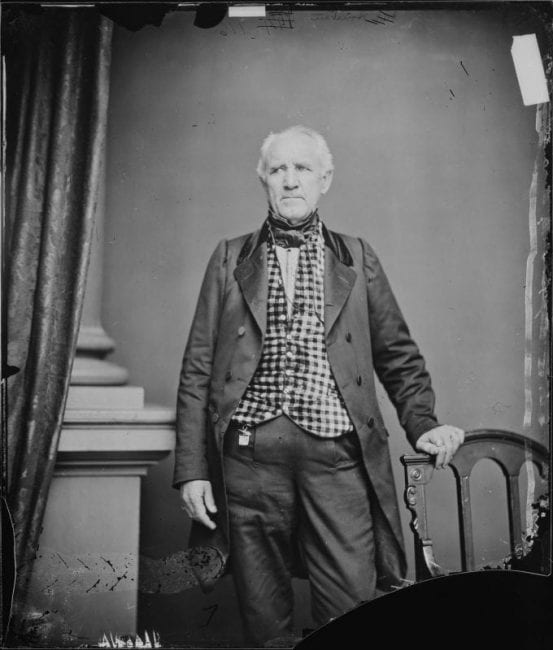
Sam Houston, photograph by Mathew Brady, c.1860–1863

Although Houston was a slave owner and opposed abolition, he opposed the secession of Texas from the Union. An elected convention voted to secede from the United States on February 1, 1861, and Texas joined the Confederate States of America on March 2, 1861. Houston refused to recognize its legality, but the Texas legislature upheld the legitimacy of secession. The political forces that brought about Texas's secession were powerful enough to replace the state's Unionist governor. Houston chose not to resist, stating, "I love Texas too well to bring civil strife and bloodshed upon her. To avert this calamity, I shall make no endeavor to maintain my authority as Chief Executive of this State, except by the peaceful exercise of my functions ... " He was evicted from his office on March 16, 1861, for refusing to take an oath of loyalty to the Confederacy, writing in an undelivered speech,

Fellow-Citizens, in the name of your rights and liberties, which I believe have been trampled upon, I refuse to take this oath. In the name of the nationality of Texas, which has been betrayed by the Convention, I refuse to take this oath. In the name of the Constitution of Texas, I refuse to take this oath. In the name of my own conscience and manhood, which this Convention would degrade by dragging me before it, to pander to the malice of my enemies, I refuse to take this oath. I deny the power of this Convention to speak for Texas....I protest....against all the acts and doings of this convention and I declare them null and void.[39]

The Texas secession convention replaced Houston with Lieutenant Governor Edward Clark.[1] To avoid more bloodshed in Texas, Houston turned down U.S. Col. Frederick W. Lander's offer from President Lincoln of 50,000 troops to prevent Texas's secession. He said, "Allow me to most respectfully decline any such assistance of the United States Government."

After leaving the Governor's mansion, Houston traveled to Galveston. Along the way, many people demanded an explanation for his refusal to support the Confederacy. On April 19, 1861 from a hotel window he told a crowd:

Let me tell you what is coming. After the sacrifice of countless millions of treasure and hundreds of thousands of lives, you may win Southern independence if God be not against you, but I doubt it. I tell you that, while I believe with you in the doctrine of states rights, the North is determined to preserve this Union. They are not a fiery, impulsive people as you are, for they live in colder climates. But when they begin to move in a given direction, they move with the steady momentum and perseverance of a mighty avalanche; and what I fear is, they will overwhelm the South.[40]

While many are led to believe that history is peopled with black and white characters, and this is sometimes the case, the more usual situation is one of gradations in gray, with good and evil mixed in often unsortable ways. Sam Houston's life is a cautionary note in this regard.

—PG

Click below to go to Page 2


Related Articles

2 comments

Gaither Stewart February 12, 2013 - 5:11 am

The old saying about Mexico’s ills still holds: Pobre Mexico tan lejos de dios y tan cerca de los Estados Unidos. Poor Mexico, so far from God and so near the United States. For there is no better place than Mexico to see first-hand the negative results of American capitalism – imperialism that has exploited the country’s hard working people for one hundred and fifty years. John Mason Hart in his monumental Empire and Revolution answers the question many Americans are asking today: “Why do they hate us so much?” At the outset Professor Hart, University of Houston, quotes a passage from Mexican writer Carlos Fuentes’ masterpiece, The Death of Artemio Cruz, the gist of which is that one cannot commit what North Americans have committed against Mexico and expect to be loved. Hart sees the historical attitudes of the United States toward its southern neighbor as the model for America’s drive for world hegemony today. It was in Mexico that the historic compulsion of American elites toward external wealth and global power was first expressed. Monroe Doctrine is of course geographical bullshit. South America, rather, all of Latin America, is another world. Mexico, on the US southern border (a shifting border, according to US policies since Mexico once included great territories north of today’s border) is a different world that relatively few Americans even know. One foot inside Mexico at the Laredo, Tx border, everything changes. You are in another world. A world that could have enriched the USA spiritually and not just US business-money interests. Nothing justifies US exploitation of the huge continent of South America and Latin America beginning on the US border, now “protected” from Latinos searching for work in the home of the Imperialism that has impoverished their homelands for two centuries.

Reply

Leave a Comment

* By using this form you agree with the storage and handling of your data by this website.

The Greanville Post
Focus Mode