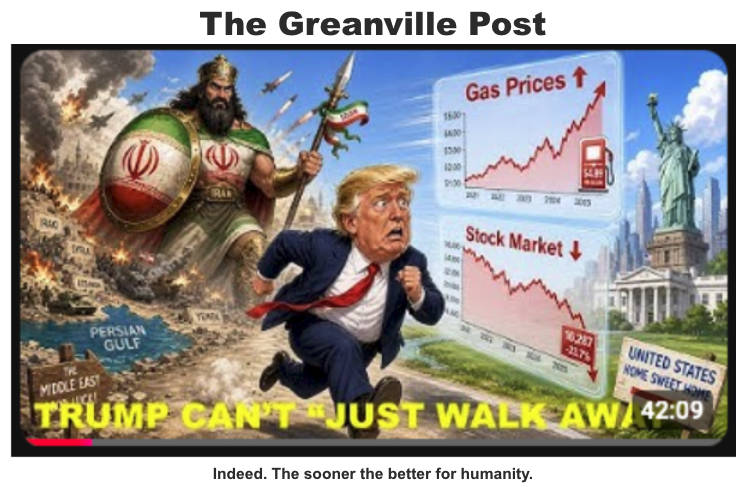
Part 2 with Scott Ritter
Scott Ritter: Iran Didn’t Break. It Adapted, Now Stronger Than Ever

[00:05] The discussion opens with Benjamin Netanyahu’s recent interview on 60 Minutes, where he claims the Middle East war could end within months. The guest speaker expresses skepticism about Netanyahu’s timeline, highlighting his history of repeatedly predicting imminent threats, particularly Iran’s nuclear capabilities, without substantive results. Scott Ritter argues that Netanyahu’s influence has sharply declined, considering him irrelevant to current geopolitical realities.
[01:13] It is emphasized that the United States currently lacks the conventional military capacity to wage a meaningful war against Iran. The economic consequences of such a conflict are significant and politically damaging for the U.S. administration. Scott Ritter stresses that Israel’s actions have become a liability rather than a solution, with American public support for Israel dropping to around 59%. Israel is described as dependent on the U.S., and currently, its role is that of a “problem,” not a driver.
[02:44] The discussion reveals that Israel played a role in instigating the current conflict after Netanyahu and his Mossad director allegedly misled the U.S. president during a White House meeting on February 11th. Scott Ritter criticizes the war’s outcomes, which have been disastrous rather than beneficial, leaving the U.S. president “holding a bag of crap” with deteriorating options. Netanyahu’s political and military influence is portrayed as waning, overshadowed by larger U.S. ambitions.
[03:44] The broader geopolitical context is introduced: Donald Trump’s global strategy is framed not as a genuine multipolar recognition but as an ego-driven attempt at global domination. The U.S. aimed to control energy supplies to China—specifically through destabilizing Venezuela and Iran—to undermine China’s economy and strengthen U.S. influence in the Pacific. The war is thus described as a proxy for energy dominance rather than a response to Iran’s nuclear program, which Scott Ritter asserts is a false pretext.
[05:17] The failure of this energy control strategy is noted, with China not capitulating as originally intended. Trump’s canceled China trip signals a shift from dictating terms to seeking cooperative solutions to a messy geopolitical problem. Scott Ritter highlights that Trump’s global vision has collapsed and that his administration is giving poor advice, including from military leaders like Scott Bessant, whose efforts to weaken Russia and China have faltered.
[07:15] Netanyahu’s political standing in Israel is described as fragile, with his security policies deemed ineffective. Scott Ritter points out ongoing problems: Hamas remains unresolved, Hezbollah is active and effective in Lebanon, Syria remains unstable, and Iran’s influence is growing. Iran’s ballistic missile program has been restored and enhanced, with capabilities reportedly stronger than at the conflict’s outset. This signals a strategic disadvantage for Israel and the U.S.
[09:20] A timeline of missile capabilities is discussed:
| Actor | Missile Capability Status | Notes |
|---|---|---|
| Iran | 120% capacity and growing | Reconstituted ballistic missile force; expanding |
| CIA Estimate | 90% capacity | Conservative estimate of Iranian missile readiness |
| United States | Nearly depleted missile inventory | Pentagon briefing indicates lack of long-range munitions; cannot sustain prolonged conflict |
The U.S. and Israel are described as being on the losing side, lacking sufficient missile interceptors and munitions for sustained warfare, particularly against Iran.
[10:48] The effectiveness of Israel’s Iron Dome missile defense system is questioned. Iron Dome was designed to intercept low-cost, unguided rockets primarily from Hamas, not sophisticated drones or ballistic missiles. Scott Ritter explains that FPV (First Person View) drones fly low and evade radar detection, making them difficult to counter. Hezbollah’s drone operations have matured significantly, employing tactics learned from conflicts in Ukraine and Russia.
[12:02] Details on FPV drone warfare include:
- FPV drones are fiber-optic guided to resist electronic jamming.
- Operators accept losses as part of drone warfare, replacing lost drones promptly.
- Early Hezbollah drone attacks were rushed, but current tactics show patience and precision.
- Drones create psychological effects by instilling fear and forcing enemy focus on defense.
- Hezbollah’s drone range is estimated at 20 kilometers, with potential extension to 60 kilometers, threatening Israeli safe zones.
This evolution in drone warfare shifts battlefield dynamics, limiting Israeli infantry and armored assaults and increasing Israeli casualties.
[18:44] The Iranian stance on the conflict is introduced, highlighting their anticipation of an inevitable U.S. attack. Iran’s foreign minister, Arachi, has communicated with China and Russia warning that attacks on Iranian interests would trigger severe retaliation. Iran has explicitly threatened:
- Destruction of Gulf Arab states’ energy infrastructure on day one if attacked.
- Potential disruption of internet and communication cables in the Gulf.
- Targeting desalination plants, aggravating water scarcity in the region.
These warnings complicate any U.S. decision to escalate military action, as consequences for regional stability and global energy markets would be severe.
[22:00] Scott Ritter estimates that the U.S. has about one week’s worth of effective bombing capability left due to depleted munitions stocks. Past targeting efforts, despite claims of precision, resulted in civilian casualties, demonstrating the limits of military options. The lack of interceptor missiles further weakens U.S. and Gulf Arab defensive posture, while Iran’s missile capacity continues to strengthen.
[23:50] The mental state of Donald Trump is discussed candidly. Scott Ritter references psychiatric analyses labeling Trump as a malignant narcissist, a diagnosis that has been vindicated by his erratic behavior. This mental instability complicates geopolitical and military decision-making, injecting unpredictability into U.S. actions. However, Scott Ritter also notes that Trump’s narcissism could be leveraged to encourage a peaceful resolution if his legacy and political survival are framed as contingent on avoiding further conflict.
[26:30] The role of China and Russia as diplomatic brokers is underscored. Both countries appear willing to facilitate a de-escalation, seeking regional stability to protect their own interests, including energy supply continuity. China has been notably restrained in its public statements, signaling a strategic choice to maintain leverage and broker a deal.
[27:39] Iran’s skepticism toward direct agreements with the U.S. is explained, rooted in past betrayals such as the U.S. withdrawal from the JCPOA under Trump. Scott Ritter asserts that the United States as a whole is agreement incapable, not just the president, due to institutional and ideological commitments to American hegemony. Iran’s best hope lies in a deal born of desperation rather than trust.
[30:15] The analogy of the U.S. as unpredictable “weather” is used to illustrate the challenges of dealing with American foreign policy. Despite its unreliability, the global community must contend with U.S. actions as an unavoidable reality. Scott Ritter stresses that Iran and others must adjust their expectations accordingly.
[32:45] The Gulf Cooperation Council (GCC) countries’ fractured positions are analyzed:
| GCC Country | Position / Role | Notes |
|---|---|---|
| UAE | Closely aligned with Israel | Allowed Israeli troops and Iron Dome on its soil |
| Kuwait | Weak military, limited negotiating power | LNG exports halted, economic difficulties |
| Bahrain | Sunni ruler with Shia majority | Internal instability risk |
| Saudi Arabia | Divided stance, some pushback against Israel | Long-standing tensions with UAE |
| Qatar | Regional player with Turkish ties | Supports Turkey’s military presence |
| Oman | Potential partner in regional security | Discussed joint stewardship of Strait of Hormuz |
The GCC is described as an institution in decline, with growing awareness that Iran’s regional dominance is irreversible. Members will need to adapt by reducing hostility toward Iran and lessening reliance on the U.S. military presence.
[40:58] The possibility of a new regional security architecture involving Russia, China, Iran, and Gulf states is explored. Scott Ritter notes parallels with shifts in Europe’s stance toward Russia, driven by energy needs and geopolitical realities. Both Europe and the Middle East are forced to reconsider their security policies in light of diminished U.S. influence.
[44:08] Regarding the potential for peace and political solutions, Scott Ritter highlights key issues:
- Nuclear program: Iran’s 60% enriched uranium stockpile could be shipped out to a neutral party (e.g., Russia), closing the pathway to a bomb and providing a political victory for Trump.
- Strait of Hormuz: A shared security arrangement involving Iran and Oman could stabilize this critical chokepoint.
- U.S. military footprint: Expected to be significantly reduced, with bases closed or eliminated.
These compromises are seen as feasible with Chinese involvement, despite U.S. institutional dysfunction.
[49:27] The impact on Israel is profound. The Abraham Accords, which underpin Israel’s regional economic and security gains, could collapse if Gulf states normalize relations with Iran. Without this accord, Israel’s long-term survival and prosperity are uncertain, shifting the focus from expansion to mere survival.
[50:55] Scott Ritter predicts that Trump could claim credit for resolving both the Iran and Russia conflicts, satisfying his narcissistic need for recognition. This political narrative could be key to enabling peace, even if the substantive complexities remain.
[51:38] The BRICS nations are discussed as an emerging geopolitical bloc with potential to reshape global economics and diplomacy. Despite internal differences and external pressures, BRICS is increasingly relevant, particularly with Iran’s survival as a member. Trump’s antagonism toward BRICS and efforts to isolate Russia and Iran have complicated its growth but have not prevented its viability.
[54:35] Scott Ritter provides insight into the global currency landscape, emphasizing the continued dominance of the U.S. dollar tied to the petrodollar system. Despite calls for alternatives like the yuan or ruble, no currency currently offers the liquidity or global acceptance to fully replace the dollar. Localized currency trades exist but are limited in scope and scale. Stability of the global economic system is a priority, with the dollar expected to remain the reserve currency for the foreseeable future.
[57:24] The ongoing U.S. economic challenges, including damage from sanctions and tariffs under Trump, are acknowledged as self-inflicted wounds undermining American power. Scott Ritter anticipates a normalization of economic policy to restore stability, recognizing the limits of unilateral American dominance.
[58:58] The overall conclusion is that the U.S. is no longer capable of maintaining global hegemony through military or economic coercion. U.S. policy must adapt to a multipolar world where cooperation is necessary, even if imperfect. The upcoming China trip by Trump is viewed as a critical test of whether the U.S. leadership can adjust to this new reality or remain trapped by narcissism and institutional dysfunction.
[01:01:20] Scott Ritter expresses skepticism about India’s current strategic positioning. India remains indecisive and overly reliant on ties with the U.S., while Pakistan is praised for its diplomatic maturity and efforts to broker peace in the region. The future of BRICS depends partly on India’s eventual commitment to the bloc and its willingness to repair relations with China.
[01:04:44] The conversation closes with a personal appeal from Scott Rider, the guest. He describes his work as independent journalism with no institutional backing, funded by subscriptions and donations. He highlights the urgency of his mission to promote peace and understanding, driven now by a personal commitment to future generations, including his newborn granddaughter. He encourages support for independent media as a vital institution capable of sustaining informed dialogue beyond individual personalities.
Key Takeaways:
- Benjamin Netanyahu’s influence is waning, and his predictions about the Middle East conflict are viewed with skepticism.
- The U.S. lacks sufficient military capacity to sustain a war against Iran or China, with depleted missile inventories and no clear path to victory.
- The war is primarily about controlling energy flows to China, not Iran’s nuclear program.
- Iran’s ballistic missile capabilities have been restored and enhanced, shifting the strategic balance.
- Hezbollah’s FPV drone warfare represents a significant tactical evolution, challenging Israeli defenses and traditional military tactics.
- Iran has issued severe warnings to Gulf states and the U.S. against attacks, threatening widespread regional disruption.
- The mental instability of Donald Trump complicates U.S. policy, but his narcissism could paradoxically incentivize peace if legacy concerns prevail.
- China and Russia are key diplomatic brokers, seeking to stabilize the region and protect their interests.
- The U.S. is ‘agreement incapable’ institutionally, limiting prospects for durable diplomatic accords.
- The GCC is fractured and declining, with most members likely needing to normalize relations with Iran.
- A new regional security architecture involving Iran, GCC states, Russia, and China is likely to emerge.
- The Abraham Accords and Israel’s regional position are at risk if Gulf states pivot toward Iran.
- BRICS remains a critical emerging bloc, with Iran’s survival as a member essential to its relevance.
- The U.S. dollar will remain dominant globally, despite challenges and calls for alternatives.
- The global order is shifting from U.S. dominance to multipolarity, requiring adaptation by all actors.
- Independent journalism and informed dialogue are essential for navigating and understanding these complex changes.
This comprehensive analysis reflects the geopolitical, military, economic, and regional dynamics shaping the current Middle East conflict and global order as of mid-2026.
Go to next page for more analysis, Part 3, with Lt Col. Anthony Aguilar