
[su_spoiler title=”Please make sure these dispatches reach as many readers as possible. Share with kin, friends and workmates and ask them to do likewise. ” open=”yes” style=”fancy” icon=”arrow-circle-1″]
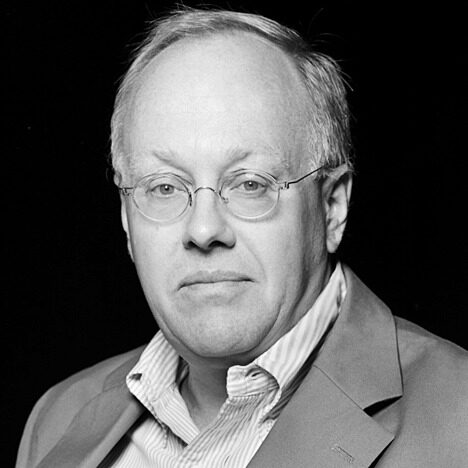
 Chris Hedges
| Traducir—Translate! | |
| Make fonts bigger>>> | [wpavefrsz-resizer] |

Summary
The 2025 Edward Said Memorial Lecture, hosted by the Australian Friends of Palestine, featured an in-depth and poignant address by Pulitzer Prize-winning journalist Chris Hedges, alongside powerful introductions and reflections by community leaders and activists. The event opened with a traditional Aboriginal welcome by Uncle Morgi, setting a tone of respect, reconciliation, and shared struggle between Indigenous Australians and Palestinians, emphasising the deep, intertwined connection of land, identity, and resistance.
Samar, a Palestinian healthcare worker and activist based in Adelaide, highlighted the importance of cultural preservation and grassroots solidarity efforts through healthcare and traditional embroidery workshops. Salah, a second-generation Palestinian diaspora member, spoke passionately about the paradox of living in exile—both present and absent—bearing witness to the Palestinian struggle while navigating displacement and identity. He connected the Palestinian cause intimately to Indigenous struggles worldwide, underscoring the shared fight for freedom and belonging.
Chris Hedges delivered a comprehensive, historically grounded, and morally charged lecture on the ongoing genocide in Gaza, the failures of peace processes, and the complicity of Western powers, particularly the United States, in enabling Israeli settler colonialism and ethnic cleansing. He traced decades of broken agreements, the erosion of Palestinian rights, and the deliberate destruction of Gaza’s cultural heritage, framing the current catastrophe as the culmination of a settler-colonial project embedded in deep historical roots and ideological extremism.
Hedges condemned the international community’s failure to enforce humanitarian law, the media’s complicity in silencing Palestinian voices, and the rise of fascistic tendencies in Israel and globally. He drew parallels between Israel’s actions and other historical genocides, emphasizing the systemic nature of such violence within Western imperialism. The lecture concluded with a sobering reflection on the erosion of democracy, press freedom, and civil society in the West, and a call for militant union activism and civil disobedience as critical avenues for resistance.
A subsequent discussion with Hedges delved into the prospects for Palestinians trapped in Gaza, the challenges of shifting geopolitical alliances, the decline of U.S. global power, and the role of activism in confronting entrenched power structures. Hedges underscored the urgent need to halt military aid to Israel, break blockades, and challenge the dominant narratives perpetuated by powerful media and political elites. He offered a bleak but honest assessment of the current political climate in the U.S., warning of authoritarian consolidation and the closing of democratic spaces.
The lecture and dialogue together provided a rigorous, insightful, and emotionally charged analysis of the Palestinian struggle, the broader implications of settler colonialism and genocide, and the imperative for global solidarity and courageous truth-telling in the face of repression.
Key Insights
-
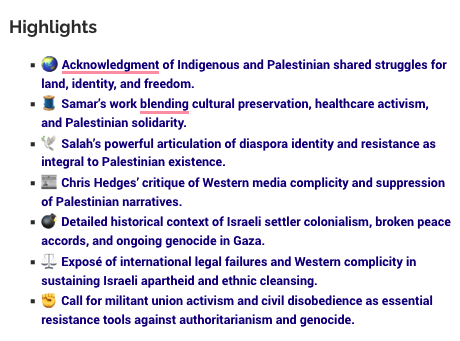
Interconnectedness of Indigenous and Palestinian Struggles: The lecture opens with an Indigenous welcome that resonates deeply with Palestinian experiences of dispossession and cultural erasure. This highlights a universal theme in anti-colonial resistance: the land as an extension of identity and memory, not a commodity. Such framing challenges dominant colonial narratives that legitimize occupation and dispossession. Understanding this connection enriches global solidarity movements and underscores the importance of cultural survival alongside political liberation.
-
Cultural Resistance as Political Resistance: Samar’s work in healthcare and traditional Palestinian embroidery workshops exemplifies how cultural practices serve as acts of resistance, healing, and education. These grassroots initiatives maintain Palestinian identity and community cohesion despite displacement and trauma, countering the erasure perpetuated by military occupation and genocide. This insight reveals the multifaceted nature of resistance beyond armed struggle, emphasizing the power of culture and solidarity.
-
Diaspora’s Dual Role in Advocacy: Salah’s testimony captures the complex identity of Palestinians in exile, who live with the paradox of assimilation and persistent connection to a homeland under siege. Diaspora Palestinians function as crucial witnesses and bridge-builders, translating stories that might otherwise be silenced. However, this duality also entails emotional exhaustion and the burden of constant representation. Recognizing this dynamic is essential for understanding the global Palestinian struggle and the significance of diaspora activism.
-
Genocide as the Logical Outcome of Settler Colonialism: Hedges situates the current genocide in Gaza within a broader historical trajectory of settler colonialism, ethnic cleansing, and broken peace accords. He argues that the ongoing destruction is not an aberration but encoded in the DNA of the Israeli apartheid state, sustained by unwavering U.S. military aid and diplomatic cover. This perspective shifts the conversation from isolated incidents to systemic and structural violence, demanding accountability for state-sponsored genocide.
-
⚖️ International Law and Peace Process Failures: The lecture critically dissects multiple peace agreements—from Camp David to Oslo—demonstrating how they have systematically failed Palestinians, often serving to legitimize further Israeli colonization and control. The lack of enforcement mechanisms, combined with Western political interests, has allowed Israel to violate international law with impunity. This insight exposes the limitations of conventional diplomatic approaches and the need for new strategies grounded in justice and human rights.
-
Media Complicity and Censorship: Hedges’ departure from mainstream media highlights the role of corporate media in perpetuating misinformation, silencing truth-tellers, and shaping public perception to favor Israeli narratives. The control of media access by Zionist groups and the demonetization and censorship on digital platforms reveal the entrenched mechanisms of narrative control. Understanding this media landscape is vital for activists and journalists committed to breaking through propaganda and amplifying marginalized voices.
-
✊ Urgent Need for Grassroots Activism and Global Solidarity: The discussion underscores that institutional change is unlikely without sustained militant union action, civil disobedience, and international pressure to cut military aid and break blockades. Hedges stresses that governments are complicit in genocide and that the power to halt violence lies in popular movements capable of disrupting economic and military flows. This insight calls for a reinvigoration of grassroots activism as the primary force to challenge entrenched power and prevent normalization of genocide.
Conclusion
The 2025 Edward Said Memorial Lecture powerfully articulates the moral, historical, and political dimensions of the Palestinian struggle within a global context of settler colonialism, imperialism, and rising fascism. Through the voices of Indigenous custodians, Palestinian activists, and a veteran war correspondent, the event not only condemns ongoing genocidal practices but also illuminates paths toward resistance, solidarity, and truth-telling. It is a clarion call to recognize shared humanity, confront oppressive systems, and mobilize collective action to ensure that the genocide in Gaza is neither ignored nor repeated.
BEFORE you leave, PLEASE pay attention to this alert.
[t4b-ticker id=”1″]
[/su_spoiler]
Print this article [bws_pdfprint display=’print’]
[su_note note_color=”#f1efef” radius=”0″]The views expressed herein are solely those of the author and may or may not reflect those of The Greanville Post, although, if we publish them, we obviously find them noteworthy and valuable. [/su_note]
 This work is licensed under a Creative Commons Attribution-NonCommercial 4.0 International License •
ALL CAPTIONS AND PULL QUOTES BY THE EDITORS NOT THE AUTHORS

