Thursday, October 8 2026 - Welcome • Bienvenidos • Bienvenu
The Rise and…Rise of ‘Color Revolutions’
Jim Kavanagh: Discussion with Garland Nixon on France/Euro Protests, Rejection of Zionism,...
MR: The Idea of the ‘Uyghur Genocide’ and the Realities of Xinjiang
Miracle and Bravery in the Skies Over the Middle East —Bollywood on...
Rees-Mogg Says He Supports the Mass-Murder of Children – and Liberals Fawn...
Democratic Party runs more than 60 military-intelligence candidates for Congress
War In The Time Of Drones & Nationalism
Youth uprising in Europe could spread from France and Spain to the...
Maysel Brar on Harpal Brar
The “Russian hybrid war” narrative: a new NATO strategy of tension?
  • HOME
  • ESSENTIAL
  • MYTH-FREE HISTORY WITH JACQUES PAUWELS
  • MUST VIDEO
  • BLOWBACK
  • NATURE
The Greanville Post
This is a truly world-civilizational war with no immediate end in sight, fought on many fronts. A fight to the death by the West against the Rest, for control of humanity.— Eric Arnow
  • HOME
  • ESSENTIAL
  • MYTH-FREE HISTORY WITH JACQUES PAUWELS
  • MUST VIDEO
  • BLOWBACK
  • NATURE
Home Author
Author

Kit Klarenberg

  • Author Profile
  • Posts by the Author
  • The Rise and…Rise of ‘Color Revolutions’
  • The Anglo-Nazi Global Empire That Almost Was
  • How ‘Human Rights’ Became Western Weapon
  • Case closed after ‘Russian disinfo’ claims led to persecution of NZ journalist
  • Voices From the Terror List: Palestine Action Members Speak Out After UK Ban
  • The Truth About the Fact-Checking Industry
Kit Klarenberg

KIT KLARENBERG is an investigative journalist exploring the role of intelligence services in shaping politics and perceptions. His work has previously appeared in The Cradle, Declassified UK, and Grayzone. Follow him on Twitter @KitKlarenberg.

The Rise and…Rise of ‘Color Revolutions’

by Kit Klarenberg Published: October 8, 2026
written by Kit Klarenberg 14 minutes read
Be sure to share these materials with friends, kin, and workmates.

Kit Klarenberg


The Rise and...Rise of 'Color Revolutions'
KIT KLARENBERG • SEPTEMBER 28, 2026

It’s rather forgotten today how Washington’s post-9/11 imperial adventurism was not restricted to military intervention. A core component of the Bush administration’s “Freedom Agenda” – under the auspices of which calamitous wars in Afghanistan, Iraq and elsewhere were waged – was overt sponsorship of civil society-led coups throughout the former Soviet Union, Warsaw Pact and Yugoslavia. Citizens of these regions, and the world, live with this meddling’s destructive consequences to this day. The seemingly never-ending – and ever-escalating – Ukraine proxy war is a particularly visceral legacy.

The 1983 creation of the National Endowment for Democracy, a US state entity avowedly concerned with executing overtly what the CIA once did covertly, ushered in a new era of “spyless coups”. Working in close conjunction with USAID and George Soros’ Open Society Institute, NED ever after provided funding, training and material assistance to NGOs, ‘independent’ media outlets, opposition groups, and other initiatives in service of regime change, across every corner of the world.

Come 9/11, NED and its confederates had devised a supremely cunning, cost-effective template for toppling troublesome governments – be they left-wing, nationalist, or even former US puppets who’d stepped out of line. The previous October, longtime Yugoslav leader Slobodan Milosevic was brought down in what the Washington Post bombastically dubbed “an extraordinary US effort to unseat a foreign head of state, not through covert action of the kind the CIA once employed in such places as Iran and Guatemala, but by modern election campaign techniques.”
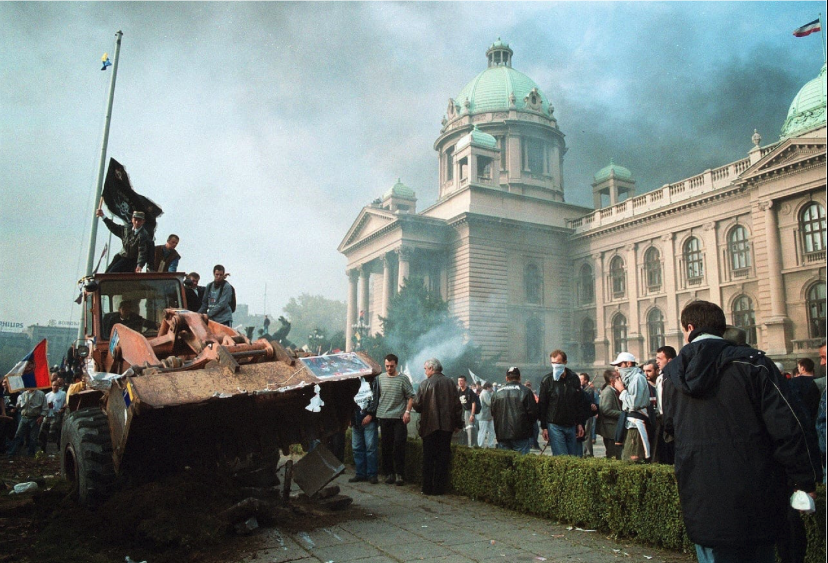


At the anti-Milosevic effort’s forefront was Otpor! (Serbian: Resistance!), a rebellious NED-funded youth activist group. Through a mix of civil disobedience, non-violent resistance, rock concerts, street theatre, and graffiti, they fomented mass public opposition to the Yugoslav President. When election day came and official results pointed to Milosevic’s victory, an NED-funded “parallel vote tabulation” purported to expose major fraud, sending millions to the streets of Belgrade to peacefully demand the President’s resignation. Milosevic duly capitulated, in the face of seemingly overwhelming people power.

The supposedly heroic struggle of Otpor! and other US-supported anti-Milosevic groups was immortalised in a slick ‘documentary’, Bringing Down A Dictator. Milosevic’s fall provided a precise blueprint for future ‘color revolutions’ – so-called because frequently, the Empire-supported activists who led these mob putsches prominently adopted specific colours for their banners, branding and logos. Initially, US officials eagerly associated themselves publicly with this upheaval. Meanwhile, the mainstream media routinely published remarkably illuminating post-mortems of the revolts, extensively exposing Washington’s guiding hand and oft-enormous financial outlay.

Nonetheless, politicians, pundits and journalists alike universally framed colour revolutions as ultimately spontaneous uprisings by liberal, progressive elements with legitimate grievances, who yearned for democracy and freedom. In reality, they almost invariably produced corrupt, repressive governments that ruled via intimidation and brutality, including political assassinations. Post-colour revolution regimes also typically conducted sweeping privatisation and other ravaging ‘reforms’, destroying living standards for average citizens by prostrating their countries to the EU, IMF, NATO, World Trade Organization, and other mechanisms of Western economic, military, and political subjugation.

Slobodan Milosevic’s NED-orchestrated ouster is nicknamed the ‘Bulldozer Revolution’, due to iconic scenes during the upheaval of a wheel loader helping anti-government agitators occupy state buildings. However, its driver quickly turned against the “Revolution”. Subsequent “shock therapy” decimated Yugoslavia’s mixed market economy, causing his successful independent business to fail, and him to go bankrupt. He subsisted until his dying day on meagre state welfare payments. For most participants, subsequent colour revolutions were similarly an object lesson in being careful about what one wishes for.

‘External Shove’

In February 2005, President George W. Bush gave a swaggering address in Bratislava, Slovakia. He hailed how “in recent times, we have witnessed landmark events in the history of liberty.” This included Georgia’s November 2003 Rose Revolution, Ukraine’s Orange Revolution the next year, and Iraq’s Purple Revolution a month prior. “The advance of freedom is the concentrated work of generations,” Bush declared. He looked ahead to Moldova, and “inevitably” Belarus, “someday proudly [belonging] to the country of democracies [sic]”:

“Eventually, the call of liberty comes to every mind and every soul. And one day, freedom’s promise will reach every people and every nation.”

Moldova’s forced transformation into a staggeringly corrupt effective EU-US colony took many years. Belarus conversely remains stubbornly resistant to “freedom’s promise”, as defined by Brussels, London, Washington, and other centres of imperial power. Still, President Bush’s confidence was well-founded. Waves of insurrectionary unrest unleashed by his government’s “Freedom Agenda” had systematically swept away designated enemy governments one by one annually since he took office. Indeed, within weeks of Bush’s speech, Kyrgyzstan’s insufficiently pro-Western leader fell victim to yet another colour revolution.

He would not be the last. Prior colour revolutions had enthusiastically emphasised the importance of techniques of nonviolent resistance – many of which were crafted by Gene Sharp, who was intimately enmeshed within the US military and intelligence establishment for much of his life. However, Kyrgyzstan’s NED-created regime change army, KelKel – directly modelled on Otpor! – attacked police, torched government buildings and even carried out bombings. Their ferocity was actively encouraged and promoted by US-funded TV stations locally. Such belligerence subsequently became a colour revolution calling card.
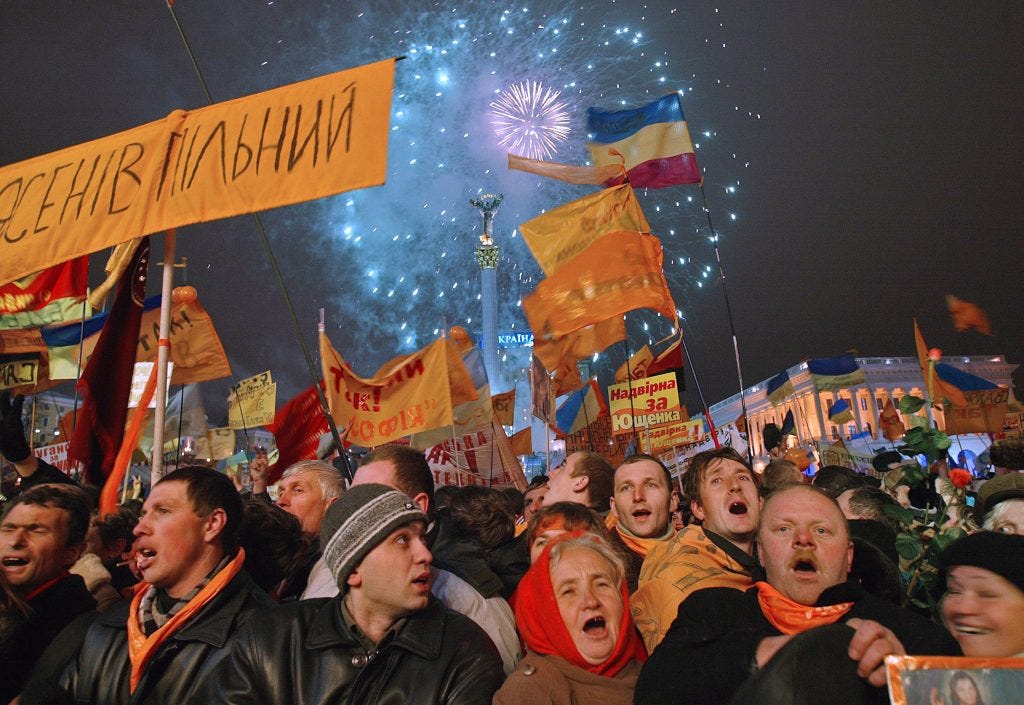


Ukraine’s Orange Revolution

That colour revolutions represented a formal weapon of war in the Empire’s post-9/11 arsenal was enthusiastically spelled out by arch-neoconservative Max Boot in late December 2004. He gushed how Ukraine’s Orange Revolution days earlier, which brought a pro-Western government to power, was “one of the most inspiring events” of that year. Boot declared the “triumph” and “miracle” of the revolution “should dispel the quaint notion still prevalent in many Western universities and foreign ministries that democracy is a luxury good suitable for rich countries”:

“These revolutions reveal the hollowness of the cliché that ‘democracy can’t be imposed by outsiders’…sometimes, when dealing with an entrenched dictatorship, this requires military intervention of the kind that occurred in Iraq and Afghanistan. More brittle regimes can be brought down by their own people, but even they often need a little external shove…There was nothing nefarious about the US intervention in Ukraine.”

Boot boasted how Washington had “spent $58 million on democracy promotion in the last two years” in Ukraine. He proposed Kiev receive “expedited NATO and European Union membership,” to finish off the Orange Revolution. “In the meantime, we need to apply elsewhere the lessons of Ukraine” Boot demanded, suggesting “an obvious candidate for a similar transformation is Iran.” He explained, “it’s hard to think of a higher priority than the overthrow of the mullahs,” encouraging the Bush administration to prioritise “liberating Iran.”

‘USAID Help’

Such was the insurrectionary fervour of the time, in January 2006 USAID went to the extent of publishing a glossy magazine, Democracy Rising, revealing in detail Washington’s central role in fomenting “grassroots” rebellions as far afield as Afghanistan, Gaza and Lebanon. Dedicated sections on colour revolutions to date were replete with stunningly forthright passages. A section on Georgia’s November 2003 Rose Revolution described how NED had financed regime change training for local “lawyers, judges, journalists, members of parliament, NGOs, political party leaders, and others.”

The stated purpose of this investment was to give Georgians “a sense that they should regulate the government.” The Rose Revolution “was the climax of these efforts.” One recipient of US financial support remarked, “without foreign assistance, I’m not sure we would have been able to achieve what we did without bloodshed.” Meanwhile, several pages were dedicated to the Orange Revolution. It noted how thousands of Ukrainian journalists were given training in “investigative reporting”, bankrolled by NED and USAID.
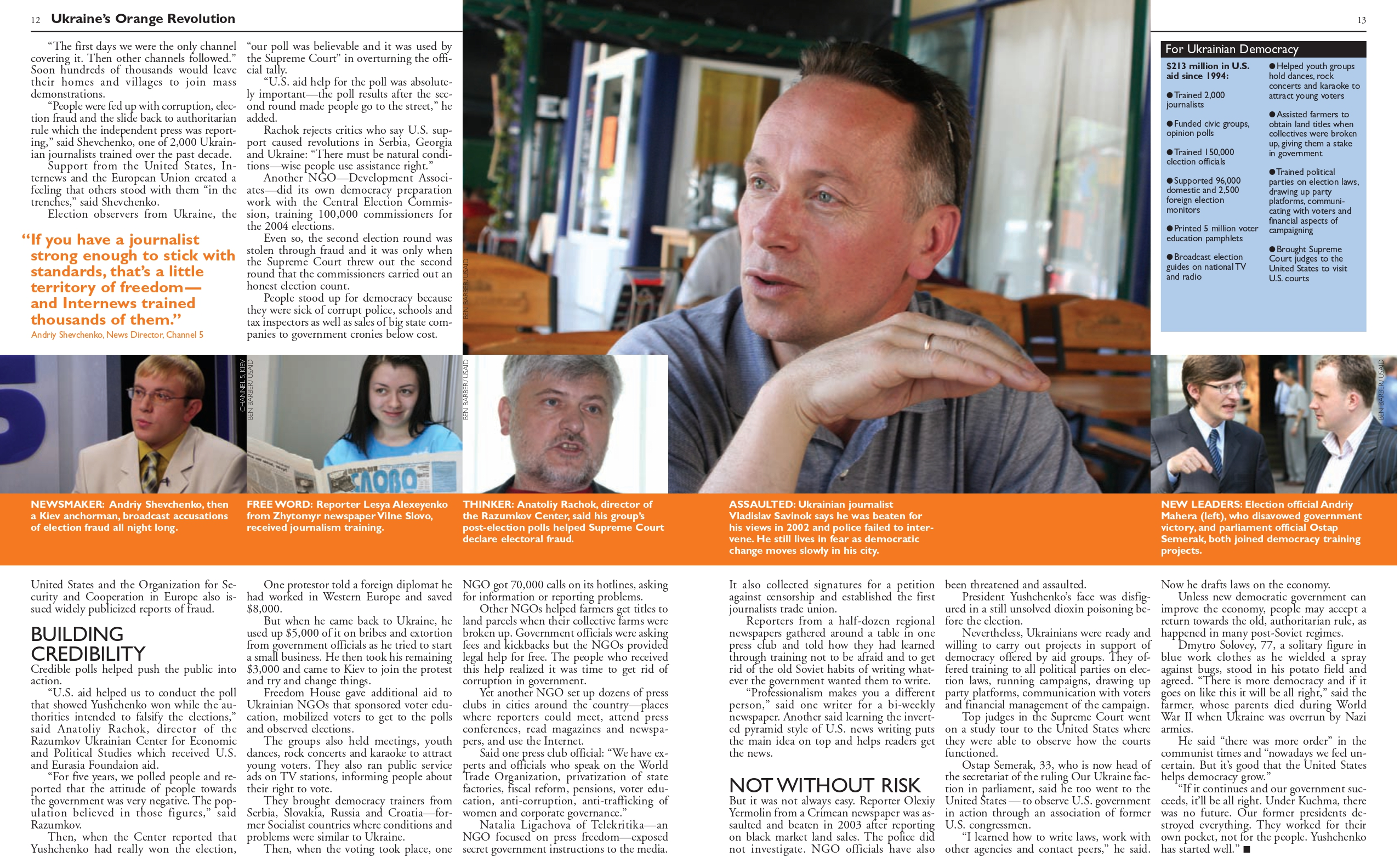
Democracy Rising on the Orange Revolution

An alumni told Democracy Rising this sponsorship “created a feeling that others stood with them ‘in the trenches’.” Concurrently, NED-affiliated Freedom House flooded the coffers of NGOs “that sponsored voter education, mobilized voters to get to the polls and observed elections.” These organisations “also held meetings, youth dances, rock concerts and karaoke to attract young voters,” and “ran public service ads on TV stations, informing people about their right to vote.” Meanwhile, “democracy trainers from Serbia, Slovakia, Russia and Croatia” were flown into the country.

In the second round of Ukraine’s presidential election, NED-financed NGOs claimed to have been inundated with tens of thousands of reports of fraud from voting stations all over the country, while exit polls they produced pointed to widespread rigging having denied pro-Western candidate Viktor Yushchenko a landslide victory. Vast protests, combined with opposition-organised general strikes, widespread civil disobedience and occupations of government buildings forced a rerun. A US-funded think tank apparatchik asserted:

“USAID help for the poll was absolutely important – the poll results after the second round made people go to the street.”

For all the hype and self-assurance of Democracy Rising, its publication came at a time when colour revolutions were increasingly being viewed with hostility and suspicion at a state and public level throughout the Global South. In every case, the radical outcomes promised by colour revolution leaders and advocates failed to materialise, while US rhetoric about the commitment of resultant pro-Western regimes to democracy and freedom was a perverse fraud.

In Ukraine, US-installed Yushchenko implemented economic austerity, slashed regulations and social spending, bailed out criminal banks, broke open state industry and natural resources for foreign plunder, attacked the rights of Russian speakers, and began preparing the country for locally-feared NATO membership. Within just nine months of entering office, his coalition government – comprised of Orange Revolution activists – collapsed due to deeply corrupt battles with feuding Ukrainian oligarchs over control of key media and industrial assets.

Yushchenko was voted out in the January 2010 presidential election, finishing fifth in the first round with just 5.5% of the vote. As Empire house journal Foreign Policy lamented years later, the Bush administration’s much-vaunted colour revolutions all turned out to be “terribly disappointing.” Each and every time, “elite corruption still continued apace” and “promises of far-reaching change never really materialized.” Damningly, “maladies that typified the preceding regimes quickly came to describe” the governments created by colour revolutions themselves.

‘Revolution Business’

That’s quite some euphemism. In Georgia, longtime Soros acolyte Mikheil Saakashvili granted himself unilateral power in key policy areas, before brazenly exploiting his position to harass and jail business and political rivals. Saakashvili’s targets would be raped and/or tortured in prison, their ordeals filmed for primetime broadcast on local TV networks. Grave questions abound over his personal involvement in several suspicious deaths, including government ministers’. He was voted out in October 2012, despite NED’s best efforts.

Kyrgyzstan’s 2005 Tulip Revolution installed Kurmanbek Bakiyev, who proceeded to run the country as his personal fiefdom for five years. Bakiyev’s relatives profited exorbitantly from legally questionable privatisation of state industries. For example, his family signed a highly controversial $1.8 billion deal to supply fuel to a local US military base, close to Kyrgyzstan’s total GDP in 2003. Elsewhere, Bakiyev’s brother oversaw Bishkek’s security apparatus – arbitrary detentions, bogus convictions, torture, and murders of opposition activists, journalists, and politicians became commonplace.

Bakiyev was himself chased out of not only the presidential palace but Bishkek itself in April 2010, following a massacre of anti-corruption protesters in which up to 100 were killed and at least 450 wounded. Thereafter, Kyrgyzstan was plunged into economic and political chaos for a decade, with numerous governments collapsing along the way. The freest and most stable Central Asian state prior to the Tulip Revolution, it is only since 2020 – following another Anglo-American coup – the country has regained some semblance of stability.

A key player in that upheaval was British ambassador Charles Garrett. He arrived in Bishkek from Macedonia, where as this journalist has revealed from April 2016 he steered what was known as the “colorful revolution”. Illegally obtained, deceptively edited wiretaps seemingly implicating government officials in shocking crimes produced huge protests, featuring widespread arson attacks and brutal clashes between demonstrators and police. Garrett distributed cash to NGOs and activists involved in the unrest from his diplomatic pouch, encouraging them to cause mass havoc.
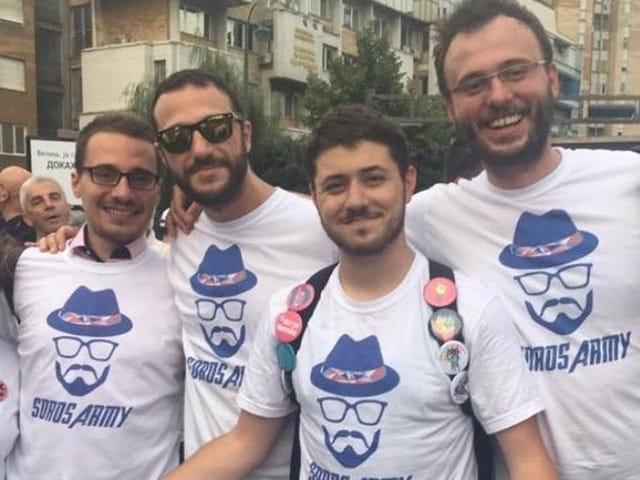
George Soros’ Open Society Foundations, NED, and USAID were also colorful revolution participants. Some protesters even proudly wore “Soros Army” shirts. Despite a huge public counter-revolutionary fightback, the tumult paralysed the Macedonian economy and state, leading to the installation of a doggedly pro-Western, dangerously dysfunctional administration that engaged in industrial scale graft, jailed political opponents on bogus charges, and changed the country’s name despite widespread opposition. Meanwhile, existing economic problems, including crippling brain drain, were gravely exacerbated.

The unfailingly disastrous results of colour revolutions surely contributed to White House officials abruptly and firmly distancing themselves from the entire enterprise, before the Bush administration’s second term was even over. The “Freedom Agenda” was quietly forgotten. The President – who in October 2004 openly mandated financial assistance to Belarusian opposition activists, and once publicly praised the Rose Revolution as an example to be followed throughout the Caucasus and Central Asia – went so far as to deny the US was in the “revolution business” at all.

‘Alternate Reality’

Colour revolutions have continued apace ever since, with the same strategies being recurrently applied the world over, to varying degrees of success. All along, non-Western governments – in particular China, Iran and Russia – have become increasingly vocal in their condemnation of and opposition to colour revolutions, in some cases passing legislation seeking to curtail the operations of foreign funded NGOs on their soil. Yet, the mainstream media long ago adopted a rigid Omertà on Washington’s culpability for civil society-driven destabilisation overseas.

In a striking example of this paradigm shift, in November 2004, before the Orange Revolution was over, The Guardian published a revealing report exposing the “US campaign behind the turmoil in Kiev.” The outlet stated unambiguously the revolt was “an American creation, a sophisticated and brilliantly conceived exercise in Western branding and mass marketing that, in four countries in four years, has been used to try to salvage rigged elections and topple unsavoury regimes.” NED, the State Department and USAID were all fingered as culprits.

Fast forward to July 2015 however, and a Guardian article on Russia’s banning of NED under foreign agent laws quite amazingly relied on a brief quote pulled from the Endowment’s official website to describe its operations. In the intervening time, the Maidan Revolution overthrew Ukrainian President Viktor Yanukovych in February 2014, setting Kiev on the warpath with Moscow. Washington’s irrefutable involvement was strenuously denied at the time by the mainstream media, and has been ever since.

Following the Ukraine proxy war’s February 2022 eruption, The New York Times took vigorous aim at independent journalists for spreading the “conspiracy theory” Maidan was US-orchestrated, dubbing the proposition an “alternative reality” and “Russian disinformation”. This is despite every prominent Maidan actor – including the individuals who started the demonstrations – receiving NED or USAID funding, leaders of US-bankrolled organisations in the country advertising their intention to overthrow Yanukovych years prior, and the Endowment spending $20 million in the country in 2013 alone.

After the outbreak of war in Ukraine, NED removed its grant records on Ukraine, listing its investment in a panoply of initiatives in the country over many years – many of which ultimately targeted Russia, one way or another. In mid-2024, the Endowment undertook the unprecedented step of removing grant records for the entire world. Today, brief entries on different geographical regions describe in vague terms the Endowment’s specific aims locally, and overall sums being spent. The crucial questions of where, and on what, aren’t clarified.

NED going underground makes the task of tracking and exposing contemporary colour revolutions difficult, but not impossible. In September 2025, mass rioting ignited in Nepal. Major news outlets without exception reported the fiery agitation as an organic burst of dissent by the country’s disaffected “Gen Z”, motivated by corruption, unemployment, and state censorship of social media. Publications barely acknowledged demonstrators committed serious crimes, including torching Nepal’s parliament and the Prime Minister’s official residence, which sent occupants fleeing in helicopters.

Based on publicly available information, the clear insinuations of a colour revolution could be discerned. An NGO that organised the protests, Hami Nepal, had clear links to organisations known to be in receipt of NED funding. Subsequent leaks amply demonstrated the Endowment and USAID expended substantial sums over the years preceding the coup training young Nepalese citizens how to protest, founding NGOs and political parties, and “advocate concerns” on issues such as corruption. Evidently, the post-9/11 “Freedom Agenda” never actually ended.

(Republished from Substack by permission of author or representative)
Published: October 8, 2026 0 comments
0 FacebookTwitterPinterestEmail

The Anglo-Nazi Global Empire That Almost Was

by Kit Klarenberg Published: September 10, 2026
written by Kit Klarenberg 12 minutes read
Be sure to share these materials with friends, kin, and workmates.

Kit Klarenberg


KIT KLARENBERG
MAY 04, 2025
All my investigations are free to read, thanks to the generosity of my readers. Independent journalism nonetheless requires investment, so if you value this article or any others, please consider sharing, or even becoming a paid subscriber. Your support is always gratefully received, and will never be forgotten.
To buy me a coffee or two, please
click this link.

As VE Day approaches, Western officials, pundits and journalists are widely seeking to exploit the 80th anniversary of Nazism’s defeat for political purposes. European leaders have threatened state attendees of Russia’s grand May 9th victory parade with adverse consequences. Meanwhile, countless sources draw historical comparisons between Nazi Germany’s appeasement throughout the 1930s, and the Trump administration’s ongoing efforts to strike a deal with Moscow to end the Ukraine proxy conflict.

As The Atlantic put it in March, “Trump Is Offering Putin Another Munich” - a reference to the September 1938 Munich Agreement, under which Western powers, led by Britain, ceded a vast portion of Czechoslovakia to Nazi Germany. Mainstream narratives of appeasement state this rancorous move represented appeasement’s apotheosis - its final act, which London et al hoped would permanently sate Adolf Hitler’s expansionist ambitions, but actually made World War II inevitable.


Neville Chamberlain’s triumphant return from Munich


Appeasement is universally accepted today in the West as a well-intentioned but ultimately catastrophically failed and misguided attempt to avoid another global conflict with Germany, for peace’s sake. According to this reading, European governments made certain concessions to Hitler, while turning a blind eye to egregious breaches of the post-World War I Versailles Treaty, such as the February 1935 Luftwaffe’s creation, and Nazi Germany’s military occupation of the Rhineland in May the next year.  

In reality though, from Britain’s perspective, the Munich Agreement was intended to be just the start of a wider process that would culminate in “world political partnership” between Berlin and London. Two months prior, the Federation of British Industries (FBI), known today as the Confederation of British Industry, made contact with its German counterpart, Reichsgruppe Industrie (RI). The pair eagerly agreed their respective governments should enter into formal negotiations on Anglo-Nazi economic integration.

Representatives of these organisations met face-to-face in London on November 9th that year. The summit went swimmingly, and a formal conference in Düsseldorf was scheduled for next March. Coincidentally, later that evening in Berlin, Kristallnacht erupted, with Nazi paramilitaries burning and destroying synagogues and Jewish businesses across Germany. The most infamous pogrom in history was no deterrent to continued discussions and meetings between FBI and RI representatives. A month later, they inked a formal agreement on the creation of an international Anglo-Nazi coal cartel.

British officials fully endorsed this burgeoning relationship, believing it would provide a crucial foundation for future alliance with Nazi Germany in other fields. Moreover, it was hoped Berlin’s industrial and technological prowess would reinvigorate Britain’s economy at home and throughout the Empire, which was ever-increasingly lagging behind the ascendant US. In February 1939, representatives of British government and industry made a pilgrimage to Berlin to feast with high-ranking Nazi officials, in advance of the next month’s joint conference.

As FBI representatives prepared to depart for Düsseldorf in March, British cabinet lead Walter Runciman - a fervent advocate of appeasement, and chief architect of Czechoslovakia’s carve up - informed them, “gentlemen, the peace of Europe is in your hands.” In a sick twist, they arrived on March 14th, while Czechoslovakian president Emil Hácha was in Berlin meeting with Hitler. Offered the choice of freely allowing Nazi troops entry into his country, or the Luftwaffe reducing Prague to rubble before all-out invasion, he suffered a heart attack.

After revival, Hácha chose the former option. The Düsseldorf conference commenced the next morning, as Nazi tanks stormed unhindered into rump Czechoslovakia. Against this monstrous backdrop, a 12-point declaration was ironed out by the FBI and RI. It envisaged “a world economic partnership between the business communities” of Berlin and London. That August, FBI representatives secretly met with Herman Göring to anoint the agreement. In the meantime, the British government had via back channels made a formal offer of wide-ranging “cooperation” with Nazi Germany.


Nazi soldiers march unopposed into rump Czechoslovakia

Nazi soldiers march unopposed into rump Czechoslovakia


‘Political Partnership’
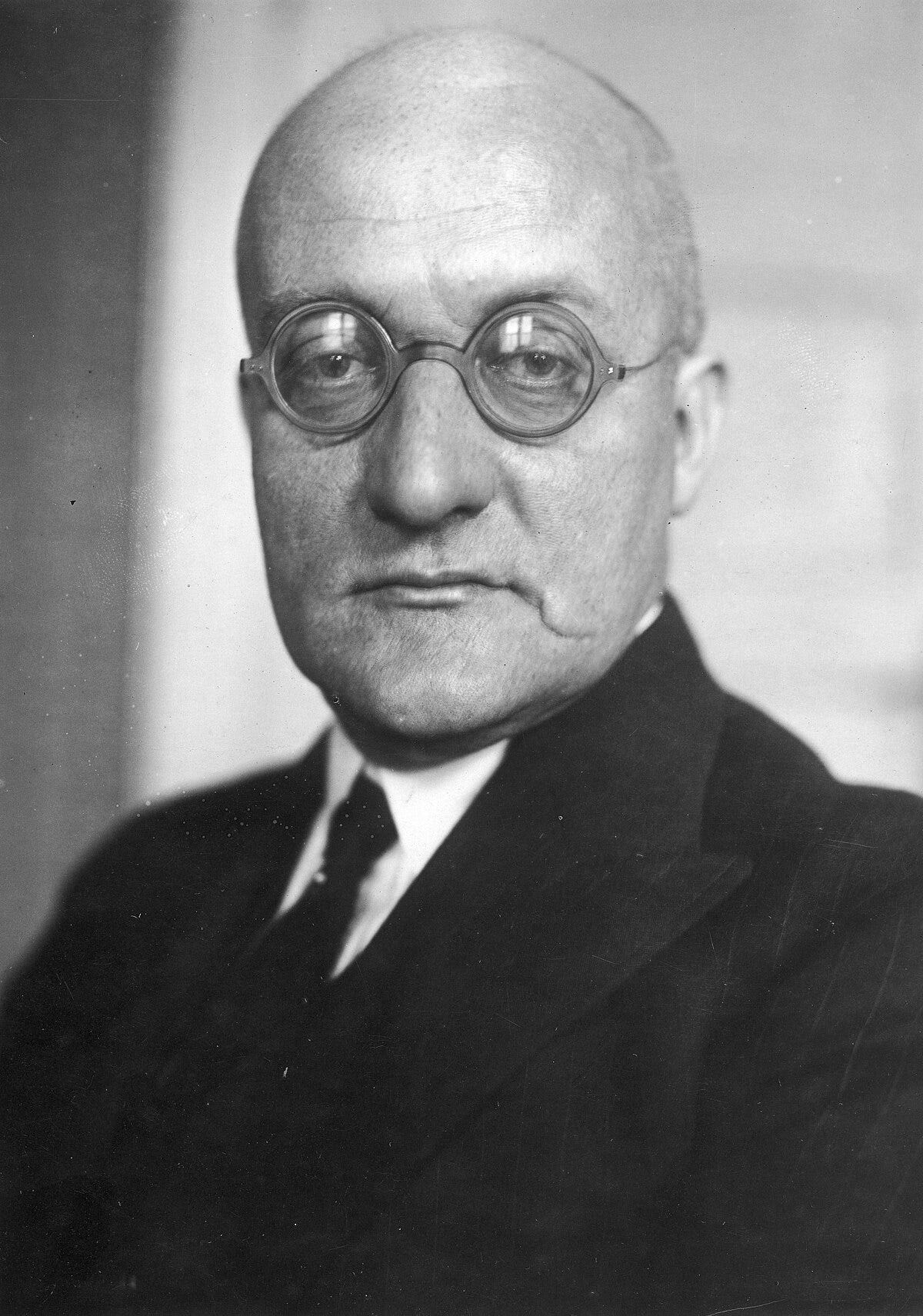
In April 1938, journeyman diplomat Herbert von Dirksen was appointed Nazi Germany’s ambassador to London. A committed National Socialist and rabid antisemite, he also harboured a particularly visceral loathing of Poles, believing them to be subhuman, and eagerly supporting Poland’s total erasure. Despite this, due to his English language fluency and aristocratic manners, he charmed British officials and citizens alike, and was widely perceived locally as Nazi Germany’s respectable face.


Herbert von Dirksen

Even more vitally though, Dirksen - in common with many powerful elements of the British establishment - was convinced that not only could war be avoided, but London and Berlin would instead forge a global economic, military, and political alliance. His 18 months in Britain before the outbreak of World War II were spent working tirelessly to achieve these goals, by establishing and maintaining communication between officials and decisionmakers in the two countries, while attempting to broker deals.

Dirksen published an official memoir in 1950, detailing his lengthy diplomatic career. However, far more revealing insights into the period immediately preceding World War II, and behind-the-scenes efforts to achieve enduring detente between Britain and Nazi Germany, are contained in the virtually unknownDirksen Papers, a two-volume record released by the Soviet Union’s Foreign Languages Publishing House without his consent. They contain private communications sent to and from Dirksen, diary entries, and memos he wrote for himself, never intended for public consumption.

Documents And Materials Relating To The Eve Of The Second World War Ii 21.6MB ∙ PDF file Download CLICK HERE
 

The contents were sourced from a vast trove of documents found by the Red Army after it seized Gröditzberg, a castle owned by Dirksen where he spent most of World War II. Mainstream historians have markedly made no use of the Dirksen Papers. Whether this is due to their bombshell disclosures posing a variety of dire threats to established Western narratives of World War II, and revealing much the British government wishes to remain forever secret, is a matter of speculation.

Immediately after World War II began, Dirksen “keenly” felt an “obligation” to author a detailed post-mortem on the failure of Britain’s peace overtures to Nazi Germany, and his own. He was particularly compelled to write it as “all important documents” in Berlin’s London embassy had been burned following Britain’s formal declaration of war on September 3rd 1939. Reflecting on his experiences, Dirksen spoke of “the tragic and paramount thing about the rise of the new Anglo-German war”:

“Germany demanded an equal place with Britain as a world power…Britain was in principle prepared to concede. But, whereas Germany demanded immediate, complete and unequivocal satisfaction of her demands, Britain - although she was ready to renounce her Eastern commitments, and…allow Germany a predominant position in East and Southeast Europe, and to discuss genuine world political partnership with Germany - wanted this to be done only by way of negotiation and a gradual revision of British policy.”

‘German Reply’

From London’s perspective, Dirksen lamented, this radical change in the global order “could be effected in a period of months, but not of days or weeks.” Another stumbling block was the British and French inking a “guarantee” to defend Poland in the event she was attacked by Nazi Germany, in March 1939. This bellicose move - coupled with belligerent speeches from Prime Minister Neville Chamberlain - was at total odds with simultaneous conciliatory approaches such as Düsseldorf, and the private stances and utterances of British officials to their Nazi counterparts.

In any event, it appears London instantly regretted her pledge to defend Poland. Dirksen records in his post-mortem how subsequently, senior British officials told him they sought “an Anglo-German entente” that would “render Britain’s guarantee policy nugatory.” This would “enable Britain to extricate her from her predicament in regard to Poland,” so Warsaw would “be left to face Germany alone”.

In mid-July 1939, Horace Wilson - an extremely powerful civil servant and Chamberlain’s right-hand man - approached Göring’s chief aide Helmuth Wohlthat during a visit to London. Wilson “outlined a program for a comprehensive adjustment of Anglo-German relations” to Wohlthat, which amounted to a radical overhaul of the two countries’ “political, military and economic arrangements.” This included “a non-aggression pact”, explicitly concerned with shredding Britain’s “guarantee” to Warsaw. Dirksen explained:

“The underlying purpose of this treaty was to make it possible for the British gradually to disembarrass themselves of their commitments toward Poland, on the ground that they had…secured Germany’s renunciation of methods of aggression.”

Elsewhere, “comprehensive” proposals for economic cooperation were outlined, with the promise of “negotiations…to be undertaken on colonial questions, supplies of raw material for Germany, delimitation of industrial markets, international debt problems, and the application of the most favoured nation clause.” In addition, a realignment of “the spheres of interest of the Great Powers” would be up for discussion, opening the door for further Nazi territorial expansion. Dirksen makes clear these grand plans were fully endorsed at the British government’s highest levels:

“The importance of Wilson’s proposals was demonstrated by the fact that Wilson invited Wohlthat to have them confirmed by Chamberlain personally.”

During his stay in London, Wohlthat also had extensive discussions with Overseas Trade Secretary Robert Hudson, who told him “three big regions offered the two nations an immense field for economic activity.” This included the existing British Empire, China and the Soviet Union. “Here agreement was possible; as also in other regions,” including the Balkans, where “England had no economic ambitions.” In other words, resource-rich Yugoslavia would be Nazi Germany’s for the taking, under the terms of “world political partnership” with Britain.

Dirksen outlined the contents of Wohlthat’s talks with Hudson and Wilson in a “strictly secret” internal memo, excitedly noting “England alone could not adequately take care of her vast Empire, and it would be quite possible for Germany to be given a rather comprehensive share.” A telegram dispatched to Dirksen from the German Foreign Office on July 31st 1939 recorded Wohlthat had informed Göring of Britain’s secret proposals, who in turn notified Nazi Foreign Minister Joachim von Ribbentrop.

Dirksen noted elsewhere Wohlthat asked the British how such negotiations “might be put on a tangible footing.” Wilson informed him “the decisive thing” was for Hitler to “[make] his willingness known” by officially authorising a senior Nazi official to discuss the “program”. Wilson “furthermore strongly stressed the great value the British government laid upon a German reply” to these offers, and how London “considered that slipping into war was the only alternative.”

‘Authoritarian Regimes’

No “reply” apparently ever came. On September 1st 1939, Nazi Germany invaded Poland, Britain declared war two days later, and the rest is history - albeit history that is subject to determined obfuscation, constant rewriting, and deliberate distortion. Polls of Europeans conducted in the immediate aftermath of World War II showed there was little public doubt the Red Army was primarily responsible for Nazi Germany’s destruction, while Britain and the US were perceived as playing mere walk-on roles.


For example, in 1945, 57% of French citizens believed Moscow “contributed most to the defeat of Germany” - just 20% named the US, and 12% Britain. By 2015, less than a quarter of French respondents recognised the Soviet Union’s role, with 54% believing the US to be Nazism’s ultimate vanquisher. Meanwhile, a survey on the 80th anniversary of D-Day in June 2024 found 42% of Britons believed their own country had done more to crush Hitler than all her allies combined.

The same poll identified a staggering level of ignorance among British citizens of all ages about World War II more generally, with only two thirds even able to place D-Day as having occurred during that conflict. The pollsters didn’t gauge public knowledge of Britain’s long-running, concerted attempts to forge a global Empire with Nazi Germany in the War’s leadup, although betting is high the figure would be approximately zero.


BRITISH POLL—WHO DID THE MOST TO DEFEAT NAZI GERMANY

Ludicrous poll reflecting the alarming ignorance and indoctrination of the British public about a key aspect of WW2.


Meanwhile, in 2009 the European Parliament instituted an annual commemoration on August 23rd, to “mark the European Day of Remembrance for Victims of All Totalitarian and Authoritarian Regimes.” This is just one of several modern-day initiatives to perversely conflate Communism and Nazism, while transforming Wehrmacht and SS collaborators, Holocaust perpetrators, and fascists in countries liberated by the Red Army into victims, and laying blame for World War II at Moscow’s feet, via the Molotov-Ribbentrop pact.

What British officials proposed to Hitler in 1939 far eclipsed the terms of that controversial agreement, but there will of course be no consideration of this when VE Day is celebrated in Western capitals in 2025. In Perfidious Albion, the government has “encouraged” the public to host street parties, and attend a march by over 1,300 uniformed soldiers from Parliament Square to Buckingham Palace. It is a perverse irony the procession will start and end at the very places where, eight decades ago, support for Nazi Germany was strongest in London.


Subscribe to Global Delinquents

By Kit Klarenberg · Hundreds of paid subscribers
The role of intelligence services in shaping politics and perceptions.

Published: September 10, 2026 0 comments
0 FacebookTwitterPinterestEmail

How ‘Human Rights’ Became Western Weapon

by Kit Klarenberg Published: August 31, 2025
written by Kit Klarenberg 9 minutes read
Pres Ford

Please share this article as widely as you can.

editors log bluePATRICE GREANVILLE


Traducir—Translate!
Make fonts bigger>>>
Resize text-+=

Pres Ford

President Gerald Ford signs the Final Act of the Conference on Security and Cooperation in Europe. Courtesy Gerald R. Ford Library, Public domain, via Wikimedia Commons


By Kit Klarenberg / Substack

August 1st marked the 50th anniversary of the Helsinki Accords’ inking. The event’s golden jubilee passed without much in the way of mainstream comment or recognition. Yet, the date was absolutely seismic, its destructive consequences reverberating today throughout Europe and beyond. The Accords not only signed the death warrants of the Soviet Union, Warsaw Pact, and Yugoslavia years later, but created a new global dynamic, in which “human rights” – specifically, a Western-centric and -enforced conception thereof – became a redoubtable weapon in the Empire’s arsenal.

The Accords were formally concerned with concretising détente between the US and Soviet Union. Under their terms, in return for recognition of the latter’s political influence over Central and Eastern Europe, Moscow and its Warsaw Pact satellites agreed to uphold a definition of “human rights” concerned exclusively with political freedoms, such as freedom of assembly, expression, information, and movement. Protections universally enjoyed by the Eastern Bloc’s inhabitants – such as free education, employment, housing and more – were wholly absent from this taxonomy.

There was another catch. The Accords led to the creation of several Western organisations charged with monitoring the Eastern Bloc’s adherence to their terms – including Helsinki Watch, forerunner of Human Rights Watch. Subsequently, these entities frequently visited the region and forged intimate bonds with local political dissident factions, assisting them in their anti-government agitation. There was no question of representatives from the Soviet Union, Warsaw Pact, or Yugoslavia being invited to assess “human rights” compliance at home or abroad by the US and its vassals.

As legal scholar Samuel Moyn has extensively documented, the Accords played a pivotal role in decisively shifting mainstream rights discourse away from any and all economic or social considerations. More gravely, per Moyn, “the idea of human rights” was converted “into a warrant for shaming state oppressors.” Resultantly, Western imperialist brutality against purported foreign rights abusers – including sanctions, destabilisation campaigns, coups, and outright military intervention – could be justified, frequently assisted by the ostensibly neutral findings of “human rights” defenders such as Amnesty International, and HRW.

Almost instantly after the Helsinki Accords were signed, a welter of organisations sprouted throughout the Eastern Bloc to document purported violations by authorities. Their findings were then fed – often surreptitiously – to overseas embassies and rights groups, for international amplification. This contributed significantly to both internal and external pressure on the Soviet Union, Warsaw Pact, and Yugoslavia. Mainstream accounts assert the conception of these dissident groups was entirely spontaneous and organic, in turn compelling Western support for their pioneering efforts.

US lawmaker Dante Fascell has claimed the “demands” of “intrepid” Soviet citizens “made us respond.” However, there are unambiguous indications that meddling in the Eastern Bloc was hardwired into Helsinki before inception. In late June 1975, on the eve of US President Gerald Ford signing the Accords, exiled Soviet dissident Alexander Solzhenitsyn addressed senior politicians in Washington, DC. He appeared at the express invitation of hardcore anti-Communist George Meany, chief of the CIA-connected American Federation of Labor and Congress of Industrial Organizations (AFL-CIO). Solzhenitsyn declared:


“We, the dissidents of the USSR don’t have any tanks, we don’t have any weapons, we have no organization. We don’t have anything…You are the allies of our liberation movement in the Communist countries…Communist leaders say, ‘Don’t interfere in our internal affairs’…But I tell you: interfere more and more. Interfere as much as you can. We beg you to come and interfere.”

‘Political Aberration’


Lech Walesa, CIA asset

Lech Walesa, CIA asset.


In 1980, mass strikes in Gdansk, Poland spread throughout the country, leading to the founding of Solidarity, an independent trade union and social movement. Key among its demands was the Soviet-supported Polish government distribute 50,000 copies of Helsinki’s “human rights” protocols to the wider public. Solidarity founder-and-chief Lech Walesa subsequently referred to the Accords as a “turning point”, enabling and encouraging the union’s nationwide disruption, and growth into a serious political force. Within just a year, Solidarity’s membership exceeded over 10 million.


The movement’s inexorable rise sent shockwaves throughout the Warsaw Pact. It was the first time an independent mass organisation had formed in a Soviet-aligned state, and others would soon follow. Undisclosed at the time, and largely unknown today, Solidarity’s activities were bankrolled to the tune of millions by the US government. The same was true of most prominent Eastern Bloc dissident groups, such as Czechoslovakia’s Charter 77. In many cases, these factions not only ousted their rulers by the decade’s end, but formed governments thereafter.

Washington’s financing for these efforts became codified in a secret September 1982 National Security Directive. It stated “the primary long-term US goal in Eastern Europe” was “to loosen the Soviet hold over the region and thereby facilitate its eventual reintegration into the European community of nations.” This was to be achieved by; “encouraging more liberal trends in the region…reinforcing the pro-Western orientation of their peoples…lessening their economic and political dependence on the USSR…facilitating their association with the free nations of Western Europe.”

In August 1989, mere days after Solidarity took power in Poland, marking the first post-World War II formation of a non-Communist government in the Eastern Bloc, a remarkable op-ed appeared in the Washington Post. Senior AFL-CIO figure Adrian Karatnycky wrote about his “unrestrained joy and admiration” over Solidarity’s “stunning” success in purging Soviet influence in the country throughout the 1980s. The movement was the “centerpiece” of a wider US “strategy”, he explained, and had been funded and supported by Washington with the utmost “discretion and secrecy.”

Vast sums funnelled to Solidarity via AFL-CIO and CIA front the National Endowment for Democracy “underwrote shipments of scores of printing presses, dozens of computers, hundreds of mimeograph machines, thousands of gallons of printer’s ink, hundreds of thousands of stencils, video cameras and radio broadcasting equipment.” The wellspring promoted Solidarity’s activities locally and internationally. In Poland itself, 400 “underground periodicals” – including comic books featuring “Communism as the red dragon” and Lech Walesa “as the heroic knight” – were published, read by tens of thousands of people.

Karatnycky boasted of how the Empire was intimately “drawn into the daily drama of Poland’s struggle” over the past decade, and “much of the story of that struggle and our role in it will have to be told another day.” Still, the results were extraordinary. Writers for Warsaw’s NED-funded “clandestine press” had suddenly been transformed into “editors and reporters for Poland’s new independent newspapers.” Former “radio pirates” and Solidarity activists previously “hounded” by Communist authorities were now elected lawmakers.

Signing off, Karatnycky hailed how Poland proved to be a “successful laboratory in democracy-building,” warning “democratic change” in Warsaw could not be a “a political aberration” or “lone example” in the region. Karatnycky looked ahead to further neighbourhood insurrection, noting AFL-CIO was engaged in outreach with trade unions elsewhere in the Eastern Bloc, including the Soviet Union itself. So it was, one by one, every Warsaw Pact government collapsed in the final months of 1989, often in enigmatic circumstances.

‘Shock Therapy’


The “revolutions” of 1989 remain venerated in the mainstream today, hailed as examples of successful, largely bloodless transitions from dictatorship to democracy. They have also served as a template and justification for US imperialism of every variety in the name of “human rights” in all corners of the globe since. Yet, for many at the forefront of Western-funded, Helsinki Accords-inspired Warsaw Pact dissident groups, there was an extremely bitter twist in the tale of Communism’s collapse across Central and Eastern Europe.

In 1981, Czechoslovak playwright and Charter 77 spokesperson Zdena Tominová conducted a tour of the West. In a speech in Dublin, Ireland, she spoke of how she’d witnessed first-hand how her country’s population had benefited enormously from Communism.

Zdena Tominová 2017

Zdena Tominová in 2017

Tominová made clear she sought to fully maintain all its public-wide economic and social benefits, while purely adopting Western-style political freedoms. For a woman who’d risked imprisonment to oppose her government with foreign help so publicly, her statements shocked audiences.

“All of a sudden, I was not underprivileged and could do everything,” she sentimentally recalled of the eradication of Czechoslovakia’s class system. “I think that, if this world has a future, it is as a socialist society…a society where nobody has priorities just because he happens to come from a rich family,” Tominová declared. She moreover reiterated her vision and mission was global in nature – “the world of social justice for all people has to come about.” But this was not to be.

Instead, newly ‘liberated’ ex-Eastern Bloc countries suffered deeply ravaging transitions to capitalism via “shock therapy”, eradicating much citizens held dear about the systems under which they’d previously lived. Thrust into a wholly new world, hitherto unknown homelessness, hunger, inequality, unemployment and other societal ills became commonplace, rather than prevented by basic state guarantee. After all, as decreed by the Helsinki Accords, such phenomena didn’t constitute egregious breaches of “human rights”, but instead an unavoidable product of the very political “freedom” they had aggressively promoted.


THe views expressed herein are solely those of the author and may or may not reflect those of  The Greanville Post. However, we do think they are important enough to be transmitted to a wider audience. 


All image captions, pull quotes, appendices, etc. by the editors not the authors. 
YOU ARE FREE TO REPRODUCE THIS ARTICLE PROVIDED YOU GIVE PROPER CREDIT TO THE GREANVILLE POST VIA A BACK LIVE LINK. 
This work is licensed under a Creative Commons Attribution-NonCommercial 4.0 International License


Published: August 31, 2025 1 comment
0 FacebookTwitterPinterestEmail

Case closed after ‘Russian disinfo’ claims led to persecution of NZ journalist

by Kit Klarenberg Published: July 27, 2025
written by Kit Klarenberg 9 minutes read
Mick Hall journalist

Please share this article as widely as you can.

editors log bluePATRICE GREANVILLE


Traducir—Translate!
Make fonts bigger>>>
Resize text-+=

Case closed after ‘Russian disinfo’ claims led to persecution of NZ journalist

By Kit Klarenberg, The Grayzone, 7/13/25

Journalist Mick Hall was accused of slipping “Russian disinformation” into copy at New Zealand’s state broadcaster, sparking an international furor about Kremlin infiltration. Following an intel agency investigation, his name was cleared.
Now, Hall tells The Grayzone how a simple copy editing dispute brought him into Five Eyes’ crosshairs.

Until two years ago, Mick Hall was a fairly obscure journalist publishing wire copy for Radio New Zealand (RNZ), far-removed from media capitals like Washington and London where international opinions are shaped. But in June 2023, Hall suddenly became the target of Five Eyes intelligence agencies when he was accused by Western sources – including his own employer – of inserting “Russian disinformation” into wire stories.

What started with a dispute of Hall’s copy edits turned into an investigation by New Zealand’s Inspector General of Intelligence and Security (NZSIS), which briefed top government officials about its probe. For months afterward, major Western media outlets fretted that Kremlin agents had infiltrated New Zealand’s national broadcaster.


Mick Hall journalist

Hall: Almost burnt on the altar of disinformation discipline.


But Hall insisted he had been unfairly accused and defamed by a pro-war element driven into the throes of paranoia by the Ukraine proxy war. In November 2024, he lodged a formal complaint against the NZSIS, demanding to know whether Wellington’s primary intelligence service “acted lawfully and properly” and followed “correct procedure” in its investigation, and if any information gathered about him “was shared appropriately, including with overseas partners.”

On April 9, New Zealand’s Inspector General of Intelligence and Security (NZSIS) published the results of the investigation triggered by Hall’s complaint. The Inspector General report noted its investigation lasted between June 10 and August 11 2023, and was closed due to “no concerns of foreign interference” being identified.

The Inspector General acknowledged the intelligence services’ probe was initiated purely due to public “allegations [emphasis added] of foreign interference,” rather than substantive evidence of any kind, and expressed sympathy that Hall found it “disconcerting to discover” he had “come to the attention of an intelligence agency…particularly as a journalist reporting on conflicts where different views can validly be expressed.” However, it concluded NZSIS’ actions were “necessary and proportionate”, and the agency acted “lawful [sic] and properly.”

Hall’s name had been cleared, but he had been denied any recompense for being smeared as a Kremlin agent, and having his career in national media effectively destroyed.

An ounce of truth

The manufactured scandal surrounding Mick Hall’s copy edits trace back to New York City, where a lawyer and Democratic party hack named Luppe B. Luppen erupted in outrage at something he happened across on RNZ’s website.

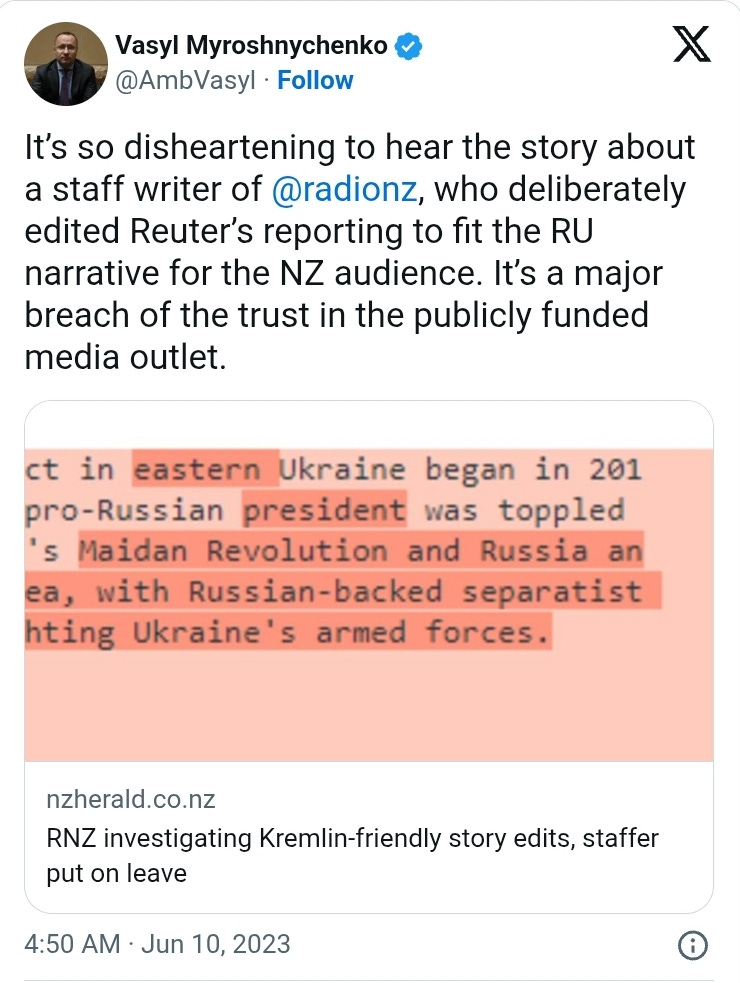
In a Twitter/X post, Luppen complained that RNZ had republished a Reuters article authored by the news agency’s Moscow bureau chief Guy Faulconbridge, with “utterly false, Russian propaganda” inserted. Namely, that the February 2014 Maidan “revolution” was in fact a “violent” US-sponsored “colour revolution,” provoking a civil war in eastern and southern Ukraine, during which local “ethnic Russians” were “suppressed.”

Mick Hall was responsible for inserting this wording.

This pathetic story should be taught in the "Free World" J-schools, but of course it won't.

He told The Grayzone, “it always seemed odd to me a New York-based lawyer would come across a republished Reuters story on a small national broadcaster’s website in the South Pacific – I’ve not read too much into it, but it felt strange at the time, and still does.” Nonetheless, Hall believed his changes were legitimate given the story’s content, and stands by his decision to this day.

Since joining RNZ in September 2018 as a “digital journalist” and subeditor, he was responsible for selecting and processing news stories from international news agencies and wire services for republication on the broadcaster’s website. Hall frequently found that copy by the BBC, Reuters, and other prominent Western news services contained extraordinary bias and distortions. He felt compelled to balance the coverage by adding context, or amending and deleting passages which seemed overtly ideological.

When the Ukraine proxy war erupted in February 2022, Hall sensed that Western news agencies were not even attempting to conceal their biases any longer.

Manufactured crisis boomerangs on RNZ

On June 9th 2023, RNZ placed Hall on leave and announced an urgent investigation into his supposedly Kremlin-influenced editing. By this point, the foundations of an international scandal had been laid. For months afterwards, “disinformation experts”, think tank hawks, mainstream ‘journalists’ and politicians whipped up a paranoid, conspiratorial frenzy over Hall’s edits. The BBC, Independent, New York Times and Reuters cranked up the controversy with blanket coverage. The Guardian’s obsessively anti-Russian Luke Harding took a particularly keen interest.

Olga Lautman, a Ukrainian nationalist from arms industry-funded think tank CEPA, strongly suggested that Hall was taking orders from the Russian state to insert “disinformation” into RNZ’s output. This libelous conjecture was not helped by RNZ chief Paul Thompson offering a servile public apology, in which he begged for forgiveness for “pro-Kremlin garbage…[ending] up in our stories.” An internal audit identified “inappropriate” edits made by Hall in 49 stories, out of 1,319 he worked on for RNZ in total – exactly 3.71%.

At his lawyer’s suggestion, Hall produced a detailed document listing every story he edited that had been flagged by RNZ for supposedly “inappropriate” tampering. He included personal explanations for why changes were made and passages inserted, along with expert supporting commentary from figures such as economist Jeffrey Sachs and political scientist John Mearsheimer. However, Hall gave up after just 39 stories. “The reasons RNZ flagged the remaining 10 – such as referring to Julian Assange, a journalist – were so ridiculous, it seemed a waste of time,” he explained.

RNZ subsequently appointed an independent panel to assess the fiasco. In a bitter irony, the report they published on July 28 2023 was a rebuke to Hall’s accusers. It declared that “not all of the examples of inappropriate editing identified by RNZ were found by the panel to be inappropriate.” Moreover, the panel accepted Hall “genuinely believed he was acting appropriately,” and “was not motivated by any desire to introduce misinformation, disinformation or propaganda.”

While the report accused Hall of several cases of “inappropriate editing,” breaching both RNZ’s editorial policy and its contractual agreement with Reuters, the panel did not conclude this was deliberate, but a well-intentioned effort to add “balance and accuracy into the stories.” Moreover, the edits flagged by the panel as “inappropriate” were usually factual, and contained valuable historical context. For example, Hall amended a May 2022 story about the attempted evacuation of Mariupol to note that Azov Battalion “was widely regarded before the Russian invasion by Western media as a Neo-Nazi military unit.”

That Azov’s extremist background, history and ideology has been obfuscated and whitewashed since the proxy war began is a basic statement of fact. The panel even acknowledged the group’s neo-Nazi links had “been noted, reported on and debated” previously, but bizarrely found Hall’s “uncritical and unexplained inclusion” of this inconvenient truth “had the effect of unbalancing the story.” This was despite the panel admitting, “experienced people operating in good faith can and do disagree” on editorial standards, which are in any event “matters for judgment”.

Conversely, the review was extremely scathing of how Hall’s “errors were framed” by RNZ’s leadership. Their conduct was found to have “contributed to public alarm and reputational damage which the panel believes was not helpful in maintaining public trust.” It furthermore concluded “the wider structure, culture, systems and processes that facilitated what occurred” were the state broadcaster’s responsibility. Grave “gaps” in supervision and training of RNZ’s “busy, poorly resourced digital news team” were identified. For example, “limitations on changing content” from newswires weren’t clearly communicated to staff.

An “intense Western-wide witch hunt over a single person amending newswire copy”

For Hall, many questions about the affair linger today – not least how the Inspector General reached his conclusions. The report states, “much of the information my inquiry has considered is highly classified, which limits the information I can provide you to explain my findings.” It is difficult to conceive what “highly classified” information NZSIS “considered” given the public nature of the allegations against Hall. What’s more, both the independent review panel and NZSIS cleared him of any wrongdoing within two months of the first accusations.

Similarly curious was the vague language which filled the three-page report. For example, it claimed that NZSIS had taken “relatively limited steps” in investigating Hall. Yet it failed to clarify which steps were taken. Confusing matters even further, the Inspector General admitted “NZSIS shared information about the conclusion of its enquiries with interested parties… to allay concerns of foreign interference.” The identity of those “interested parties,” and why it was NZSIS’ responsibility to ameliorate their baseless anxieties, was also unclear.

“We’ll likely never know the answer to any of these mysteries. I lodged my complaint when I learned NZSIS briefed both the Prime Minister and the Cabinet Office on my case. I also have grounds to believe at least one of Wellington’s Western intelligence partners was given information on me,” Hall tells The Grayzone.

“This was a simple matter of minor procedural errors on my part, and disagreement over editorial standards with RNZ’s management, which could’ve been quietly and professionally resolved internally. Instead, I was thrust into the glare of the international media and the Five Eyes global spying network. The intense Western-wide witch hunt over a single person amending newswire copy at a tiny news outlet could indicate there was some kind of deeper, darker coordination at play. Again though, we’ll probably never know.”


The views expressed herein are solely those of the author and may or may not reflect those of  The Greanville Post. However, we do think they are important enough to be transmitted to a wider audience. 


All image captions, pull quotes, appendices, etc. by the editors not the authors. 
YOU ARE FREE TO REPRODUCE THIS ARTICLE PROVIDED YOU GIVE PROPER CREDIT TO THE GREANVILLE POST VIA A BACK LIVE LINK. 
This work is licensed under a Creative Commons Attribution-NonCommercial 4.0 International License


Published: July 27, 2025 0 comments
0 FacebookTwitterPinterestEmail

Voices From the Terror List: Palestine Action Members Speak Out After UK Ban

by Kit Klarenberg Published: July 26, 2025
written by Kit Klarenberg 16 minutes read
Free Palestine Action members
Please make sure these dispatches reach as many readers as possible. Share with kin, friends and workmates and ask them to do likewise.

Kit Klarenberg
MINTPRESS NEWS
Traducir—Translate!
Make fonts bigger>>>
Resize text-+=

Logo

Free Palestine Action members

Investigation

Voices From the Terror List: Palestine Action Members Speak Out After UK Ban


On July 1, British Home Secretary Yvette Cooper announced that Palestine Action (PA), a crusading campaign effort, would be proscribed as a terrorist group. Describing the movement as “dangerous,” she charged that its “orchestration and enaction of aggressive and intimidatory attacks against businesses, institutions and the public” had “crossed the thresholds established in the Terrorism Act 2000.” As a result, PA is now the country’s first protest group to be formally branded a terrorist entity, placing it in the same league as al-Qaida and ISIS.

Based on Cooper’s characterization, a typical consumer of mainstream media might conclude PA posed a grave threat to Britain’s public safety and national security. However, other comments by Cooper appeared to undermine her incendiary headline charges. In justifying PA’s proscription, the Home Secretary cited recent actions conducted by the movement. These included “attacks” on factories owned by defense contractors Thales in 2022 and Instro Precision in 2024, each causing more than £1 million in damages.

As hundreds of lawyers and multiple U.N. experts argued in the week before the proscription took effect, the move set an extremely dangerous precedent not only in Britain but for Palestine solidarity efforts worldwide. The group did not engage in activities that could plausibly be categorized as “terrorism”—a highly contentious concept, popularized by Israel for political reasons—in other Western jurisdictions. Average citizens were not in Palestine Action’s crosshairs, and not once did the group’s activism harm a human being.

Instead, PA engaged in multifaceted civil disobedience, targeting firms closely tied to Israel’s slaughter of Palestinians, most prominently the Israeli-owned defense giant Elbit Systems. Entities providing services to those targets—such as companies leasing commercial space to Elbit—were also in the group’s crosshairs. These actions proved devastatingly effective, hitting Elbit’s bottom line at home and abroad. PA’s disruption also brought unwelcome mainstream attention to Elbit’s operations, spotlighting the firm in ways it clearly sought to avoid.

In proscribing Palestine Action, the British government may have been motivated, in part, by a desire to avoid awkward questions and inconvenient disclosures. In one of the group’s final actions, on June 19, several members broke into Royal Air Force base Brize Norton and defaced two military planes parked there. The site is a key hub for refueling and repairing British jets that have conducted hundreds of reconnaissance flights over Gaza since the genocide began in October 2023.

These routine surveillance flights are just one component of London’s active involvement in the genocide, which authorities systematically seek to conceal from public view. Another is the presence of the SAS conducting “counterterrorism” operations in Gaza, which has been covered up via direct state decree. However, the origins of Palestine Action’s proscription stretch back much further. The story behind the ban is a sordid and largely hidden one marked by long-running, opaque collusion between British and Israeli authorities and the global arms industry.

The Legal and Political Fallout

As a result of PA’s proscription, it is now a criminal offense to be a member of, or to express “support” for, the group, punishable by up to 14 years in prison. However, an Actionist who wishes to remain anonymous predicts many will deliberately breach the proscription order, knowing they’ll face legal consequences, to increase pressure on authorities. Already, dozens of British citizens — including an 83-year-old priest — have been arrested for peacefully displaying signs declaring, “I oppose genocide. I support Palestine Action.”

This is like something from an Alan Moore comic. https://t.co/uVoqIGJlrA

— Asa Winstanley (@AsaWinstanley) July 19, 2025

Voices From the Terror List: Palestine Action Members Speak Out After UK Ban

“Things are going to happen, without doubt. The group may be proscribed, but you can’t proscribe ideas, whether that’s opposition to the Holocaust in Gaza, sympathy with Israel’s innocent victims, or a desire to disrupt the network of genocide in Britain to which Elbit and its subsidiaries and suppliers are so central,” the Actionist tells MintPress News. “Still, the chilling effect on Palestine solidarity is obvious, and no doubt deliberate.”

The mass arrest of peaceful demonstrators for simply expressing sympathy for Palestine Action highlights a deeply troubling aspect of British “counterterror” legislation. The term “support” isn’t even clearly defined, and according to legal precedents, can extend far beyond practical or tangible assistance, to “intellectual” support, including “agreement with and approval” or “speaking in favor” of a proscribed group. In December 2024, UN experts expressed immense disquiet over this “vague and overbroad” interpretation, warning that it could “unjustifiably criminalize legitimate expression.”

“The proscription of Palestine Action is unprecedented. It’s the first time Britain has banned as ‘terrorist’ a protest group which has never used guns or bombs,” Asa Winstanley of Electronic Intifada tells MintPress News. “It seems like a massive overreach, and therefore it’s not surprising there’s been lots of civil disobedience in response.”

Surprisingly, even The Times, typically a reliable megaphone for Britain’s intelligence, military and security apparatus, published an editorial on July 7 intensely critical of “the heavy-handed branding of Palestine Action as terrorists,” dubbing the proscription “absurd.” While describing the group as “a malign force” and “antisocial menace,” the outlet argued that activists’ damage to commercial and private property could be “prosecuted into submission” under existing criminal law and the use of “lighter-touch measures” given the level of threat posed by Palestine Action.

Notably absent from The Times editorial was any consideration of the fact that criminal proceedings against Palestine Action frequently ended in failure. In several cases, Actionists who caused mass disruption or damage to Elbit sites walked free even on relatively minor charges, because the company declined to provide police or prosecutors with witnesses or other evidence.

Elbit is extremely wary of advertising the central role its arsenal plays in the killing of Palestinians. The company’s marketing brochures typically omit mention of its Israeli ownership, instead emphasizing the supposed economic and social benefits its operations deliver to British communities. A January 2023 puff piece on UAV Systems, an Elbit subsidiary repeatedly targeted by Palestine Action, even referred to the company as a “little company making repurposed Norton motorbike engines.”

In cases where Elbit did provide evidence, Actionists used the opportunity to turn the tables and place the company and the Israeli state on trial. In November 2022, five of the group’s activists who vandalized Elbit’s London HQ were acquitted. In defending their actions, several of the accused testified to witnessing first-hand atrocities committed by Israeli occupation forces in Gaza and the West Bank. While Elbit argued Palestine Action’s buckets of red paint were “improvised weapons,” the jury was not persuaded.


Palestine Action Drop Elbit

Palestine Action members target Allianz offices in London, demanding it stop insuring Israeli arms maker, Elbit Systems. Joao Daniel Pereira | AP


Judicial Battles and Public Defiance

Fast forward to today, and the anonymous Actionist is under no illusions that the British legal system alone will be enough to reverse Palestine Action’s proscription. “It has to be fought amongst the public, on the streets and in the courts,” they tell MintPress News. The group has applied for a judicial review in an effort to overturn its ban. This follows an application for interim relief to delay the proscription, which was denied after Yvette Cooper’s announcement.

Despite submitting an extensive witness statement outlining the serious implications that Actionists—and ordinary British citizens—could face if the ban took immediate effect, a panel of three judges took less than 90 minutes to reject the request. The justices acknowledged that there would be “serious consequences” from the government’s ban, including the risk that individuals could “unwittingly commit” criminal offenses and that those associated with the group might face “social stigma and other more serious consequences at university or at work.”

Palestine Action had warned the ban would create confusion and chaos. Police responses to pro-PA protests across Britain have varied wildly. Some resulted in no arrests, while in Wales, protesters were not only arrested under terror legislation but also had their homes raided. Videos of interactions between Palestine solidarity protesters and police suggest officers themselves are unsure about what is now lawful. In Scotland, four people were arrested for wearing T-shirts that didn’t even mention the group.


British Police Officers Say Holding A "Free Gaza" Poster Is A Terrorism Offence

Advocating against genocide in the UK is now being considered support for Palestine Action, just proscribed a terrorist group. A real time consequence of the ban.

Free Speech=Terrorism in Kent, UK. pic.twitter.com/IQdFKhx5s6

— MintPress News (@MintPressNews) July 15, 2025


Speaking to MintPress News, the anonymous Actionist expressed frustration over the court’s decision. “A UN Special Rapporteur supported us, warning the proscription breached international standards, but apparently British judges know better. It just shows how corrupt the entire system is. Every part of it is rotten,” they lament. “The government, almost unanimously supported by parliament, rammed through the conscription without warning or any public debate whatsoever, after falsely briefing the media we might be funded by Iran. Who will they target like this next?”

As Declassified UK has documented, nearly every major British outlet ran with the Home Office’s Iran narrative, without offering PA a rebuttal. In a particularly revealing twist, the pro-Israel lobby group We Believe In Israel—which does not disclose its funding sources—openly took credit for the government’s decision. In an X post, the organization called the proscription its “victory,” claiming it was the direct result of months of “sustained research, strategic advocacy, and evidence-based reporting” contained in a report it had published earlier in the year.


Palestine Action Blue Flag

A banner reading “PROTESTING THIS ISN’T TERRORISM” is taken down by London police. Lab Mo | AP Images


Collusion and Israeli Influence

Again, the anonymous Actionist is unsurprised that British policy—if not legislation—is effectively being written by Israeli lobby groups. Yvette Cooper, Foreign Secretary David Lammy, Chancellor Rachel Reeves and Prime Minister Keir Starmer were all named as supporters of Labour Friends of Israel, before the list was scrubbed from the internet ahead of the 2024 general election. LFI, which praised the proscription, maintains a close relationship with Tel Aviv’s London embassy, which is widely believed to be infested with Mossad agents—a connection the group works to obscure.

In recent months, PA and independent journalists have uncovered compelling evidence that the Home Office has been in secret contact with Elbit representatives and Israel’s London embassy almost since the group’s founding in 2020. The full scope of this collusion is still unknown and may never come to light. However, documents released under Freedom of Information laws raise serious concerns about whether this concealed relationship influenced both the prosecution of Actionists and the decision to proscribe the group.

For example, in March 2022, then-Home Secretary Priti Patel met privately with Elbit UK CEO Martin Fausset to reassure the firm—and, by extension, its Israeli handlers—that the British government was taking “criminal protest acts against Elbit Systems UK” seriously. At the time, officials acknowledged that Palestine Action’s activities did “not meet the threshold for proscription” under British law. Before that meeting, no PA members had been successfully prosecuted. In the months that followed, legal actions against the group escalated dramatically.

Still, many Actionists continued to walk free. In December 2023, six members—including co-founders Huda Ammori and Richard Barnard—were acquitted of nine charges by a jury. The following month, internal correspondence revealed Elbit UK’s security director wrote to British officials expressing concern that “a re-trial is not a certainty” and suggesting it was “very much in the public interest” for the trial to be reheard.

Mere days later, a retrial was announced—for 2027. That would mark six years since the alleged offenses took place. One Actionist called the drawn-out process a “form of psychological warfare on defendants,” saying it prevents them from making long-term plans or securing employment. Meanwhile, other PA members are imprisoned awaiting trial, some already incarcerated for extended periods. There are disturbing signs that their detention and prosecution are being coordinated with Israeli authorities.

Among the most alarming revelations are heavily redacted emails showing that, in September 2024, the British Attorney General’s Office shared contact details for the Crown Prosecution Service and counterterrorism units with the Israeli embassy. The timing raises suspicions of Israeli interference in the prosecution of PA members who, earlier that month, broke into Elbit’s Filton factory and destroyed quadcopters—weapons routinely used to maim and kill Palestinians in Gaza.


British Israeli collusion

Source | Kit Klarenberg | The Grayzone


In all, 18 Actionists involved currently remanded in prison, their pre-trial detention period running to 182 days, well in excess of standard limits for non-terror-related cases. Their contact with the outside world has also been severely restricted, in violation of international legal norms. On July 15, another five PA members were arrested and charged in connection with Filton.

If the Israeli government played any role in these prosecutions, it would represent a flagrant breach of Crown Prosecution Service guidelines, which prohibit “undue pressure or influence from any source.”

In May, British prosecutors announced they would consider “terrorism connections” in the case of 10 Actionists who targeted Instro Precision, an Elbit supplier, in June 2024. While the charges—aggravated burglary, criminal damage and violent disorder—do not qualify as terrorism under British law, prosecutors say those connections may factor into sentencing. If upheld, that designation could lead to significantly harsher penalties than standard criminal charges would normally carry.


Legal Challenges Mount

On July 21, London’s High Court heard arguments from lawyers representing Huda Ammori, seeking permission to challenge Palestine Action’s proscription. In addition to citing devastating figures related to the genocide in Gaza and Elbit’s direct involvement, the legal team also emphasized the legal uncertainty now faced by activists and journalists as a result of the ban.

In response, government lawyers argued that the Proscribed Organisations Appeal Commission—not a judicial review—was the appropriate forum to challenge the designation. At the hearing’s conclusion, the judge stated a full ruling would be issued on July 30.

Earlier, on June 24, Jewish News revealed that British authorities had hesitated to proscribe PA out of concern that a judicial review “could overturn” the decision. That concern reportedly contributed to initial “reticence” from the Home Office. Even if the review is authorized, it could take months for a ruling to be reached.

In the meantime, journalist and legal scholar Leila Hatoum offered a stark assessment of the situation. She told MintPress News that the British state’s targeting of the group “for standing against genocide and oppression” was “nothing short of tyranny.” She added that the ban not only threatens basic rights—particularly freedom of speech and freedom of the press—but also violates international law.

The Convention on the Prevention and Punishment of the Crime of Genocide, which was adopted by the UN in 1948, notes it is the duty of all nations and peoples to act to stop a genocide. By legally pursuing those who are seeking to prevent Israel’s ongoing apartheid, occupation and genocide against the Palestinians in Gaza, especially members and supporters of Palestine Action, the UK has positioned itself against the international law, and alongside the forces of darkness. The country has failed humanity.”

A Legacy of Resistance

Despite this bleak outlook—and the possibility that the group could remain proscribed regardless of any court challenge—Palestine Action’s example remains an inspiration to people across Britain and beyond. A volunteer group of ordinary citizens, spanning every age, ethnicity, faith and gender, without financial or institutional backing, posed such a threat to entrenched power that the British government, for the first time in history, resorted to a legal “nuclear option” to neutralize them.

Civil disobedience aimed at disrupting military operations has a long and established history. Since the early 1980s, the Christian pacifist Plowshares movement has carried out sabotage against U.S. military bases and nuclear installations. In 2003, five activists were prosecuted for damaging American bombers at a British base to prevent their use in the Iraq War. One of the defendants was represented by none other than Keir Starmer, who argued successfully that although their actions were technically illegal, they were justified as an effort to prevent war crimes.

Palestine Action represents the first group to maintain this legacy during an active, ongoing genocide, but ever since its launch, it has achieved major victories. In January 2022, Elbit sold off one of its component factories, and a British government prosecutor acknowledged that PA’s sustained actions against the site “forced the closure.” Two additional Elbit sites targeted by the group have since been shut down. Governments around the world, including Brazil and even Britain, have canceled lucrative contracts with the company.

Had the British state not acted so forcefully, it is likely that Palestine Action’s momentum would have continued building, possibly forcing Elbit out of the UK entirely. Yet despite the risk of arrest or prison, solidarity with Palestine and overt support for Palestine Action show no sign of fading. As Israel’s favorability plummets to historic lows across the West, there are countless individuals around the world ready to follow PA’s example, risking their liberty to stop the ongoing genocide.

After all, it is not just a moral duty. It is a legal one.

Truth Has Enemies. We Have You.

For over a decade, MintPress News has been at the forefront of exposing Israeli apartheid, occupation, and war crimes—when few dared to. We’ve been censored, smeared, and blacklisted for telling the truth. But we haven’t stopped. Independent journalism like this isn’t just important, it’s under attack. If you believe in reporting that defends the voiceless and challenges the powerful, we need your support.

Support Us on Patreon
Feature photo | A protestor holds a placard during the demonstration. Hundreds of Palestine Action protestors congregated at HMP Brixton Prison to lobby for the release of all Political Prisoners on their annual New Year’s Eve “Noise Demo”. Lab Ky Mo |Sipa | AP Images


Print this article [bws_pdfprint display=’print’]

The views expressed herein are solely those of the author and may or may not reflect those of The Greanville Post, although, if we publish them, we obviously find them noteworthy and valuable. 

Creative Commons LicenseThis work is licensed under a Creative Commons Attribution-NonCommercial 4.0 International License • 
ALL CAPTIONS AND PULL QUOTES BY THE EDITORS NOT THE AUTHORS

Published: July 26, 2025 0 comments
0 FacebookTwitterPinterestEmail
  • 1
  • 2

You’re reading the best annotated digest of political information in the English language

Choose your language

Recent Posts

  • The Rise and…Rise of ‘Color Revolutions’

    Published: October 8, 2026
  • Jim Kavanagh: Discussion with Garland Nixon on France/Euro Protests, Rejection of Zionism, Class Dictatorship, etc

    Published: October 8, 2026
  • MR: The Idea of the ‘Uyghur Genocide’ and the Realities of Xinjiang

    Published: October 8, 2026
  • Miracle and Bravery in the Skies Over the Middle East —Bollywood on steroid

    Published: October 8, 2026
  • Rees-Mogg Says He Supports the Mass-Murder of Children – and Liberals Fawn Over Him

    Published: October 8, 2026

Search

AND THERE’S NOTHING WASHINGTON CAN DO TO STOP IT.

Why US War on China Will FailClick inside the image to read


Speaking for the suppressed is our mission

IF YOU THINK THE WARMONGERING MEDIA ARE A DISGRACE AND A HUGE OBSTACLE TO REAL CHANGE IN AMERICA…
why haven’t you sent at least a few dollars to The Greanville Post (or a similar anti-imperialist citizen’s media)?. Think about it.  Without educating and organizing our ranks our cause is DOA. That’s why our citizens’ media need your support.  
Click anywhere on the image.

Gateway

  • Log in
  • Entries feed
  • Comments feed
  • WordPress.org

Most Important Info Sources


Most Trusted:
Andrei Martyanov
Black Agenda Report
Caitlin Johnstone
Caleb Maupin
China Rising/Jeff J. Brown
Consortium News
Danny Haiphong
Don Hank
Free PalestineTV–Laith Marouf

Garland Nixon
George Galloway
George Hazim
Gilbert Doctorow —Armageddon
Glenn Greenwald
Godfree Roberts / Here Comes China
Information Clearinghouse
In Defense of Communism
Jim Kavanagh/The Polemicist
Jonathan Cook Blog
Julian Macfarlane
Michael Roberts
Mondoweiss
Moon of Alabama
Multipolarista
Oliver Boyd-Barrett
Orinoco Tribune
Revolutionary Blackout Network/ Nick Cruse
Richard Medhurst
Roger Boyd
Sabby Sabs
Scott Ritter/AskThe Inspector
Seek Truth From Fact Foundation (STFF)
Simplicius the Thinker
Sonar21/Larry C Johnson
The Cradle
The Electronic Intifada
The Grayzone
The Jimmy Dore Show
The New Atlas/ Brian Berletic
The Vineyard of the Saker
Thomas Fazi Dispatches
Voltairenet.org
William Schryver / imetatronink

DONATE to The Greanville Post! It’s your media.


“Nothin’ tougher than cat herding!”

NOW IN THE TOP 1% OF AMAZON’S ASIA TITLES. WITH A SPECIAL FOREWORD BY PEPE ESCOBAR. 568 PP, ILLUSTRATED.

About Us

Kitty studious philosopherTHE GREANVILLE POST (TGP) is an antidote to and refuge from the ubiquitous brainwash long afflicting most people in the United States and the rest of the collective West. TGP is an independent, (barely) reader-supported, non-dogmatic publication dedicated to seeking the truth wherever it may be found. Thus, we publish voices from any point in the political spectrum, left, right, up, down, except shitlibs, professional disinformers, media whores, and demagogues of the extreme right. TGP is already heavily shadowbanned; it could be gone tomorrow. That’s the lousy, uber-hypocritical times we inhabit, so read it while you can, and do pass its carefully selected articles to others: friends, kin and workmates. Incidentally, if you can send a donation, do so. For obvious reasons, we do not operate behind a paywall. Defeating the Big Lie is too important and urgent to subject the truth to the test of wallet power.

He does not believe in Western “objectivity”.

bandido no stinking badge

Legalities: Disclaimer, etc.


Disclaimer Notice
  • Facebook
  • Twitter

@2021 - All Right Reserved. Designed and Developed by PenciDesign


Back To Top
The Greanville Post
  • HOME
  • ESSENTIAL
  • MYTH-FREE HISTORY WITH JACQUES PAUWELS
  • MUST VIDEO
  • BLOWBACK
  • NATURE