Print this article [bws_pdfprint display=’print’]
This work is licensed under a Creative Commons Attribution-NonCommercial 4.0 International License •
ALL CAPTIONS AND PULL QUOTES BY THE EDITORS NOT THE AUTHORS
Max Blumenthal (born December 18, 1977) is an American author and blogger. He was a writer for The Nation, AlterNet, The Daily Beast, Al Akhbar, Mondoweiss, and Media Matters for America, and has contributed to Al Jazeera English, The New York Times and the Los Angeles Times.[4] He has been a writing fellow of the Nation Institute.[6] He is a regular contributor to Sputnik and RT. Blumenthal is the editor of The Grayzone website, known for its criticism of US foreign policy and its positive coverage of the Chinese, Russian, Syrian, and Venezuelan governments, including its denial of chemical attacks by the Syrian government and of human rights abuses against Uyghurs, and other big lies and false flag ops staged and disseminated by the West's disinformation machine.


| Traducir—Translate! | |
| Make fonts bigger>>> | Resize text-+= |
Feb 20, 2026 #TheGrayzone

Subscribe to The Grayzone: https://substack.com/@thegrayzone
SPECIAL: US political elites advance Israel's war on Iran |
In Munich I saw my enemies - The Grayzone live
BEFORE you leave, PLEASE pay attention to this alert.
[t4b-ticker id="1"]
This work is licensed under a Creative Commons Attribution-NonCommercial 4.0 International License •
ALL CAPTIONS AND PULL QUOTES BY THE EDITORS NOT THE AUTHORS

| Traducir—Translate! | |
| Make fonts bigger>>> | Resize text-+= |
The video presents a critical discussion on U.S. foreign policy and its involvement in Venezuelan political conflicts, focusing on accusations of U.S.-backed coup attempts and corruption within the Venezuelan opposition. Blumenthal rebuts claims made by other panelists, referencing historical and contemporary evidence to support their points. They highlight the CIA’s alleged role in founding the Cartel of the Suns to facilitate cocaine trafficking in the U.S., as revealed in a 1993 “60 Minutes” exposé. Blumenthal defends his scrutiny of government officials involved in coup plotting, specifically condemning Venezuelan opposition leaders such as Leopoldo Lopez and Maria Corina Machado for orchestrating violent riots and failed military coups, which resulted in civilian casualties. Furthermore, Blumenthal criticizes corporate interests like Exxon Mobil and mercenaries linked to U.S. cronies for exploiting Venezuela’s natural resources under the guise of political intervention. He contrasts the vilification of Venezuelan President Nicolás Maduro with the apparent immunity of other global figures involved in serious crimes, such as Benjamin Netanyahu and Ecuador’s President Daniel Noboa, emphasizing the selective nature of international condemnation. The overall narrative suggests a deeply flawed and hypocritical international approach to Venezuelan politics and broader geopolitical struggles over resource control and regime change.
Overall, the transcript offers a critical perspective on Venezuela’s political crisis, emphasizing themes of U.S. interventionism, opposition violence, resource exploitation, and international hypocrisy. It challenges mainstream narratives by providing historical context, specific examples of opposition misconduct, and pointing to broader geopolitical interests shaping the conflict.
BEFORE you leave, PLEASE pay attention to this alert.
[t4b-ticker id="1"]
This work is licensed under a Creative Commons Attribution-NonCommercial 4.0 International License •
ALL CAPTIONS AND PULL QUOTES BY THE EDITORS NOT THE AUTHORS


| Traducir—Translate! | |
| Make fonts bigger>>> | Resize text-+= |
The video features a detailed interview with Max Blumenthal conducted by Judge Andrew Napolitano on October 13, 2025, focusing on the recent ceasefire and ongoing conflict in Gaza and Israel. Blumenthal presents a critical analysis of the political and military developments over the past two years, highlighting the missed opportunities for peace, the roles of key international players, and the consequences of the war on civilian populations. He argues that the conflict could have been resolved much earlier if the U.S. administration, particularly under President Biden, had exercised political will to pressure Israel into peace negotiations. Instead, Blumenthal contends that the Biden administration enabled prolonged violence by supporting Israeli military actions and failing to push Prime Minister Netanyahu toward a ceasefire.
Blumenthal credits the Trump administration with finally facilitating a ceasefire deal through unconventional diplomatic efforts led by Steve Wickoff, motivated partly by Trump’s desire for a legacy and Nobel Prize. He reveals the complex dynamics within Gaza, including the Israeli-backed gangs that previously looted aid supplies and the role Hamas has played in maintaining order under extremely difficult conditions. Trump’s public remarks approving Hamas as a policing force in Gaza—despite their designation as a terrorist group—illustrate the pragmatic, if controversial, shifts on the ground.
The interview also discusses the fragile political situation in Israel, where Netanyahu’s coalition is unstable, and his political future uncertain. Netanyahu reportedly needs a new regional war to maintain his power. The release of Israeli hostages by Hamas is described with nuance, revealing unexpected relationships between hostages and captors. Blumenthal contrasts the treatment of Israeli prisoners with the brutal conditions endured by Palestinian prisoners in Israeli custody.
Throughout the interview, Blumenthal condemns the vast destruction of Gaza, the high civilian death toll, and the ongoing human rights abuses committed by Israel. He highlights the hypocrisy and propaganda surrounding the conflict, criticizing Western media and political narratives that obscure the realities on the ground. The interview ends with a warning about the volatility of the ceasefire and the potential for renewed violence, especially given Netanyahu’s political calculations and Trump’s ambiguous role.
Missed Diplomatic Opportunities: Blumenthal underscores that the war could have been halted much earlier through diplomatic pressure, specifically citing Gershon Baskin’s back-channel efforts that were ignored by the Biden administration. This reveals how political calculations and ideological biases can obstruct peace even when all parties are willing. The failure to act decisively resulted in tens of thousands of deaths and extensive destruction.
️ Trump’s Pragmatic Intervention: Trump’s unexpected role in brokering a ceasefire reflects his personal political motivations but also a pragmatic recognition of the stalemate’s toll. Steve Wickoff’s involvement and Trump’s push for a deal contrast sharply with the more traditional, cautious diplomacy under Biden, illustrating how individual leadership styles and objectives can drastically influence international outcomes.
️ Governance and Order in Gaza: Despite immense devastation, Hamas has demonstrated a capacity to maintain civil order and provide municipal services under siege conditions. This challenges the narrative that Hamas is purely a militant group incapable of governance. The Israeli-backed gangs, by contrast, acted as spoilers, looting aid and destabilizing Gaza, which complicates the conflict’s internal dynamics.
⚖️ Political Calculations in Israel: Netanyahu’s precarious coalition and need for a regional war to maintain power highlight how domestic political interests can perpetuate conflict. The interview suggests that peace is often sacrificed for political survival, underscoring the intersection of war and politics in Israeli governance. Trump’s mockery and call for Netanyahu’s pardon reveal the deep dysfunction and corruption within Israeli politics.
Hostage Dynamics and Humanization: The release of hostages who showed friendly gestures toward their Hamas captors disrupts monolithic portrayals of the conflict’s human elements. It suggests complex interpersonal dynamics that arise even in adversarial conditions and highlights the political utility of hostages as leverage in negotiations.
Human Rights Violations and Propaganda: Blumenthal’s detailed recounting of massacres, bombings, and torture exposes the extreme human cost of the conflict, often minimized or distorted in mainstream media. The disparity in treatment between Israeli and Palestinian prisoners lays bare systemic abuses and raises ethical questions about accountability and justice.
Role of International Influence: The U.S. remains the decisive external actor, with Israel’s military strength and occupation dependent on American arms and political support. The interview makes clear that shifting U.S. policy could dramatically alter the conflict’s trajectory, underscoring the geopolitical dimension of the Israeli-Palestinian conflict and the power of international actors to either perpetuate or resolve violence.
This analysis provides a comprehensive understanding of the current state of the Israel-Gaza conflict as of late 2025, the geopolitical dynamics involved, and the human toll that continues to shape the region’s future.
BEFORE you leave, PLEASE pay attention to this alert.
[t4b-ticker id="1"]
This work is licensed under a Creative Commons Attribution-NonCommercial 4.0 International License •
ALL CAPTIONS AND PULL QUOTES BY THE EDITORS NOT THE AUTHORS


| Traducir—Translate! | |
| Make fonts bigger>>> | Resize text-+= |
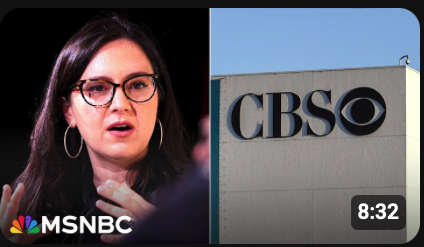
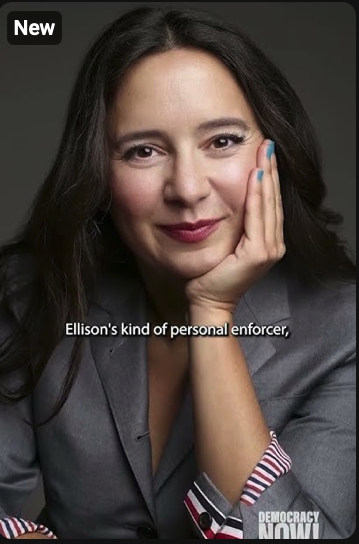
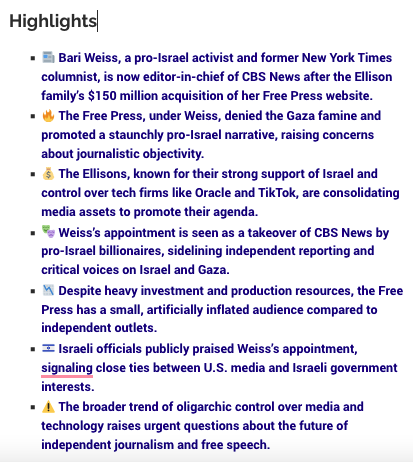
The video provides a critical and detailed analysis of Bari Weiss’s recent appointment as editor-in-chief of CBS News following the acquisition of the Free Press by the Ellison family, notably Larry and David Ellison, wealthy pro-Israel billionaires. Bari Weiss, a former New York Times opinion columnist known for her pro-Israel activism and anti-“woke” stance, founded The Free Press, a site criticized for promoting Israel and denying the humanitarian crisis in Gaza. The Ellisons’ $150 million purchase of the Free Press and installation of Weiss at CBS News is framed as a strategic takeover with the intent to consolidate pro-Israel narratives in mainstream media and suppress dissenting voices, particularly those critical of Israeli policy.
The transcript explores Weiss’s background, emphasizing her lack of traditional journalism experience and highlighting her history of anti-Palestinian activism, including efforts to remove Palestinian professors from Columbia University. The video contrasts the Free Press’s limited audience and production scale with CBS News’s legacy and resources, questioning the inflated valuation of the Free Press and the motivations behind Weiss’s appointment.
Furthermore, the video situates this media consolidation within a broader context of pro-Israel billionaire influence over U.S. media and technology platforms, including Oracle and TikTok, both controlled by the Ellisons. It exposes conflicts of interest involving Weiss’s financial backers, including AI and tech oligarchs tied to controversial figures and government policies favoring Israel and suppressing criticism.
The transcript also highlights reactions from Israeli officials celebrating Weiss’s appointment as a victory for “common sense” and pro-Israel discourse, while independent journalists and critics warn of the erosion of journalistic integrity under her leadership. The video warns that CBS News under Weiss will likely avoid coverage of critical issues like the Gaza genocide and instead promote sanitized, politically palatable narratives aligned with Zionist and technofeudal interests.
Finally, the transcript reflects on the broader implications of oligarchic control over media and technology, noting similar patterns in other countries and expressing concern over the future of independent journalism and the dissemination of truthful, critical news in an increasingly corporatized and ideologically controlled media landscape.

Corporate Media Takeover by Ideological Actors: Bari Weiss’s appointment illustrates how major media outlets like CBS News can be acquired and controlled by wealthy ideological actors with specific political agendas. This raises profound concerns about media independence and the diversity of viewpoints presented to the public. Weiss’s background as an opinion columnist with overt political commitments, rather than a traditional journalist, underscores a shift from objective reporting to ideological advocacy at the highest editorial levels.
️♂️ Conflict of Interest and Editorial Integrity: The significant conflicts of interest surrounding Weiss—financially backed by tech and AI billionaires with ties to pro-Israel lobbying and controversial government policies—undermine CBS News’s claim to impartiality. Maintaining editorial control of the Free Press while leading a legacy news organization creates a dual platform that can channel biased narratives into mainstream media, blurring the lines between opinion activism and factual reporting.
Inflated Valuations and Manufactured Influence: The $150 million valuation of the Free Press appears disconnected from its actual audience size and engagement, indicating that financial and ideological backers have artificially inflated its market value to justify its acquisition and Weiss’s elevation. This phenomenon reflects a broader trend where ideological content platforms are monetized and leveraged for political influence rather than journalistic merit.
Tech Oligarchs and Media Consolidation: The involvement of the Ellison family, Oracle, and related tech investors signals a convergence of technology, media, and political influence. With Oracle’s control over data infrastructure and TikTok’s social media platform, these oligarchs are positioned to shape public discourse across multiple channels, embedding pro-Israel and technocratic agendas deeply into digital and traditional media ecosystems.
Israeli Government Influence on U.S. Media: The enthusiastic endorsements from Israeli officials for Weiss’s appointment reveal the extent to which Israeli state interests are intertwined with U.S. media ownership and narratives. This relationship raises critical questions about foreign influence in American journalism and the suppression of coverage that challenges Israeli policies, especially regarding the Gaza conflict.
Erosion of Journalistic Standards and News Quality: The video foresees a degradation of CBS News’s journalistic quality under Weiss, with an emphasis on viral content, podcasts, and narratives catering to conservative, pro-Israel, and anti-“woke” audiences. This shift may marginalize rigorous investigative reporting and critical perspectives, further polarizing media consumption and undermining public trust.
Global Pattern of Media Capture by Elites: The transcript contextualizes the CBS News takeover within a worldwide trend where oligarchs and political elites buy and control media outlets to suppress dissent and consolidate power—examples include Ecuador and Turkey. This global pattern threatens the viability of independent media and freedom of expression, posing a profound challenge to democratic accountability and informed citizenry.
The appointment of Bari Weiss as editor-in-chief of CBS News represents a watershed moment in the convergence of oligarchic power, ideological media control, and the erosion of journalistic independence. Backed by pro-Israel billionaires and tech oligarchs, Weiss’s leadership threatens to transform a major legacy news organization into a vehicle for partisan narratives that suppress uncomfortable truths, particularly about Gaza and Israeli policies. This development exemplifies broader global patterns of media consolidation by powerful elites, raising urgent questions about the future of free and independent journalism in democratic societies.
BEFORE you leave, PLEASE pay attention to this alert.
[t4b-ticker id="1"]
This work is licensed under a Creative Commons Attribution-NonCommercial 4.0 International License •
ALL CAPTIONS AND PULL QUOTES BY THE EDITORS NOT THE AUTHORS

| Traducir—Translate! | |
| Make fonts bigger>>> | Resize text-+= |
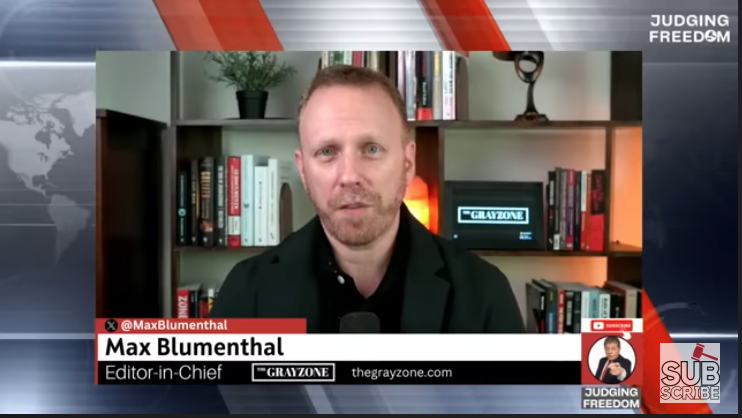
The video features a detailed conversation between Judge Andrew Napolitano and journalist Max Blumenthal, discussing the complexities of the ongoing conflict in Gaza, Israel’s geopolitical maneuvers, and the increasing influence of Zionist billionaires in American media and politics. The discussion opens by examining former President Donald Trump’s attempt to broker a ceasefire with Hamas and Israel’s refusal to halt bombings, driven by Netanyahu’s coalition pressure for total victory through ethnic cleansing and annexation plans in Gaza and the West Bank. Blumenthal underscores the futility of negotiations with Hamas given Israel’s continued military aggression and occupation policies, especially the transformation of the West Bank into a heavily controlled prison-like area.
The dialogue then shifts to Israel’s covert and overt efforts to influence American public opinion and policy through digital propaganda wars. This involves the purchase and control of major media outlets, notably the acquisition of CBS, Paramount, and TikTok by the Ellison family—Larry Ellison, Oracle’s billionaire founder, and his son David Ellison—who have close ties to Israeli interests. The Israeli government is reportedly orchestrating a vast campaign targeting American Christian Zionists via geo-targeted digital ads, virtual reality experiences, and social media influencer networks, all aimed at shaping pro-Israel narratives and suppressing pro-Palestinian activism.
Blumenthal reveals leaked documents showing a decade-long plan involving David Ellison and a coalition of Zionist billionaires to wage “cognitive warfare” on the American public, leveraging AI and crypto policy to control information and silence dissent. This campaign includes the use of former Mossad operatives, digital paramilitaries, and sophisticated surveillance, signaling a foreign takeover of American media and political discourse unprecedented in scale. The conversation also highlights the erosion of constitutional protections in the U.S., with militarized federal forces suppressing dissent under the guise of combating crime and terrorism, further entrenching a technocratic authoritarianism aligned with Israel’s global agenda.
In closing, Blumenthal and Napolitano express grave concern about the state of American democracy, media integrity, and civil liberties amid these converging forces of foreign influence, militarization of law enforcement, and the weaponization of AI-driven propaganda. The video calls for awareness and resistance to what is described as a foreign-backed takeover of American society’s informational and political spheres.
Netanyahu’s Strategic Use of Military Force to Maintain Power: Netanyahu’s refusal to halt Gaza bombings and his explicit commitment to permanent occupation reflect a strategy to appease his extremist coalition partners who advocate for ethnic cleansing and Judaization of northern Gaza. This highlights the internal political calculus driving prolonged conflict, where political survival outweighs peace or humanitarian considerations. The ethnic cleansing agenda and continuation of occupation underscore the deep-rooted settler-colonial aims of Israel’s current government, making any genuine peace negotiations nearly impossible under existing conditions.
️ Armed Resistance as a Survival Mechanism: Hamas and Hezbollah’s refusal to disarm is grounded in historical experience and practical reality. Disarmament in the face of an occupying power typically leads to increased vulnerability and loss of political leverage. The West Bank’s transformation into a prison-like area under the Palestinian Authority’s complicity exemplifies why Gaza’s militant groups maintain weapons as essential to defending Palestinian autonomy and dignity. This insight reveals how militarization becomes embedded in resistance movements under systemic repression.
Digital Propaganda and Psychological Warfare Targeting American Christians: The Israeli government’s deployment of digital tools—geo-fencing, targeted ads, and immersive virtual reality content—aimed at Christian Zionist communities in key U.S. states is a sophisticated effort to manufacture consent and mobilize support for Israel’s policies. This represents a novel form of information warfare that exploits religious and cultural affiliations to embed pro-Israel narratives deeply within American society, effectively weaponizing religion for geopolitical ends.
Media Consolidation as a Tool of Foreign Influence: The Ellison family’s acquisition of major American media assets such as CBS, Paramount, and TikTok, combined with the appointment of overtly Zionist figures like Barry Weiss to editorial leadership roles, signals a deliberate strategy of media capture. This consolidation ensures control over narratives disseminated to the American public, marginalizing dissenting voices and legitimizing Israeli propaganda. The blending of billionaire influence, state sponsorship, and media control exemplifies an unprecedented threat to journalistic independence and democratic discourse.
The Convergence of AI, Social Media, and Foreign Lobbying: The use of AI-driven social media manipulation, influencer contracting, and algorithm gaming by pro-Israel operatives points to a new frontier in cognitive warfare. This approach not only suppresses pro-Palestinian activism but also reshapes public opinion through subtle, often invisible means, raising profound ethical and legal questions about transparency, foreign interference, and the manipulation of democratic processes. The involvement of tech industry figures linked to the Trump administration further complicates the nexus of power and influence.
Erosion of Civil Liberties and Militarization of Domestic Policing: The discussion highlights a disturbing trend where federal agencies like ICE, ATF, and FBI engage in paramilitary operations targeting dissidents and marginalized communities under broad definitions of terrorism. The use of masked, armed forces to suppress protests and conduct warrantless arrests signals a shift toward authoritarian governance. This internal militarization serves not only to enforce domestic control but also aligns with the external geopolitical agenda of Israeli influence, demonstrating how foreign policy and domestic repression are intertwined.
Long-Term Planning and Covert Operations for Cognitive Dominance: The leaked documents revealing a decade-long Israeli initiative involving billionaire funding, Mossad operatives, and digital paramilitary groups suggest that the current media and political influence campaign is the culmination of extensive, covert planning. This underscores the strategic intent behind the campaign: to wage a silent cognitive war on American society, shaping perceptions and policies without overt confrontation. The lack of mainstream media coverage or governmental investigation into this foreign meddling highlights systemic failures in democratic oversight and accountability.
The video provides a comprehensive and sobering analysis of how the Gaza conflict intertwines with broader geopolitical strategies involving media control, digital propaganda, and domestic militarization in the United States. It paints a picture of an ongoing cognitive war waged by Israeli-aligned billionaires and political actors to shape American public opinion and policy through covert influence operations and media consolidation. The erosion of civil liberties and the rise of authoritarian enforcement mechanisms domestically compound the risks to democratic governance. The insights call for heightened awareness, critical media literacy, and active resistance to protect democratic institutions from foreign domination and technocratic authoritarianism.
BEFORE you leave, PLEASE pay attention to this alert.
[t4b-ticker id="1"]
This work is licensed under a Creative Commons Attribution-NonCommercial 4.0 International License •
ALL CAPTIONS AND PULL QUOTES BY THE EDITORS NOT THE AUTHORS