
Justin Podur
THE ANTI EMPIRE PROJECT

| Traducir—Translate! | |
| Make fonts bigger>>> | Resize text-+= |
|
When America sends the National Endowment for Democracy, the National Democratic Institute, and the International Republican Institute abroad, they are teaching the rest of the world the best political system invented so far, the worst one except for all the others as Churchill said, the system at the end of history as Fukuyama declared, the system that peoples around the globe fought and bled for, multiparty democracy. Ideally, two-party democracy, so that people have a choice, but not too much choice. Never mind that rather undemocratic means can be used to keep other parties out of the game; or that begging rich people for campaign money is the principal activity of American politicians; or that politicians do not do what they promised; or that decisions like investment, pricing, money supply, energy and military planning are either jointly private-public or entirely private matters outside of democratic control. There’s a jest in the East that in the Chinese system you can change the policy but not the party, while in America you can change the party but not policy. This is another thing the genocide should have taught us. After an American election season where both parties promised enthusiastically to continue the genocide of Palestinians, while in other Western countries parties compete to show the most fealty to the genocidal state, Western electorates have never been more helpless. Given the opportunity to change the party, they’ll change the party. But it makes no difference. In the Global South, elections often matter. They’re high stakes affairs for several reasons. First, a real alternative might get into office and engage in actual wealth redistribution, land reform, or measures towards economic sovereignty. Second, if voters dare to vote for such an alternative the country will face US-backed coups, sanctions, and sabotage. In the West, though, democracies are more mature. The most important policies won’t be changed through something as capricious as the public will. Americans who want Medicare For All, for their police to kill fewer of them each year, or simply an end to the genocide, can’t vote those in. The notion of asking the public to vote on regime change, covert wars, or overt ones, in Eastern Europe or West Asia - is even more ridiculous. Analytical energy is being wasted on what the Biden administration is trying to do before Trump comes in, or how Trump might want to take on the deep state but for now he has to bide his time, or in Canada how hapless the liberal leader is and how prime ministerial the conservative candidate looked in the latest podcast video with an immensely popular, totally conventional pro-Israel commentator who is of course portrayed as an outsider and maverick. In the West, these frothy shows known as elections are of tremendous value to the corporate interests and owners of private fortunes that decide whether the masses of the Global South will have peace or genocide, whether the masses of the Global North will have public health care and education or crumbling infrastructure. To name a few of these benefits:
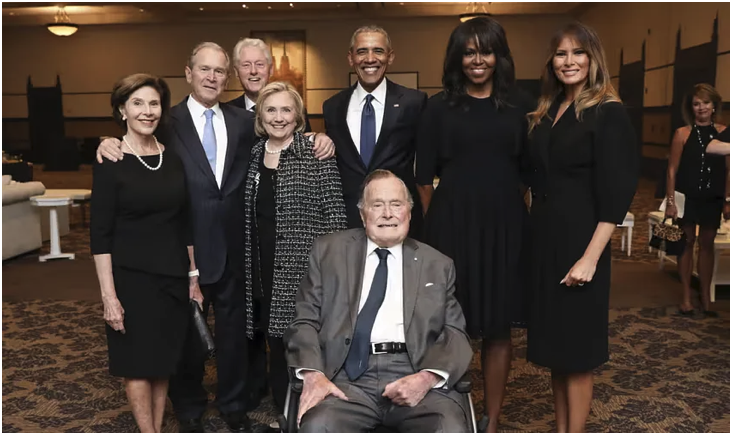
The belief that established Western political parties offer meaningful differences in policy from one another has taken different forms. Advocates of lesser-evilism admit that the differences between what parties do in power are actually very small, but argue that these small differences matter and so it’s important to go and vote for the lesser evil. Advocates of strategic voting argue that you need not like a party or candidate but that you should vote for them anyway to fulfill some broader strategic objective, which is usually blocking the party you don’t like from coming to power. I propose subsuming these variants and coining the word, partyism, for any form of the belief that Western political parties are meaningfully different on important policy matters. Partyism can never be disproven, since we could never know what the loser would have done had the winner not won. We could only ever speculate. But circumstantial evidence against partyism is presented every time a party betrays their electoral promises - something that does happen from time to time, though notably, neither Harris nor Trump were willing even to make a promise to end the genocide that they could later renege on. Instead of falling into the partyist trap, look at a country’s billionaires, the statements by the chambers of commerce, the policies advocated for the country in America’s business newspapers (regardless of which country you’re in). Political scientists Martin Gilens and Benjamin Page have done a big study twenty years ago and another ten years ago to show that politicians listen to the rich, not to you. You know who’s not in this picture? You. Subscribe to The Anti-Empire Project
By The Anti Empire Project · Launched 2 years ago
Anti-Empire notes from writer, podcaster, and academic Justin Podur
|
Print this article [bws_pdfprint display=’print’]
This work is licensed under a Creative Commons Attribution-NonCommercial 4.0 International License •
ALL CAPTIONS AND PULL QUOTES BY THE EDITORS NOT THE AUTHORS


2 comments
Who is not present in that birthday photograph of Poppy Bush is, you guessed it, Donald J. Trump. He is the outsider and thus to be hated, like a highschool misfit. Tribalism is one of the strongest bonds in a capitalist structure.
What Debs said in 1904 remains relevant today. “The Republican and Democratic parties … are the political wings of the capitalist system and such differences as arise between them relate to spoils and not to principle. With either of these parties in power one thing is always certain and that is that the capitalist class is in the saddle and the working class under the saddle … The ignorant workingman who supports either of these parties forges his own fetters and is the unconscious author of his own misery’