[su_spoiler title=”Please make sure these dispatches reach as many readers as possible. Share with kin, friends and workmates and ask them to do likewise. ” open=”yes” style=”fancy” icon=”arrow-circle-1″]

 Jyotishman (I&GL)
chats with
VIJAY PRASHAD
| Traducir—Translate! | |
| Make fonts bigger>>> | [wpavefrsz-resizer] |
 India & Global Left
Analysis
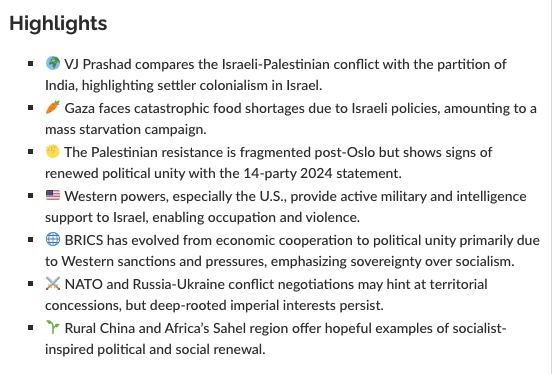
In this comprehensive discussion, historian and political commentator VJ Prashad provides a nuanced analysis of the current socio-political crises in Palestine, the dynamics of global geopolitics including BRICS and NATO, and reflections on socialism’s relevance today. Prashad draws historical parallels between the partition of India and the ongoing Israeli-Palestinian conflict, emphasizing the settler-colonial nature of Israel and its continuous policy of dispossession and occupation against Palestinians. He highlights the fragmentation within the Palestinian resistance movements post-Oslo Accords, but also points to recent signs of renewed unity, such as the 14-party statement brokered with Chinese facilitation.
Prashad critiques Western imperial powers, particularly the U.S. and Europe, for their complicity in sustaining Israeli occupation through military, intelligence, and political support, despite growing grassroots opposition within these societies, including amongst Jewish communities. He elaborates on the complexity of the Israel-Palestine question, weighing the tactical necessity of maintaining the two-state solution internationally while acknowledging long-term debates around a one-state solution that challenges Zionism’s foundational premise.
Turning to the global south, Prashad contrasts the anti-colonial, socialist-leaning origins of the Non-Aligned Movement (NAM) with the more economically driven and politically diverse nature of BRICS, which has gained political coherence mainly due to Western economic pressures and conflicts such as the Ukraine war. He argues sovereignty is the unifying principle for BRICS rather than socialism or radical economic transformation, warning that financial dependence on imperial centers limits true autonomy.
On the Russia-Ukraine conflict and NATO, Prashad suggests potential openings for negotiation amid shifting U.S. and NATO stances, though he remains skeptical about fundamental changes given entrenched imperial interests. He also critiques recent political rhetoric and disinformation, urging a pragmatic understanding of global power shifts.
In the final segment, Prashad challenges the notion of “technofeudalism” as a break from capitalism, asserting that modern tech companies are capitalists advancing productive forces while extracting surplus value. He maintains that capitalism’s underlying dynamics remain consistent despite technological changes.
Concluding with reflections on socialism and alternative futures, Prashad expresses hope grounded in tangible developments, notably in rural China where socialist principles visibly improve social relations and living conditions. He also points to movements in Africa’s Sahel region, where military-led revolutions seek sovereignty and political renewal amid failures of traditional bourgeoisie politics. Prashad dismisses Western-style electoral democracy as an ideal, focusing instead on governance that effectively addresses people’s immediate needs as a practical measure of progress.
Key Insights
-
️ Historical Parallels and Settler Colonialism: Prashad uses the Indian partition to contextualize Palestine but stresses a critical difference—the settler colonial nature of Israel. Unlike India and Pakistan, where partition led to two recognized states, Israel’s creation involved the displacement and ongoing dispossession of Palestinians without recognition or sovereignty. This leads to a permanent conflict where the Israeli state continues to expand territorially and militarily, seeking to erase Palestinian presence entirely. The “permanent Nakba” (catastrophe) is a concept that encapsulates this ongoing ethnic cleansing and denial of Palestinian statehood, making the conflict structurally different from other post-colonial partitions.
-
Complex Palestinian Resistance Landscape: The fragmentation of the Palestinian resistance after the Oslo Accords represents a key challenge. The PLO’s decline and the rise of factions opposing Oslo (such as Hamas, PFLP, Islamic Jihad) reflect diverging strategies between negotiated statehood and armed resistance. Nevertheless, recent efforts—such as the 14-party joint statement facilitated by China—signal potential re-unification of Palestinian political forces. This moment of cautious optimism is crucial but fragile given Israeli repression, imprisonment of leaders, and lack of international support beyond token statements. The prisoner’s letter from Israeli jails remains a symbolic blueprint for new politics.
-
️ Western Imperial Complicity and Growing Grassroots Opposition: The U.S. and European countries are the main enablers of Israel’s occupation through arms supply, intelligence sharing, and diplomatic backing. Prashad underscores the hypocrisy of Western leaders who publicly condemn violence selectively while facilitating Israel’s aggressive policies. However, he also notes an important shift: widespread protests and dissent within these imperial societies, including among Jewish communities in the U.S., challenge the conflation of Israel criticism with antisemitism. This growing grassroots pressure complicates official policies and introduces new dynamics in global solidarity movements.
-
BRICS vs. NAM: Political Shifts in the Global South: The Non-Aligned Movement was rooted in anti-colonial, socialist-leaning politics, backed by mass movements. In contrast, BRICS emerged in response to the 2007-08 financial crisis as a coalition driven by economic interests and sovereignty concerns rather than ideological unity. Its political coherence hardened after Russia’s invasion of Ukraine, when member states refused to isolate Russia despite Western pressure. BRICS represents a pragmatic, sovereignty-focused bloc aiming to counter Western dominance but lacks a socialist agenda. This reflects the complexity of contemporary geopolitics where economic imperatives and survival dominate over ideological purity.
-
NATO-Russia Negotiations and Imperial Constraints: Prashad analyzes emerging signals from NATO and Russia regarding possible territorial compromises in Ukraine, highlighting NATO’s internal contradictions and the U.S.’s ultimate supremacy in decision-making. While some NATO officials hint at short-term acceptance of territorial changes, the long-term rejection remains ambiguous. Trump’s potential negotiations with Putin may reflect a strategic shift toward a “reverse Kissinger” approach, aiming to drive a wedge between Russia and China. However, deep structural interests in maintaining NATO’s influence and the military-industrial complex’s priorities limit the possibility of genuine peace or de-escalation.
-
Critique of “Technofeudalism”: Prashad challenges the notion that contemporary digital capitalism represents a new “technofeudal” system. Instead, he argues these are classic capitalist enterprises that invest heavily in infrastructure and extract surplus value through commodification of data and services. The rhetoric of “technofeudalism” mystifies capitalism’s enduring mechanisms and detracts from understanding the structural relations of production and exploitation. This critique helps clarify contemporary economic debates and avoids romanticizing or mystifying the capitalist mode of production.
-
Socialism’s Prospects in the Global South: Despite global capitalism’s dominance, Prashad remains hopeful about socialism’s future based on tangible progress in places like rural China, where socialist principles improve social equity, and in Africa’s Sahel, where military-led nationalist movements seek sovereignty and political renewal. He dismisses Western-style electoral democracy’s idealization, stressing that effective governance solving people’s immediate problems is the real measure of progress. This pragmatic socialist vision focuses on sovereignty, social justice, and practical outcomes rather than idealized political forms.
BEFORE you leave, PLEASE pay attention to this alert.
[t4b-ticker id=”1″]
[/su_spoiler]
Print this article [bws_pdfprint display=’print’]
[su_note note_color=”#f1efef” radius=”0″]The views expressed herein are solely those of the author and may or may not reflect those of The Greanville Post, although, if we publish them, we obviously find them noteworthy and valuable. [/su_note]
 This work is licensed under a Creative Commons Attribution-NonCommercial 4.0 International License •
ALL CAPTIONS AND PULL QUOTES BY THE EDITORS NOT THE AUTHORS