

 Gabriel Rockhill
| Traducir—Translate! | |
| Make fonts bigger>>> | [wpavefrsz-resizer] |

(July 7, 2021).
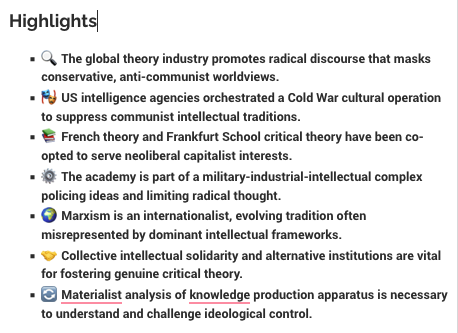
The video presents a comprehensive lecture on the global theory industry, its intellectual history, and the material social forces shaping it, particularly emphasizing left anti-communism and its impact on critical theory. Prof. Rockhill traces their personal intellectual journey from an initial engagement with radical critical theory rooted in the Frankfurt School and French theory (structuralism and post-structuralism) to a materialist critique of these traditions and the broader apparatus of knowledge production under neoliberal capitalism. The central argument is that the dominant global theory industry promotes a generalized critical theory that cloaks conservative and anti-communist worldviews in radical discourse, limiting genuine revolutionary and anti-capitalist thought.
Prof. Rockhill discusses the historical conditions that gave rise to this phenomenon, highlighting the role of US national security agencies (like the CIA) in shaping intellectual discourse during the Cold War through organizations such as the Congress for Cultural Freedom. This network strategically promoted anti-communist leftist ideas while undermining communist and socialist intellectual traditions globally. The lecture critiques key figures like Foucault, Derrida, and the Frankfurt School theorists for their anti-Marxist stances and disconnect from materialist politics, arguing that their work often serves as a conservative ideological bulwark disguised as radical thought.
The talk also addresses the challenges faced by scholars operating within the academy, which is deeply intertwined with capitalist and state power structures, limiting intellectual autonomy and reinforcing ideological boundaries. Prof. Rockhill advocates for a shift from idealist, subjectivist approaches to a materialist, objective framework that examines the institutional, economic, and political forces shaping knowledge production. Emphasizing solidarity, collective struggle, and engagement with actual socialist and anti-capitalist traditions, the lecture calls for a reinvigoration of Marxist and historical materialist analysis as tools for radical social transformation.
Key Insights
-
️♂️ The Apparatus of Knowledge Production Controls Intellectual Discourse: Prof. Rockhill elucidates how knowledge is not produced or circulated neutrally but is shaped by material forces—economic, political, and institutional. This apparatus predetermines which ideas gain public recognition and which are marginalized or attacked. This insight reveals the structural constraints under which intellectuals operate, emphasizing the need to analyze the systems enabling or limiting certain knowledge forms rather than solely focusing on individual thinkers.
-
Cold War Cultural Warfare Shaped Intellectual Fields: The CIA and affiliated organizations like the Congress for Cultural Freedom orchestrated an extensive global propaganda campaign that promoted anti-communist leftist ideas while undermining communist and socialist intellectuals. This operation included funding journals, conferences, translations, and media articles worldwide, effectively embedding a politically motivated intellectual agenda. Understanding this history is crucial to decoding why certain theoretical traditions dominate today and others remain marginalized.
-
Generalized Critical Theory Masks Conservative Politics as Radical:The lecture critiques French theory (Derrida, Foucault, Kristeva, etc.) and Frankfurt School theorists for presenting themselves as radical while maintaining conservative or liberal political positions. These schools often eschew revolutionary Marxist politics, focusing instead on culture, discourse, and representation in ways that divert attention from class struggle and political organizing. This “radical” discourse functions as ideological cover that sustains the capitalist order.
-
⚖️ Left Anti-Communism as the Lingua Franca of Contemporary Theory: Prof. Rockhill highlights that an unspoken but pervasive anti-communism within leftist academic circles functions as a boundary policing mechanism. This left anti-communism conflates communism with fascism, delegitimizes actually existing socialism, and excludes more revolutionary socialist perspectives. It constitutes a form of ideological control protecting neoliberal capitalism from radical critique.
-
The Globalization of the Theory Industry and Its Impact on the Global South: The theory industry’s reach extends globally, influencing intellectuals in India, Latin America, Australia, and beyond. However, this globalization often involves mediated forms of inclusion that still reinforce class and colonial hierarchies by canonizing certain “global” theorists while excluding indigenous Marxist or socialist intellectual traditions. This highlights the ongoing imperialist nature of global knowledge production.
-
Materialist Analysis as a Necessary Framework: Prof. Rockhill advocates shifting from an idealist, subjectivist focus on individual intellectual production to an objective, materialist analysis of the institutional and economic forces shaping intellectual life. This approach can reveal the underlying social relations and power structures that condition theoretical production and circulation, enabling a more radical and emancipatory scholarship.
-
Collective Intellectual Work and Alternative Institutions as Sites of Resistance: Given the constraints of the academy and the global theory industry, Prof. Rockhill emphasizes the importance of creating alternative spaces for intellectual work—such as critical theory workshops, activist communities, and counter-institutions—that foster genuine radical critique and solidarity beyond institutional co-optation. This strategy counters the isolation and careerism prevalent in academic structures.
-
Reclaiming Marxist Intellectual Traditions and Historical Materialism: The lecture stresses the misrepresentation of Marxism as Eurocentric, determinist, or reductionist, highlighting its rich, internationalist tradition that has historically led struggles for racial, gender, and colonial liberation. Reengaging deeply with these traditions can provide robust tools for understanding and transforming capitalism, contrasting with the symbolic radicalism of generalized critical theory.
-
Dialectical Relationship Between Subjective Agency and Objective Structures: Prof. Rockhill clarifies that intellectuals are not mere marionettes controlled by external forces, but participate in a dialectical relationship where subjective agency is conditioned by objective material relations. This explains why intellectuals may willingly participate in ideological projects that serve capitalist interests, often unconsciously, due to systemic pressures and incentives (“uplift”). Recognizing this dynamic is key to developing self-reflexive and autonomous critical practices.
-
Praxis-Oriented Critique of Identity Politics and Neoliberal Co-optation: The lecture critiques liberal identity politics as an ideology that acknowledges real social issues like racism and sexism but frames them in ways that obscure their material causes and perpetuate tokenistic, non-transformative solutions. A radical praxis requires linking identity struggles to broader class and materialist analyses to develop substantive, collective emancipatory strategies.
-
️ Navigating Intellectual Work Within and Beyond the Academy: Prof. Rockhill acknowledges the harsh realities of academic labor markets, tenure systems, and ideological constraints, advising scholars to strategically negotiate these environments while seeking or building alternative spaces for radical work. This includes leveraging institutional resources tactically, developing collective support networks, and maintaining a big-picture materialist perspective to counter intellectual Taylorism and fragmentation.
-
Importance of Incorporating Diverse Global Marxist Perspectives: The lecture underscores the necessity of engaging with Marxist and socialist intellectual traditions from non-Western contexts—India, Russia, Latin America, Africa—many of which remain untranslated or marginalized. This internationalist approach enriches historical materialism and challenges the Eurocentric and colonial biases of the dominant global theory industry.
-
Critical Examination of Influential Theorists is Complex and Necessary: While critical of thinkers like Foucault, Derrida, Adorno, and others, Prof. Rockhill does not advocate wholesale rejection but suggests a compositional hermeneutics—identifying useful elements while exposing limitations and ideological biases. This nuanced engagement allows for more productive critique and the extraction of valuable insights without uncritical acceptance.
-
The Crisis of Capitalism and the Urgency of Radical Intellectual Work: Finally, Prof. Rockhill situates these theoretical debates in the context of the existential crises facing humanity—ecological destruction, pandemics, deepening inequality—and argues that radical social theory rooted in historical materialism is urgently needed to address these challenges. This underscores the high stakes of intellectual work and the imperative to reconceptualize theory as an active force for social transformation.
Conclusion
This lecture offers a sweeping critique of the global theory industry and its entanglement with Cold War politics, neoliberal capitalism, and anti-communism. It calls for a rigorous materialist analysis of the social forces shaping intellectual production and advocates for reclaiming Marxist and historical materialist traditions as tools for radical social change. Emphasizing the dialectical interplay between agency and structure, Prof. Rockhill encourages collective intellectual solidarity and the cultivation of alternative spaces for critical thought beyond the academy’s constraints. The lecture challenges scholars to rethink the nature and purpose of critical theory in the contemporary world, highlighting the urgent need for praxis-oriented, materialist approaches to confront the systemic crises of capitalism.

First run Apr 10, 2025 #Postmodernism #Foucault #Marxism
This video features an in-depth debate between Professor Gabriel Rockhill, a Marxist philosopher critical of postmodernism and poststructuralism, and Assistant Professor David Guignion, a philosopher sympathetic to postmodern and poststructuralist traditions. The discussion centers on the comparative strengths and weaknesses of Marxism—particularly dialectical and historical materialism—and the French poststructuralist/postmodernist theories associated with thinkers like Foucault, Derrida, and Baudrillard.
Professor Rockill critiques the poststructuralist tradition as fundamentally reactionary, bourgeois, and counterrevolutionary, arguing that these thinkers were co-opted by the US imperialist intellectual apparatus to undermine Marxism and genuine revolutionary praxis. He highlights French theorists’ anti-Marxist politics, their involvement in anti-communist activities, and their failure to seriously engage with the colonial question and class struggle. Rockill emphasizes the scientific rigor and practical utility of dialectical and historical materialism, its global history of socialist state-building, and its commitment to addressing all forms of oppression—class, race, gender, and sexuality—within a unified materialist framework.
Conversely, David Guignion challenges the strict separation between Marxism and poststructuralism, advocating for a pluralistic approach that incorporates insights from both traditions. He acknowledges the limitations and problematic aspects of French theory but sees value in its nuanced understandings of power, subjectivity, and language. Ginon stresses the importance of intersectionality, recognizing that oppression predates capitalism and that a revolutionary theory must account for gender, race, and other social relations alongside class. He also highlights the real-world influence of poststructuralist ideas in contemporary social movements, such as anti-carceral activism, and underscores the need for theory to be accessible and relevant to diverse struggles worldwide, including those in the Global South.
The debate also touches on the role of academics and intellectuals in revolutionary practice, the commodification of theorists like Foucault and Marx, and the challenges of maintaining ideological rigor without dogmatism. Both interlocutors agree on the primacy of class struggle and opposition to imperialism but diverge on the theoretical tools best suited for advancing socialist transformation.
The conversation closes with a mutual recognition of shared political goals despite theoretical disagreements, advocating ongoing dialogue and collaboration to build a just and egalitarian society.
Highlights
- Debate between Marxist dialectical materialism and poststructuralist/postmodernist theory.
- Rockill critiques French theory as bourgeois, anti-Marxist, and imperialist-aligned.
- Emphasis on Marxism’s historical role in anti-imperialist socialist state-building.
- Ginon advocates pluralism, integrating Marxist and poststructuralist insights.
- ✊ Discussion on the role of intellectuals in real-world revolutionary struggles.
- Examination of poststructuralism’s limits and its influence on social movements like anti-carceral activism.
- ⚖️ Agreement on political goals but divergence on theoretical methods and frameworks.
Key Insights
-
Theory as Class Practice and Commodity: Rockill situates intellectual production within broader capitalist social relations, arguing that French poststructuralist theory is produced and promoted by the imperialist “theory industry” for exchange value, primarily serving the professional-managerial class rather than working-class struggles. This contrasts with dialectical and historical materialism, which is geared towards use value—real-world transformation. This insight highlights how theory is embedded in material conditions and class interests, shaping its political efficacy and reach.
-
️ Dialectical and Historical Materialism as a Scientific Tradition: Contrary to accusations of dogmatism, Rockill defends Marxism as a living, collective scientific tradition aimed at rigorously understanding and transforming material reality. He emphasizes its adaptability and global scope, especially in socialist state-building projects that historically resisted imperialism, underscoring Marxism’s practical and epistemological strengths.
-
️♂️ Poststructuralist Theorists and Political Alignment: Rockill provides a critical historical analysis of French theorists’ political positions, revealing their anti-communist activities and ideological roots in reactionary traditions (e.g., Nietzschean aristocratic radicalism and Heideggerian fascism). This challenges the often-uncritical academic valorization of these figures and calls for a reevaluation of their political implications.
-
Intersectionality vs. Class Reductionism: Ginon stresses the importance of intersectional analysis, arguing that oppression (gender, race, sexuality) preexists capitalism and must be addressed alongside class struggle. He critiques tendencies within some Marxist circles to reduce all forms of oppression to class alone and champions a more inclusive approach that resonates with diverse social movements, especially in the Global South.
-
The Role of Academics in Revolutionary Practice: The debate surfaces tensions about the relevance and accessibility of academic theory for working-class and grassroots movements. Ginon advocates for theory that connects with lived experiences and is usable by activists, while Rockill stresses the embeddedness of theory in class relations and the need for rigorous scientific grounding to avoid ideological confusion.
-
Commodification and Symbolic Use of Radical Thought: Both interlocutors acknowledge the commodification of radical thinkers like Foucault and Marx but interpret its implications differently. Rockill sees the commodification of French theorists as a mechanism for ideological control and dilution, while Ginon notes the coexistence of commodification across traditions and the potential for ideas to be tools for diverse struggles despite this.
-
Common Ground in Political Commitment: Despite theoretical disagreements, both Rockill and Ginon concur on the centrality of opposing imperialism, fostering egalitarian transformation, and the necessity of ongoing dialogue. This shared political commitment frames the debate as a productive engagement rather than a polarizing confrontation, emphasizing the pragmatic importance of coalition-building in leftist politics
BEFORE you leave, PLEASE pay attention to this alert.
[t4b-ticker id="1"]
Print this article [bws_pdfprint display=’print’]
 This work is licensed under a Creative Commons Attribution-NonCommercial 4.0 International License •
ALL CAPTIONS AND PULL QUOTES BY THE EDITORS NOT THE AUTHORS


2 comments
to be cynical about this (regarding the guignon and rockhill discussion), thatcher was correct: “there is no alternative”. one can be concerned about the obfuscation, but how to educate the masses. even lenin was conflicted about it.
Yallah, both men are correct, but what intellectuals think is immaterial to the masses. Trump is a catalyst for change.