[su_spoiler title=”Please make sure these dispatches reach as many readers as possible. Share with kin, friends and workmates and ask them to do likewise. ” open=”yes” style=”fancy” icon=”arrow-circle-1″]

 Daniel Davis / Deep Dive
CHATS WITH
Col. Rt. Douglas Macgregor
| Traducir—Translate! | |
| Make fonts bigger>>> | [wpavefrsz-resizer] |

Summary
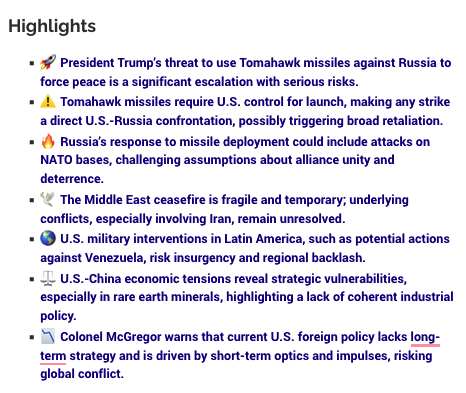
The video features a detailed discussion between Rt Col. Daniel Davis and Rt. Colonel Douglas Macgregor, a defense and foreign policy analyst, focusing primarily on the implications of supplying Ukraine with Tomahawk missiles, the ongoing conflict with Russia, and broader geopolitical tensions involving the Middle East, Iran, Venezuela, and U.S.-China relations. President Trump’s recent remarks about potentially using Tomahawk missiles to pressure Russia into peace terms favorable to Ukraine serve as the conversation’s launch point. Macgregor critically analyzes the military, political, and strategic ramifications of such a move, emphasizing the risks of escalation and miscalculation.
The conversation outlines the technical capabilities and limits of Tomahawk missiles, highlighting their operational control by U.S. forces and the consequent perception in Russia of a direct American act of war. MacGregor warns that Russian retaliation could be swift and severe, potentially targeting NATO bases and escalating into a broader conflict. The discussion also explores internal pressures on President Putin from his population and military advisors, who may push for harsher responses, while Putin himself is portrayed as a cautious leader seeking to avoid full-scale war.
Shifting focus, the dialogue touches on the fragile ceasefire in the Middle East, notably between Israel and Gaza, framing it as a temporary pause rather than a lasting peace, with continued underlying tensions and strategic interests, particularly regarding Iran. Trump’s belief that military force was integral to achieving the ceasefire is questioned and contextualized within a broader critique of his preference for military solutions over diplomacy.
The conversation extends to U.S. foreign policy challenges in Latin America, especially regarding Venezuela, where Macgregor opposes any military intervention, warning of insurgency and regional backlash. Finally, they discuss escalating U.S.-China trade tensions and economic vulnerabilities, particularly concerning rare earth minerals critical to technology and defense, underscoring America’s strategic disadvantages due to supply chain dependencies.
Macgregor concludes with a call for a more coherent, long-term U.S. strategy focused on retrenchment from unnecessary conflicts, emphasizing the dangers of short-term, impulsive policymaking that risks global war and domestic instability. The dialogue ends with an invitation to join ongoing conversations about America’s future direction.
Key Insights
-
Tomahawk Missiles as a Dangerous Escalation: The Tomahawk missile system, while technologically advanced, is not a game-changer militarily in the Ukraine conflict but represents a major political escalation. Since launches would be controlled by U.S. personnel, Russia would view any use as a direct act of war by the U.S., not just Ukraine. This blurs the lines of engagement and increases the risk of rapid and severe Russian retaliation, potentially expanding the war beyond Ukraine’s borders. The missile’s range and payload make it suitable for targeting critical infrastructure, but these strikes could provoke a disproportionate response. Macgregor emphasizes that Trump’s underestimation of this risk is dangerous and potentially catastrophic.
-
⚔️ Russian Strategic Calculus and Internal Pressures: Putin is portrayed as a leader exercising restraint despite internal pressures from a frustrated population and hardline military advisors demanding harsher actions. This tension within Russia’s leadership complicates the conflict’s trajectory, as Putin balances the desire to avoid a full-scale war, especially one involving nuclear weapons, against the demands of his inner circle and public opinion. This dynamic creates unpredictability, as a significant provocation like Tomahawk strikes could tip the balance toward escalation. Medvedev’s fiery rhetoric serves as an expression of popular anger and an indicator of possible escalation pathways that Putin might seek to control but cannot entirely suppress.
-
️ NATO’s Fragility and European War Weariness: The discussion highlights the lack of cohesion within NATO, contradicting common assumptions about alliance unity. Many European members, including Slovakia, Hungary, and even Poland, may resist direct confrontation with Russia, revealing fractures that Russia likely monitors carefully. Public opposition to the war and military mobilization is growing in key European states, with protests and political instability undermining government support for continued conflict. This internal division weakens NATO’s deterrence and complicates U.S. plans to escalate military support for Ukraine.
-
️ Middle East Ceasefire is Temporary and Tactical: The ceasefire between Israel and Gaza is characterized as a fragile, short-term operational pause rather than a durable peace agreement. Israeli leadership’s underlying strategic objectives—including confrontation with Iran and regional dominance—remain unchanged. The use of proxy forces like ISIS elements to maintain pressure on Hamas hints at future flare-ups. Trump’s framing of the ceasefire as a historic peace achievement is criticized as overly optimistic and disconnected from the complex realities on the ground. This points to the broader challenge of achieving lasting peace in a region marked by deep-seated conflicts and geopolitical rivalries.
-
Risks of U.S. Military Intervention in Latin America: Macgregor strongly cautions against U.S. plans to intervene militarily in Venezuela, noting the country’s size, population, and armed militia capable of sustained insurgency. Such an intervention would likely backfire by galvanizing anti-American sentiment across Latin America, deepening regional hostility and instability. Instead, he advocates for engagement through economic cooperation and investment, particularly in Venezuela’s oil and gas sectors, as a more constructive approach. This reflects a broader critique of U.S. foreign policy’s reliance on coercion and military force over diplomacy and economic partnership.
-
⚖️ Strategic Economic Vulnerabilities in U.S.-China Relations: The imposition of high tariffs on China is unlikely to coerce Beijing into concessions, given China’s minimal economic dependency on the U.S. market (estimated at 3%). China’s growing economic power and control over critical supply chains, especially in rare earth minerals essential for defense and technology, place the U.S. at a strategic disadvantage. The lack of domestic rare earth refining capacity and the failure to develop a coherent industrial strategy exacerbate this vulnerability, undermining U.S. national security and economic resilience. This insight calls for a reassessment of economic policy with a focus on long-term strategic autonomy.
-
Need for Long-Term, Coherent U.S. Strategy: Throughout the discussion, Macgregor stresses the absence of a unified, forward-looking U.S. strategy. Current policies are described as reactive, optics-driven, and short-term, lacking serious consideration of the consequences. The reliance on perpetual conflict in regions like Ukraine, the Middle East, and Latin America serves narrow elite interests while risking catastrophic escalation. Macgregor advocates for retrenchment, reducing unnecessary global commitments, and focusing on rebuilding domestic strength and stability. This approach aims to avoid entanglement in unwinnable wars and preserve peace and prosperity at home and abroad.
Conclusion
This comprehensive analysis underscores the complexity and danger inherent in the current geopolitical environment. The potential introduction of Tomahawk missiles into the Ukraine conflict illustrates how tactical military decisions can have profound strategic consequences, risking broader war and nuclear escalation. Simultaneously, the fragility of alliances, persistent regional conflicts, and economic vulnerabilities expose the limitations of U.S. power under current policy frameworks. The conversation highlights the urgent need for measured leadership, thoughtful diplomacy, and long-term strategic planning to navigate an increasingly volatile global landscape and avert disaster.
BEFORE you leave, PLEASE pay attention to this alert.
[t4b-ticker id=”1″]
[/su_spoiler]
Print this article [bws_pdfprint display=’print’]
[su_note note_color=”#f1efef” radius=”0″]The views expressed herein are solely those of the author and may or may not reflect those of The Greanville Post, although, if we publish them, we obviously find them noteworthy and valuable. [/su_note]
 This work is licensed under a Creative Commons Attribution-NonCommercial 4.0 International License •
ALL CAPTIONS AND PULL QUOTES BY THE EDITORS NOT THE AUTHORS