
[su_spoiler title=”Please make sure these dispatches reach as many readers as possible. Share with kin, friends and workmates and ask them to do likewise. ” open=”yes” style=”fancy” icon=”arrow-circle-1″]

 Judge Napolitano
CHATS WITH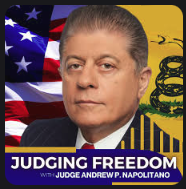
Max Blumenthal
| Traducir—Translate! | |
| Make fonts bigger>>> | [wpavefrsz-resizer] |

Streamed live on Oct 13, 2025
Summary
The video features a detailed interview with Max Blumenthal conducted by Judge Andrew Napolitano on October 13, 2025, focusing on the recent ceasefire and ongoing conflict in Gaza and Israel. Blumenthal presents a critical analysis of the political and military developments over the past two years, highlighting the missed opportunities for peace, the roles of key international players, and the consequences of the war on civilian populations. He argues that the conflict could have been resolved much earlier if the U.S. administration, particularly under President Biden, had exercised political will to pressure Israel into peace negotiations. Instead, Blumenthal contends that the Biden administration enabled prolonged violence by supporting Israeli military actions and failing to push Prime Minister Netanyahu toward a ceasefire.
Blumenthal credits the Trump administration with finally facilitating a ceasefire deal through unconventional diplomatic efforts led by Steve Wickoff, motivated partly by Trump’s desire for a legacy and Nobel Prize. He reveals the complex dynamics within Gaza, including the Israeli-backed gangs that previously looted aid supplies and the role Hamas has played in maintaining order under extremely difficult conditions. Trump’s public remarks approving Hamas as a policing force in Gaza—despite their designation as a terrorist group—illustrate the pragmatic, if controversial, shifts on the ground.
The interview also discusses the fragile political situation in Israel, where Netanyahu’s coalition is unstable, and his political future uncertain. Netanyahu reportedly needs a new regional war to maintain his power. The release of Israeli hostages by Hamas is described with nuance, revealing unexpected relationships between hostages and captors. Blumenthal contrasts the treatment of Israeli prisoners with the brutal conditions endured by Palestinian prisoners in Israeli custody.
Throughout the interview, Blumenthal condemns the vast destruction of Gaza, the high civilian death toll, and the ongoing human rights abuses committed by Israel. He highlights the hypocrisy and propaganda surrounding the conflict, criticizing Western media and political narratives that obscure the realities on the ground. The interview ends with a warning about the volatility of the ceasefire and the potential for renewed violence, especially given Netanyahu’s political calculations and Trump’s ambiguous role.
Highlights
- Ceasefire brokered after two years of continuous conflict, largely due to Trump administration’s intervention.
- Biden administration criticized for prolonging the war by failing to pressure Israel into peace.
- Hamas has maintained order in Gaza amid devastation, while Israeli-backed gangs looted aid and fueled violence.
- Netanyahu’s political future is unstable, potentially driving the need for renewed conflict.
- Released Israeli hostages showed complex emotional dynamics with their Hamas captors.
- Palestinian prisoners released in poor condition, highlighting human rights abuses.
- The destruction of Gaza is massive, with 83% destroyed and hundreds of thousands dead, mostly civilians.
Key Insights
-
Missed Diplomatic Opportunities: Blumenthal underscores that the war could have been halted much earlier through diplomatic pressure, specifically citing Gershon Baskin’s back-channel efforts that were ignored by the Biden administration. This reveals how political calculations and ideological biases can obstruct peace even when all parties are willing. The failure to act decisively resulted in tens of thousands of deaths and extensive destruction.
-
️ Trump’s Pragmatic Intervention: Trump’s unexpected role in brokering a ceasefire reflects his personal political motivations but also a pragmatic recognition of the stalemate’s toll. Steve Wickoff’s involvement and Trump’s push for a deal contrast sharply with the more traditional, cautious diplomacy under Biden, illustrating how individual leadership styles and objectives can drastically influence international outcomes.
-
️ Governance and Order in Gaza: Despite immense devastation, Hamas has demonstrated a capacity to maintain civil order and provide municipal services under siege conditions. This challenges the narrative that Hamas is purely a militant group incapable of governance. The Israeli-backed gangs, by contrast, acted as spoilers, looting aid and destabilizing Gaza, which complicates the conflict’s internal dynamics.
-
⚖️ Political Calculations in Israel: Netanyahu’s precarious coalition and need for a regional war to maintain power highlight how domestic political interests can perpetuate conflict. The interview suggests that peace is often sacrificed for political survival, underscoring the intersection of war and politics in Israeli governance. Trump’s mockery and call for Netanyahu’s pardon reveal the deep dysfunction and corruption within Israeli politics.
-
Hostage Dynamics and Humanization: The release of hostages who showed friendly gestures toward their Hamas captors disrupts monolithic portrayals of the conflict’s human elements. It suggests complex interpersonal dynamics that arise even in adversarial conditions and highlights the political utility of hostages as leverage in negotiations.
-
Human Rights Violations and Propaganda: Blumenthal’s detailed recounting of massacres, bombings, and torture exposes the extreme human cost of the conflict, often minimized or distorted in mainstream media. The disparity in treatment between Israeli and Palestinian prisoners lays bare systemic abuses and raises ethical questions about accountability and justice.
-
Role of International Influence: The U.S. remains the decisive external actor, with Israel’s military strength and occupation dependent on American arms and political support. The interview makes clear that shifting U.S. policy could dramatically alter the conflict’s trajectory, underscoring the geopolitical dimension of the Israeli-Palestinian conflict and the power of international actors to either perpetuate or resolve violence.
This analysis provides a comprehensive understanding of the current state of the Israel-Gaza conflict as of late 2025, the geopolitical dynamics involved, and the human toll that continues to shape the region’s future.
BEFORE you leave, PLEASE pay attention to this alert.
[t4b-ticker id=”1″]
[/su_spoiler]
Print this article [bws_pdfprint display=’print’]
[su_note note_color=”#f1efef” radius=”0″]The views expressed herein are solely those of the author and may or may not reflect those of The Greanville Post, although, if we publish them, we obviously find them noteworthy and valuable. [/su_note]
 This work is licensed under a Creative Commons Attribution-NonCommercial 4.0 International License •
ALL CAPTIONS AND PULL QUOTES BY THE EDITORS NOT THE AUTHORS


