[su_spoiler title=”Please make sure these dispatches reach as many readers as possible. Share with kin, friends and workmates and ask them to do likewise. ” open=”yes” style=”fancy” icon=”arrow-circle-1″]

 DEMOCRACY NOW
chats with
JEREMY SCAHILL
| Traducir—Translate! | |
| Make fonts bigger>>> |

Summary
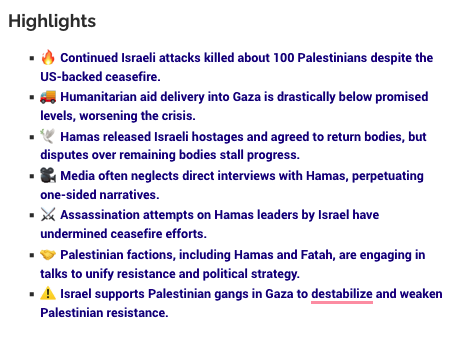
The Democracy Now report, anchored by Amy Goodman, provides an in-depth examination of the ongoing conflict and ceasefire situation in Gaza following a US-backed truce deal with Hamas. Despite the ceasefire agreement, Israel has continued military attacks killing around 100 Palestinians in the last two weeks and has severely restricted humanitarian aid into Gaza, allowing only a fraction of the promised supply trucks daily. The humanitarian situation remains dire with urgent needs for food, water, fuel, and shelter. The ceasefire deal included Hamas releasing all Israeli hostages and agreeing to return the bodies of deceased hostages; however, disputes over the return of the last 13 bodies have stalled further negotiations.
Jeremy Scahill, co-founder of Drop Site News and an expert journalist with unique access to Hamas and Palestinian Islamic Jihad leaders, provides critical insights into the ceasefire dynamics, media coverage failures, and the broader political context. He highlights the journalistic malpractice of not engaging directly with Palestinian armed groups, which perpetuates dehumanizing narratives. Scahill profiles Hamas leaders, humanizing them as individuals shaped by loss and repression rather than caricatures of terrorism.
He details the complex political interplay between former US administrations, noting that while the Biden administration was ideologically Zionist and allowed Israeli sabotage of ceasefires, the Trump administration approached negotiations more transactionally, with erratic policies influenced by personal and political interests. Scahill recounts how Hamas accepted almost all terms of a US-Israeli ceasefire framework, but Israel responded with assassination attempts on Hamas leaders, undermining peace efforts. These attacks killed administrative staff but failed to eliminate key figures.
In the current phase, Hamas remains the primary combatant and negotiating party, but the broader Palestinian political landscape is engaged, with talks including factions traditionally opposed to Hamas, such as Fatah, highlighting a shared concern over external interference and the future of Palestinian liberation. Scahill also discusses the grim reality of hostage bodies and the cruel practice by Israel of holding Palestinian bodies since 1967, underscoring the deep-rooted cycle of violence and retaliation.
Finally, Scahill touches upon Israel’s strategy of empowering local Palestinian gangs to foment internal divisions and civil unrest, a tactic aimed at weakening Palestinian unity but facing resistance from Gaza’s governing authorities. The interview paints a comprehensive, nuanced picture of the Gaza conflict, emphasizing the need for honest journalism and political engagement to better understand and address the ongoing crisis.
Key Insights
-
Journalistic Malpractice and Dehumanization: The failure of many Western media outlets to engage directly with Hamas and Palestinian Islamic Jihad leaders contributes to a simplistic and dehumanizing portrayal of Palestinians. This lack of dialogue prevents the public from understanding the nuanced realities on the ground and allows government narratives—often portraying Palestinians merely as terrorists—to dominate. By not interviewing key actors, media perpetuates a one-dimensional conflict narrative that obscures legitimate grievances and political complexity.
-
Humanizing Hamas Leadership: Hamas leaders are often portrayed as faceless militants, but Scahill reveals their backgrounds as professionals—doctors, lawyers, chemists—who have suffered profound personal losses due to the conflict. This humanization challenges dominant narratives and invites a more empathetic understanding of why these leaders pursue armed resistance and negotiation simultaneously. Their histories of trauma and loss shape their political motivations and decisions.
-
️ US Political Influence and Contrasting Approaches: The Biden and Trump administrations took markedly different approaches to the Gaza conflict. Biden’s administration, ideologically Zionist, allowed Netanyahu to sabotage ceasefires without serious repercussions, prioritizing alliance stability over peace. Trump, more transactional and ego-driven, pushed for ceasefires to claim political victories but also greenlit or ignored Israeli assassination attempts on Palestinian leaders, which sabotaged peace efforts. This dynamic underscores the profound impact US politics and personalities have on the conflict’s trajectory.
-
⚔️ Assassination Attempts Undermine Peace: Israel’s assassination attempts on Hamas leaders, especially those engaged in ceasefire negotiations, reveal a strategic choice to weaken political leadership rather than pursue peaceful resolution. The killing of administrative staff and family members instead of key leaders suggests a tactic of intimidation and destabilization. This approach complicates diplomatic efforts and perpetuates cycles of violence, demonstrating how military actions directly sabotage political solutions.
-
Palestinian Political Complexity and Unity Efforts: Though Hamas leads the armed resistance and negotiations, a wider range of Palestinian factions, including Fatah, are involved in discussions about the conflict’s future. The engagement between Hamas leaders and Fatah representatives signals a recognition that unity is crucial to facing external pressures such as foreign troops, privatization efforts, and neo-colonial agendas. This tentative cooperation reflects a broader Palestinian political awakening to the existential stakes of the conflict.
-
⚰️ The Tragic Politics of Hostage Bodies: The treatment of dead hostages and the withholding of Palestinian bodies by Israel since 1967 is emblematic of a brutal and reciprocal policy of dehumanization and control. The practice of holding bodies as bargaining chips or political tools highlights the inhumanity embedded in the conflict. The emotional toll on Palestinian families searching through rubble for remains and the use of heavy equipment to locate bodies amidst civilian casualties illustrate the ongoing humanitarian crisis and the deep scars of war.
-
Israel’s Use of Local Collaborators to Divide Palestinians: Israel’s support for Palestinian gangs operating in occupied Gaza areas aims to foment internal conflict and civil unrest, a classic divide-and-conquer tactic. These gangs have terrorized Palestinians, undermining social cohesion and weakening resistance. However, efforts to create internal divisions have largely failed due to the longstanding governance and legitimacy of Hamas in Gaza, highlighting the resilience of Palestinian social and political structures against external manipulation.
This comprehensive analysis by Jeremy Scahill, juxtaposed with Amy Goodman’s reporting, provides a critical perspective on the Gaza ceasefire, the humanitarian crisis, political maneuvering, and the importance of nuanced and humanizing journalism in conflict zones.
BEFORE you leave, PLEASE pay attention to this alert.
[t4b-ticker id=”1″]
[/su_spoiler]
Print this article [bws_pdfprint display=’print’]
[su_note note_color=”#f1efef” radius=”0″]The views expressed herein are solely those of the author and may or may not reflect those of The Greanville Post, although, if we publish them, we obviously find them noteworthy and valuable. [/su_note]
 This work is licensed under a Creative Commons Attribution-NonCommercial 4.0 International License •
ALL CAPTIONS AND PULL QUOTES BY THE EDITORS NOT THE AUTHORS