
[su_spoiler title=”Please make sure these dispatches reach as many readers as possible. Share with kin, friends and workmates and ask them to do likewise. ” open=”yes” style=”fancy” icon=”arrow-circle-1″]

 Nima R. Alkhorshid
 DIALOGUE WORKS
chats with
Roving Independent Correspondent Pepe Escobar
| Traducir—Translate! | |
| Make fonts bigger>>> | [wpavefrsz-resizer] |


Summary
The video features a detailed geopolitical analysis and commentary centered around the ongoing global power dynamics in 2025, particularly focusing on the United States’ waning imperial influence, the strategic challenges faced by the U.S. administration under Donald Trump 2.0, and the rising power of the Russia-China strategic partnership. The dialogue touches on multiple interconnected themes, including the U.S.’s strategic defeats in Russia (Novorossiya) and China (trade and tech wars), the desperate imperial attempts to maintain dominance by destabilizing regions in the Global South—especially Latin America and Venezuela—and the broader implications of new military technologies and alliances shaping a potential post-Western world order.
The interview further examines Russia’s advanced military capabilities, including next-generation nuclear weapons developed with continuity from Soviet-era science, and highlights Russia’s strategic patience in avoiding direct confrontation while maintaining a formidable deterrent. China’s steady technological and economic rise, including initiatives like digital currency and Eurasian integration projects, underscores the gradual but profound shift toward a multipolar world order. The complexities within BRICS and the ongoing efforts to reduce dependence on Western financial systems were discussed as part of this transformation.
The video concludes with reflections on the precarious situation in Latin America, the risks of imperial overreach, and the cautious yet confident stance of Russia, China, and their allies as they prepare to face an increasingly erratic and desperate U.S. foreign policy.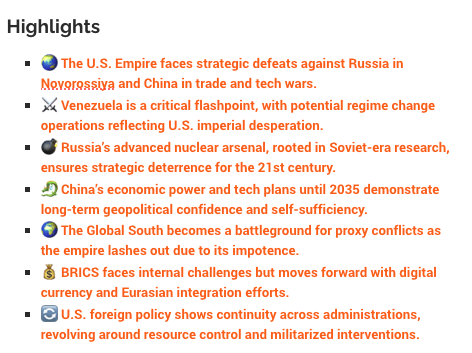
Key Insights
-
Empire of Chaos’s Strategic Despair and Proxy Warfare: The U.S. under Trump 2.0 is grappling with two major strategic defeats: a near collapse in eastern Ukraine (Novorossiya) against Russia and a failure in the trade and tech war against China. Unable to confront these powers directly due to overwhelming geopolitical and military disadvantages, the empire resorts to proxy wars and destabilization campaigns, particularly in Venezuela, Latin America, Africa, and the Middle East. The desperation is evident in aggressive proposals such as regime change through military intervention in Venezuela, underscoring the empire’s declining global influence.
-
️ Natural Resources as a Core Motivator in U.S. Foreign Policy: Much like Dick Cheney’s obsession with Iraqi oil in 2001, the Trump administration’s focus on Venezuela is driven by the desire to seize control of natural resources, especially oil. This continuity reveals that despite changes in leadership, the imperial mindset remains fixated on resource dominance to sustain its waning global power. The blending of the “war on terror” with the “war on drugs” serves as a legal and rhetorical framework to justify these interventions, reflecting a pattern of extraterritorial aggression.
-
Russia’s Advanced Military Deterrence and Strategic Patience: Russia’s unveiling of next-generation nuclear weapons—including hypersonic missiles and nuclear-powered torpedoes—represents a leap forward in military technology. This arsenal, developed through decades of Soviet scientific continuity, provides Russia with unmatched deterrence capabilities intended to prevent any direct military aggression. Importantly, Russia does not view these developments as an arms race but as necessary homeland defense, signaling a strategic posture of measured strength rather than provocation.
-
China’s Long-Term Tech and Economic Planning: China’s five-year plans, extending to 2035, highlight its calm and calculated approach to technological self-sufficiency and geoeconomic dominance. Despite U.S. tariff and tech wars, China remains unshaken, focusing on internal development and expanding influence through initiatives like the digital yuan and the Belt and Road tech corridor connecting Eastern Russia, Central Asia, and China. This economic integration is slowly but surely undermining Western financial hegemony and signaling a shift toward a post-Western multipolar order.
-
BRICS’s Internal Challenges and the Complexity of a New World Order: Although BRICS countries present a united front against Western dominance, internal frictions and problematic members (e.g., UAE) complicate the alliance’s coherence. The dysfunction in the BRICS Development Bank and the uneven adoption of alternative trade currencies illustrate the challenges of building a new global financial architecture. Nevertheless, progress in fintech and digital currencies, especially between Russia and China, marks significant steps toward de-dollarization and economic sovereignty for members of the Global South.
-
The Role of Neoconservatives and Internal U.S. Divisions: The Trump administration is influenced by hardline neoconservatives like Marco Rubio, who push for aggressive regime change policies in Venezuela and beyond. However, there are internal clashes within the U.S. national security establishment between more realistic factions and ideologues, particularly over the true sources of drug trafficking and the feasibility of military interventions. This internal fragmentation adds unpredictability to U.S. foreign policy, increasing the risk of irrational and dangerous decisions.
-
Strategic Partnerships Between Russia, China, and the Global South: The Russia-China alliance, combined with growing cooperation from countries in Latin America, Africa, and Central Asia, forms a counterweight to U.S. imperialism. While these partnerships are cautious and emphasize patience over confrontation, they also prepare to respond decisively to any out-of-control imperial aggression. The strategic deal between Moscow and Caracas, for example, could test Russia’s willingness to directly confront U.S. actions in Latin America, indicating a new phase of geopolitical contestation beyond traditional Euro-Atlantic theaters.
Conclusion
The conversation reveals a world at a critical geopolitical crossroads, where the United States, burdened by strategic defeats and imperial overreach, lashes out unpredictably in weaker regions to maintain control over resources and global influence. Meanwhile, Russia and China, through advanced military technology and long-term economic planning, project an image of measured strength and resilience. The Global South is increasingly becoming the arena for this contest, with alliances shaped by mutual interests in sovereignty and resistance to Western dominance. Despite internal challenges and complexities, these dynamics suggest the gradual emergence of a multipolar, post-Western world order marked by new forms of cooperation and confrontation.

Are China-Russia – and a great deal of the Global Majority – really ready? Call it an auspicious vow.
Close the door, put out the light
You know they won’t be home tonight
The snow falls hard and don’t you know
The winds of Thor are blowing cold
—Led Zeppelin, No Quarter
In a matter of less than a year, Russian scientific know-how came up with four bangers:
1. Oreshnik: hypersonic missile, already tested in the Ukraine battleground.
2. Burevestnik: Or “Stormbringer”, with that nice Deep Purple ring. Nuclear cruise missile with unlimited range.
3. Poseidon: nuclear-powered torpedo, capable of loitering underwater, undetected, for unlimited time; then, at a command, strikes enemy coasts with a nuclear payload, provoking a radioactive tsunami. Largely exceeds the destructive power of the Sarmat, Russia’s largest ICBM.
4. Khabarovsk: nuclear sub. Call him The Messenger of Doom: capable of delivering at least 6 Doomsday-enabling Poseidons.
President Putin was crystal clear when detailing some key facts. The “compact nuclear systems” used in the Burevestnik and the Poseidon “can also be adapted to create new energy sources, including for the Arctic.”
Putin also stressed how both Burevestnik and Poseidon “use only Russian-made parts”. Praise the Lord for those chips from upgraded Soviet washing machines.
And there’s a lot more to come following the tracks of Burevestnik and Poseidon: “I’m talking about…the Avangard system, or the serial production of the Oreshnik missile system…soon the heavy intercontinental Sarmat missile.”
[su_note note_color=”#ebf1f7″ radius=”17″]The Sarmat – nicknamed Satan II – will enter combat next year: a super-heavy ICBM, carrying 10 heavy warheads, and compatible with the Avangard hypersonic glider, capable of dodging any anti-ballistic missile system.[/su_note]
Welcome to Russia’s next generation nuclear-powered cruise missiles, with reactors going online in a matter of seconds, and 3x speed of sound, heading towards hypersonic status.
In a nutshell: Burevestnik and Poseidon “will ensure strategic parity for the whole 21stcentury.”
Cue to thunderous silence heard all across the NATOstan sphere – permeated by the usual “the Russians are bluffing” gaggle noise.
Who cares? Facts are stubborn, and continue to be incontrovertible. Extra facts: Putin and Xi signing into law a mutual investment protection agreement, which translates as China protecting trillion-dollar worth Russian companies, Sberbank, Rosneft and Lukoil in case of a potential NATO-Russia war.
Or, in Eurasia connectivity corridor terms, take Putin, during the Russia-Central Asia summit, proposing unifying Eurasian logistics projects into a single network: “This would allow us to exponentially increase the volume of international transportation through our shared region.”
The massive economic/trade potential of Eurasia still remains largely untapped. Cut to the Russia-China goal of building a production-technological belt from the Russian Far East to Central Asia.
Ain’t got no deal on Russia-China
Well, these sharp facts are inbuilt in the new, emerging global reality, now a historical process – in sharp contrast with the paroxysms of Deep Desperation exhibited by the fragmented West and, significantly, the rise and rise of unilateral Empire of Chaos bullying.
Exhibit A is of course Venezuela.
The Circus Ringmaster – in a revamped remix of the war on drugs meets the war on terra – is mulling:
[su_note note_color=”#ebf1f7″ radius=”17″]Bombing of Venezuelan military bases; deployment of Navy SEALS to capture or kill President Maduro; “securing” – as in invading and seizing Venezuelan oil fields, after controlling their key airfields; or even all of the above.[/su_note]
Trump 2.0, totally bypassing the US Congress and of course the illegality of assassinating foreign leaders, is already drafting dodgy legal “justifications” to go after Maduro as a “narco-terrorist” – much to the delight of ghastly Nobel Prize 5th columnist Machado, the female Guaido.
Total psyops is in full effect – complete with intimidating B-52 and B-1 bombers and the deployment of aircraft carrier USS Gerald R. Ford and thousands of troops.
Venezuelans though are not impressed. Diego Sequera, from the excellent Mission Verdad, notes, “if you take how things are seen from here you get the feeling that nothing will happen. No social breakdown, no one’s freaking out. Everyone is about their business looking for la plata with an end-year holiday mood.”
Still, they have to run rings over Circus Ringmaster – who wants all that oil so bad (the takeover of natural resources is essential to maintain the Empire) and pathetic neo-con gusano Marco Rubio’s only obsession in life: regime change in Venezuela, Cuba and Nicaragua.
And that brings us, once again, to the insoluble Empire of Chaos drama. TACO Trump, even if his brain is not capable of conceptualizing it, may be coming to grips with the hard facts of life: he cannot “win” – or impose a “deal” – on the Russia-China strategic partnership.
On the contrary: he needs to find diversionist tactics to evade the fact he is being inflicted a massive strategic defeat in Ukraine (yes, it’s his war now) while he simply does not have the cards (all made in China) to win a protracted trade-tariff-tech war against Beijing, as demonstrated in that G-2 in South Korea. Managed decoupling is already on.
Still, the supreme delusion of American military might persists, graphically incarnated by the clownish Secretary of Forever Wars. Can’t harm Moscow or Beijing? Caracas will do.
Oh, that Shakespearean sound and fury signifying…nothing, as the Empire of Chaos devours itself by re-colonizing the vassal puppies (Europe), financial shakedown-style, while threatening/ bullying selected Global South latitudes.
Emmanuel Todd has summed it all up, succinctly. What to do when “this is indeed the first American strategic defeat on a global scale, in a context of massive deindustrialisation in the United States and difficult reindustrialisation”, while “it is already too late to compete [with China] industrially.”
Hence the vociferous, bullying Circus Ringmaster, without saying a word (a miracle, in his particular case) progressively hitting TACO-on-steroids territory when it comes to Russia-China.
That’s our cue to the new Netflix series: the Empire of Rage lashing out, irrationally, against anyone, any nation, it deems weaker, a graphic demonstration of its massive resentment. Those fishing boats are full of narco-terrorists because I say so. Kill them all.
An extra danger is that the EUro-chihuahuas take a cue from this irrational drive to increase their Russophobic provocations inter-galactically. The only rational way to deal with it would be by Oreshniking them.
The mountains are high, but the Emperor is everywhere
A classic Chinese motto, repeated dynasty after dynasty, merrily states that “The mountains are high, and the Emperor is far away”. Well, in our contemporary case, there’s no mountain high enough – to borrow from Motown – and the all-seeing Emperor of Chaos, enabled by AI, is everywhere.
Yet even that is not enough to prevent him from collapsing inside his own schizophrenic bubble, unleashing Primal Fear into the intertwined plutocracies of Big Money, Big Oil and Big Tech.
Dystopia Central: it’s not hard to draw the map of the deep, dark geostrategic void self-described “elites” plunged themselves in.
And that brings us to how – in which register – the Russian leadership is watching the show. No expectations: realism prevails.
[su_note note_color=”#ebf1f7″ radius=”17″]There may be a Trump 2.0 escalation in Ukraine – or not. There may be a more devastating attack on Iran – or not. There may be a serious regime change attempt in Venezuela – and that one is a near certainty. Trump 2.0, after all – complete with Zionist oligarchs on backing vocals – is a privileged psycho-killer realm.[/su_note]
And then there’s the ultimate chimera: de-dollarization – which is happening in practice, slowly but surely, without being named, in several domains. Only four months ago, the Circus Ringmaster was in panic: “BRICS was set up to hurt us; BRICS was set up to degenerate our dollar and take our dollar … off as the standard”.
The panic is still there. So when in doubt – and when you can’t strike Russia-China – the next “best” option is to strike another BRICS member. Demand capitulation from Iran. Or else. Tehran, as much as Caracas, is not impressed.
Chinese wisdom, once again, would solve the enigma: “Let him be strong, the breeze will blow over the hills; let him be arrogant, the bright moon will shine on the vast rivers.”
It will be a very rough ride – to stare down the Empire of Chaos without letting it unleash Total Dementia, destabilizing Africa, West Asia, the Caribbean, everywhere, using the Syria al-Qaeda playbook (the former headchopper is to be received at the Oval Office soon).
Are China-Russia – and a great deal of the Global Majority – really ready? Call it an auspicious vow.
BEFORE you leave, PLEASE pay attention to this alert.
[t4b-ticker id=”1″]
[/su_spoiler]
Print this article [bws_pdfprint display=’print’]
[su_note note_color=”#f1efef” radius=”0″]The views expressed herein are solely those of the author and may or may not reflect those of The Greanville Post, although, if we publish them, we obviously find them noteworthy and valuable. [/su_note]
 This work is licensed under a Creative Commons Attribution-NonCommercial 4.0 International License •
ALL CAPTIONS AND PULL QUOTES BY THE EDITORS NOT THE AUTHORS

