
2.1K

Please make sure these dispatches reach as many readers as possible. Share with kin, friends and workmates and ask them to do likewise.

 BREAKING POINTS
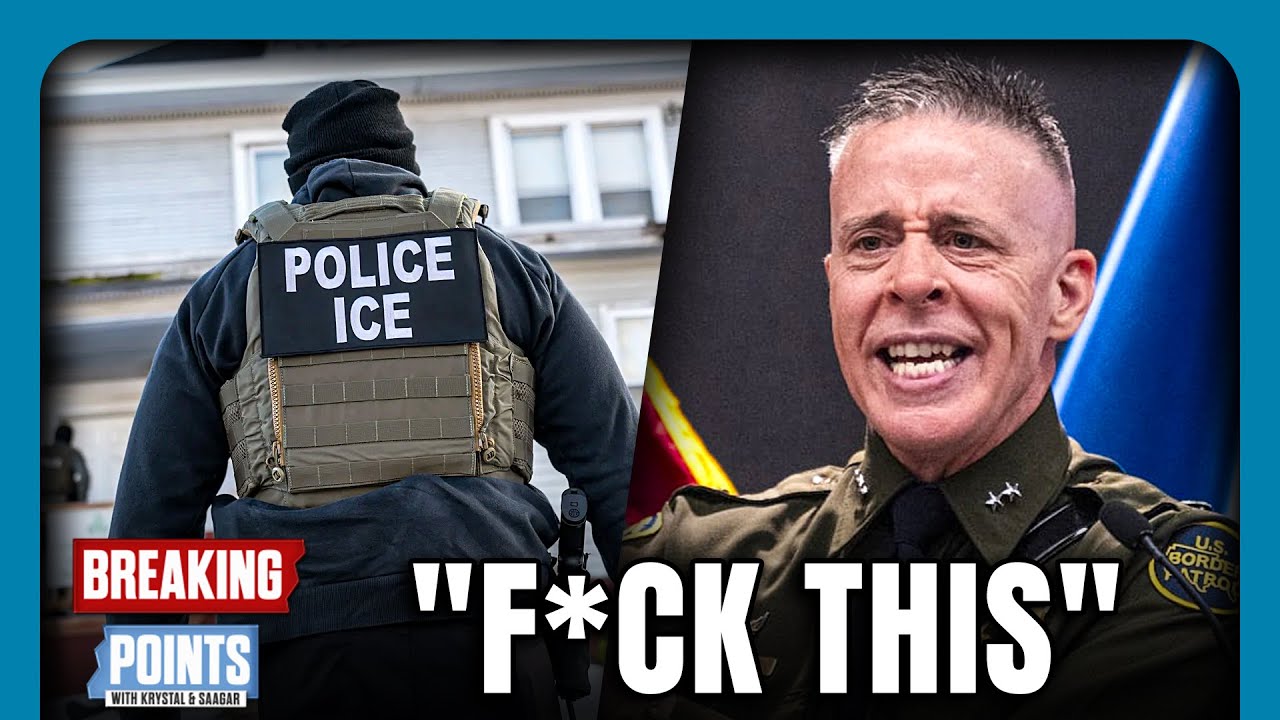
Krystal and Emily are joined by Ken Klippenstein
to discuss an internal ICE revolt.

| Traducir—Translate! | [gtranslate] |
| Make fonts bigger>>> | [wpavefrsz-resizer] |

Breaking Points
Ken Klippenstein: https://www.kenklippenstein.com/
Ken Klippenstein: https://www.kenklippenstein.com/
Summary
The video features Ken Clippenstein discussing his investigative reporting on the internal dynamics and morale within U.S. Immigration and Customs Enforcement (ICE) and Customs and Border Protection (CBP) amid recent federal deployments to manage protests and immigration enforcement. Drawing from interviews with eight agents mostly identifying as Republicans, Ken reveals deep dissatisfaction with current operations, describing a chaotic, unprofessional environment likened to a “Reno 911” episode rather than elite law enforcement action.
Key Insights & More In-Depth Analysis
[bg_collapse view="button-orange" color="#4a4949" expand_text="Click here for full details" collapse_text="Show Less" ]
- Widespread Criticism of Border Patrol Officers: All interviewed agents, including Republicans, blamed recent violent incidents involving Border Patrol officers, criticizing their conduct as unprofessional and chaotic.
- Inexperienced Recruits: The influx of young, poorly trained recruits—hired through aggressive recruitment efforts—is viewed as ineffective and unprepared for the realities of their deployments, especially when tasked with crowd control in urban settings unlike traditional border work.
- Shift in Mission: Agents feel the mission has shifted from immigration enforcement to a counterinsurgency against protesters, whom the federal government labels as domestic terrorists. This shift is widely opposed internally.
- Selection Bias in Deployments: More experienced agents avoid these deployments, leaving only the most aggressive and ideologically motivated recruits volunteering to engage protesters, contributing to the excessive force and macho behavior seen in viral videos.
- Poor Agency Morale and Culture Clash: There is significant tension and distrust within the agencies, including between ICE and CBP. Border Patrol’s mindset, shaped by border-specific laws and threats like cartels and human trafficking, clashes with the urban environment and mission demands.
- Substance Use and Unprofessional Conduct: Reports and viral videos indicate systemic drinking on the job and unprofessional behavior among deployed agents.
- Internal Opposition to Federal Deployment: Agents overwhelmingly dislike the large federal deployment to protests, viewing it as damaging to their agency’s reputation and operational focus on violent felons.
- Mixed Political Views but Uniform Concern: Though agents hold a range of political beliefs, most reject the administration’s public narrative and feel demoralized by the current approach.
- Conflicting Messaging from Leadership: Despite public statements promoting aggressive tactics and labeling protesters as terrorists, internal legal counsel advises agents on limits of conduct, creating confusion, especially for new recruits.
- Implications of Immunity Statements: Public support from figures like JD Vance and administration leaders promising “absolute immunity” is interpreted by agents as encouragement for aggressive tactics, despite potential legal risks at the state level.
- Resistance to Change: A CBP memo post-leadership change signals continuation of current operations (“steady state”), suggesting little immediate shift despite public relations efforts and leadership changes.
Core Concepts
- Counterinsurgency Framing: The federal government’s portrayal of protesters as domestic terrorists has transformed immigration and protest policing into a national security mission.
- Recruitment and Training Crisis: Rapid hiring has outpaced training capacity, leading to poorly prepared agents overwhelmed by the operational environment.
- Agency Morale and Culture Clash: ICE and CBP agents feel alienated by current directives, internal leadership struggles, and public scrutiny.
- Legal and Ethical Ambiguity: Mixed messages from political leaders and legal counsel create confusion about rules of engagement and acceptable conduct.
- Long-Term Institutional Damage: Agents predict lasting harm to the agency’s reputation and effectiveness beyond the current administration.
[/bg_collapse]
Conclusion
Ken Clippenstein’s reporting reveals profound internal discontent within ICE and CBP regarding the handling of recent federal deployments. Agents are frustrated by the mission’s transformation into a counterinsurgency against protesters, the influx of inexperienced recruits, and conflicting directives from leadership. Despite public administration claims of professionalism and control, the reality inside these agencies is one of chaos, poor morale, and growing distrust, posing significant challenges for future immigration enforcement and federal law enforcement operations.

Addendum

Summary
This video discussion centers on newly surfaced footage showing Alex Pretti (referred to as Alex Party in the transcript) in a confrontation with U.S. Customs and Border Protection (CBP) agents approximately 11 days before his fatal shooting. The video, confirmed by Pretti’s family and verified by BBC Verify, captures a hostile encounter in Minneapolis where Pretti spits at agents, verbally confronts them, and kicks out a tail light of their vehicle. The agents respond by physically assaulting him but do not arrest him. This incident is believed to have resulted in Pretti breaking his ribs.
The hosts analyze the implications of this video in the broader context of law enforcement, protest conduct, and the subsequent shooting of Pretti. They emphasize that while Pretti’s behavior was clearly aggressive and unlawful, this did not justify his later killing. The conversation draws parallels to other controversial law enforcement incidents such as Waco and Ruby Ridge, highlighting the principle that wrongdoing by individuals does not legitimize excessive or lethal force by authorities.
Key Insights and Core Concepts
-
Confrontation Details:
- Pretti aggressively confronts federal agents by spitting, yelling, and damaging property.
- Agents respond with physical force but do not arrest him, which the hosts view as a failure in law enforcement protocol.
- Pretti’s violent behavior in this video contrasts with the narrative of him as a peaceful protester.
-
Law and Order Perspective:
- The failure to arrest Pretti after the initial incident may have contributed to the escalation leading to his death.
- Proper law enforcement response—arrest and due process—could potentially have prevented the fatal outcome.
- The hosts argue law and order mechanisms, if properly applied, save lives.
-
Behavior and Responsibility:
- Pretti’s conduct while carrying a firearm was reckless and illegal, including violating concealed carry norms by openly displaying a gun in his waistband.
- The video portrays Pretti as a violent agitator, undermining some sympathetic portrayals by progressive media.
- Despite this, the hosts reject the idea that his behavior warranted execution or lethal force.
-
Political and Social Context:
- The video has been used by right-wing groups as evidence that Pretti “had it coming,” similar to attempts to discredit other protest-related deaths.
- It highlights the politicization of incidents involving law enforcement and protesters, often weaponizing character judgments over legal and ethical scrutiny.
- The discussion notes that activists are being tracked in federal databases, raising questions about whether prior hostile interactions, like Pretti’s, influenced law enforcement’s aggressive response.
-
Government and Law Enforcement Response:
- Both agents involved in the shooting have been placed on administrative leave—a step described as standard but which reportedly has not been consistently applied in other ICE shootings.
- The administration’s handling of the incident, including public statements and political rhetoric (e.g., labeling Pretti a “domestic terrorist”), is criticized for lacking due process and escalating tensions.
- The hosts emphasize the importance of consistency in law enforcement and government reactions to shootings and protests.
Conclusions
- Alex Pretti’s prior violent conduct was real and significant but does not justify his killing. The hosts stress that character does not equal cause for extrajudicial execution.
- Proper law enforcement protocol, including arrest and due process, was not followed, contributing to a tragic outcome. This failure represents a breakdown in law and order.
- The video fuels political narratives that oversimplify and distort the situation, reflecting broader tensions around protest movements, law enforcement, and government accountability.
- The government’s administrative actions and public statements reveal inconsistencies and potential politicization, undermining trust in impartial justice.
- The discussion urges a balanced approach that holds both protesters and law enforcement accountable, emphasizing the importance of de-escalation, professionalism, and adherence to legal standards.
 BEFORE you leave, PLEASE pay attention to this alert.
[t4b-ticker id="1"]
Print this article [bws_pdfprint display=’print’]
The views expressed herein are solely those of the author and may or may not reflect those of The Greanville Post, although, if we publish them, we obviously find them noteworthy and valuable.
 This work is licensed under a Creative Commons Attribution-NonCommercial 4.0 International License •
ALL CAPTIONS AND PULL QUOTES BY THE EDITORS NOT THE AUTHORS

