

Julian Macfarlane
The winter of Kiev’s discontent
A longer war for the West
Here’s yesterday’s video for SouthFront….
If you watch this you will find more confirmation of Russia’s advances. Russia is now threatening the Slavyansk-Kramatorsk agglomeration, as well as Zaporozhzhe in the South. It is also making gains in the north and Ukraine is effectively landlocked, with Russia continuing to strike its drone factories and arms depots , as well as logistics.
Ukraine is getting desperate, threatening strikes on commercial aviation in Russia.
That’s a sign. Naturally, most people are predicting a quick end to the SMO.
In any other age, that might be a smart assessment —especially if this were a “war” as war was thought of then.
But this is not war as war used to be.
Even if Slavyansk and Kramatorsk and Zaporozhzhe fall tomorrow, that does not end the war, it would just mean a new stage. The Russians are not fielding the manpower necessary to take these cities “shock and awe” style. Zelensky is therefore taking the bait, sending his dwindling reserves and mercenaries in with instructions to fight to the death, and with barrier squads to make sure they do.
So it is that the Ukrainians are now losing not 30,000 a month anymore— but 40,000. The Russian strategy has been consistent. It’s goals are not territory - but attrition.

Vladimir Putin recently spoke about the encirclement of two Ukrainian Armed Forces groups in the Kharkiv region, 2000 and 5000 men respectively. Counting other victories, that means the casualty rates for Kiev are going to be off the charts.
A large Ukrainian army group was completely blocked near Vovchansk after losing control of several key settlements in the region.
The encirclement of the enemy in the Kharkiv region was the result of a successful advance by Russian forces, RIA Novosti reports . Units of the “North” group liberated the villages of Vasilevka, Blagovatnoye, Dolzhanka, and Sliznevo.
The Ukrainian Armed Forces have fallen into this ‘Volchansk Cauldron,’ having lost the villages of Vasilevka, Blagovatnoye, Dolzhanka, and Sliznevo. Around 2,000 Ukrainian Armed Forces troops are encircled, including motorized infantry from the 159th and 22nd Brigades, as well as border guards.
The second cauldron is on the eastern bank of the Oskol River. Thirteen Ukrainian Armed Forces battalions, numbering a total of five thousand men are trapped there. It doesn’t look for them
The Ukrainian command urgently deployed drone operators to the area to help break the cauldron’s blockade. Several days earlier, the enemy had unsuccessfully attempted to rescue its officer corps from encirclement.
In addition to that, the defense of Orekhov is effectively gradually transitioning to an operational encirclement as the arrows indicate. When Orekhov falls, Zaporozhezhe is doomed.
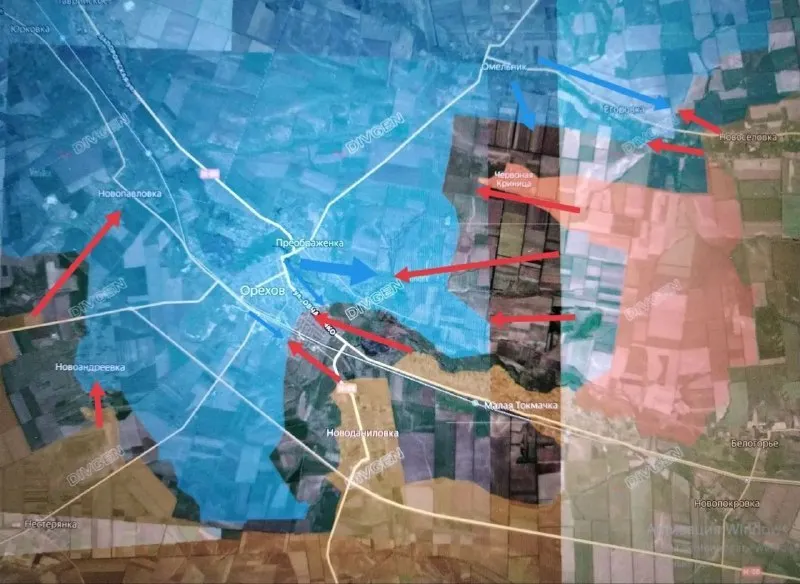
As for Slavyansk-Kramatorsk, Zelensky is desperate. Kiev is in chaos politically with infighting between factions becoming increasingly violent, as the video suggests. So now Zelensky is committing his most extreme followers to the battle. Maybe he’s hoping they will kill each other.
Denys Prokopenko and Andriy Biletsky —both terrorists and extremists— will lead two renewed groups in the Slovyansk and Kramatorsk area. Both are from Azov . Both have just received the Gold Star of Hero of Ukraine. And both are being deployed to the last major line of defense the Ukrainian Armed Forces still have left in the Donbas.
The symbolism here isn’t hidden….. Biletsky is the founder of Azov, the brand’s ideologist since 2014. Prokopenko is a battalion commander who surrendered Mariupol and left Azovstal in an exchange to spend two years touring Western capitals as a living exhibit.
The appointment should be read not as a military decision, but as a political one.
But the Russians are not in a hurry.

To denazify Ukraine , Russia must demilitarize Ukraine completely, killing or capturing its soldiers, destroying the mythology of Ukrainian invulnerability inculcated for decades, and destroying infrastructure that supports the Banderites with weapons and supplies. Russia must destroy not only Ukraine’s ability to fight, but its will.
To destroy morale, it cannot use words but facts on the ground, not just battleground but in ordinary life — showing ordinary people how much they have been lied to — the most important fact being that Ukraine has already lost and its leaders are continuing out of fear of retribution for their crimes, lust for power, and greed. For ordinary people there are consequences to passivity.
That’s something we all need to remember.
Editor's Note: In the above context, please read this related commentary by Black Mountain Analysis:
THE GEOPOLITICAL TRAP: STRUCTURAL INCENTIVES PROLONGING THE WAR IN UKRAINE [I]
Remember the Western story that Russia was losing, short on everything, the economy collapsing , losing on the battlefield, and the people would rise up, suddenly aware of the error of their ways and overthrow the government and install a Western friendly one?
But, my great great great great Grandfather’s friend, Samuel Johnson said,
Depend upon it, sir, when a man knows he is to be hanged in a fortnight, it concentrates his mind wonderfully.
Ukraine will not be hanged in a fortnight. I will take, much, much longer. It will have a lot of time to reflect. So, the Russians will go slow, ,minimizing their casualties, while maximizing those of the Ukrainians, while destroying the social and industrial infrastructure of Ukraine, flooding Europe with Kievan refugees from the privations of a cold winter.

The narrator suggests the boy was in danger from the other gorillas and the Silverback protected him. In fact, the other gorillas were curious. But the Silverback was Boss and silverbacks are fiercely protective of the young and he took over because that was his job. Harm could only come from a competitor-silverback and I didn’t see any in the video.
One Earth, Many Worlds.
Support News Forensics.
Please contribute. As I mentioned earlier, with my pension suspended, every coffee helps. A LOT.
Ichi and Chappy figure I am a lost gorilla, so they look after me and teach me to speak Cat. .
Your coffees pay for my keepers —Ichi and Chappy— in their favorite currency — tuna.
You can contribute by clicking on the graphic or the url below.

I would really like to get to 5000 subscribers. If you like my work, share the urls on other blogs and sites and in comments on podcasts.
Show us you care by buying us coffee at https://buymeacoffee.com/julicow

You will notice that I’m very critical of some alt media people. However, there are others who deserve your respect – real analysts, who are almost always instructive.
One is Elijah Magnier. It is to Nima’s credit that he engages with people of his intellectual caliber.
The video I have posted provides answers to a lot of questions I hear asked a lot, with Magnier explaining in simple and very understandable terms. His logic is impeccable.
For example, many people continue to ask why is Iran taking its time in its war with the US and Israel if it has the long-range missile capabilities that it claims to have?
Why isn’t it stepping in to engage the Israelis in Lebanon? Why has it opted for a long slow war, just as Putin has in Ukraine?
This video provides a lot of the answers. It doesn’t cover everything, but it provides a very clear strategic overview.
Iran is right now conducting a low intensity war, exhausting US resources, as Trump weakens the American state in one way or another, with one crazy action after another.
Militarily he is a moron. A 9 year war gamer could do it better.
His recent strikes against Iran included strikes on Larak Island and bombing a wedding party.
Iranian strikes hit American bases in Jordan and GCC countries. In Jordan, the US fired as 10% of its remaining inventory of Patriot 3 missiles, hitting mostly decoys. There was extensive damage —denied of course by CENTCOM who nobody believes anymore.
As Magnier says, Jordan’s air defenses are not set up to defend Jordan, but Israel. Once those defenses have been reduced, it will be much easier for Iran to launch massive strikes on Israel when the time is right — which the Israelis will not be able to defend against. They could, of course, launch nukes— but by that time it would be too late — the country would already be destroyed.
The longer the Iranians wait, the weaker both the US and Israel become, both militarily and economically. The US has already de facto evacuated many of its people from a lot of its bases in the Middle East since the bases are no longer really operational.
Masada 2.o?
This is surely the stupidest of the US’s many wars, conducted in the most incompetent manner. And the US military is reportedly unhappy.
I cannot see how Trump could NOT lose the Midterms or avoid another impeachment trial. The only way would be dirty tricks in the election, like interfering with mail-in ballots.
The Trump White House has put into place a series of mechanisms to fix or invalidate the midterm elections. Congress will not save us. The courts will not save us. Our only hope — should the election be rigged or stolen — is nationwide strikes. Our only hope is to cripple the machinery of commerce and government, although this militancy will be met with savage state repression.
Otherwise, we are doomed. There will be no exit.
Hedges suggests a General Strike. Could it succeed?

General Strike 1926
Tests?
Please contribute. As I mentioned earlier, with my pension suspended, every coffee helps. A LOT.
Ichi and Chappy test me continually except recently since I have had stomach flu for the last week and they have been busy looking after me.
Your coffees pay Dr. Ichi and Dr. Chappy— in their favorite currency — tuna.
You can contribute by clicking on the graphic or the url below.
I would really like to get to 5000 subscribers. If you like my work, share the urls on other blogs and sites and in comments on podcasts.
Show us you care by buying us coffee at https://buymeacoffee.com/julicow
Directed by George Cukor, the IMDb drama acts as an early wartime warning against domestic fascism, demagoguery, and how authoritarianism can hide behind patriotism.






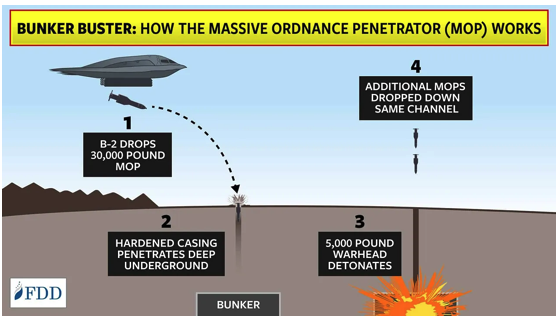

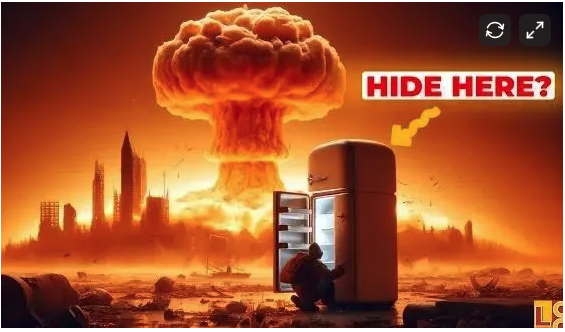




Back in the 1960s, as a whizz-kid consultant to the Pentagon, Daniel Ellsberg had a tour of top-level US ships and bases in the Pacific. He saw things that even generals and admirals weren't allowed to.
"Many operations and plan centers and command posts in Okinawa, Formosa, Guam, and Tokyo, and on several carriers and command ships in the Pacific that I visited, had a large map showing nuclear targets. It was their most secret map, usually covered by a screen or curtain when people who lacked authorization (unlike me) were being briefed in the room. These maps, typically, did not demarcate at all between China and Russia. The Sino-Soviet bloc appeared as one giant landmass, with arrows and pins indicating the various targets...
All these factors combined to create a situation in which, if we were under attack, it would be simply physically impossible to retaliate against Russian or Chinese targets alone, even if the president ordered his forces to do so... "
"I never found anyone in Washington who had any idea that there was this kind of problem". Ellsberg, Daniel (2017). The Doomsday Machine: Confessions of a Nuclear War Planner