By THOMAS FAZI

One step away from the brink: NATO’s march towards all-out war with Russia
Putting out high-quality journalism requires constant research, most of which goes unpaid, so if you appreciate my writing please consider upgrading to a paid subscription if you haven’t already. Aside from a fuzzy feeling inside of you, you’ll get access to exclusive articles and commentary.
The risk of an all-out conflict between NATO and Russia is higher than it’s ever been — even at the height of the Cold War — given how deeply the two sides are now entangled in what is, in every operational sense, an increasingly direct military confrontation, even if the fiction of non-belligerence is still formally maintained. Unlike during the Cold War, when the superpowers maintained elaborate protocols designed to prevent direct confrontation, the lines today are blurred to the point of near-invisibility. A war that was supposed to be contained within Ukraine’s borders has steadily metastasised into something far more dangerous: a proxy conflict in which NATO’s role has become so operationally central that the distinction between proxy and principal has largely collapsed, and in which each week brings fresh evidence that the escalatory logic is running well ahead of any political capacity to control it.
The events of recent weeks have made this unmistakably clear.
Last week, a Ukrainian drone in the Donbas struck a college in Donbas, killing 21 people, most of them women students.
This represents a very serious escalation in Ukraine’s intensifying drone offensive against Russia in recent months — including a growing number of deep-strike attacks carried out on Russian territory. Just a few weeks ago, at least three people were killed and several more injured in a large-scale Ukrainian drone attack on the Moscow region.
Meanwhile, according to Reuters, by March Ukrainian drone strikes on Russia’s three main export terminals on its western coasts — Novorossiysk on the Black Sea, and Primorsk and Ust-Luga on the Baltic — had knocked out around 40% of Russia’s oil export capacity. According to a New York Times estimate, by early April Ukrainian strikes had also damaged or destroyed around 20% of Russia’s oil refining capacity. Just this month, Ukrainian drones have struck two dozen Russian oil refineries, according to the Ukrainian Ministry of Defence.
Some of the more recently targeted sites were located as far as 1,500-1,700 km from the Ukrainian border, signalling a significant improvement in Ukraine’s long-range drone capabilities.
As John Mearsheimer noted in a recent interview with Glenn Diesen, Ukrainian drone and missile strikes on Russian territory, including Moscow, represent a significant step up the escalation ladder. Though unimpressed by their immediate military effect, the trajectory concerns him deeply:
The amount of damage that those drones can do is not that great... it’s certainly not going to affect the outcome of the war in any meaningful way. That’s not going to happen. But I think the great danger moving forward here is that the Ukrainians working with the Europeans who remain determined to defeat Russia will increase the number of strikes and the kind of strikes on Russia.
Russia has already responded to the drone attack on the Donbas college with a massive assault on Kyiv, one of the largest since the start of the war, including the use of nuclear-capable Oreshnik missiles. And it has already threatened to launch a fresh wave of “systematic strikes” against the capital. The new strikes will target “decision-making centres and command posts”, alongside drone manufacturing facilities in the city, Russia’s Foreign Ministry said in a statement. Moscow has called for foreign nationals and diplomats to leave Kyiv “as soon as possible” and warned citizens to stay away from administrative and military buildings.
So far Moscow has refrained from targeting Ukrainian headquarters — a rather remarkable fact given that the Ukrainian armed forces have repeatedly targeted Russian headquarters, as Anatol Lieven noted. On Tuesday, the Ukrainian General Staff claimed that it had destroyed a major Russian command and control centre in Lugansk with British Storm Shadow cruise missiles. The effective use of these missiles — which Ukraine has been firing for the past two years — requires US targeting data.
Despite this, Moscow has not targeted Ukrainian headquarters in Kyiv precisely because of the likelihood that US and other NATO soldiers and intelligence officers would be killed, risking drastic escalation in response by the West. Since Donald Trump returned to the presidency and reopened diplomatic negotiations, the Russian government has also been restrained by a desire not to either anger or weaken him. However, last week US Secretary of State Marco Rubio declared that the peace talks are at a standstill, and that “there are no such talks occurring at this time”.
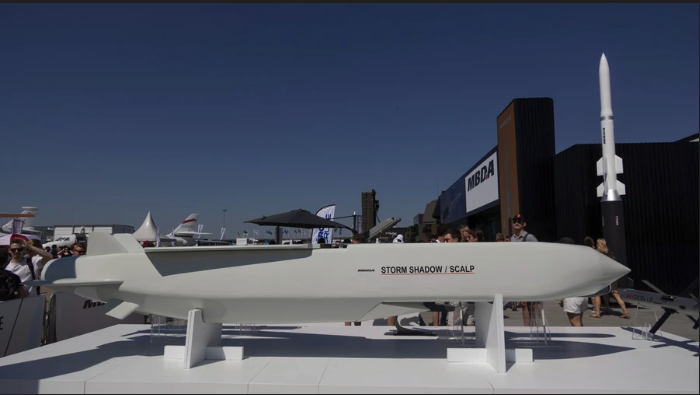
A Storm Shadow missile. Made by Britain and France and supported by US logistics, the Ukrainians are using them to strike deep into Russia, often hitting civilian targets.
This points not merely to a dangerous escalation in the war — but also to its potential expansion beyond Ukraine’s borders.
After all, though these attacks are formally being carried out by Ukraine, the reality is that Ukraine could never carry out these drone attacks on Russian territory without intelligence and satellite support from NATO — and from the US specifically. Despite Trump’s peace overtures, his administration has continued providing Ukraine with intelligence to carry out long-range drone attacks against Russian energy infrastructure, according to multiple US and Ukrainian officials. The intelligence helps Ukraine “shape route planning, altitude, timing and mission decisions, enabling Ukraine’s long-range, one-way attack drones to evade Russian air defenses”. One source described Ukraine’s drone force as the “instrument” the US is using to achieve the goal of undermining the Russian economy and pushing Putin toward a settlement. The CIA has also been involved in building up Ukraine’s drone programme.
The degree of US involvement goes further than mere intelligence-sharing. While one US official said Ukraine selects the target and the US provides information on its vulnerabilities, other officials said the US has actually been setting target priorities for the Ukrainian military — meaning the US is in effect choosing what to strike.
This means that Ukraine’s deep-strike operations against Russia are functionally a US-NATO operation wearing Ukrainian colours. But NATO isn’t just providing the intelligence and satellite support for these attacks — and of course the money for the drones. Increasingly, it is providing the drones themselves as well.
Even though the overwhelming majority of drones used by Ukrainian forces are produced inside Ukraine itself, a newer and strategically significant development is the deliberate expansion of drone manufacturing into European countries, partly to reduce vulnerability to Russian strikes on Ukrainian facilities. Zelensky announced plans to open ten joint enterprises for drone production in Europe in 2026.
The country at the centre of this development is Germany. The Merz government is deepening its military cooperation with Kyiv, becoming increasingly a co-belligerent in the conflict with Russia. With American disengagement, Germany has long been Ukraine’s primary financial backer. But in mid-April, for the first time the German government entered into a strategic partnership with the defence sector of a country at war. The agreement paves the way for the co-production of weapons systems, drones with a range of up to 1,500 km and long-range missiles, together with Kyiv. One of the most visible examples is Quantum Frontline Industries in Germany — a joint venture between Quantum Systems and Ukraine’s Frontline Robotics — where the first drone rolled off the production line less than two months after the partnership was announced.
With a stroke of the pen, the German government has swept away the entire domestic debate of recent years over supplying German weapons to Ukraine for strikes on targets inside Russian territory. As former German MP Sevim Dagdelen has written, with the integration of Berlin’s and Kyiv’s defence industries we are witnessing the emergence of a German-Ukrainian military-industrial complex under Berlin’s hegemony. Indeed, it is likely that German-made long-range drones were used in the recent attacks on Moscow and the Moscow region.
Other European countries are involved as well. Since the end of 2024, Finnish group Summa Defence has set up several joint ventures with Ukrainian firms to produce drones in Finland. British firm Prevail Partners and Ukraine’s Skyeton joined forces in July 2025 to produce the Raybird surveillance drone in the UK. Skyeton has also opened a Raybird production line in Slovakia and is negotiating additional European partnerships, while Ukrainian drone consortiums are building assembly and component plants in Finland and Denmark.
This means that European nations — first and foremost Germany — are becoming ever more directly involved in the conflict. This seriously increases the risk of Russian retaliatory strikes on European territory. Indeed, in mid-April, the Russian Defence Ministry published the names and addresses of European companies — including several Italian firms — involved in the production of Ukrainian drones, stating that “the European public should both clearly understand the true reasons of threats to their security and know the addresses and locations of ‘Ukrainian’ and ‘joint’ enterprises producing UAVs and components for Ukraine on the territory of their countries”.
To make matters worse, there is growing evidence that Ukrainian drones are passing through the airspace of Baltic NATO countries to attack Russian targets — such as the drones that hit the Russian oil terminals in Primorsk and Ust-Luga on the Baltic Sea. Just this month, Ukrainian drones have triggered repeated airspace alerts over Estonia, Latvia and Lithuania, prompting NATO fighter jet scrambles on multiple occasions, with at least one Ukrainian drone being shot down by a NATO jet over Estonia on May 19. Just days before, another Ukrainian drone struck an empty oil storage facility in Latvia. The political fallout has been significant, causing the collapse of the Latvian government over its handling of the crisis.
Russia has accused the Baltic states and NATO of actively allowing Ukrainian drones to use their airspace for strikes on Russia, framing it as NATO aggression. Presidential adviser Nikolai Patrushev stressed that this constitutes direct NATO country participation in attacks on Russian territory. For their part, Ukraine and the Baltic countries have rejected claims of deliberate collusion, accusing Russia of using electronic warfare and jamming to redirect Ukrainian drones into Baltic airspace — though this does not explain why Russia has proven unable to prevent drone attacks on sensitive and civilian targets, including in Moscow. European Commission President von der Leyen went as far as saying that “Russia and Belarus bear direct responsibility” for the Ukrainian drone incursions.
What is clear is that tensions in the Baltic are higher than they have ever been. The risk of a conflict between NATO and Moscow breaking out there is heightened further by the recent announcement of the creation of a joint naval force, dubbed the Northern Navies Initiative, comprising the United Kingdom, Norway, Sweden, Denmark, Finland, Iceland, Estonia, Latvia, Lithuania and the Netherlands. This force appears to have the explicit aim of containing Russia between the Arctic and the Baltic, potentially by obstructing Moscow’s commercial traffic — and in particular its so-called “shadow fleet”. Provocations such as the boarding of Russian vessels, or even a naval blockade, would constitute an obvious casus belli. To this must be added the militarisation of Finland, which recently joined NATO, and the espionage and aerial surveillance operations being conducted from its territory against Moscow — factors that are transforming the Scandinavian country into a new strategic threat in Russia’s eyes.
It is not an exaggeration to say that we are one incident — real or engineered — away from the situation rapidly escalating into a direct NATO-Russia war. This is particularly concerning given the fact that Western provocations are emboldening the hardliners in Moscow.
Among the more radical approaches, that of Sergey Karaganov stands out — a long-standing political scientist, formerly an adviser to both Gorbachev and Yeltsin, and currently among Putin’s advisers. Since the beginning of the conflict, Karaganov has advocated the possible use of nuclear weapons in Europe. His argument is that European elites are entirely discredited and lack the legitimacy to remain in power. But above all, they are incapable of reaching a compromise with Russia. They must be stopped by force of arms to prevent the conflict from spreading across Europe — first and foremost by striking strategic and highly symbolic military targets on European territory with conventional weapons.
According to Karaganov, if this were not sufficient to “persuade” European elites to come to terms with Russia, it would be necessary to resort to a “demonstrative” nuclear strike, or even one aimed at eliminating the European elites themselves. Such ideas, largely marginal at the outset of the conflict, are progressively gaining ground in both Russian military and political circles. In parallel, pressure on Putin for a change of strategy is mounting.
Mearsheimer takes seriously the argument advanced by Karaganov — that Russia should strike European targets with conventional weapons, escalating to nuclear if necessary — noting that what was once a minority view has gained wide acceptance inside Russia:
He argues now and I take him at his word because he is an honest person that the overwhelming majority of people that he talks to agree with him. The Russians in a sense are fed up.
On the nuclear dimension, Mearsheimer explains why the mere prospect of nuclear use gives Karaganov’s strategy its coercive logic:
Once you begin to go up the escalation ladder, everybody understands that at some point up there... somewhere up that ladder is nuclear use. On one of the rungs is the use of nuclear weapons... the mere threat of nuclear weapons will have huge deterrent value.
He also makes a striking historical comparison regarding Western red-line violations:
It’s truly amazing that the United States and Britain aided Ukraine when it invaded the Russian homeland in the summer of 2024. This is the Kursk offensive... the idea that we would help an ally invade the Soviet Union, that would never happen... or that we would help an ally attack one leg of the strategic nuclear triad. This is just unthinkable. It was just so dangerous.
His conclusion on the Russian strategic dilemma is the following:
If you’re playing Russia’s hand... you’re going to have to put your foot down, as my mother used to say. And you’re going to have to send a very clear signal that this is just unacceptable.
The risk of war is not some distant abstraction — it is dangerously, imminently real. The mechanisms of escalation that have brought us to this point are well understood: each step up the ladder, taken with the confident assumption that the other side will back down, makes the next step more likely and the space for de-escalation narrower. Western leaders have convinced themselves, through a combination of wishful thinking and institutional inertia, that Russia will continue to absorb provocations without responding in kind. But every week that passes without a diplomatic off-ramp brings us closer to the moment when that assumption is tested to destruction.
What makes the current situation uniquely perilous is not just the military escalation but the complete collapse of the political imagination that might arrest it. There are no Cold War realists, no back-channel, no serious European leader with the standing and the will to propose a negotiated settlement. There is only the momentum of the war machine, now distributed across a dozen countries and thousands of companies, producing weapons in Finnish factories, German joint ventures and British workshops — all of them feeding a conflict that, in the absence of urgent political intervention, has no logical terminus short of catastrophe.
The responsibility lies, ultimately, with European citizens. Our governments are not acting in our name or in our interests. It falls to us — before the next incident, the next miscalculation, the next drone that crosses into the wrong airspace — to demand that they step back from the brink.
Thanks for reading. Putting out high-quality journalism requires constant research, most of which goes unpaid, so if you appreciate my writing please consider upgrading to a paid subscription if you haven’t already. Aside from a fuzzy feeling inside of you, you’ll get access to exclusive articles and commentary.
Thomas Fazi • Website: thomasfazi.net