
 Julian Macfarlane
NEWS FORENSICS




| Traducir—Translate! | |
| Make fonts bigger>>> | Resize text-+= |
From the LongBow to Oreshnik
Weapons maketh the man
History is often determined by many things - not the least by weapons.
The English longbow, for example.
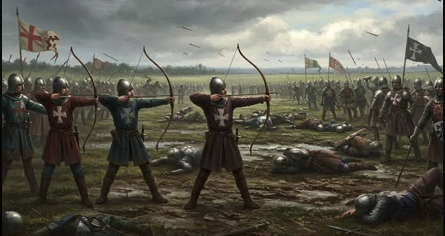
Cannons and muskets. Machine guns. Warplanes. Submarines. Aircraft carriers. Atomic weapons. If you had weapons superior to your enemies you won, often despite differences in numbers.
Missiles and Drones
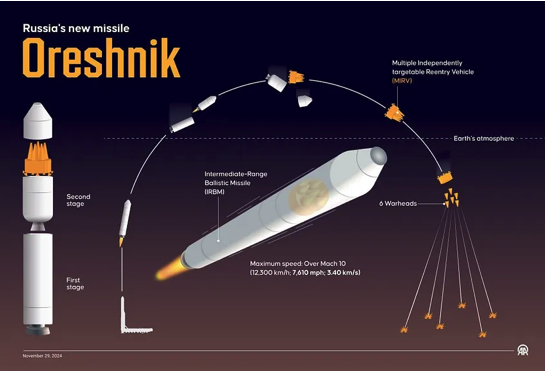
Russia’s unlimited range nuclear powered 9M730 Burevestnik missile and Poseidon torpedo, along with Oreshnik have captured the imagination of the Western media since the West has virtually no defenses against them.
Of course, the Western media don’t really understand these weapons, nor the significance of their creation and the technological leaps they represent, defining the future.
In the case of Burevestnik and Poseidon, it is the creation of practical nuclear propulsion that, of course, could be used for space war but also for peaceful purposes including the exploration and development of outer space. It is what the Americans tried to develop years ago – and failed at. It never flew … but the MIC had great artists.

A NASA project that never made it.
In the case of Oreshnik, it is Russian materials technology, especially metallurgy which makes the missile capable of hypersonic maneuverability, among other things. This too, however, is a technology with many peaceful applications.
No matter— these weapons are impressive game changers, even if the games that they change haven’t quite been played yet.
The Russians are practical and pragmatic. They also have foresight.
Strategic weapons
 The Russians plan supersonic and hypersonic Burevstniks!
Tactical wars
The Russians do not consider the SVO (the "Special Military Operation" in Ukraine) as a “war’: it is a tactical conflict, something less than a war. They used Oreshnik just once in the Ukraine – as a test!
Right now, the real game changers are weapons that can be applied in the Ukraine tactically and through their success deter European warmongering.
Only one of these is-- how should I put it? –glamorous and moderately expensive with both tactical and strategic uses . That’s the Zircon missile originally developed as a naval weapon.
It costs a little over $5 million . Actually cheap compared to a Patriot battery at $1 billion, especially when you consider that Patriots cannot shoot down Russian hypersonic missiles despite the propaganda.
What I am saying is that Zircon is expensive but not too expensive for use against high value targets in a tactical scenario.
How good is it?
ATO Name: SS-N-33
Speed: Mach 8–9 (around 9,800–11,000 km/h or 6,100–6,900 mph)
Range: 1,000 km (620 miles) in a semi-ballistic trajectory; around 400-450 km at low altitudes
Propulsion : solid-fuel booster for the first stage; scramjet for sustained hypersonic flight
Altitude: 30-40 km (92,000–130,000 feet) during the cruise phase
Warhead: both conventional (300-400 kg high-explosive) and nuclear warheads
Guidance: inertial navigation and active/passive radar homing
Launch Platforms: Originally Admiral Gorshkov-class frigates and other surface ships, submarines. Now mobile ground launchers.
Advantages
Maneuverability: Highly maneuverable throughout its flight path, does not follow a predictable ballistic arc
Kinetic Energy: Its kinetic energy alone is enormous and can inflict severe damage on targets of all kinds
Ground launched, it is a tactical weapon that can be used against command centers, depots, airfields, and infrastructure of all kinds.
The Drone Revolution
Right now, Russia is deploying jam-proof fiber-optic FPV platforms with a 50-kilometer range, disrupting UAF logistics and operations in all areas. The Ukrainians do too although their drones are less sophisticated. This has led to both sides targeting drone operators.
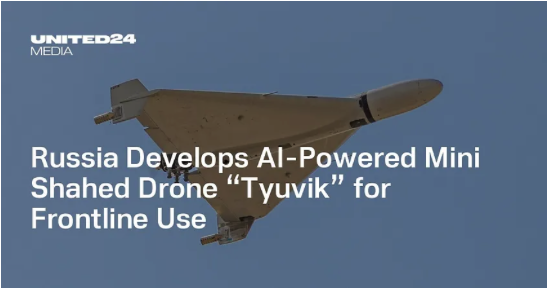
The V2U strike drone, Shahed MS001 and Tyuvik drones all make use of AI technology.
 Shahed drone with AI and thermal imaging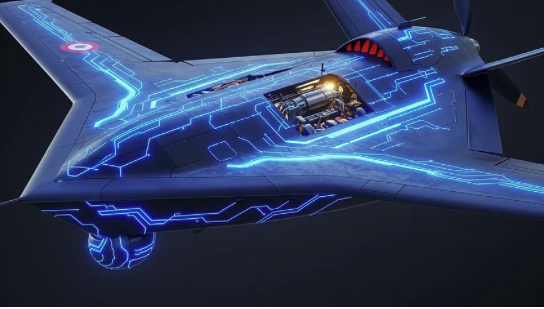
There are Chinese alternatives to the Jetson Orin –and Russia also uses Chinese electronics — but Amazon makes is sooooooo easy to get around sanctions!

Russia’s new “digital predators” are capable of finding and attacking targets without human control. They are not only effective but they save drone operators’ lives – now a major consideration, with both sides in the SVO targeting operators as I mentioned earlier.
Some say that V2U is the most advanced AI drone. It was first used in the Sumy region in February 2025. By mid-May it was in action at least 50 times a day across all fronts. But the three drone types shown here all appeared more or less at the same time, and each has its special applications and advantages.
Let’s take the V2U as an example.
The Russians update onboard code weekly, training the AI through battlefield experience. It is powerful enough to fly up and down roads searching for targets, although it occasionally makes mistakes.
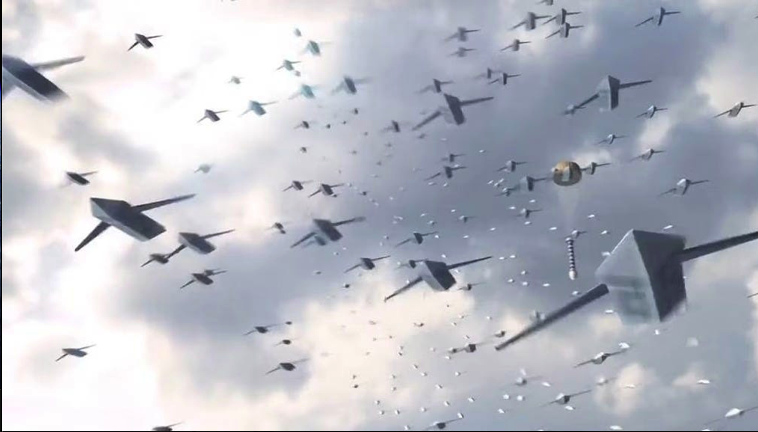
Large “mother drones” transport V2Us and then release them for individual strikes. In addition, it can release coordinated swarms of seven or eight V2Us, each painted with distinct wing colors for visual identification by their AIs.
These drones can organize their attacks and perform anti-air evasive maneuvers demonstrating primitive swarm intelligence that is being improved on and adapted for Russia’s long-range Shahed drones, to create fully autonomous loitering-munitions swarms that can saturate enemy defenses.
In the meantime, the US is building supercarriers which can cost as much as $120 billion and a Golden Dome defense system that won’t work and will cost $600 billion.
The most expensive Russian drones cost about $35,000.

China spanks Japan
The mouse that squeaked

Relative to China, Japan is militarily inconsequential, especially given the fact that the US is proving itself an unreliable partner.
In 2012, the Japanese government purchased Diaoyu islands from a private Japanese owner of dubious provenance for approximately $26 million.
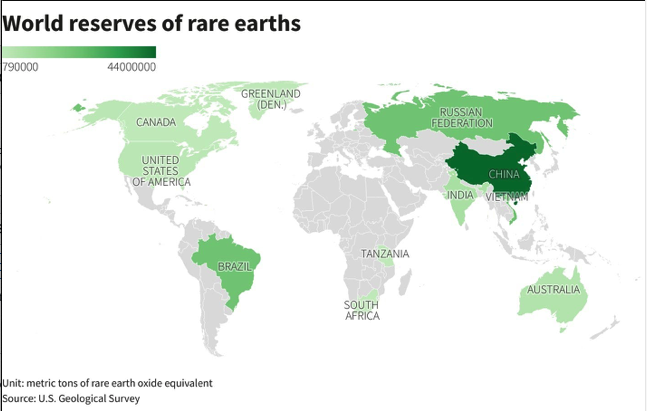
Beijing saw this as an unfriendly act and immediately restricted rare earth metal exports to Japan, which severely impacted the Japanese electronics and automotive industries. China’s ban on rare earths was not formal— but indirect, with the Chinese government putting pressure on Chinese companies.
By and large, China prefers such indirect tactics to head-on confrontation.
This time around China is also using indirect means to pressure Japan – asking its people to avoid visiting Japan for tourism or study which would be a significant blow to the Japanese economy, if the Chinese comply with their government — which is highly likely.
In addition, China can still restrict exports of rare earths to Japan, its agreements with the Americans notwithstanding.
In April and October 2025, China announced new, stricter export licensing requirements for 12 out of 17 total rare earth elements and related processing technologies which allow it to delay or reject specific shipments to companies, including those in Japan, especially those related to defense or advanced semiconductors. The underlying legal framework for restrictions remains active and can be reimposed at any time.

Japan’s Response
Some members of the Diet were upset with Takaichi, as you saw in my last post.“Japan is just an American colony”, they said, with considerable justification.
But Japanese business and industry were even angrier.
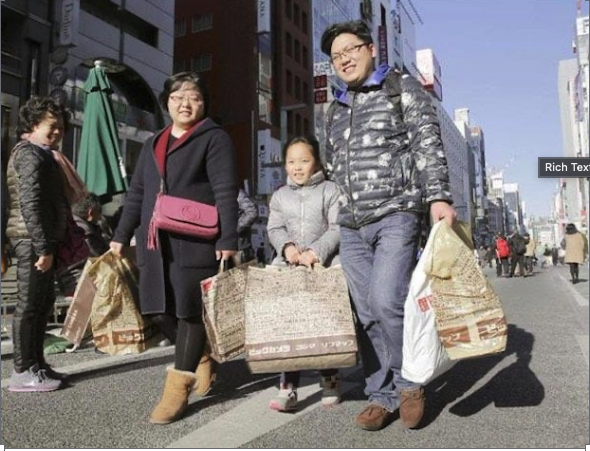
That aside, the immediate problem for Japan is Chinese tourism which it needs to cope with its current economic slump. Chinese tourists buy bigly in Japan.
So, Takaichi had to do something!
Naturally, the Japanese diplomatic delegation will argue Takaichi’s recent statements do not contradict its fundamental position as stated n the 1972 bilateral communiqué.
Takaichi is learning the hard way how important realism is to sensible foreign policy, which includes her position on nuclear weapons in Japan…. If she renounces Japan’s nonnuclear policies, she will be throwing the gauntlet down to the Chinese and we’re back to square one. The Chinese won’t be filling Japan’s food dish, as Chappy puts it.
Changing the Japanese position in the area of nuclear policy would not only anger the Chinese but also the Russians and the North Koreans.
What exactly did Takaichi say?
Takaichi has attempted to soften her rhetoric, saying that she was talking about the hypothetical use of self-defense forces in a “worst-case scenario” – but that’s not going to satisfy China since that “scenario” would only occur if Japanese forces attacked the Chinese to assist a Taiwanese insurrection, despite having agreed that Taiwan is part of China.
In the meantime, shares for Japanese travel and retail companies crashed. Shiseido fell 9%, the department store group Takashimaya fell more than 5%, and Fast Retailing (owner of Uniqlo) fell more than 4% – just a beginning of course unless things get back to normal.
China is firm about this. It has warned of “full readiness for serious countermeasures,” including possible sanctions, suspension of economic, diplomatic, and military ties, and trade restrictions.
Coffee Time
Reward me when you think I am contributing something with my work. Buying a coffee also gives you access to all my special articles and even books, in DocX, PDF, EPUB, Mobi, and HTML.
I write thank you messages to everyone who contributes. I am behind on that right now due to all the time it took to get the most recent “special article” up on the servers. But I will catch up. I tend to ramble with opinions about geopolitical events of the day — sorry.
To donate and keep me and Chappy and Ichi in kibble, click HERE are on the graphic below.

To everyone else, please donate and keep me and Chappy and Ichi droning on every night, click HERE are on the graphic below.


[t4b-ticker id="1"]
Print this article [bws_pdfprint display=’print’]
 This work is licensed under a Creative Commons Attribution-NonCommercial 4.0 International License •
ALL CAPTIONS AND PULL QUOTES BY THE EDITORS NOT THE AUTHORS

1 comment
On the one hand. But on the other hand…
Within the past month and a half I have observed a disturbing trend of netizens in China supporting Takaichi’s premiership and hawkish policy, hoping that her interference in Taiwan can give China a pretext to take revenge on Japan and collect its “blood debt” of 35 million people after 80 years. You see it in such internet comments like “It’s a deal! (一言为定)” and/or something to the effect of “No surrender this time”. To give an idea of these netizens’ mentality, when Takaichi announced once that she wouldn’t be going to the Yasukuni shrine, those same netizens complained. Contrast this with the government who has consistently warned Takaichi not to trample into Chinese affairs.
Someone else told me that netizens in what is supposedly the largest socialist state in the world tend to be nationalist and not give a hoot about international solidarity, let alone communism or socialism. I don’t know if that’s true (it’d explain a whole lot if it were), but even then, what benefit would such a war bring to China? Didn’t Mao Zedong once call the Japanese nation brothers in arms with China against militarism, imperialism and fascism? And what would Mao (or Confucius for that matter) think of the whole “blood debt” thing anyhow?