
[su_spoiler title=”Please make sure these dispatches reach as many readers as possible. Share with kin, friends and workmates and ask them to do likewise. ” open=”yes” style=”fancy” icon=”arrow-circle-1″]
 Nima R. Alkhorshid
 DIALOGUE WORKS
chats with
PROF. MICHAEL HUDSON
(With our thanks to our fraternal colleague Eric Arnow)
| Traducir—Translate! | |
| Make fonts bigger>>> | [wpavefrsz-resizer] |
Michael Hudson: The 28-Point REALITY CHECK: What Russia Would Demand If NARRATIVES DIDN’T RULE

Streamed 26 Nov. 2025
Summary
The video features a detailed discussion with Michael Hudson about the geopolitical dynamics surrounding the proposed U.S. 29-point peace plan for the Ukraine conflict, the broader context of NATO-Russia relations, and the ongoing war’s implications. Hudson asserts that the U.S. proposal is not a genuine peace plan but a sophisticated propaganda tool designed to shape public opinion and frame the narrative in favor of NATO and the Ukrainian government formed after the 2014 Maidan coup. He stresses that the plan is unlikely to be accepted by Russia, NATO, or Ukraine and serves primarily to justify continued Western hostility toward Russia while obscuring the actual causes and consequences of the war.
Hudson outlines Russia’s perspective that the conflict began with Ukraine’s aggression against its Russian-speaking population and the NATO expansion that violated earlier promises not to encroach eastward. He highlights Russia’s intention to hold war crimes trials akin to Nuremberg trials, which terrify NATO and Ukrainian elites due to corruption and crimes committed. The discussion covers the economic aspects, notably the seizure of over €200 billion of Russian assets by the West and the West’s refusal to acknowledge reparations owed to Russia for damages caused.
The conversation further explores the unrealistic nature of Ukraine maintaining a large army supported indefinitely by NATO, likening this to a refusal to demilitarize as was done with Germany and Japan post-World War II. Hudson warns that the West’s continued arming of Ukraine risks escalating the conflict and potentially dragging Europe into catastrophic losses, especially as public support for the war wanes amid rising economic hardships and migration pressures.
Finally, the interview touches on internal Western political struggles, including attacks on figures like Steve Witkov, who recognize Russia’s military success and advocate for a pragmatic approach, which is labeled “pro-Russian” by the establishment. Hudson concludes that the conflict is not only military but a fundamental clash over values and the future order of civilization, with Russia and its Eurasian allies aiming to establish a new legal and political framework based on universal principles abandoned by the West.
Key Insights
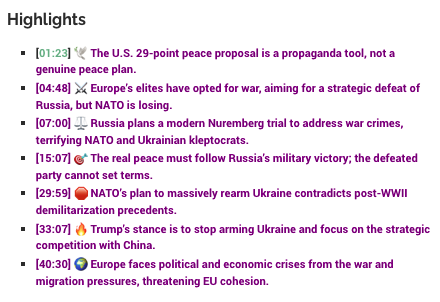
- [01:23] ️ Propaganda over Peace: The 29-point plan is crafted to manipulate public perception, framing the Ukrainian coup and subsequent war as justified while portraying Russia as the aggressor. This underscores how modern conflicts are fought as much in the information sphere as on battlefields, with narratives weaponized to maintain political and military support.
- [07:00] ⚖️ War Crimes and Accountability: Russia’s insistence on conducting war crime trials to establish historical truth and legal accountability reveals a deeper struggle over international law’s interpretation. This threatens Western-backed Ukrainian leaders who have benefited from corruption and want impunity, highlighting the intersection of war, justice, and political survival.
- [15:07] The Logic of Victory and Defeat: Hudson emphasizes the classical principle that peace terms are dictated by victors, not losers. Russia’s overwhelming military success means any peace must reflect its conditions, challenging Western narratives that try to ignore the balance of power and prolong the conflict for geopolitical aims.
- [29:59] Militarization vs. Demilitarization: The push by NATO to increase Ukraine’s army size dramatically and maintain Nazi-aligned forces contrasts sharply with post-WWII demilitarization efforts for defeated aggressors. This signals NATO’s intent to keep Ukraine as a permanent front against Russia, risking perpetual conflict and instability in Europe.
- [33:07] Shift in U.S. Strategy: Donald Trump’s refusal to continue arms supplies to Ukraine and his focus on China as the primary adversary reflects a strategic recalibration. This marks a potential pivot away from endless proxy wars toward a broader confrontation with the global majority, signaling challenges ahead for U.S. foreign policy coherence.
- [40:30] European Political and Economic Strains: The war has exacerbated migration pressures, social unrest, and nationalist backlashes within Europe, undermining EU unity and raising questions about Europe’s ability to absorb Ukraine or sustain prolonged conflict support. This internal fragility could reshape Europe’s geopolitical role.
- [50:08] Civilizational Values Clash: The conflict embodies a fundamental contest over the values underpinning global order—Russia and its allies seek to form a new legal and political framework based on universal principles, while the West is portrayed as having abandoned these ideals, leading to a wider systemic breakdown and realignment.
Extended Analysis
Michael Hudson’s commentary provides a comprehensive unpacking of the Ukraine conflict beyond surface-level reporting. His framing of the 29-point peace proposal as a propaganda stratagem rather than a sincere diplomatic effort is critical for understanding the information warfare aspect of this conflict. The plan’s primary goal is to shape the narrative to justify continued Western opposition to Russia, especially amidst NATO’s military setbacks.
The emphasis on the Nuremberg-style war crimes trials signals a decisive split in how accountability is perceived and enforced internationally. Russia aims to use legal mechanisms to delegitimize the Ukrainian government installed after the Maidan coup, which it accuses of committing atrocities and enabling corruption. This legal battle over narrative and truth is as crucial as the military one, influencing international law and post-war settlements.
Hudson’s perspective on military realities—that the defeated party cannot dictate peace—reflects classical military and diplomatic wisdom. The refusal of Ukraine and NATO to acknowledge Russia’s battlefield advances and insistence on continuing the fight undercuts any potential for immediate peace and prolongs suffering. This also reflects the strategic desperation of NATO and the U.S., which hoped to weaken Russia economically and militarily but have failed.
The discussion about the size and armament of the Ukrainian military touches on a key contradiction: while Russia seeks to demilitarize Ukraine to prevent future threats, NATO aims to expand and empower a hostile force on Russia’s border. This not only defies historical lessons from the aftermath of World War II but also risks dragging Europe into a broader conflict, especially given the apparent depletion of Western arsenals and growing war weariness among European populations.
Trump’s stance introduces a fissure within the Western camp, prioritizing the competition with China over the Ukrainian conflict. This realignment highlights the complexity of global power struggles where regional conflicts are entangled with larger geostrategic contests between great powers.
Europe’s internal challenges—economic hardship, migration crises, and political discontent—are presented as direct consequences of the war. The rise of nationalist parties and declining support for EU policies reveals the fragile social fabric that could unravel further if the conflict continues. The war’s impact is not confined to Ukraine but reverberates throughout the European continent.
Finally, the conversation about values and civilization frames the Ukraine war as part of a broader global realignment. The West’s abandonment of previously championed ideals and Russia’s attempt to establish a new order point to a systemic transformation in international relations. This ideological and legal contest may define the geopolitical landscape for decades.
In sum, Michael Hudson’s analysis offers a multi-dimensional view of the Ukraine conflict, blending military, legal, economic, and ideological factors into a coherent narrative that challenges mainstream Western interpretations and highlights the profound stakes involved.
BEFORE you leave, PLEASE pay attention to this alert.
[t4b-ticker id=”1″]
[/su_spoiler]
Print this article [bws_pdfprint display=’print’]
[su_note note_color=”#f1efef” radius=”0″]The views expressed herein are solely those of the author and may or may not reflect those of The Greanville Post, although, if we publish them, we obviously find them noteworthy and valuable. [/su_note]
 This work is licensed under a Creative Commons Attribution-NonCommercial 4.0 International License •
ALL CAPTIONS AND PULL QUOTES BY THE EDITORS NOT THE AUTHORS

