
[su_spoiler title=”Please make sure these dispatches reach as many readers as possible. Share with kin, friends and workmates and ask them to do likewise. ” open=”yes” style=”fancy” icon=”arrow-circle-1″]

 Wilfred Burchett
(Materials distributed by his son, George Burchett)
| Traducir—Translate! | |
| Make fonts bigger>>> | [wpavefrsz-resizer] |
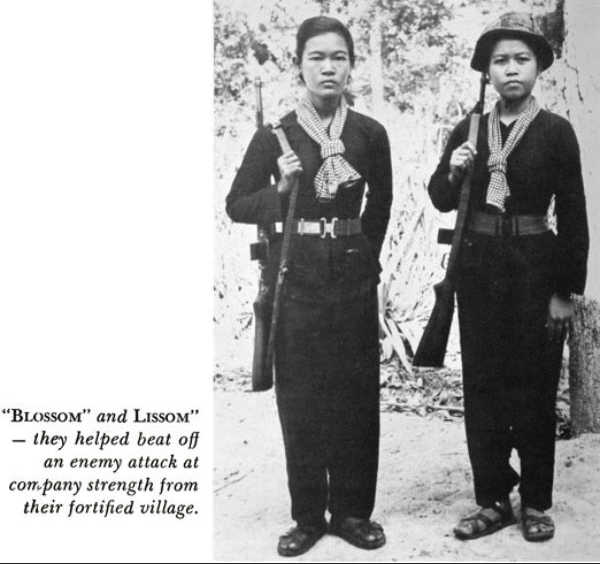
BLOSSOM AND LISSOM, photo by Wilfred Burchett, 1964-65
FORTIFIED HAMLET—
from VIETNAM – INSIDE STORY OF THE GUERRILLA WAR
Among those I met the following day were two dimpled and demure girl guerillas, whose names in Vietnamese meant “Blossom” and “Lissom,” respectively. They were both from the same village and the district guerilla leader had mentioned them as having helped, with five lads from their village, to repulse a company of enemy troops. They were in spotlessly clean black cotton shirts and trousers; hand grenades dangled from their U.S. webbing belts and each had a US. carbine. They looked 15 years, but “Blossom” said she was 19 and “Lissom” assured me she was 22.
“Blossom” was the real heroine of the action and she made it sound quite simple. “When the enemy came very close, I rushed from one firing position to another firing my carbine and one of the puppets fell each time I fired. We all shifted our positions so they would think there were a lot of us. Actually most of our self-defense unit was away that day and we were only seven,” she explained in a light, babyish voice. “The enemy started to set up a machine gun to fire at one of our positions, so I ran there and threw a hand grenade. It killed the gunner and put the machine gun out of action. By then the enemy had nine killed and wounded and they withdrew. Later they fired some shells but they did no damage.” That was all. It seemed incredible to me that a company, 80 to 100 men, would break off an engagement with nine casualties or that they would not have tried to take the positions by assault.
Then I was taken to have a look at the “fortified village” which the two girls had helped defend. The defenses consist of a maze of tunnels, about 20 miles in this one hamlet, I was told, leading into spacious fire positions which cover every approach. They are big enough for some one of Vietnamese size to run doubled up from one fire position to another, as “Blossom” had describe.
I was taken to inspect a single clump of bamboo and told to look very carefully for anything suspicious among the roots. I found nothing. Then I was taken into the tunnel and to a firing position which could accommodate three or four people. Someone took a stick and poked it through what seemed to be blind slits with earthen gun rests behind them. The slits opened up to cover the road along which we had cycled a few minutes earlier into the hamlet. Again I was taken to the bamboo clump and there my attention was drawn to the tiny slits which had been opened up among the bamboo roots, impossible for anyone to detect at even a few yards.
Other firing positions which I inspected were also perfectly camouflaged and as the guerillas changed places constantly, even if the gun flash or smoke gave a position away, it would be little use firing at it. All roads, paths and canals approaching the village were adequately covered. To jump for cover at the time when the firing started was inevitably to fall into a terrible series of traps, most of them deep pits with bamboo and steel spikes; others with grenades and anti-personnel mines made in a local arsenal. I understood why an action was broken off after nine casualties. To take even the outer perimeter of such a fortified hamlet would be a very costly affair. If attacking troops were to penetrate the tunnels, all sorts of hand-operated traps would go into action. The attackers would probably be diverted to a section which would be blown up with everyone in it. If an assault force attacked in the center it would be fired on from the flanks, if it attacked the flanks it would be fired on from the cen
The “fortified hamlet” of “Blossom” and “Lissom,” was the first of such perfection I had visited. I was later to visit other tunnel systems which linked a whole group of hamlets and had over 500 firing positions and successive traps to block off sections in case flame-throwers or some sort of poison gas was used.
A hundred thousand work hours had been put into building the tunnel defenses of some of the hamlets. They were built almost entirely by the young people of the villages, the older ones keeping up supplies of rice, tea and fruit while they worked often from dusk to dawn.
“The enemy builds big posts with huge watch towers to try and control the countryside,” said the military chief of Saigon-Gia Dinh. “We build our fire positions as close to the ground as possible and the rest underground, because our people are defending their own homes. They need to see the enemy—over their sights—only when he comes with evil intent to the gates of their hamlets. The enemy cannot move along the roads and paths near our villages without being continually in the sights of our guns. This is what we mean by people’s war.”
There were about 4,300 such fortified villages in South Vietnam at that time, mostly in the Mekong Delta region, but they were being added to every day in Central Vietnam. It seemed to me that those who devised them had pooled the experiences of General Vo Nguyen Giap and his creeping system of trenches used so effectively at Dien Bien Phu, the tunnel system used by the Chinese guerillas in Hopei province during the anti-Japanese war in which whole counties were linked by underground defense and communications networks, and the system of defensive tunnels built by the Korean-Chinese forces across the waist of Korea near the 38th parallel. If one such hamlet could keep a company at bay—and I heard of plenty of cases where even battalions were repulsed—one only has to multiply by 4,500 the magnitude of the task of any regime or any military machine in trying to re-conquer them.
Wilfred Burchett, VIETNAM – INSIDE STORY OF THE GUERILLA WAR, International Publishers, New York, 1965
 Chapter 7
PATRIOTS & MERCENARIES
A TERRORIST SQUAD
My journalist-interpreter friend excused himself for having awakened me. My watch showed 10.44 pm; I had been dead to the world in my hammock for a good two hours. “Three compatriots have arrived with a very interesting story,” he said. “Can’t it wait till morning?” I asked, and he replied that it was really an “exceptionally interesting story,” and the three were only resting for an hour before they took off again.
So I swung out of the hammock and was guided to a little clearing where the tiny bottle lamps had been set up on tree stumps, the flickering flames lighting up the faces of three exhausted-looking but triumphant men. Almost exactly three hours previously they had exploded a 25-pound bomb inside Saigon’s “U.S. Only” Capitol Cinema. According to the official account of the results, as I heard it over the “Voice of America” next morning, three U.S. servicemen were killed and 57 wounded.
Two of the three before me were former peasants from the Saigon outskirts, the third a former factory worker, and I shall refer to them as No. 1, 2 and 3. No. 1, the worker, was the master planner and also organized the escape: “We had previously blown up the MAAG (Military Aid and Advisory Group) headquarters,” he said. “That was in July 1963. Another group had tried to blow up this cinema but failed because they tried to attack it from the rear. And still another group had exploded a bomb in a U.S. baseball stadium the week before. Our task was to succeed where the others had failed at the Capitol. We had decided to do this after the Lunar New Year ceasefire period, but when American planes napalm-bombed a big meeting in Cu Chi district on New Year’s Day, we decided to teach them a lesson. Also we thought they should be punished for the coup they had just made in putting Nguyen Khanh in power. By that they wanted to show that they were the real masters in Saigon; we wanted to show that the people are still there too. So we decided to attack within the ceasefire period which they had violated.”
As they described it, while Nos. 1 and 2 created a diversion at the side entrance, No. 3, the second peasant with the rather exalted face of a poet, walked through the main entrance with the explosive. “Because of the shooting outside, the Americans inside were alerted,” No. 3 said. “Two jumped on me as I entered and started to strangle me. Because I had the explosive in my arms, I could not defend myself. But I managed to pull the detonator and as it spluttered the Americans were stupefied with fear, and ran up some stairs. There is just ten seconds after pulling the detonator before it explodes. I had time to put it down between the aisles and walk out, closing the grenade-proof steel doors after me just as the explosion took place.”
“You intended to blow yourself up with the two Americans?” I asked, and he eyed me calmly and said, “Of course.” Looking at him, I thought of the descriptions in 19th century Russian literature of the poets and intellectuals who sacrificed their energies and talents, and often enough their lives, in trying to blow up the tsars. No. 3 was of that category. What pushes people to such deeds, I wondered, scanning as much of their tense faces as the bottle lamps would permit, their profiles etched against the impenetrable black of jungle night on which a newly born moon made no impression at all. There was silence for a moment, except for the monotonous cry of an intensely boring night bird which never ceased its metallic two-note cry between dusk and dawn.
“There are thousands of militants like us in Saigon,” said No. 2, “ready to sacrifice ourselves at any moment, but we want to kill five or ten Americans for every one of us.”
“Were there women and children in the cinema?” I asked.
“We don’t make war against women and children,” blazed forth No. 2. “But what do they care for our women and children? In that cinema are only the pilots that go out day after day in their planes and blindly bomb and strafe our villages. Do they ask if there are women and children inside the houses they napalm? They bomb and fire on every living thing they see.”
No. 1 explained that a 12-year-old sister of the one who had planted the explosive had been killed with 15 other children in the strafing of a school in Cau Xe.
I was interested in knowing enough about their lives to understand what impelled people into such desperate ventures. No. 1 had spent five of the preceding nine years in Diemist prisons: “In front of my eyes I saw my comrades, the finest men that ever lived, tortured to death for no other reason than that they had been patriots in the struggle for independence,” he said. The hamlet of No. 2 had been bulldozed out of existence to make way for airfield extensions north of the city. After that he had worked as a coolie on an American military base. “I will never forgive them for what they did to our women,” he said. “I saw things that no human being should see. As long as they remain on my soil while I live, I shall take my revenge. For my own sister and my own compatriots, our young women violated, comrades tortured and massacred.”
It was time for them to move on. As they swung their small packs on their shoulders, I asked where they were heading. “We are going to a rest area,” said No. 1, “and there we have to work out something special to mark May 1. In Saigon we have a tradition of celebrating May Day.” I thought of them later when the radio reported an audacious coup in which a 14,000-ton U.S. aircraft-transport was sunk in Saigon harbor in the small hours of May 1 and a second bomb exploded killing and wounding Americans who came to investigate salvage possibilities. This happened despite exceptionally strict security precautions and mixed U.S.-Vietnamese anti-sabotage patrols set up following the Capitol Cinema incident.
HATRED OF THE INVADERS
Huynh Tan Phat had earlier explained to me that terrorist attacks against Americans were part of Front policy. “We have the spontaneous support of the population for such actions,” he said. “We attack only cabarets, cinemas, sports grounds, restaurants reserved exclusively for U.S. military personnel. They have to put up barbed wire and anti-grenade grilles, as the French did in their time. This helps to expose their real situation—that they live in mortal fear of the population. Of course it would be impossible to carry out such actions with a handful of isolated, individual terrorists, but it is possible with the support of the whole population who always find means of sheltering them. It has happened several times when someone has been hurrying away after such an action, before the police got on his trail, that an unknown person has pushed him inside his house or shop and hidden him; or pressed money in his hand and said: ‘Take this for a taxi.’ “
A couple of weeks after the Capitol Cinema incident, the Front broadcast a warning for Americans in Saigon not to take their wives and children to public places reserved for Americans. The terrorist attacks were for “men only.”
Chapter 7
BEFORE you leave, PLEASE pay attention to this alert.
[t4b-ticker id=”1″]
[/su_spoiler]
Print this article [bws_pdfprint display=’print’]
[su_note note_color=”#f1efef” radius=”0″]The views expressed herein are solely those of the author and may or may not reflect those of The Greanville Post, although, if we publish them, we obviously find them noteworthy and valuable. [/su_note]
 This work is licensed under a Creative Commons Attribution-NonCommercial 4.0 International License •
ALL CAPTIONS AND PULL QUOTES BY THE EDITORS NOT THE AUTHORS

