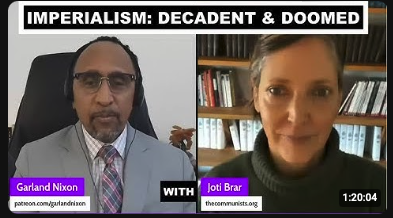
Garland Nixon
| Resize text-+= |
Dispatch No. 1
US SHIPS & PLANES HIT BY MISSILES - HIGH RANKING ISRAELI OFFICIALS TARGETED - AIR DEFENSE COLLAPSE
Summary
In this detailed and candid commentary, Garland Nixon provides an in-depth analysis of the deteriorating situation facing the Trump administration and its allies, particularly Israel, in the Middle East. Nixon argues that the U.S. and Israeli narratives of dominance and invincibility are collapsing under the weight of ongoing military setbacks, technological countermeasures by Iran, and growing international opposition. The core of the discussion revolves around the strategic and symbolic blows dealt to U.S. and Israeli forces, including the destruction of vital military equipment such as KC135 Stratotankers refueling planes, multiple F-18, F15, etc aircraft, and the apparent failure of Israel’s air defense systems amid sustained missile attacks on Tel Aviv.
Nixon highlights the increasing effectiveness and boldness of Iranian and allied forces, who have struck deep into enemy territory, targeting high-level officials and military assets, including possible hits on Israeli leadership figures. This, Nixon suggests, undermines the myth of U.S. and Israeli technological and military superiority. He describes the psychological and strategic impact of these developments, including a potential shift in global power dynamics, with China and Russia gaining influence due to the weakening of the U.S.-led order.
The discussion also touches on the limitations of traditional warfare in the modern age, given advancements in long-range missile and drone technology that make large troop deployments suicidal. Nixon notes the implausibility of a World War II-style conflict today due to surveillance and precision strike capabilities, which favor asymmetric engagements and standoff attacks instead.
Finally, Nixon points to the economic dimensions of the conflict, particularly Iran’s challenge to the U.S. dollar’s dominance in global oil trade through demands for yuan-based transactions, signaling a broader geopolitical realignment. He warns of an imminent strategic defeat for the U.S. and Israel in this conflict, accompanied by a loss of narrative control and popular support, both domestically and internationally.
Highlights
- [02:00] 🚨 Six KC135 Stratotankers destroyed or damaged, marking significant losses to U.S. air refueling capabilities.
- [09:30] 🎯 Iran and Israel engage in targeted assassinations and doxing of high-ranking military officials, escalating the conflict’s intensity and complexity.
- [23:00] 🎉 Iranian civilians openly celebrate missile strikes on Israeli cities, indicating high morale and resilience against U.S.-Israeli aggression.
- [33:45] 🔥 Tel Aviv’s main fuel provider is on fire amid heavy missile barrages, suggesting critical infrastructure under severe threat.
- [38:00] 🛡️ Israeli air defense systems are reportedly overwhelmed and crippled after loss of early warning radar capabilities.
- [46:30] 🌍 Iran asserts control over Strait of Hormuz, dictating passage of international ships and demanding oil sales in yuan, challenging U.S. dollar dominance.
- [50:00] ⚔️ Modern warfare dominated by long-range missile strikes and drone attacks, rendering traditional large-scale troop deployments obsolete and highly vulnerable.
Key Insights
- [01:30] 🔥 Military setbacks reveal narrative fragility: The U.S. is forced to attribute multiple aircraft losses and equipment failures to mechanical issues rather than enemy action, highlighting a weakening narrative of invincibility essential to maintaining domestic and international influence. This denial reflects the administration’s discomfort with admitting vulnerability, which undermines confidence in U.S. military power and strategy.
- [05:00] 🤥 Lying about the war’s purpose erodes public support: Nixon argues that the Trump administration’s dishonesty regarding the true motives behind U.S. involvement in the Middle East has led to a loss of public backing, making it politically difficult to sustain the conflict. This disconnect between government narrative and public perception creates an environment ripe for strategic and political failure.
- [09:00] 🕵️♂️ Targeted assassinations as tools of intimidation and asymmetric warfare: The use of drone strikes and intelligence capabilities to assassinate key figures has become a double-edged sword. While the U.S. and Israel pioneered these tactics, Iran and its allies have adopted them effectively, eroding the unilateral advantage and leveling the playing field in covert warfare. This development destabilizes the traditional power hierarchy and increases the risk of leadership decapitation on all sides.
- [20:00] ⚖️ Mutual vulnerability forces strategic caution: The possibility that Israel’s and U.S. leadership figures could be targeted and eliminated has profound strategic implications. Decision-makers must now weigh the risk of reciprocal decapitation strikes, which could deter aggressive escalation and limit military options, shifting the conflict towards stalemate rather than decisive victory.
- [38:00] 🛑 Loss of early warning radar cripples air defense: The destruction of high-value radar systems by relatively low-cost Iranian drones marks a technological and tactical breakthrough. Without early warning, missile defense systems have only seconds to react, reducing interception effectiveness and exposing critical infrastructure and population centers to sustained attack. This shift redefines air defense capabilities and challenges existing military doctrines.
- [46:00] 💰 Economic warfare through energy and currency dominance: Iran’s control over the Strait of Hormuz and its demand for yuan transactions in oil trade strike at the heart of U.S. economic power. The potential erosion of the petrodollar system threatens U.S. financial stability and global influence, underscoring that modern warfare extends beyond kinetic battles to economic and geopolitical arenas.
- [50:00] 🚀 Evolution of warfare mandates new military strategies: The advent of hypersonic missiles, long-range drones, and satellite surveillance has rendered conventional mass troop deployments and mechanized warfare strategies obsolete. Future conflicts will be shaped by precision standoff capabilities and rapid, dispersed engagements, requiring innovation in military doctrine and force structure. This reality constrains the U.S.’s ability to project power traditionally, especially in contested regions like the Middle East.
Garland Nixon’s analysis provides a comprehensive and critical view of the multifaceted challenges facing U.S. and Israeli forces amid escalating conflict with Iran and its allies, highlighting the erosion of military, technological, economic, and narrative dominance that once underpinned American global hegemony.
Dispatch No. 2
THE IRAN WAR - WHERE US TACTICS WITHOUT STRATEGY IS THE NOISE BEFORE DEFEAT
Mar 15, 2026
Summary
In this extensive analysis, Garland Nixon presents a detailed assessment of the ongoing conflict between the United States and Iran, framing it as a lost war for the U.S. He uses vivid metaphors, such as the U.S. being “out on its feet,” to describe a situation where the U.S. appears functional but is effectively incapacitated and losing. Nixon explains that the U.S. is trapped in a reactive posture—constantly responding to Iran’s strategic moves rather than dictating the course of the conflict. Iran, on the other hand, employs a sophisticated blend of symmetrical and asymmetrical warfare, combining pre-planned retaliations with surprise tactics, supported by advanced missile and drone capabilities, likely enhanced through alliances with Russia and China.
Nixon highlights the critical vulnerability of the U.S. military’s limited weapon stockpiles and the exhaustion of its defensive capabilities, predicting a near future where the U.S. will be unable to defend its assets effectively. He contrasts this with Iran’s patience and long-term strategic outlook, which aims to outlast and exhaust the U.S. economically and militarily, forcing Washington into a position of desperation and negotiation on Iran’s terms. The video also draws parallels with the Ukraine conflict, emphasizing how ideological rigidities and flawed planning have led to prolonged conflicts without clear paths to victory for the U.S. and its allies.
Furthermore, Nixon discusses the broader geopolitical implications, particularly the shifting energy dynamics favoring Russia as a stable supplier and Iran’s control over the critical Strait of Hormuz, a chokepoint for global oil supplies. He argues that the U.S. empire’s credibility and narrative of dominance are eroding, both militarily and economically, as allies lose trust and adversaries gain leverage. The potential use of nuclear weapons is addressed as a mutually destructive but ultimately ineffective option for the U.S. The video concludes with a grim outlook on the collapse of U.S. strategic power and the rise of a multipolar world where former U.S. allies may abandon it, especially as Europe faces severe energy crises exacerbated by Russian tactics.
Highlights
- [01:00] 🥊 U.S. is “out on its feet” in the Iran conflict—appearing active but effectively defeated.
- [06:00] 🤼♂️ Iran’s warfare combines symmetrical and asymmetrical tactics, keeping the U.S. off balance.
- [14:00] 🎯 Iran’s missile and drone capabilities, boosted by Russian and Chinese support, rival or surpass U.S. targeting.
- [21:00] ⚠️ U.S. is rapidly depleting its regional weapon stockpiles, leading to desperation in sourcing arms globally.
- [29:00] ⏳ Iran’s strategy focuses on exhausting U.S. resources, forcing negotiations from a position of strength.
- [42:00] 💥 Use of nuclear weapons would lead to massive destruction but not strategic victory—mutual ruin.
- [58:00] 🌍 The conflict erodes U.S. credibility and power narrative, risking abandonment by allies and empowering adversaries.
Key Insights
- [01:00] 🥊 “Out on its feet” metaphor vividly captures the U.S. strategic collapse: Nixon stresses that despite appearances, the U.S. is incapacitated, unable to execute a winning strategy but only responding tactically to Iranian moves. This highlights the critical difference between tactics and strategy in warfare, where initiative defines power.
- [07:00] 🔄 Symmetrical vs. asymmetrical warfare: Iran’s dual use of symmetrical retaliation (e.g., tit-for-tat strikes on infrastructure) combined with asymmetrical tactics (unpredictable, unconventional attacks) creates a complex challenge the U.S. cannot effectively counter. This balanced approach underscores Iran’s strategic maturity and adaptability.
- [14:00] 🎯 Enhanced missile and drone capabilities: With support from Russia and China, Iran’s targeting precision and offensive technology have reached parity or superiority with the U.S., undermining decades of American military dominance in the region and shifting the balance of power.
- [21:00] ⚠️ Weapon stockpile depletion: Nixon reveals that the U.S. has only weeks’ worth of offensive and defensive ordnance in the region, forcing a global arms scramble (e.g., from South Korea, Africa, Asia). This critical shortage weakens U.S. operational capacity and signals desperation, undermining deterrence.
- [29:00] ⏳ War of attrition as Iran’s core strategy: Iran aims to exhaust the U.S. over time, exploiting America’s limited industrial and military endurance. This long-term outlook contrasts sharply with the U.S.’s short-sighted planning and ideological rigidity, leading to strategic failure.
- [42:00] ☢️ The nuclear option is mutually destructive but strategically futile: Iran warns that any U.S. nuclear strike would trigger catastrophic retaliations, including Israel’s destruction and Gulf infrastructure devastation, plunging the West into economic and social collapse. This deterrence dynamic further restricts U.S. options.
- [58:00] 🌍 Geopolitical fallout and erosion of U.S. global dominance: The conflict accelerates the decline of U.S. credibility and the unipolar world. Allies grow distrustful, Europe faces severe energy crises, and Russia and China emerge as stable energy suppliers and strategic partners to Iran, reshaping global power structures.
Detailed Analysis
Garland Nixon’s assessment shows a conflict where the U.S. is tactically active but strategically inert. His “out on its feet” analogy encapsulates a critical stage in warfare where a power is effectively defeated but still struggling to maintain the facade of strength. The U.S. is portrayed as reactive, always responding to Iranian initiatives rather than shaping the battlefield or the political narrative. This loss of initiative is crucial because it means the U.S. is not pursuing a coherent strategy but engaging in piecemeal tactics, which inevitably lead to attrition and exhaustion.
Iran’s warfare approach is sophisticated, blending symmetrical retaliations—where they match U.S. attacks with equivalent strikes—with asymmetrical tactics that surprise and destabilize American forces. This duality ensures that the U.S. cannot predict or effectively counter Iranian actions. The mention of war games from 2002-2003 led by General Von Riper highlights that Iran’s use of asymmetry originated from necessity but has evolved into a position of strength, given their enhanced military capabilities today.
The video underscores that Iran’s missile and drone technology, supported by Russia and China, now matches or exceeds U.S. capabilities in targeting and precision strikes. This parity neutralizes traditional U.S. military advantages and complicates any offensive or defensive operation in the Persian Gulf region. The destruction of U.S. regional bases and aircraft, including tankers in Saudi Arabia, exemplifies this erosion of American military infrastructure.
A critical vulnerability highlighted is the U.S.’s limited stock of missiles and air defense systems in the region, with estimates suggesting only a few weeks’ worth of supplies remain. This shortage forces the U.S. to scavenge arms from bases worldwide, signaling desperation and weakening deterrence. Iran’s strategy leverages this by continuously striking U.S. assets, gradually depleting their resources and increasing the effectiveness of subsequent attacks as U.S. defenses falter. Nixon’s analysis of missile usage strategy—suggesting Iran will use new, formidable weapons first to drain U.S. defenses before unleashing older, less sophisticated weapons that can no longer be stopped—reflects a deep understanding of attrition warfare.
Nixon draws parallels with the Ukraine conflict, pointing out the U.S.’s flawed short-term planning and ideological rigidity, which have led to prolonged conflicts without clear victory paths. He praises Putin’s strategy of maintaining course and speed, refusing to respond to provocations tactically and instead grinding down NATO through attrition. Iran appears to have learned from this, applying similar principles against the U.S.
The geopolitical consequences are profound. Iran’s control over the Strait of Hormuz gives it leverage over global oil supplies, and Russia’s role as a stable energy supplier contrasts starkly with the volatility in the Persian Gulf. This dynamic is accelerating the decline of the U.S.-led unipolar world order. Europe, heavily dependent on Russian energy, faces severe shortages and potential economic collapse, which Russia can exploit to extract concessions, including the lifting of sanctions.
Finally, Nixon addresses the nuclear dimension, emphasizing that while the U.S. might threaten nuclear strikes, such actions would lead to mutually assured destruction of infrastructure and economies, with no clear strategic gain. Iran’s message is one of deterrence and resolve: any nuclear use would trigger catastrophic retaliation and economic collapse in the West.
In conclusion, Nixon argues that the U.S. has started a war it cannot end, trapped in a cycle of tactical responses without strategic solutions. The erosion of U.S. military and economic power, the depletion of weapons, the loss of credibility, and the shifting global alliances all point to a historic decline. The conflict is reshaping global power balances, empowering Russia, China, and Iran, and signaling the end of U.S. unipolar dominance.
AND...
Dispatch No. 3
IRANIANS ARE IN NO MOOD FOR A CEASEFIRE
enough is enough.
Streamed live 5 hours ago
Summary
The video transcript captures a vehement and uncompromising speech emphasizing resistance and opposition to any form of ceasefire or negotiation with Israel. The speaker firmly rejects the very idea of a truce, declaring that such a concept does not exist and will never be accepted. They stress unwavering loyalty to their leader, who opposes any form of compromise with Israel. The speaker recalls recent Israeli attacks as justification for continued resistance, invoking the example of historical figures like Aba Abdullah to symbolize steadfastness and sacrifice.
The core message is clear: negotiation with Israel is impossible and equated to betrayal. The speaker highlights the personal pain and loss caused by Israeli actions, especially the killing of family members, and insists that forgiving or negotiating with the enemy is out of the question. Any call for dialogue is labeled as foolish or treasonous, and those advocating it are branded as traitors or collaborators.
The speech further invokes religious and ideological imperatives, citing Imam Khomeini’s directive that Israel must be destroyed, framing this as a divine and moral obligation. The speaker insists that the fight will continue relentlessly until Israel is completely eradicated, and expresses a readiness to shed blood until that goal is achieved. The closing remarks emphasize a firm timeline and a committed battle to ensure the destruction of Israel and its allies, with no room for compromise.
Highlights
- 00:19 🔥 No truce exists; any talk of ceasefire is rejected outright.
- 00:40 ⚔️ Resistance must continue until the destruction of Israel.
- 01:00 ✋ Negotiation is dismissed as foolish and impossible after past betrayals.
- 01:30 💔 Personal loss fuels refusal to negotiate or forgive Israel.
- 02:00 🚫 Anyone advocating negotiation is labeled a traitor or collaborator.
- 02:30 📜 Imam Khomeini’s directive to destroy Israel is cited as a religious mandate.
- 02:50 ⏳ The fight will persist until Israel’s complete destruction is achieved.
Key Insights
- 00:19 🔥 Absolute rejection of ceasefire or truce: The speaker categorically denies the existence or possibility of any ceasefire with Israel, framing the concept as nonexistent. This highlights a strategy of total resistance without pause or negotiation, reflecting a zero-sum mindset where compromise is seen as defeat.
- 00:40 ⚔️ Unwavering commitment to resistance: Resistance is portrayed as a sacred duty, continuing “until the destruction of Israel.” The invocation of historical and religious symbols like Aba Abdullah emphasizes the speaker’s view that resistance is both a moral and existential imperative, not just a political stance.
- 01:00 ✋ Negotiation equated to betrayal and naivety: The speaker dismisses calls for negotiation as foolish, arguing that those who believe in dialogue are ignoring painful lessons from past experiences where trust was broken. This insight reveals a deep mistrust and the belief that Israel cannot be engaged through peaceful means.
- 01:30 💔 Personal trauma as a motivator for resistance: Personal loss, specifically the killing of family members by Israeli forces, is used to justify the refusal to negotiate and to fuel a desire for vengeance. This personal dimension adds emotional intensity to the political stance and explains the depth of hostility.
- 02:00 🚫 Labeling negotiation supporters as traitors: The speech not only rejects negotiation but also aggressively vilifies anyone supporting it, calling them traitors or collaborators. This tactic serves to police internal discourse and maintain ideological purity within the speaker’s community or group.
- 02:30 📜 Religious and ideological justification for destruction: Quoting Imam Khomeini’s directive that Israel must be destroyed elevates the conflict from political to a religiously sanctioned duty. This framing galvanizes supporters by invoking divine authority and historical continuity.
- 02:50 ⏳ Endurance and long-term commitment to conflict: The speaker commits to a long-term struggle, indicating readiness for prolonged conflict until Israel’s destruction is achieved. This insight underscores the intractability of the conflict and the speaker’s rejection of any negotiated peace within a foreseeable timeframe.
The transcript reveals a worldview defined by uncompromising resistance, deep personal and collective grievances, ideological and religious motivations, and a rejection of any form of diplomacy or ceasefire with Israel. The speech is a potent expression of conflict rhetoric that prioritizes total victory and frames negotiation as synonymous with betrayal.
BEFORE YOU LEAVE:
People's journalism can't survive without your active support.
Because YouTube (Google) is a heavily (and capriciously) censored platform aggressively enforcing the Empire of Lies' official narrative, dissident, anti-imperialist voices like Garland Nixon's are constantly harassed via demonetization, shadowbanning and outright deletion. This forces such voices—all of us, actually—to seek alternative platforms that still respect the right of free speech, such as Rumble.com, Rofkin.com, etc. Garland has now alternative archives on Rofkin, Rumble, etc. Should YouTube pull the plug, be sure to find him there. Also, please consider a donation to keep his work as vibrant as ever.
GARLAND'S ROFKIN & RUMBLE PLATFORMS:
ROFKIN: https://www.rokfin.com/garlandnixon
RUMBLE: https://rumble.com/user/garlandnixon/videos
DONATIONS:
BUY ME A COFFEE • https://www.buymeacoffee.com/garlandnh
PayPal - garlandn@gmail.com
/ garlandnixon
[t4b-ticker id="1"]
Print this article [bws_pdfprint display=’print’]
The views expressed herein are solely those of the author and may or may not reflect those of The Greanville Post.
Unfortunately, most people take this site for granted.
DONATIONS HAVE ALMOST DRIED UP…
PLEASE send what you can today!
JUST USE THE BUTTON BELOW
This work is licensed under a Creative Commons Attribution-NonCommercial 4.0 International License