
By Oliver Boyd-Barrett

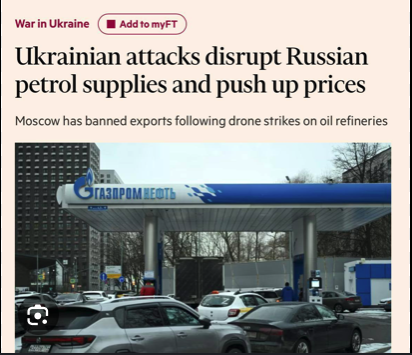
On May 20, Reuters reported that virtually all major oil refineries in central Russia have been forced to halt or scale back fuel output following Ukrainian drone attacks. Moscow had implemented a ban on gasoline exports from April to the end of July. The combined capacity of affected operations accounts for around a quarter of Russia’s total refining capacity. Ukrainian strikes on Russian energy infrastructure, Reuters reports, have doubled the number of oil refineries targeted since the start of 2026. Oil and gas taxes contribute approximately one quarter of federal revenue (although some or all of the shortfall created by successful Ukrainian strikes is compensated for by the higher fuel prices occasioned by the Gulf crisis). Russia has moved to restrict aviation fuel exports until the end of 2026.
Midday today (June 4th, California time) Military Summary Channel reported a growing fuel crisis in Crimea, presumably in the wake of successful drone attacks that have damaged or disabled many oil refineries along Russia’s Black Sea coast and Ukrainian strikes on Russian oil trucks, and that will interrupt the flow of fuel to support the Russian advances in Zaporizhzhia and Kherson, even though Russian forces are making considerable advances in western Zaporizhzhia (moving on Orekhiv and Tavriiske).
At root of Russia ‘s new fuel crisis is the emergence of new classes of Ukrainian drones such as Hornets that are driven by AI and do not need operators whereas Russia needs hundreds of operators to bring down the Ukrainian drones. Russia is mobilizing its Rubicon forces to concentrate on attacking Ukrainian drone launchers and operators. But what Russia mainly needs and will likely soon develop is an AI system that will discover and destroy Ukrainian drones. Until this happens Russia is disadvantaged by an overall shortage of drone and interceptor operators and can only focus these on the Crimea-Zaporizhzhia areas by diverting others from, say, the northern border of Ukraine, in turn leaving these areas under-protected. Attempts to build up operator units on ships in the Azov sea have been stymied by recent Ukrainian concentration of effort in attacking Russia’s Azov fleet.
Because so many airfields in Ukraine have been destroyed by Russian missile and drone attacks and because airfields used to be Ukraine’s primary choice for location of drone launchers, Ukraine has transitioned to greater use of mobile drone launchers which, while they may make the business of coordinated drone swarm attacks more challenging, do make it more difficult for Russians to identify and take out Ukrainian drones.
Russia, meantime has been depending more on trucks for the transport of fuel. Long queues of Russian fuel trucks—and accompanying kilometer-long lines at civilian gas stations—are the result of a severe, nationwide fuel crisis driven by targeted Ukrainian drone strikes on Russian oil refineries and logistical supply lines. As already discussed, these infrastructure attacks have significantly reduced Russia’s refining capacity. With the Kerch Bridge limited, Russian forces are heavily reliant on fuel trucks traveling the R-280 “Novorossiya” highway and the M14 overland corridor. Ukrainian UAVs and autonomous drones are actively targeting these ground lines of communication (G-LOCs), destroying tankers and supply depots, which causes immense traffic bottlenecks and delivery delays. Massive lines have formed at crossing points, such as tanker trucks waiting to board ferries into Crimea, and these are very vulnerable to Ukrainian attack. Crimea is experiencing a near total supply meltdown. Long lines stretch for kilometers at stations in major hubs like Sevastopol. Fuel shortages and stations running completely dry have spread to mainland regions, including Belgorod, Kursk, and St. Petersburg.
Crimean authorities say the fuel situation in Crimea is deteriorating, and that the free sale of gasoline to civilians (large companies, emergency services, etc. are exempted) has been suspended. Fuel for civilians is being sold only using previously issued coupons. Not only have cash sales been restricted for several days, but no coupons are available for purchase and none are expected to become available in the near future. Gasoline is being sold in limited quantities (20 liters per person), using only old coupons.
Anatol Lieven claims (Lieven) that yesterday’s successful Ukrainian strike on energy facilities near Saint Petersburg have led voices in the Russian establishment to begin to call publicly for an early peace, even at the price of giving up key Russian demands. The Trump administration continues to walk away from the conflict, yielding what Lieven, in my view naively, sees as an opportunity for the European Union to play a key role. If it is to do that, he opines, the EU must bring forward concrete incentives to Putin, perhaps including a limited resumption of energy purchases - something which right now Europe adamantly opposes. He claims, without evidence that I have seen, that Russia is increasingly worried by its dependence on China and frustrated with China’s determination to drive the hardest possible bargains over their energy purchases and investments. On the contrary, I would argue that it is China that may be growing worried about its increasing dependence on Russia for energy. It is perfectly obvious to both parties, however, that the political West clings to an insane hostility to the threat that they think the Global South poses to the West’s era of authoritarian liberalism. Russia and China know very well that united they stand, divided they fall. Lievan acknowledges that for the most part Europe has stupidly set its sights on an unconditional Russian ceasefire, which is simply not going to happen.
The Duran Daily (Duran) notes that Russia opened the St. Petersburg International Economic Forum not simply in sight of Ukrainian attacks on a Russian oil refinery but under the shadow of one of the largest drone assaults in recent months.
“Hundreds of drones reportedly targeted cities, energy facilities, and industrial sites across the country, including locations near St. Petersburg. Ukrainian officials openly highlighted the distances traveled by the drones, portraying the attacks as proof of expanding operational reach. The timing of the strikes, coinciding with the opening of Russia’s flagship economic gathering, was widely interpreted as an attempt to disrupt a major political and economic event. Questions are also emerging about how drones are reaching targets so deep inside Russian territory, with reports from the Baltic region fueling speculation about flight paths that may extend beyond Ukrainian-controlled airspace”
I would say that there is little doubt that the intensity of Ukrainian drones owes a great deal to the fanatical and fatal involvement of Finland and the Baltic states who permit the launch of Ukrainian (and, increasingly NATO-produced drones) from and over their territories towards targets deep in Russia, gravely escalating the chances of outright nuclear war, for which Russia’s new SARMAT is well disposed. This is precisel;y the kind of behavior that is fuelling support for a Russian resort to a “demonstration” nuke to confirm its seriousness and shut down the warmongering Kallas classes.
In eastern Zaporizhzhia, Russia now controls Hulapelske and Verkhaya Tersa, making further advances in central and southern Vozdvyzhivka and establishing new positions on the northern outskirts of Bilohiya to the south. It is advancing on the second line of Ukrainian defense that runs from Barvinivka in the north to Chervonc in the south, improving its positions west of Huliapole ready to strike on Orekhiv.
West of Pokrovsk in the Donetsk region, Russia looks set to continue its movement towards Bilytske via Serhivivka to Novopidhorske and Muravka. Russia’s control of Konstantynivka is expanding, and its bombardments of Slavyansk intensifying, while north of Kupyansk, now fully recovered from Ukraine, Russia eats into more of the northeast of Kharkiv east of the Oskil river, and is likely soon to find itself only 30 kilometers from the Siversk-Donetsk canal south of Vovchansk which Russia also holds.
Last night’s (June 3-4) Ukrainian drones attacked targets in Belgorod, Bryansk, Volgorod, Voranyk, Kursk, Novgorod, Oryol, Roskov, Ryazen, Tambov, Crimea, and shipping targets in the Azov and Black Sea. Yesterday, Ukraine attacked shipping and energy targets in Saint Petersburg (including a ship docked on the island of Kronstadt, though this is likely repairable) where Russia is hosting an international economic forum well outside the center of the city. In addition to impacting the Saint Petersburg oil refinery, recent Ukrainian drones have also inflicted significant damage on the Saratov oil refinery in the Saratov Oblast in the southeasat of European Russia, in the northern part of the Lower Volga region, and on the Illysk oil refinery. The Ilsky Oil Refinery is located in the Seversky district of the Krasnodar Krai in southwestern Russia.
Russia says that it launched some 294 drones last night on energy infrastructure (e.g. an oil storage facility in Perelaslavska, gas stations, warehouses and probably also mobile Ukrainian drone launch trucks). Targets did not include Kiev given the visit there of NATO chief, Mark Rutte - a clear indication of continuing restraint by Russia when it comes to senior NATO personnel. Rutte stated during his visit that the US was continuing to do what it can for the Kiev regime.
Ukraine is soon expected to replace its military commander, Syrsky, with Zelenskiy’s current head of the presidential office, Kiril Budanov, former head of military intelligence. Zelenskiy and Budanov have made recent statements that they expect an end to the conflict by November, and three of Ukraine’ European sponsors - the UK, Germany and France - are reported to be planning for negotiations to this end, busily if fruitlessly looking for likely candidates who can head such negotiations. It is difficult to reconcile such reports with Zelenskiy’s obduracy and Russian resistance to conciliatory moves. What perhaps these reports signify is continuing Ukrainian and European investment in the idea of freezing the conflict along current lines of combat, especially if they are successful in persuading or tricking the US into full re-engagement even as the Iran crisis and Washington’s obsession with China continues to absorb most US energy.
The U.S. House of Representatives has forced a floor vote on a new Ukraine assistance package in an effort led by Democrats and a handful of Republicans who bypassed House Speaker Mike Johnson. The House voted 218-204 to dislodge the Ukraine Support Act from the Rules Committee. Defying Republican leadership, a bipartisan coalition used a rare “discharge petition” (garnering 218 signatures) to force the vote, directly rebuking the White House.
The legislation aims to authorize $8 billion in loans to Ukraine, heavily target Russia with sweeping new sanctions, and establish a reconstruction trust fund. These measures are puny, relative to the size of previous Biden and Trump administration-directed largesse to Ukraine. The administration has also finalized a separate $400 million military assistance package pulled from existing authorization, intended to procure ammunition directly from U.S. defense contractors. The Senate has also been reviewing a broader bill aimed at penalizing countries that purchase Russian oil, gas, and uranium.
The United States has appropriated approximately $195 billion for the Ukraine response since the 2022 invasion, though direct U.S. government assistance has sharply decreased. A significant portion of the $195 billion remains in the pipeline but roughly a quarter of that money is being used to replenish Department of Defense (DoD) weapons stockpiles. Ongoing U.S. financial support is increasingly constrained due to policy shifts, though smaller supplemental packages, such as the above-mentioned delayed $400 million military allocation, are currently moving through the interagency process. Since Trump has directed Europe to furnish much of the money for weapons expenditure in Ukraine, European nations and institutions have outpaced total U.S. commitments, having now provided more than $200 billion in military, financial, and humanitarian expenditure.
