

 Godfree Roberts
1940 • 2026

Our dear friend, colleague, and superior sinologist Godfree Roberts has just left us. His mission in life, expressed with characteristic humility, was summed up in a few words: "I’ve tracked China’s rise since '61. Now unpacking why it leads: democracy at the bottom, data in the middle, talent at the top." His weekly newsletter “Here Comes China” was and will remain an exemplary, highly engaging form of mass education about a crucial subject: the true nature and direction of China, this planet's most consequential and probably most misunderstood nation. Godfree knew that the torrent of ever-present malicious lies cranked out by the West about China would inevitably lead to war, and possibly the destruction of our planet. He saw that acquiring and spreading the truth by every means available was the only antidote. He also knew this task was urgent, and becoming more so with each passing day. That's why he never stopped in his labours. I never met Godfree in person, certainly my loss, but over the years the injection of his materials into The Greanville Post, generously extended free of charge by Godfree, did much to perfect and expand the quality of the discussion about China, (already high due to the contributions of fellow China experts Frans Vandenbosch and Jeff J. Brown, the latter also our senior associate editor and personal friend). Since the purpose of these lines is not vanity, let me just add that this event hit me hard, too. Maybe it's my own advancing years. Let Frans' words, therefore, speak for me in this space. He says exactly what I wanted to say. Only better. —PG
I never met Godfree in person, certainly my loss, but over the years the injection of his materials into The Greanville Post, generously extended free of charge by Godfree, did much to perfect and expand the quality of the discussion about China, (already high due to the contributions of fellow China experts Frans Vandenbosch and Jeff J. Brown, the latter also our senior associate editor and personal friend). Since the purpose of these lines is not vanity, let me just add that this event hit me hard, too. Maybe it's my own advancing years. Let Frans' words, therefore, speak for me in this space. He says exactly what I wanted to say. Only better. —PG
 In memory of Godfree Roberts, 1940-2026
| News has reached me of the passing of Godfree Roberts in Chiang Mai, at the age of 86. Jeff J. Brown shared the news, and it has hit me hard. I knew Godfree for more than ten years. Over that time our friendship grew through long, intense email exchanges that never ran dry of ideas. He was, without question, one of the sharpest minds I have ever encountered. Godfree's book, "Why China Leads the World", remains the finest work on China I have ever read. He spent decades in China and near the Chinese border in Thailand, watching the country change close up rather than from a distance. His writing carried a strict, straightforward, almost scientific clarity. There was no padding in his prose, no hedging, just argument built on evidence. What struck me most was his temperament. His health was weak for years, yet his outlook stayed cheerful and optimistic. He kept working, kept publishing his newsletter, kept engaging with readers and friends, right to the end. Only a few weeks ago he republished one of my articles. That gesture meant a great deal, coming from someone whose judgement I respected so highly. I still think back to our lunch together in Chiang Mai on 25 October 2024. We talked for hours, ranging widely over China, history and the state of the world. It was the kind of conversation that stays with you. Godfree spent his life pushing back against lazy, hostile narratives about China, insisting that people look at facts rather than assumptions. He did this not as propaganda but as correction, grounded in fifty years of study and direct experience. He leaves behind a body of work that will keep informing readers long after him. He also leaves a gap among those of us who valued his friendship and his fierce, clear-eyed honesty. Rest well, Godfree. Your work continues. — Frans Vandenbosch 方腾波 |
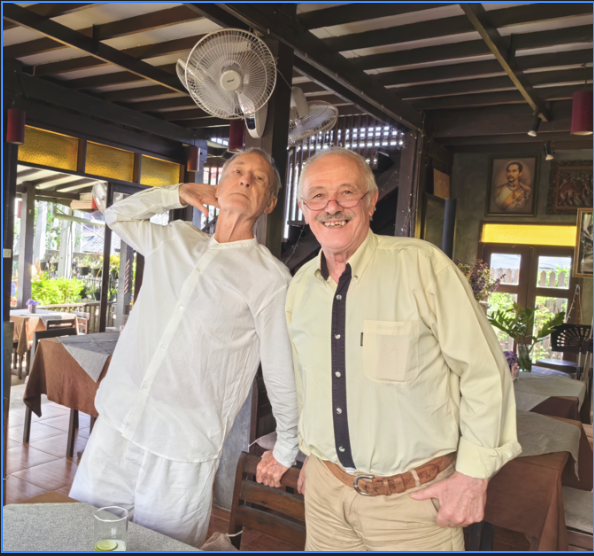
Godfree (l) - Frans Vandenbosch (r)

Godfree Roberts discusses his new book, “Why China Leads the World: Talent, Data and Democracy”.
Please go to Page 2














The Synthesis Apr 22
The 60-day default approval at NMPA (deemed approved if no objection raised, post-2018 reform) is the operational expression of what you're describing. FDA's median IND review is 30 days, but the prep work behind that submission averages 12-18 months and seven figures. Speed at the hospital is downstream of speed at the regulator, and increasingly downstream of who is willing to bear the prep cost.
China as a System @leonliaoApr 22
Exactly. This is why formal review timelines can be misleading. A 30-day FDA clock tells you very little if getting to the starting line already takes 12–18 months and seven figures. At that point, the real gatekeeper is not the nominal review period. It is the prep burden.
That is also why China’s speed should be understood as a whole-system phenomenon. Faster hospitals are downstream of faster regulators, and faster regulators are downstream of a system that imposes lower entry friction on early clinical experimentation. The question is no longer just who reviews faster on paper. It is who has built a system in which fewer things have to be painfully assembled before innovation can even touch a patient.
Te Time Apr 18
They are also real good at finding organ donors. I think the wait time is two weeks.
Apr 18
The Chinese government crackdown started in 1994 because of the number of people who were going bankrupt from buying all those "holy texts". Then a Falun Gong genius staged an illegal protest in Tiananmen Square and the government decided to just shut the whole cult/scam down. Falun Gong is a business masquerading as a cult (like Scientology) derived from traditional Chinese spiritual and health beliefs (like western yoga) with restrictions on using modern medicine (like Jehovah's Witnesses).
It strictly educates and controls what its followers say and do, and is aim directly at taking down the Communist Party of China, so it happily profits from political arbitrage between China and the West. Falun Gong profits from Western fascination and ignorance of Chinese culture: their Shen Yun is billed as a spectacular Cirque du Soleil-style presentation of Chinese culture that the Communists [supposedly] destroyed.
In reality, it’s a Disneyfied caricature of Chinese culture to indoctrinate audiences about Falun Gong. Falun Gong runs a propaganda campaign that’s far more sophisticated than the Communist Party of China. (Maybe they have help from a foreign agency with long experience in that field?)
China as a System @leonliaoApr 18
That is a much more sensitive category, and I would be careful not to confuse speed with legitimacy. In some areas of healthcare, China’s advantage really does come from stronger system coordination, lower friction, and faster execution. But organ transplantation is different. If wait times are unusually short, the question is no longer just institutional efficiency. It is also about donor sourcing, transparency, and whether the process can be independently verified. In that domain, speed by itself is not a clean signal of system strength.
To be fair, China’s officially reported organ donation and transplant volumes have been rising in recent years. In 2024, the official figures reported 6,744 organ donations and 24,684 transplant surgeries. China has also built out a more complete institutional framework over the past decade. Since 2015, voluntary citizen donation has been designated as the only legal source of organs, with the reform presented as being aligned with WHO principles and still undergoing further refinement. That includes new regulations that took effect in 2024, as well as COTRS, the national organ allocation system.
At the level of system design alone, it is entirely plausible that a national allocation platform, a high concentration of major hospitals, a dense cluster of leading transplant centers, and tighter multidisciplinary integration inside large hospitals could shorten the organizational timeline at several points in the process: identifying donors, coordinating across hospitals, retrieving and transporting organs, and moving patients into surgery quickly.
But the American problem is not simply “too few donors.” It is also a system with extremely long waiting lists, complex allocation rules, difficult cross-regional coordination, and much higher compliance and transparency requirements. Both official U.S. data and the GAO have shown that around 2025, the number of people waiting for transplants in the United States was still above 100,000. So long waits in the U.S. do not automatically mean another country is “miraculously efficient.” In many cases, they also reflect the fact that the U.S. is a system with high transparency, dense rules, and heavy oversight — but also very high friction.