

By Eric Zuesse
 "There's no long-term thinking in the West."
—Alastair Crooke
Here’s the Iran-U.S. Deal:
Draft 14-Point U.S.-Iran Memo Hints at Unprecedented Concessions Ahead of Final Deal
A reported memorandum of understanding outlines sweeping terms, including a U.S. naval withdrawal, massive financial release, and the reopening of the Strait of Hormuz, as the U.S. president halts military strikes to pursue a breakthrough.
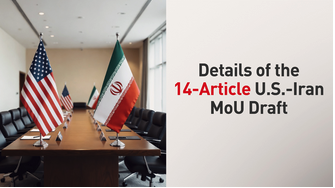
ERBIL (Kurdistan24) - A confidential 14-article draft memorandum of understanding (MoU) between Iran and the United States has reportedly been prepared, outlining a potential framework for a permanent cessation of hostilities and a pathway toward a comprehensive diplomatic settlement.
According to a report published by the Mehr News Agency (MNA), which cited a source close to the Iranian negotiating team, the sweeping draft proposes profound strategic concessions from both sides.
While Iranian authorities have not finalized the text, its reported terms suggest that back-channel negotiations have moved far beyond a simple ceasefire, attempting to fundamentally restructure the geopolitical balance in the Persian Gulf.
The disclosure of the draft document coincides with an abrupt de-escalation by Washington.
According to reporting by Jon Gambrell and Aamer Madhani of The Associated Press, U.S. President Donald Trump dramatically reversed course on Thursday, calling off new military strikes and abandoning a threat to seize Iran's primary oil terminal at Kharg Island.
Instead, Trump announced from the Oval Office that he had secured a "great settlement" and expected a formal agreement within days.
If the terms reported by MNA accurately reflect the current state of negotiations, the framework represents a highly ambitious, and politically explosive, diplomatic gamble.
Inside the Draft Memorandum
The reported 14-article MoU delineates a phased approach to de-escalation, linking military withdrawal directly to the unfreezing of Iranian assets and the resumption of global energy trade.
At its core, the draft calls for an "immediate and permanent cessation of hostilities on all fronts, including Lebanon."
This explicit linkage is a crucial diplomatic victory for Tehran, which has consistently demanded that any agreement with Washington must also constrain Israeli military operations against its ally, Hezbollah.
In exchange for halting the war, the document reportedly outlines sweeping American concessions regarding its military posture in the Middle East.
According to MNA, the U.S. would commit to a policy of non-interference, respect Iranian sovereignty, and completely lift its naval blockade within 30 days.
Furthermore, Washington would agree to withdraw its military forces from Iran's "immediate periphery," while control over the reopening and security of the strategically vital Strait of Hormuz would be governed entirely by Iranian arrangements.
The financial components of the reported draft are equally vast.
The MoU proposes the immediate suspension of U.S. sanctions targeting the sale of Iranian oil and petrochemical products.
During a subsequent 60-day window designated for final negotiations, $24 billion in blocked Iranian funds would be released, with half that amount made accessible to Tehran before the talks even begin.
Most controversially, MNA reports the draft includes a stipulation that the United States and its allies provide reconstruction plans for Iran totaling a minimum of $300 billion.
In return, the MoU reportedly demands that Iran reiterate its commitment to the Treaty on the Non-Proliferation of Nuclear Weapons (NPT) and explicitly pledge not to produce nuclear arms.
During the 60-day negotiation period, both sides would agree to a freeze on escalation, with the U.S. refraining from increasing troop levels or imposing new sanctions.
The final agreement would ultimately be ratified by a United Nations Security Council resolution.
Crucially, the MNA report indicates that the scope of the final negotiations will be strictly limited to the status of enriched materials, the lifting of sanctions, and economic reconstruction.
The draft deliberately excludes discussions regarding Iran's ballistic missile program and its support for regional proxy groups, topics that have traditionally been central to U.S. security demands.
Draft 14-Article Memorandum of Understanding Between Iran and the United States1- Immediate and permanent cessation of hostilities on all fronts, including Lebanon. |
A Whipsaw Diplomatic Strategy
The emergence of the draft MoU provides vital context for President Trump's erratic public signaling.
As the AP reported, Trump's abrupt pivot from threatening to hit Iran "VERY HARD" to declaring a diplomatic breakthrough underscores a high-stakes, maximum-pressure negotiating strategy that nearly triggered a full-scale regional war.
The conflict, which erupted on February 28 following joint U.S.-Israeli strikes on Iran, has severely disrupted global energy supplies. The AP noted that Iran's effective closure of the Strait of Hormuz has crimped supply chains, driven up international fuel prices, and increased the cost of food globally.
Concurrently, the U.S. military has enforced a strict blockade on Iranian ports, a campaign that recently resulted in the deaths of three Indian sailors when American forces struck a merchant vessel accused of blockade evasion, according to the AP.
For Washington, extending the fragile ceasefire that began in April provides critical time to negotiate terms regarding Iran's nuclear program, the primary justification cited by Trump for launching the war. However, the diplomatic environment remains highly volatile.
The AP reported that Israeli Prime Minister Benjamin Netanyahu's office has explicitly stated that Israel is not a party to the emerging agreement between the U.S. and Iran, raising questions about how the Lebanese component of the MoU could be enforced.
The Path Forward
While the reported draft MoU suggests a viable blueprint for peace, the diplomatic reality remains highly contingent. MNA stressed that the 14-article text is still subject to review and finalization by Iranian governing bodies.
Meanwhile, Iranian Foreign Ministry spokesperson Esmail Baghaei acknowledged on state television that the text is "mostly finalized" but cautioned that contradictions in America's position have caused turbulence in the process, according to the AP.
If the terms outlined in the draft are ultimately adopted, the agreement would mark a profound shift in U.S. Middle East policy, prioritizing nuclear containment and the restoration of global energy markets over the dismantling of Iran's regional military network.
However, as the sudden escalation and de-escalation of the past week demonstrate, translating a draft memorandum into a durable, multi-lateral peace settlement remains a formidable challenge in a region where military miscalculations can instantly erase diplomatic progress.
Summary A reported 14-article draft MoU between the U.S. and Iran proposes lifting the naval blockade, unfreezing $24 billion, and reopening the Strait of Hormuz in exchange for nuclear commitments. The outline emerges as President Trump claims a breakthrough, extending a fragile ceasefire amid ongoing negotiations. |



https://x.com/ElBaradei/status/2065877204383257030
https://archive.ph/4qRrN
Post
See new posts
Conversation
Mohamed ElBaradei
@ElBaradei
#Trump desperately trying to show that his new “deal” is superior to “Barack Hussein Obama’s” #JCPOA, when it seems to be a return to the status quo ante in the aftermath of horrific killing, destruction and serious damage to the world economy!
Needless to say negotiations with #Iran under the threat of nuclear weapons is a sure way to create insecurity and distrust which is the best incentive for any country to go nuclear …
Quote
Aaron Rupar
@atrupar
Jun 13