

Judge Napolitano
 chats with
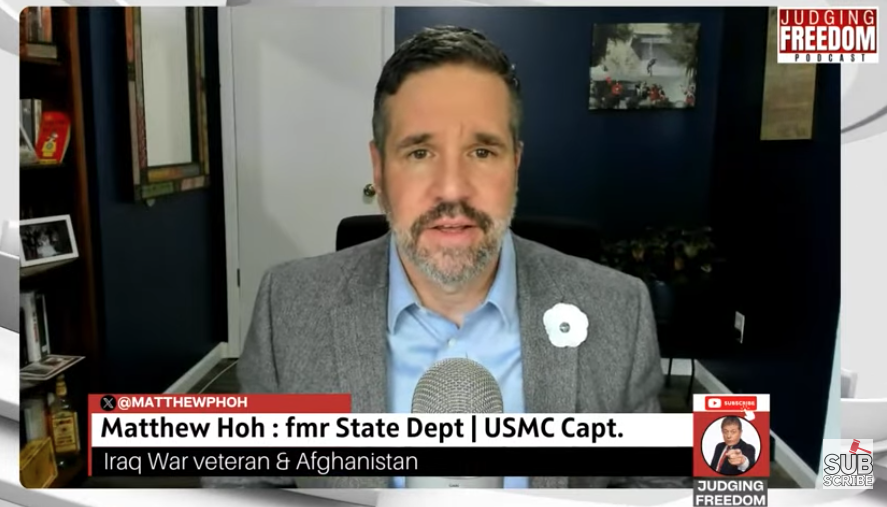
MATT HOH


STREAMED LIVE 26 MAY, 2026
Summary
The video is a deep and critical discussion led by Judge Andrew Napolitano with his guest Capt. (Ret) Matt Hoh on the contemporary realities of American foreign policy, misinformation, and the problematic role of the Pentagon and U.S. government in perpetuating war and conflict. It opens with a philosophical reflection on the legitimacy of government force and the need for citizens to question the government’s use of aggression, framed by historical and moral questions about freedom, governance, and resistance.
The conversation tackles recent geopolitical events, notably the U.S. attack on Iranian Revolutionary Guard boats, which resulted in the killing of five Iranian sailors despite an ongoing ceasefire. The discussion points out the U.S. government’s Orwellian and hypocritical stance that the lack of American casualties means no ceasefire breach has occurred, exposing a blatant devaluation of non-Western lives and an instrumental use of language to justify violence.
The video further highlights a public debate between American foreign policy hawks and academic realists. In this debate, the realists dismantle the official narrative propagated by U.S. officials like Mike Pompeo and Victoria Nuland, revealing contradictions, historical interventions such as the 1953 CIA-backed coup in Iran, and the folly of the U.S. maintaining a continuous war-driven narrative. The American political establishment is shown to prioritize maintaining narratives that justify war and sanctions, rather than pursuing diplomatic solutions that could lead to peace, stability, or prosperity.
The dialogue explores the domestic political dynamics preventing progress toward peace with Iran, emphasizing the bipartisan consensus favoring war to serve specific foreign interests, particularly those of Israel and neoconservative factions. The Gulf States' apprehension and attempts to influence U.S. policy underscore the complex regional stakes, while Iran’s strategic gains discourage concessions, prolonging the conflict. The economic consequences for the U.S. and the world loom large, with the possibility of recession or even depression, worsened by unresolved geopolitical tensions.
The key theme revolves around institutional deception, particularly within the Pentagon. Matt Hoh explains why the Pentagon lies: war itself requires deceit, and the enormous, unaccountable military bureaucracy thrives on secrecy and lack of transparency. The systemic lack of accountability allows lies to flourish unchecked, which is entrenched in both the military-industrial complex and the political narratives that support it.
The video concludes with a somber acknowledgment that this culture of lies and war has been understood even by insiders like President Eisenhower, who famously warned about the military’s propensity toward dishonesty and warmongering. The conversation ends on a critical note but with recognition of the courage needed to confront these realities.
Highlights
- [02:05] 🚤 Analysis of U.S. attack on Iranian boats and the Orwellian spin around ceasefire rules.
- [04:07] 📰 Exposure of how language is manipulated by the U.S., Israel, and Europe to justify violence abroad.
- [05:21] 🎙️ Clip from debate revealing clashes between academic realists and U.S. policymakers on Middle East conflicts.
- [09:02] ⚖️ Discussion about how U.S. policies prioritize narrative over peace or pragmatic diplomacy.
- [11:13] 🇮🇷 Political obstacles to peace with Iran; influence of Netanyahu and bipartisan support for war.
- [16:14] 💥 Commentary on Iran’s strategic advantage and implications for regional stability and U.S. domestic politics.
- [19:24] 🛡️ Explanation of why the Pentagon lies: institutional culture, lack of accountability, and existential reliance on war.
Key Insights
[02:05] 🚤 Orwellian Linguistic Manipulation in War: The U.S. government’s justification that killing five Iranian soldiers does not violate a ceasefire because no Americans were harmed is an example of Orwellian manipulation of language. This reflects deeper ethnocentrism where Western lives are valued over others, enabling aggression under moral pretexts. Such euphemistic redefinitions erode trust and silence valid international law concerns.
[05:21] 🎙️ Academic Realism vs. Political Propaganda: The debate between Professor John Mearsheimer and Steven Walt against Pompeo and Nuland reveals a profound disconnect between facts and official narratives. Historical interventions such as the 1953 coup in Iran and U.S. complicity in Middle Eastern conflicts are often erased or distorted to maintain a simplistic “good vs. evil” storyline that feeds perpetual conflict and sanctions, undermining diplomacy.
[09:02] ⚖️ Narrative Over Policy: The U.S. government prioritizes maintaining a consistent narrative that justifies warfare over formulating policies that could actually produce peace or stability. This inversion—where narrative dictates policy rather than policy shaping narrative—creates a self-perpetuating cycle of conflict that disregards practical outcomes. This reveals a system more invested in its own legitimacy and control than in global peace.
[11:13] 🇮🇷 Political Entrenchment Against Peace: Both political parties in the U.S., alongside Israeli interests, effectively form a bipartisan consensus against engaging in diplomatic solutions with Iran. The political cost of appearing “soft” on security matters or antagonizing powerful lobbies prevents President Trump (and by extension, other leaders) from pursuing meaningful agreements, even when such deals could benefit the global economy and reduce conflict risks.
[16:14] 💥 Iran’s Strength and Regional Power Dynamics: The Iranian government perceives itself as strategically victorious, having achieved critical military and political leverage. This enhances Iran’s regional control and bargaining power, discouraging concessions and fueling continued stalemate. The Gulf States’ divided positions highlight regional complexities, with some monarchies advocating caution, while others may sabotage détente due to their sectarian or geopolitical ambitions.
[19:24] 🛡️ Pentagon Lies as Institutional Necessity: The Pentagon’s culture of deceit stems from war’s inherently immoral nature, combined with the vast, opaque bureaucracy that handles trillions of dollars with minimal oversight. The lack of an enforced accountability structure incentivizes misinformation. This institutionalized dishonesty is not incidental but embedded in the survival and operational paradigms of the military-industrial complex.
[22:27] 🕊️ Historical Awareness of Military Deception: Eisenhower’s acknowledgment that generals and admirals lie demonstrates a long-standing, systemic problem within the military establishment. His efforts to restrain military excesses during the Cold War reflect an acute understanding that unchecked military power and dishonesty pose grave risks to democracy and global peace. This historic warning remains relevant to contemporary U.S. governance.
Detailed Analysis
The intellectual foundation of the video focuses on the moral legitimacy of government and war, invoking ideas from Thomas Jefferson about government’s role and the conditions under which citizens might be justified in resisting or overthrowing it. The call to reject force and demand accountability stands against the backdrop of ongoing U.S. military aggression and covert interventions.
A significant part of the discussion is devoted to the manipulation of language and narrative, which the speakers argue is a tool of modern imperialism to manufacture consent for war. The strange logic around ceasefire violations and casualty counting reveals how power dynamics are exerted through controlling discourse—Western lives are privileged, others marginalized, and international law selectively enforced.
The critique of official U.S. foreign policy narratives is supported by the reference to a public debate showing that academic and diplomatic realities are suppressed in favor of myths that serve geopolitical interests. The discussion exposes how U.S. administrations consistently escalate conflicts and avoid peace efforts because the established narrative and military interests demand continuity.
Domestically, the entrenched bipartisan consensus on foreign interventions inhibits realistic diplomacy. The discussion of how political parties calculate electoral gains and losses with regard to Israel lobby positions provides insight into how domestic politics perpetuate foreign conflicts. The Gulf States’ nuanced role introduces another level of complexity, showing how regional powers also jockey for advantage, often prioritizing their own long-term strategic goals over peace.
The economic context—looming recessions, bubbles, and market dynamics—further complicates these issues. The video’s argument suggests that political dysfunction in foreign policy directly impacts global economic stability, with any failure to resolve conflicts risking a prolonged global economic decline.
The centerpiece of institutional critique focuses on the Pentagon’s role in perpetuating military deception. Matt Hoh’s explanation relates the necessity of lying to the nature of war itself and the sprawling, secretive bureaucracy that escapes meaningful public or governmental scrutiny. Eisenhower’s historical caution underscores that this is neither new nor accidental but systemic.
Ultimately, the video presents a comprehensive, nuanced critique of American militarism, the politics of war narratives, and the institutional structures that sustain them. It calls for intellectual honesty, public awareness, and political courage to challenge these entrenched dynamics in pursuit of true freedom and peace.