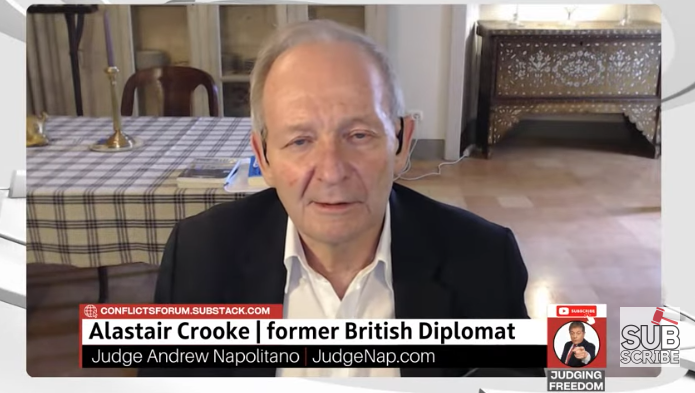
Judge Nap chats with Amb Chas Freeman
The video opens by addressing the prevalence of undeclared wars and critiques the U.S. government’s use of preemptive war (aggression) without popular consent. It highlights a societal desensitization toward the illegitimate use of government force and stresses the need to understand and reject the initiation of force to achieve a truly free society. The segment references Thomas Jefferson’s political philosophy, pondering questions about government legitimacy, such as whether it is better to alter or abolish a government that is unjust, whether government should govern least, and if fighting for freedom is preferable to living in slavery. It sets a tone that freedom faces urgent threats today.
[02:40] Discussion shifts to the Strait of Hormuz, a critical global oil chokepoint. Ambassador Freeman states:
- Iran controls the Strait and its openness depends entirely on Iranian decisions.
- The U.S. Navy is no longer enforcing a blockade to restrict oil flow.
- The situation hinges on the implementation of a memorandum of understanding (MOU) between the U.S. and Iran, which stipulates no use or threats of force by either party.
However, the MOU is strained because:
- During ongoing talks in Bürgenstock, Switzerland, President Trump issued threats violating the MOU.
- This led Iran to terminate direct contact with the U.S. negotiating team.
- The Iranian side demands Israeli withdrawal from Lebanon as part of the MOU; Israel refuses categorically.
- Israeli leaders affirm they will not withdraw any territory and aim to annex southern Lebanon, creating major diplomatic ruptures.
[04:00] The complex geopolitical dynamic involving Iran, the U.S., and Israel is explored further:
- The U.S.-Israel alliance is fracturing due to disagreements over Israeli actions in Lebanon.
- Reports indicate the U.S. withdrew permission for Israel's free conduct in Lebanon, placing Israel "on a tether."
- Trump’s aggressive rhetoric and policies have created a political dilemma and an impending U.S.-Israel confrontation over regional policies.
[05:17] A key excerpt from President Trump’s threats during negotiations is highlighted:
"Within 48 hours of signing the MOU, you close the Strait of Hormuz and you won't have a country."
"You won't even make it back to your effing country."
Ambassador Freeman condemns these threats as potentially war crimes and violations of the MOU, noting they demonstrate a loss of presidential self-control, likening the behavior to someone with dementia. He emphasizes that:
- In negotiation, such threats are counterproductive.
- The threats likely caused Iran to walk out.
- These actions are unwise and incompatible with diplomacy.
[07:13] The segment continues on the dangers of mistrust:
- Iranian mistrust of the U.S. is reinforced by ongoing bombings during negotiations (notably in June and February).
- These attacks are seen as desperate measures related to the midterm elections.
- The MOU is more accurately a "memorandum of misunderstanding" due to lack of real consensus.
[08:36] The next focus is on the consequences of Israeli actions in Lebanon:
- Persistent Israeli military actions in Lebanon violate the MOU and exacerbate tensions.
- A joint U.S.-Iran monitoring effort over ceasefire and Israeli withdrawal from Lebanon is part of the MOU.
- Lack of trust from Iran toward Trump is stark and public.
- European allies are distancing themselves from the U.S., fearing arbitrary U.S. sanctions, including on AI technology exports.
- There is declining trust even within Trump's own domestic supporters, due to perceived failures in diplomacy and promises, including those to Zionist donors.
[11:25] The video then examines statements from Ben Gvir, an extreme Israeli cabinet member:
- He advocates for turning all of Lebanon into an Israeli target, refusing to differentiate between Lebanon as a country and Hezbollah.
- His rhetoric compares Hezbollah to Nazis and calls for applying the same harsh tactics used against Nazis.
- Amb. Freeman identifies this as an advocacy for genocidal policies akin to those in Gaza, extending them to Lebanon.
- These statements are not dismissed lightly, causing international backlash.
- Ben Gvir issues an implicit threat to Trump, suggesting consequences if demands are not met—an indication of Israeli political entitlement.
[15:11] Regarding Israeli public opinion and the June 2025 war:
- Israelis apparently recognize the war was a mistake but exhibit no evidence of introspection.
- Israel continues to apply military force in place of diplomacy, which has worsened regional conditions.
- The blame for failures is shifted onto Trump and the U.S., rather than sitting with Israeli policy responsibility.
[17:05] The segment turns to Iran’s nuclear inspections under the MOU:
- Vice President Vain claims Iran agreed to invite International Atomic Energy Agency (IAEA) inspectors back.
- Amb. Freeman states this is misleading, as inspections were already mandated under the Obama-era JCPOA.
- Iran denies any commitment on the nuclear agenda during talks.
- There may be an indirect Iranian openness to resuming interaction with the IAEA, but this remains uncertain.
- The June 2025 attacks on Iran appear to have been partly sourced from IAEA-linked information.
- The speaker categorizes U.S. announcements about inspection agreements as political spin with unclear prospects.
[19:40] Transitioning to a domestic issue, the discussion focuses on the reflecting pool controversy in Washington, D.C.:
- President Trump claimed the reflecting pool was vandalized with a 350-foot slit cut by a knife, asserting the pool’s repair and paint would last 50 years.
- Journalists found no evidence of such vandalism.
- Amb. Freeman explains the algae growth and discoloration are due to the heat retention from dark blue paint, which is scientifically predictable and unrelated to vandalism.
- The contract that paid for this work violated public bidding laws; it was awarded without competitive bidding to a Trump-favored contractor.
- The situation reflects broader themes of government inefficiency and corruption.
[23:12] The conversation expands on broader themes of corruption and incompetence in government:
- The upcoming midterm elections will focus heavily on corruption involving Congress and the presidency.
- A purge in the National Intelligence Department is underway, firing experienced personnel from past administrations without clear reasons.
- The current intelligence leadership is criticized as unqualified, specifically the acting head (“Mr. PY”), who lacks requisite experience.
- This purge is viewed as self-destructive, especially during international crises.
- The broader problem is described as the spoils system taken to extremes, with political loyalty prioritized over competence.
- This administration is characterized as the least competent in U.S. history.
[26:09] The video closes with a preview of upcoming guests and shows on "Judging Freedom," signaling continued coverage of geopolitical and domestic issues.
Key Insights and Conclusions
- Undeclared or preemptive wars are normalized but illegitimate under constitutional and moral grounds; force initiation must be rejected for freedom.
- The Strait of Hormuz is under exclusive Iranian control; its openness is a strategic bargaining chip tied to complex U.S.-Iran-Israel relations.
- The Trump administration’s threats and aggressive posture have damaged diplomacy and damaged U.S. credibility internationally.
- Israel’s policies in Lebanon, especially under extremist cabinet members like Ben Gvir, increase regional tensions and risks of confrontation with the U.S.
- Iranian distrust of the U.S. is profound and exacerbated by ongoing military attacks during negotiations.
- The Federal Reserve’s monetary policy is inflating the dollar, making gold and silver sound investments to protect wealth and liberty.
- Domestic governance issues, including corruption, incompetence, and political purges, compound the U.S.’s international difficulties.
- Scientific explanations contradict claims of reflecting pool vandalism, illustrating government mismanagement and misinformation.