Print this article [bws_pdfprint display=’print’]
This work is licensed under a Creative Commons Attribution-NonCommercial 4.0 International License •
ALL CAPTIONS AND PULL QUOTES BY THE EDITORS NOT THE AUTHORS

| <• Choose your language • Elija su idioma | |
Resize text-+= |
It is an eloquent comment on the pathetic state of the Left in the US that for years, and despite repeated instances of bald-faced treason, Bernie Sanders, a cowardly opportunist, continues to be followed and respected by a significant segment of the "progressive" and independent public. This repulsive statement should cure most people of any hopes that Sanders could ever play a decisive beneficial role in US politics, but I doubt he will really lose that much traction. The non-Marxist left in the US has long acted as the viciously battered wife of a recalcitrant bully who refuses to press charges, or simply walk out. So Sanders is likely to keep playing his despicable game.
This work is licensed under a Creative Commons Attribution-NonCommercial 4.0 International License •
ALL CAPTIONS AND PULL QUOTES BY THE EDITORS NOT THE AUTHORS

| <• Choose your language • Elija su idioma | |
Resize text-+= |
The US government's talks with Russia are more about China than Ukraine. Donald Trump admitted he wants to "un-unite" Russia and China, in a reverse of the divide-and-conquer strategy used by Nixon and Kissinger in the 1970s. Will Trump succeed? Ben Norton explains why the United States sees China as the main threat to its global imperial dominance.
Trump's Ukraine Peace Deal: A TRAP for Putin & China? Ben Norton on the TRUTH They're Hiding
Ben's channel:
/ @geopoliticaleconomyreport
This work is licensed under a Creative Commons Attribution-NonCommercial 4.0 International License •
ALL CAPTIONS AND PULL QUOTES BY THE EDITORS NOT THE AUTHORS

| <• Choose your language • Elija su idioma | |
Resize text-+= |
Indonesia rarely makes the headlines. It is the least understood of the world’s most populous countries and the largest majority Muslim country, its population of 280 million exceeded only by those of the US, India and China; it is the world’s fourteenth largest country by area and its economy is the fifth largest in Asia. It has been known to Europeans since 1512 and gained independence from the Netherlands 75 years ago. Its citizens span hundreds of ethnic groups and languages. It is also one of the most biodiverse places on Earth, home to almost 20 per cent of the world’s wildlife species. Some writers, in an attempt to bring anglophone attention to the country, have wondered whether Indonesia might turn its back on religious pluralism. But last year’s presidential election was won by Prabowo Subianto with the support of large numbers of Christian and Hindu voters. His predecessor, Joko Widodo (known as Jokowi), banned groups advocating for an Islamic caliphate in the country.
In his new book, Revolusi, David Van Reybrouck puts the creation of the republic at the centre of the story. Indonesia was the first country to declare independence in the wake of the Second World War, shortly after the surrender of Japan, which had occupied what was then known as the Dutch East Indies since 1942. After the war, the Dutch tried to reconquer the islands, leading to ferocious fighting. Sovereignty wasn’t formally handed to the government in Jakarta until 27 December 1949, more than four years after Sukarno, the leader of the nationalist movement, had read out the ‘Proklamasi Kemerdekaan Indonesia’ – a declaration of independence.
Van Reybrouck is best known as the author of Congo: The Epic History of a People, which established a template for his lively works of history based on extensive interviews. Van Reybrouck often drops himself into the narrative to tell you how exciting the interviews were – that he sat ‘with bated breath’ or talked ‘as darkness gathered over the sea’ – which is unnecessary, since the vignettes are effective enough on their own. Revolusi was published in Dutch in 2020, and this translation (by David Colmer and David McKay) is the most important book in English to place the Indonesian revolution in a global context since the work of Benedict Anderson, though very different: Van Reybrouck’s skill lies in telling the story for a wide readership.
The existence of a country called Indonesia within its current borders is unimaginable without Dutch imperialism. There is no natural dividing line between Indonesia and the islands that now comprise the Philippines, and there was no firm cultural or linguistic division either before the Europeans arrived. At the other end of the country, where Indonesia wraps around former British possessions, the boundaries make even less sense: most of the Indonesian island of Sumatra, for instance, lies to the west of Malaysia.

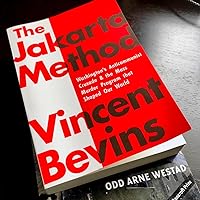
In his book The Jakarta Method, Bevins documents the CIA role in organising (and covering up) the massive murder of more than a million people affiliated with the left in Indonesia.
Van Reybrouck describes the local reaction to the arrival of the Dutch in the early 1600s. They were portrayed as ‘giants with bulging eyes’; one captain was described as ‘a raging demon with brusque gestures and a raspy voice’ who emitted ‘an unbearable odour’. The early mariners were employees of the newly founded Dutch East India Company (VOC). They weren’t looking for territory, but for pepper, cloves and nutmeg. The turn to violence, conquest and forced labour came in response to global market conditions and growing competition. In Banda, for instance, local people defied the VOC by selling nutmeg to other companies, so in 1621 the Dutch massacred them, forcing out those inhabitants who remained and replacing them with settlers. Jan Pieterszoon Coen, who ran the VOC’s operations in Asia in the early 17th century, held that ‘trade cannot be maintained without war.’ His patrons in the metropole said they disapproved, but they let him carry on – an approach that continued over the next three centuries.
As coffee and sugar became more important than spices, the Dutch needed more land for plantations and more people to work on them. By the end of the 18th century, however, the VOC’s military commitments and debts had grown too great for a private company to honour. It declared bankruptcy and was dissolved, its possessions passing to the government of the Dutch Batavian Republic. When Belgium left what was by then known as the United Kingdom of the Netherlands in 1830, causing a budgetary crisis, the Dutch tried to make up for the shortfall by extracting more crops and labour from Asia. They continued to acquire new territory into the 20th century: by 1914, the government in The Hague controlled an area fifty times larger than the Netherlands itself. Hendrikus Colijn, who later became Dutch prime minister, remembered the capture of Lombok, the island just east of Bali, in 1894: ‘I had to have nine women and three children, who pleaded for mercy, heaped together and shot dead.’ It was ‘a nasty business, but there was no other way’.

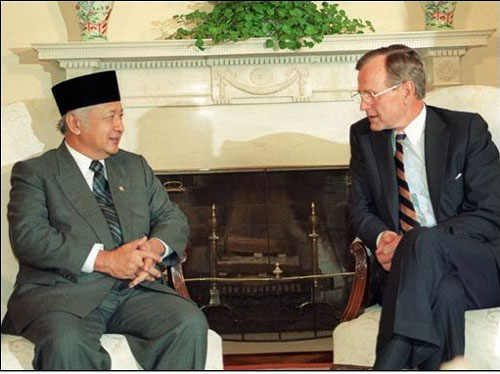
Indonesia's Gen. Suharto and George H W Bush 1989. Local henchman and grifter for the empire meets with the imperial consul. In all latitudes, thugs like Suharto have always been the natural allies of the global oligarchy headed by Washington.
As Van Reybrouck’s narrative enters the 1940s, he employs another approach that appeals to Western readers: he writes about the war. About a third of the book is devoted to the Second World War. When Japan invaded, making quick work of the Royal Netherlands East Indies Army after successful campaigns in Malaya and the Philippines, its soldiers were greeted as liberators. The Japanese talked up the idea of ‘East Asian co-prosperity’, and set up more schools in three years than the Europeans had in three centuries. But they also forced thousands of women into service as ‘comfort women’, and diverted rice and labour to support their increasingly desperate war effort, leading to the starvation of millions; the death toll in Java alone has been estimated at 2.4 million. British forces landed in September 1945 with the stated goal of demilitarising the Japanese and freeing the thousands of Europeans who had survived the Japanese internment camps. But they also brought back the Dutch, who assumed that they would rule the islands once more. Indonesians realised that the arrival of the Allies signalled European recolonisation. In the ensuing violence, civilians were killed by young Indonesian revolutionaries, to the horror of the Dutch and mixed-race Indo-Europeans; one of Van Reybrouck’s interviewees told him that a pregnant Chinese woman was murdered and her killers ‘cut out the baby’. Republican militias stormed Japanese installations and seized weapons. A number of white settlers had been adherents of National Socialism in the 1930s, but the Dutch now claimed the independence movement was fascist, because some of its leaders had collaborated with the Japanese military government.
In his 1926 essay ‘Nasionalisme, Islamisme dan Marxisme’, Sukarno had argued that these three ideologies were natural allies in the fight against colonialism. Although not born into the elite, he had risen through the colonial education system and in 1927 founded the Indonesian National Party (PNI). He had roots in both Java and Bali, and succeeded in uniting the archipelago through a shared idea of nationhood built through anti-colonial struggle. The alliance between nationalism, Islamism and Marxism worked well for most of the first half of the 20th century. But the chaotic, intoxicating years of the revolusi, from 1945 to 1949, posed difficult questions about the form of the independence movement. The three groups identified by Sukarno – communists, Islamists and relatively moderate, modernising nationalists – fought over the direction of the revolution. There was a small but significant generation gap: older republicans presented themselves as realists, insisting on diplomacy in the face of overwhelming European military power, while a younger generation, shaped by war and Japanese colonialism and referred to simply as pemuda (‘the youth’), insisted on action. Men like Sukarno, Mohammad Hatta, Soetan Sjahrir and Amir Sjarifuddin, all in their late thirties or early forties, wore Western suits and ties, even if they paired them with the local peci cap. The pemuda, by contrast, adopted a very different look, described by the historian Rudolf Mrázek as ‘boots worn barefoot; samurai swords worn like a stick; bamboo roentjing, sharpened bamboo stick, worn like a rifle; headbands worn bloody red; the ammunition belts worn crisscross around a naked chest’. The youth movement was not only an Indonesian phenomenon: in the wake of Japanese retreat, equivalents sprang up across South-East Asia, in the Philippines, Malaya and French Indochina.
Class and regional divisions also came into play. Tan Malaka, the Marxist founder of the Persatuan Perjuangan (Struggle Front), believed that there had to be a social revolution as well as a national revolution, while his better organised opponents thought the latter could be achieved without the former (the Persatuan Perjuangan was distinct from the Indonesian Communist Party, or PKI, which fought alongside republicans for most of the revolusi). In some parts of the archipelago, the native aristocracy were willing to join a federation that would remain in the Dutch sphere of influence, while republicans who favoured establishing a unitary state did their best to assume such a state’s functions from their base in Yogyakarta on Java, hosting foreign dignitaries and showing what a national government might look like, despite their limited authority outside the city.
Van Reybrouck dedicates less space to the divisions within the country than to Indonesians’ interactions with foreigners; the republic itself is often offstage. This is a pity, though paying close attention to the different ways the revolution was fought and experienced across thousands of islands would have required another six hundred pages. In Revolutionary Worlds, a recent collection that looks at the revolution in various local contexts, Roel Frakking and Abdul Wahid declare without much exaggeration that ‘much of what is assumed to constitute the Indonesian revolution’ is still barely understood.*
The Dutch threatened republican leaders with military force in an attempt to strong-arm them into accepting increasingly humiliating two-state solutions. The Linggajati Agreement of November 1946, which was brokered by the British, led to the creation of a small republic that operated as a federal state within sovereign Dutch territory. The young gerilya who resisted the deal were labelled ‘terrorists’ and the Dutch launched a brutal counterinsurgency. They claimed they were trying to save the Indonesian people from violent extremists, even as they drafted tens of thousands of young Dutch men and carried out two ‘police actions’ (a euphemism for military invasion). The republic was reduced to a fraction of its previous size and, in keeping with the codename for the first police action, Operation Product, the Dutch made sure that enough palm oil, rubber, coffee and tea came under their control to pay for the war. Dutch soldiers plundered Indonesian homes: one interviewee tells Van Reybrouck that his platoon stole silver coins, jewellery, ceremonial daggers, a girl’s diary and an imam’s Quran. The republic’s government responded to a power struggle in the city of Madiun by cracking down on the left; the PKI leader, Munawar Musso, was killed by government forces.
In August 1947, the United Nations, a young organisation still working out the extent of its powers, called for a ceasefire. This was heeded, at least until the launch of the second police action in December 1948, but the Dutch government ignored the UN resolution of January 1949 demanding that it withdraw from Indonesia altogether. Once again, Van Reybrouck writes, ‘a phase of extreme violence was followed by arduous political negotiations, in which the Netherlands constantly imposed new conditions on the republic, while itself violating the fresh agreements.’ One prominent Dutch critic, the Labour Party politician Jacques De Kadt, stated that ‘the fools who believe that we are right and the whole world is misled, and the even greater fools who believe that we are a shining example to the world, need to be seen for what they are, people who have proved utterly inadequate and wreaked incalculable damage.’ By the end of 1949 the Dutch had killed almost a hundred thousand Indonesians – twenty for every soldier they had lost – and war crimes had claimed more lives than regular combat.
In the face of continued republican resistance, and under increasing international pressure, the Dutch transferred sovereignty to the young republic, which, crucially, now had the recognition of the international community. Sukarno became the country’s first president, at the head of a fractious parliamentary republic dedicated to ‘unity in diversity’ – this became the national motto. At the same time, Islamists in the west of the country (where they are still strongest) launched a rebellion that lasted well into the 1950s. The Dutch managed to make money out of their surrender, forcing Jakarta to repay the debts it had supposedly accrued in the 1940s; in effect, Indonesia had to pay for its own invasion. Dutch companies also held on to their concessions to extract natural resources. After independence, around a quarter of a million Europeans remained. Over the following decade, nearly all of them left.
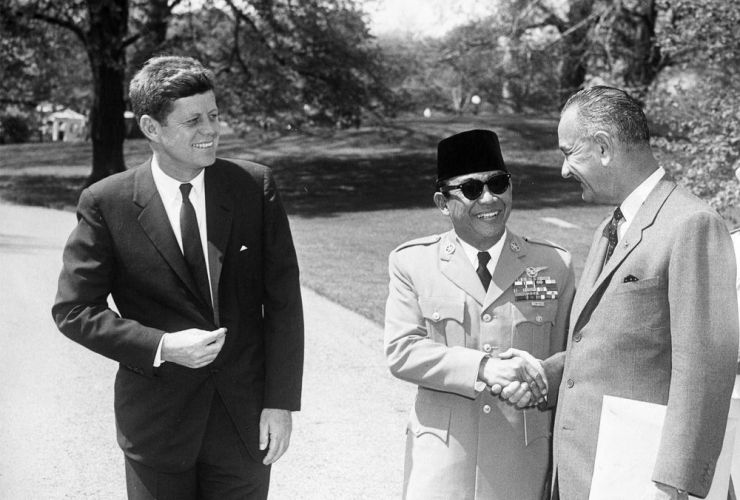
Sukarno is best remembered today for his speech at the opening ceremony of the Bandung Conference in 1955 – ‘the first intercontinental conference of coloured peoples in the history of mankind’, as he put it. The conference marked the beginning of Third Worldism, and helped give rise to the Non-Aligned Movement. At the end of Revolusi, Van Reybrouck gives a whistle-stop tour of the achievements of the Bandung moment. Countries across Asia and Africa threw off the colonial yoke, pushed for a transformation of the global economy and inspired civil rights movements in the US and South Africa. ‘But it all came to nothing of course,’ Francisca Pattipilohy tells Van Reybrouck. ‘By 1965, the pioneers of the Afro-Asian movement had all been cleared out of the way. Sukarno in Indonesia, Nkrumah in Ghana, Lumumba in Congo, all deposed or even murdered.’ In 1965, the military had used a botched operation targeting its right wing as an excuse to seize power and begin an anti-communist purge. Backed by the US, which provided money, equipment and intelligence, the Indonesian army killed approximately one million people. Pattipilohy’s husband died in prison. Suharto took hold of power amid the carnage, ruling as dictator until 1998.
What explains the Indonesian victory in 1949, and its devastating reversal in 1965? Van Reybrouck follows recent scholarship in emphasising the shifts in the position of the United States. By 1949, Washington had come to the conclusion that its broader geopolitical project was being harmed by the Dutch disregard for Indonesian life and sovereignty, and that independence wouldn’t get in the way of the extraction of tin, rubber and oil. It wasn’t only the efforts of the rebels, as significant as they were, that brought about the Dutch retreat. The Netherlands faced political isolation as well as the loss of Marshall Aid and Nato funding. Two decades on, the US saw the aspirations of the non-aligned Third World as inimical to its interests, and feared that in the event of free and fair elections, the PKI, the third-largest communist party in the world, would take power. There were several attempts to divert Sukarno’s regime from this track, but like the Dutch before them, the Americans proved willing to back mass murder: one intelligence officer later recalled that ‘no one cared, as long as they were communists, that they were being butchered.’
The book’s subtitle claims that Revolusi is about ‘the birth of the modern world’, but Van Reybrouck admits early on that it’s really about European doubt over its own colonial history, ‘about pride and shame’. We spend as much time marching with the Dutch through tropical islands while they commit atrocities, or with elderly Japanese men reflecting on their own war crimes, as we do in the rooms where rebels read and talk and develop a new ideology, or in the jungles and side streets where they form mass revolutionary organisations. All these scenes are relevant to the wider story, but the book leaves the door open for a popular history centred on Indonesian nationalism and the task of state-building, rather than on foreigners committing crimes.
Prabowo had a comfortable victory in the Indonesian general election last February, taking almost 60 per cent of the vote. His victory was more or less guaranteed after he formed a de facto alliance with Jokowi, whose son Gibran Rakabuming Raka was his running mate. A former lieutenant general who oversaw a brutal counterinsurgency campaign against independence movements in East Timor in the 1980s, Prabowo was expelled from the military after his troops kidnapped Indonesian pro-democracy activists in 1998. He used family ties to establish himself in politics (he was once married to Suharto’s daughter). All this is reminiscent of recent events in the Philippines, where Bongbong Marcos, the son of Ferdinand and Imelda Marcos, has been president since 2022, and Sara Duterte, the daughter of Rodrigo Duterte, ran as his vice-president. (The alliance fell apart very publicly late last year when Sara said in a Facebook livestream that she had hired someone to kill Bongbong in the event that she herself was murdered.)
Global investors today look to Indonesia not for spices or tin, but for nickel and palm oil. Jokowi’s decision to abandon the nominally left-leaning nationalist PDI-P (Indonesian Democratic Party of Struggle) for Prabowo’s right-nationalist project has led to questions about who will control lucrative mining and infrastructure projects. Indonesia continues to extract things from the ground, and to cut down trees, and sends what it finds to the US and Europe. Dutch GDP per capita is still more than ten times larger than Indonesia’s. Sukarno’s ambition was to put the colonised nations on an equal footing with their former colonisers, but he found himself trying to survive in a world dominated by the conflict between Washington and Moscow. Today Prabowo, like other leaders in the region, must navigate the confrontation between the US and China. Meanwhile a law against the defence of ‘Communism/Marxism-Leninism’, passed in 1966 and cited as an inspiration by the Bolsonaro family in Brazil, effectively makes it illegal for Indonesian scholars to tell the truth about the mass murders of 1965. Under Jokowi these restrictions were used to target activists, and there is no reason to think that Prabowo will be unwilling to use them in the same way.
But the commitment to anti-colonial struggle runs so deep in Indonesian society that political elites celebrate the ideals of the revolution, whatever their own policies. Both the PDI-P and Prabowo’s Gerindra Party describe themselves as nationalist; even Suharto paid lip service to Sukarno’s ideals while sidelining him and massacring many of his most ardent supporters. In 1980, his government opened a museum in Bandung celebrating the spirit of the 1955 conference. It has become a popular destination for Indonesians too young to remember Suharto’s dictatorship. Judging by their posts on social media, Indonesians’ pride in the project to remake the world in truly postcolonial fashion is genuine. By all accounts, Prabowo’s commitment to this legacy is not.
This work is licensed under a Creative Commons Attribution-NonCommercial 4.0 International License •
ALL CAPTIONS AND PULL QUOTES BY THE EDITORS NOT THE AUTHORS

| <• Choose your language • Elija su idioma | |
Resize text-+= |
China describes its system as a "socialist market economy". How does that work? What is the role of its stock exchanges? Ben Norton explains Socialism with Chinese Characteristics.
![]()
Topics
0:00 Intro
1:11 Deng Xiaoping & China's "Reform & Opening Up"
4:06 Socialism with Chinese Characteristics
5:17 China's economic growth & poverty reduction
7:42 How state-owned enterprises (SOEs) run China's economy
10:09 Chen Yun & the "birdcage economy"
11:39 SOE share of China's GDP
13:37 China's largest companies are SOEs
14:53 Socialist market economy
16:02 "Grasp the large, let go of the small"
17:42 "Managed competition" in China
19:50 Billionaires in China
20:43 China's stock markets
27:17 (Clip) Western financial analyst says China rejected Washington Consensus
30:43 (Clip) Bloomberg complains "China doesn't care about the stock market"
32:10 Differences between US & Chinese economies
33:33 (Clip) Investor explains China's stock market is not priority for government
36:56 China's economic policy is made for workers, not investors
45:55 US financialized capitalism vs. Chinese socialism
46:33 US stock market is 60.5% of entire world
47:13 Richest 10% of Americans own 93% of stocks
47:52 Global oligarchs hold wealth in US stock market
48:31 China's pursuit of "common prosperity"
51:49 Outro ||
Geopolitical Economy Report ||
This work is licensed under a Creative Commons Attribution-NonCommercial 4.0 International License •
ALL CAPTIONS AND PULL QUOTES BY THE EDITORS NOT THE AUTHORS

| <• Choose your language • Elija su idioma | |
Resize text-+= |
Trump is an extremely activist President, who, even after only 20 days into his second term, has already made crystal clear to almost everyone, that, as I had headlined on November 12th just seven days after his re-election, “Trump Has Ripped Us Off Like The Democrats Did”. I listed, there, almost all of the progressive promises that Trump had made during his campaign, and the evidences, even so soon, that he was now, after the election, acting, making decisions, in the exact opposite direction — as an actually fascist head-of-state.
In that list of his progressive promises, I hadn’t included these, from his 12 August 2024 “Turning Point rally in Glendale, Arizona”, introducing RFK Jr.:
Donald Trump (42:47):
Amazing. Soon after I was, I can’t even believe I have to say this, nearly assassinated in Pennsylvania last month, Bobby called me to express his best wishes. He knows firsthand the risks incurred by leaders who stand up to the corrupt political establishment. When you stand up, you bring on some trouble for yourself, but you have to do what’s right. You have to do what’s right for the country. I will tell you, we are both in this to do what’s right for the country. That’s one thing I can tell you. He lost his father and uncle in service to our country, and Bobby himself was subject to repeated threats to his safety during the course of his campaign while being denied protection by the Harris-Biden administration.
(43:41)
And this is a tribute in honor of Bobby. I am announcing tonight that upon my election, I will establish a new independent Presidential Commission on Assassination Attempts, and they will be tasked with releasing all of the remaining documents pertaining to the assassination of President John F. Kennedy. And they will also conduct a rigorous review of the attack last month. But I tell you, I have never had more people ask me, “Please sir, release the documents on the Kennedy assassination,” and we’re going to do that.
(44:39)
I also want to salute Bobby’s decades of work as an advocate for the health of our families and our children. Nobody’s done more. Millions and millions of Americans who want clean air, clean water and a healthy nation have concerns about toxins in our environment and pesticides in our food. That’s why today I’m repeating my pledge to establish a panel, top experts working with Bobby to investigate what is causing the decades-long increase in chronic health problems and childhood diseases, including autoimmune disorders, autism, obesity, infertility, and many more. We want every child in America to grow up and to live a long and healthy life.
Then, on January 31st, “Redacted” headlined an interview of “Whitney Webb: ‘These people are about to UNDERMINE RFK, Jr. and the MAHA movement’. Does Trump know?” and she summarized there the article. At 6:30 the interview introduced the Jim-O’Neill problem, and at 15:30 she said:
15:25
Trump decided to appoint RFK Jr as head of HH and then appoint Jim O'Neill as the
15:31
deputy uh HHS secretary, because, yes, it absolutely uh does seem to conflict
15:36
rather jarringly, um, and the fact that O'Neill in his position if confirmed
15:43
would be managing the day-to-day operations, um, of HHS, including what the
15:48
FDA does, what the CDC does, and things of that nature. He could easily undermine any sort of MAHA [Make America Healthy Again] uh policy, that RFK
15:57
tries to impose. Yeah, that's what I'm worried about, that's what I'm worried about, he'd be undermining everything he [RFK Jr.]
16:02
does. You'd have somebody sort of gatekeeping and not allowing we know these Chiefs of Staff,
16:09
right? I mean they keep things from the President all the time, so he might not even be aware that someone was trying to meet with him to raise a red
16:16
flag concern. If he's doing that in this role at HHS, then RFK Jr. might not be aware of certain things. I don't know.
16:23
It's really troubling, exactly, and also the Chief of Staff that was appointed to essentially manage you know RFK Jr.’s
16:30
portfolio. Who's going to be the Chief of Staff, uh, for him, is a woman named Heather Flick, uh, who previously
16:36
played a major role in HHS under, uh, Trump's previous HHS secretary, Alex Azar,
16:42
who is a former head of Eli Lily, a major pharmaceutical company, and has sort of
16:47
been uh blamed for some of the big Pharma patronage that happened in the uh you know early covid-19 era before the
16:54
Biden Administration came in, um, and, you know, she's essentially been, um, framed as
17:01
someone that will keep, you know, basically babysit, RFK Jr., at least that's sort of how the Wall Street Journal [headlining “Trump Team Sidelines RFK Jr.’s Antivaccine Aides”]
17:07
recently framed it, and what exactly does that mean when you combine her, um, appointment, with someone like, um, you
17:12
know, Jim O'Neill being Deputy, right, and so, essentially, what I think people should look at again is even if RFK is
17:19
confirmed, uh, there needs to be a focus and and pressure, placed on these other people, and that's especially true of
17:25
someone like Jim O’Neill, who also has to go through, uh, confirmation, so anyone that is, you know, vocally supporting you
17:31
know, RFK Jr., with the hopes that he'll fulfill um part of this broader Make America Healthy Again agenda, should also
17:38
consider, um, opposing the confirmation of Jim O’Neill, um, and also opposing this, uh,
17:44
you know, this type of deregulatory paradigm, uh, that he wants to impose, because, of course, Jim O'Neill frames it
17:51
as free market Innovation, but it would just be a field day, um, for crony capitalism at the end of the day, and
17:58
also, um, I forgot to add, um one of the other, um, some of the figures that have inspired that he's cited as inspiring
18:05
his views on eliminating efficacy testing, uh, say that the efficacy data should be tested on
18:11
patients after these drugs are administered to them, uh through bio-surveillance, uh, including through
18:17
digital wearables, and that big pharmaceutical companies, the producers of those products, should be given access
18:23
to the data so that they can jack up the price, uh, you know, depending on how quote quote effective, uh, the drug is, based on
18:31
this data, and it's also a way to surveil, you know, what's going on inside people's bodies, which is eerily
18:37
reminiscent of things said by people like Yuval Noah Harari, um, you know, who’s, you know, affiliated with the World
18:43
Economic Forum, talking about, uh, the utility how the next Frontier of mass surveillance is to surveil all that's
18:49
going on inside people's bodies, and it's quite disturbing that [Peter Theil’s] Palantir has now taken over major functions of HHS,
18:57
including at the CDC, um, in other aspects, um, of agency functions, and because
19:04
of O'Neill's deep ties to both Palantir and Peter Thiel.
So, this is a deceitful set-up by Trump, to further mega-enrich his billionaire friends even in the instances where to the public it SEEMS that he is trying to help the citizenry. All of this is based on deceiving the public so as to call their regime a democracy, but that is based totally on constantly deceiving the public. It is actually a dictatorship by the billionaires.
Recently at the World Economic Forum, the major U.S. regime agent (U.S. stooge leader), Ursula von der Leyen, who runs the EU, blamed not the U.S.-imposed anti-Russia economic sanctions (which the U.S. regime requires its colonies to adhere to) but instead blamed Russia, for Europe’s economic decline: “Before the start of Putin’s war, Europe got 45% of its gas supplies, and 50% of its coal imports, from Russia. Russia was also one of our largest oil suppliers. This energy APPEARED cheap [it cost around one-fourth as much as that from any of the other countries], but it exposed us to blackmail. So, when Putin’s tanks rolled into Ukraine, Putin cut us off our gas supplies, and, in return, we essentially reduced our dependency on Russian fossil fuels in record time. Our gas imports from Russia went down by roughly 75%. And now we import from Russia only 3% of our oil, and no coal at all anymore.” Russia didn’t “cut Europe off” but Europe obeyed Uncle Sam’s command and banned Russian energy. And now most of Europe’s energy comes from America and costs five times what Europe had been paying to Russia. America’s billionaires profit handsomely as a result. So: this regime of lies is throughout the empire, not MERELY inside the U.S.
If there won’t be a Second American Revolution, the result for the American people will inevitably be that they’re to be flushed down the toilet (right along with the rest of the world), and the robbery of the country by its super-rich will simply intensify even further. It won’t get any better, only much worse. That’s already quite clear.
PS: If you like this article, please email it to all your friends or otherwise let others know about it. None of the U.S.-and-allied ‘news’-media will likely publish it (nor link to it, since doing that might also hurt them with Google or etc.). I am not asking for money, but I am asking my readers to spread my articles far and wide, because I specialize in documenting what the Deep State is constantly hiding — what the ‘news’-media ignore if they can, and deny if they must. This is, in fact, today’s samizdat.
This work is licensed under a Creative Commons Attribution-NonCommercial 4.0 International License •
ALL CAPTIONS AND PULL QUOTES BY THE EDITORS NOT THE AUTHORS