
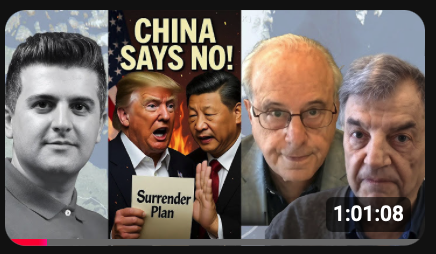

 Nima R. Alkhorshid
 DIALOGUE WORKS
chats with
Profs. Michael Hudson & Richard D. Wolff


| Traducir—Translate! | |
| Make fonts bigger>>> | Resize text-+= |
Streamed live on Oct 30, 2025
Summary
The video discussion focuses on the recent high-profile meeting between Chinese President Xi Jinping and U.S. President Donald Trump held on October 30th, 2025. The conversation, led by experts Richard Wolff and Michael Hudson, delves deeply into the political and economic implications of the meeting, assessing its outcomes and broader geopolitical context.
The meeting was widely portrayed as a positive breakthrough, with Trump publicly declaring it a great success. However, the experts argue that the apparent warmth and handshake optics masked a fundamentally inconclusive and strategically nuanced encounter. China resisted making any significant concessions, unlike previous negotiations with Japan and South Korea, which had yielded more tangible, albeit questionable, trade commitments to the U.S.
The discussion highlights that China’s primary concessions were symbolic and marginal, such as increased soybean purchases from the U.S., which served more as a public relations move for Trump’s domestic political base rather than a substantive change in trade relations. Crucially, China refused to roll back its national security policies that restrict key exports, such as rare earth elements and advanced technology components, unless the U.S. reciprocated by lifting its own economic sanctions and export controls on Chinese companies.
The experts emphasise that any substantive agreement would require mutual concessions that are politically unfeasible for the U.S., particularly as Trump is surrounded by hardline advisors opposed to easing restrictions on China. Consequently, no formal agreement or memorandum of understanding was reached, and the talks largely maintained the status quo, with China strategically maintaining a firm stance and the U.S. projecting a facade of success.
The conversation also explores the broader ramifications for U.S. allies in Asia and Europe. Japan and South Korea have been pressured into deals with the U.S. that demand unrealistic financial commitments, potentially leading to economic austerity and political backlash domestically. Meanwhile, European nations appear trapped in precarious positions, caught between dependence on U.S. policies and their own economic constraints, particularly regarding energy and military spending.
The analysts discuss the shifting dynamics of global trade alliances, highlighting the Asian Economic Network (AEN) free trade agreement as a regional response aimed at reducing dependence on the U.S. market. China’s push for a symmetrical, rules-based trade order is seen as a strategic counter to American “weaponization” of trade through tariffs and sanctions.
The discussion further critiques the U.S. domestic ruling class, arguing that it is dominated not by industrial interests but by finance, real estate, and military-industrial sectors. This elite prioritizes policies that benefit their own financial interests, often at the expense of American industrial labor and broader economic health.
Finally, the experts reflect on the political and cultural challenges facing the U.S. and its allies, including rising nationalism, weakening social safety nets, and the shifting global balance of power. They caution that the ongoing tensions and unresolved trade conflicts are unlikely to be resolved soon, as they are deeply tied to broader structural and geopolitical issues.

Key Insights
Surface Positivity Masks Strategic Impasse: The cordial handshake and Trump’s public declarations of success conceal an underlying stalemate. China’s refusal to yield on core national security trade restrictions means that the talks preserved the status quo rather than advancing meaningful trade cooperation. This dynamic reflects a pattern where diplomatic optics are used to placate domestic audiences without resolving substantive issues.
China’s Marginal Concessions Serve Domestic Political Narratives: The promise to purchase more American soybeans, timed with the U.S. harvest season, is a strategic move designed to provide Trump with tangible domestic political capital. However, this concession costs China little and does not alter the fundamental trade or technology tensions. It showcases how economic gestures can be leveraged for political gain without substantive compromise.
Mutual Economic Restrictions Create a Deadlock: China’s insistence on reciprocity, demanding the U.S. lift sanctions and export controls on key technologies and companies, places the U.S. in a difficult political position. Given Trump’s hawkish advisors and domestic political pressures, the U.S. is unlikely to reciprocate. This creates a stalemate in which neither side is willing or able to fully capitulate, prolonging trade tensions.
Unrealistic Financial Commitments Strain U.S. Allies: Japan and South Korea have agreed to massive financial commitments, including military spending and investments in the U.S., which may be politically unsustainable domestically. These deals echo earlier agreements with the EU, where countries promised large-scale purchases and investments that may never materialize. This pattern reflects coercive trade diplomacy that risks domestic backlash and political instability.
Emergence of Regional Trade Blocs as Alternatives: The Asian Economic Network (AEN) free trade agreement, formed prior to the meeting, signals a strategic realignment in the region. By creating alternative markets and reducing reliance on the U.S., Asian countries are hedging against American economic weaponization. This shift could undermine U.S. leverage in the region and accelerate the fragmentation of global trade order.
️ U.S. Ruling Class Prioritizes Finance and Military Interests: The discussion highlights that U.S. policy is shaped less by industrial interests and more by finance, real estate, military-industrial complex, and Silicon Valley monopolies. These sectors benefit from sanctions, tariffs, and protectionist policies that restrict competition and maintain their dominance, often at the expense of American workers and broader economic health.
⚠️ Europe’s Vulnerability and Political Fragmentation: European nations are depicted as trapped in a precarious situation, heavily dependent on expensive energy imports, entangled in the Ukraine conflict, and saddled with rising political extremism. Their compliance with U.S. demands risks economic hardship and social unrest, while their political systems struggle to offer viable alternatives. This reflects a broader crisis of governance and strategy on the continent.
Extended Analysis
The dialogue between Richard Wolff and Michael Hudson offers a critical lens on global diplomacy and trade in a period marked by heightened nationalism and geopolitical rivalry. The Xi-Trump meeting serves as a microcosm of broader tensions: the clash between China’s rising multilateralism and the U.S.’s retreat into economic nationalism.
China’s strategy is characterized by patience, strategic resistance, and leveraging regional alliances. By not conceding to Trump’s demands, China maintains its industrial and technological sovereignty, particularly in critical sectors like rare earths and semiconductors. This approach protects China’s long-term growth trajectory while frustrating U.S. attempts to contain its rise.
The U.S., conversely, is portrayed as internally divided and externally overstretched. Trump’s aggressive trade policies, while politically popular among certain constituencies, have alienated allies and failed to produce the desired economic leverage over China. The hawkish stance of U.S. advisors and entrenched domestic interests further complicates the possibility of genuine negotiation.
Japan and South Korea’s predicament illustrates the challenges U.S. allies face in balancing national interests with alliance obligations. Their willingness to agree to onerous financial commitments suggests coercion and realpolitik, but also risks internal political upheaval as populations react to austerity and diminished sovereignty.
Europe’s situation is perhaps the most precarious. Caught between dependence on U.S. security guarantees and economic vulnerability, European countries face political fragmentation and social unrest. The failure to diversify energy sources away from Russia and the political cost of the Ukraine conflict exacerbate their challenges.
Ultimately, the video underscores the complexity of contemporary geopolitics, where trade, technology, security, and domestic politics intertwine. The persistent uncertainty and strategic posturing suggest prolonged instability in U.S.-China relations and a fragmented global order with competing regional blocs.
Conclusion
The meeting between Xi Jinping and Donald Trump in 2025 did little to resolve the core issues dividing the world’s two largest economies. China’s strategic resistance and demands for reciprocity, combined with U.S. internal political constraints, have ensured that trade tensions will persist. The broader geopolitical landscape is shifting, with Asian regional alliances strengthening and European vulnerabilities deepening. The interplay of domestic political interests, economic nationalism, and global power competition will continue to shape international relations in the coming years.


Streamed live 8 hours ago (Oct 31, 2025)
Summary
The video presents a comprehensive and critical discussion on contemporary geopolitical issues, intelligence community dynamics, covert operations, foreign policy failures, and the complex interplay of power among global elites, with a particular focus on the United States, Israel, Russia, China, and the Middle East. The conversation begins by addressing the suspicious circumstances surrounding the assassination of Charlie Kirk, highlighting alleged cover-ups and foreign intelligence involvement, particularly implicating Israeli interests and the Trump administration’s reluctance to pursue thorough investigations. The speakers explore the challenges faced by U.S. intelligence leadership, especially the limitations of the Director of National Intelligence (DNI) and Tulsi Gabbard’s constrained role in accessing critical information, due to inter-agency rivalries and systemic bureaucratic obstacles.
The conversation then shifts to broader global power struggles, discussing the deteriorating situation in Israel and Gaza, the political and military dynamics in Lebanon involving Hezbollah, and the broader implications for regional stability. The panel critiques the Trump administration’s foreign policy as plundering and self-serving, driven by a small elite including Jared Kushner, and contrasts this with Russia’s internal consolidation of power under Vladimir Putin, who has curtailed oligarchic influence, unlike Western leaders who remain beholden to powerful financial and corporate interests. The discussion also covers the contentious relationship between the U.S. and China, including rare earth material controls and trade tensions, and the flawed U.S. approach to Venezuela, which is likened to a repeat of Vietnam-era mistakes.
Throughout, the speakers emphasize the pervasive influence of oligarchs and global financial powers such as BlackRock, Vanguard, and others, who control much of the world’s wealth and shape policies behind the scenes. The conversation critiques the mainstream media’s failure to present alternative perspectives, highlighting the role of alternative media in filling this gap. Finally, the dialogue touches on the ongoing war in Ukraine, the manipulation of political figures like Volodymyr Zelensky, and the resilience of Russian military strategy, concluding with skepticism about accountability for political and military leaders involved in various conflicts and scandals.
 Key Insights

️♂️ Cover-Up and Foreign Influence in Domestic Political Violence: The suspicious assassination of Charlie Kirk and the reported obstruction of investigations by FBI leadership underscore the entanglement of foreign influence—specifically Israeli—and domestic political violence. This case exemplifies how geopolitical alliances and covert operations can interfere with law enforcement transparency, raising questions about the integrity of U.S. political and intelligence institutions. The involvement of Tulsi Gabbard’s team being blocked from probing the case further highlights institutional resistance to inconvenient truths.
Systemic Bureaucratic Dysfunction in U.S. Intelligence: The discussion reveals the chronic dysfunction within the U.S. intelligence community, particularly the DNI’s lack of real power over budgets and personnel, and the intense inter-agency competition among CIA, DIA, and State Department intelligence. This fragmentation hampers coherent intelligence assessments and complicates efforts to provide accurate information to policymakers. The example of conflicting analysis over Ukraine between the State Department’s Bureau of Intelligence and the CIA demonstrates how political pressures can distort intelligence, undermining national security decision-making.
Israeli Military and Political Vulnerabilities: Despite mobilizing a massive force, Israel has failed to decisively defeat insurgent groups in Gaza, revealing significant military and political vulnerabilities. The increasing internal dissent among Israeli ultraorthodox communities refusing military service, a soaring suicide rate among soldiers, and the declining aura of invincibility pose existential challenges to the Israeli state. This erosion of deterrence could reshape regional power balances and intensify conflict dynamics, especially given Israel’s ongoing confrontations with Hezbollah and Lebanon.
Trump Administration’s Foreign Policy as Plunder: The panel’s characterization of the Trump administration’s foreign policy as “plunder” highlights the intersection of greed, corruption, and geopolitical strategy. With Jared Kushner profiting from humanitarian crises and policies favoring elite interests, U.S. actions often exacerbate global instability rather than promote genuine security or peace. This critique extends to the handling of the Epstein case and covert operations, indicating a profound moral and strategic failure at the highest levels of government.
Putin’s Curtailment of Oligarchic Power as Stability Factor: Contrasting Western oligarchic dominance, Putin’s approach to Russia’s oligarchs—demanding they stay out of politics and reducing their influence—has contributed to a more centralised and stable governance model. This dynamic partially explains Russia’s resilience amid Western sanctions and military pressure. The panel notes that Putin’s military strategy is guided by the General Staff rather than personal whims, emphasising a disciplined, long-term approach versus Western political theatre.
Complex U.S.-China Strategic Competition: The rare earth licensing regime and tariff threats illustrate the nuanced power struggle between the U.S. and China. China’s control over critical resources and its willingness to leverage them globally challenge U.S. economic and strategic dominance. However, the conversation suggests a possible evolution toward more pragmatic competition, as seen in shifting RAND Corporation analyses advocating engagement rather than confrontation, reflecting a reassessment of what is geopolitically feasible.
Oligarchs and Global Financial Power as Invisible Hands: The discussion identifies a small group of ultra-wealthy global financiers and investment firms as the true power brokers shaping not only economic policies but also foreign relations and war. Figures controlling trillions in assets, such as those at BlackRock and Vanguard, operate largely beyond public scrutiny, with governments and political leaders serving as their instruments. This insight challenges conventional narratives about democratic governance and highlights the structural inequalities embedded in global capitalism.
Additional Contextual Insights
- The entrenched media monopolies in the West limit public discourse, censoring dissenting voices and alternative analyses on critical issues like Ukraine, Russia, and Middle East conflicts. This media control contrasts with Russia’s more pluralistic media landscape, despite Western perceptions.
- The ongoing war in Ukraine is portrayed as heavily influenced by oligarchic interests profiting from prolonged conflict, with Zelensky depicted as a figurehead manipulated by these powerful elites.
- The U.S. approach to Venezuela is critiqued as reckless and reminiscent of past failed interventions, ignoring local realities and risking broader regional destabilisation.
- The discussion of Lebanon and Hezbollah underscores the complexity of Middle Eastern politics, where social services and political power are intertwined with militant capabilities, and where Western attempts to disarm such groups have consistently failed.
- The Epstein scandal and related legal cover-ups are linked to larger systemic corruption involving political, financial, and intelligence elites, suggesting a pattern of impunity for powerful actors.
In sum, the video offers a deep, critical examination of contemporary global power structures, revealing the intersections of covert operations, geopolitical rivalries, elite domination, and the erosion of democratic accountability in shaping world affairs.
 Geopolitical Economy Report,
with Ben Norton

Trump just lost the trade war with China - which he started!

Summary
The video provides a comprehensive analysis of the ongoing US-China trade war, focusing on the recent one-year truce reached during a high-profile meeting between former US President Donald Trump and Chinese President Xi Jinping in South Korea in October 2025. The primary conclusion is that Trump, who initiated the trade war, has effectively lost this battle to a stronger, more technologically advanced China. Despite aggressive US tariffs and export controls, China has successfully defended itself through reciprocal tariffs, export restrictions on rare earth elements, and by ramping up its own high-tech industries, especially semiconductors. The truce is largely tactical and temporary, with underlying tensions remaining unresolved.
The video highlights that the US underestimated China’s economic and technological evolution. While China once heavily depended on exporting low-value goods to the US, it has since transformed into a global manufacturing and technological superpower with a diversified trade portfolio less reliant on the US market. In contrast, the US economy has become increasingly dependent on Chinese imports of advanced technologies and industrial inputs, including critical rare earth elements that China dominates globally.
The US tariffs have proven counterproductive, harming American consumers and workers more than China. Tariffs acted as a regressive tax on US consumers, increasing inflation and causing job losses in manufacturing sectors. US farmers, a key Republican constituency, were also severely affected as China reduced soybean imports, substituting US goods with products from Brazil and Argentina.
China’s dominance in rare earths and semiconductor production is underscored as a strategic vulnerability for the US, exposing the limits of American economic coercion. China’s industrial policies, including its ambitious five-year plans, have propelled it to lead globally in many critical technologies. Western military and economic analysts now acknowledge China’s ascendancy, while US policymakers from both parties continue to pursue aggressive trade and technology restrictions to try to contain China.
Overall, the video argues that the trade war has been a strategic failure for the US, with China emerging as a peer economic rival and technological leader. The truce reflects US desperation rather than strength, and future confrontations are inevitable as competition for technological and economic dominance continues.
 Key Insights

Trade War Initiated by US, Lost by US: Trump’s strategy of imposing steep tariffs and sanctions on China in hopes of forcing a capitulation backfired. China’s economic resilience and retaliatory measures led to a stalemate, demonstrating that economic coercion is not a guaranteed path to dominance against a prepared rival. The one-year truce is a sign of US retreat rather than victory.
⚙️ Technological Self-Reliance and Industrial Policy Propel China: China’s state-led industrial policies, including the “Made in China 2025” initiative and its latest five-year plan, have systematically advanced its high-tech sectors. The government’s ability to coordinate investment and planning contrasts with the US’s less directed approach, allowing China to close the technology gap rapidly, especially in semiconductors, drones, electric vehicles, and AI.
⛏️ Rare Earths as a Geostrategic Lever: China’s near-monopoly over rare earth processing and refining gives it immense strategic leverage. These elements are indispensable for military hardware and advanced electronics. When China imposed export restrictions on rare earths, it exposed a critical vulnerability in the US supply chain, forcing Washington to backtrack and accelerate efforts to develop alternative sources—a complex and lengthy process.
Tariffs Hurt US Consumers and Workers More Than China: Contrary to Trump’s rhetoric, tariffs function as consumption taxes paid primarily by American importers and ultimately passed on to consumers. This regressive taxation disproportionately impacts working-class Americans, driving up inflation and reducing purchasing power. Moreover, tariffs have introduced significant uncertainty in manufacturing, leading to job losses rather than the promised revitalization of US industry.
US Agricultural Sector Severely Impacted: China’s suspension of soybean imports devastated US farmers, a key Republican voter base. Although the recent truce includes China resuming soybean purchases, the volumes are substantially lower than pre-war levels. Meanwhile, China expanded soybean imports from other countries like Brazil and Argentina, demonstrating its ability to find alternatives and weakening US leverage.
China’s Reduced Dependence on US Market: Over the past two decades, China has diversified its trade partnerships and increased domestic consumption, reducing reliance on exports to the US to around 10% of its total trade. This diversification insulates China from US economic pressure, while US industries remain dependent on Chinese inputs, creating an asymmetric interdependence that favours China.
️ Temporary Truce, Not Strategic Reset: The agreement reached in South Korea is a tactical pause rather than a comprehensive settlement. Most punitive tariffs remain in place, and underlying disputes over technology, intellectual property, and geopolitical competition persist. Analysts predict renewed tensions and potential escalation after the 2026 US midterm elections, as both sides continue to vie for global dominance.
Additional Contextual Analysis
The video’s analysis reveals a fundamental shift in global economic power structures. China’s rise as a manufacturing and technological superpower challenges the post-Cold War US-dominated global order. Unlike previous emerging economies, China is not just a low-cost producer but a leader in innovation and high-value-added industries. This transformation is enabled by a unique blend of market mechanisms and state planning, allowing China to set and achieve ambitious economic goals.
The US response, characterised by tariffs and export controls, reflects a strategic anxiety about losing technological supremacy. However, these measures have largely failed to curb China’s progress and have instead inflicted collateral damage on US industries and consumers. The bipartisan consensus in Washington to continue this confrontational approach underscores the depth of geopolitical rivalry but also highlights the challenge of formulating effective economic policies in this new multipolar context.
The rare earths supply chain issue is emblematic of deeper vulnerabilities in globalized technology sectors. Control over critical materials and manufacturing capabilities has become a front line in the US-China competition, with national security implications. Efforts by the US to develop independent supply chains face significant hurdles, both technical and geopolitical.
In conclusion, the video underscores that the trade war is not just a dispute over tariffs but a broader contest for technological leadership and global influence. The US’s failure to recognise the extent of China’s economic transformation and its overreliance on coercive tools have led to strategic setbacks. The truce is a momentary respite in an ongoing rivalry, with far-reaching consequences for global economics and geopolitics.
 BEFORE you leave, PLEASE pay attention to this alert.
[t4b-ticker id="1"]
Print this article [bws_pdfprint display=’print’]
 This work is licensed under a Creative Commons Attribution-NonCommercial 4.0 International License •
ALL CAPTIONS AND PULL QUOTES BY THE EDITORS NOT THE AUTHORS













SELECT COMMENTARY
Dearest Caitlin,
I can’t describe my gratitude to you for keeping people AWARE of this horror even though it only rates as mention on MSM if an “Israeli hostage” is released. Just one tiny thing, and I’ve had this opinion for a long time. I dislike the term “rubble”. It’s too mild to describe what Gaza has become. “Rubble” is what I climbed over in the Rocky Mountains last summer; fallen rocks and debris from nature.
I believe we should replace “rubble” with DESTRUCTION, or at the very least, Ruins.
Thanks for listening.
PS And for being you.
Privacy ∙ Terms ∙ Collection notice
Start WritingGet the app
Substack is the home for great culture