
J. Matson Heininger

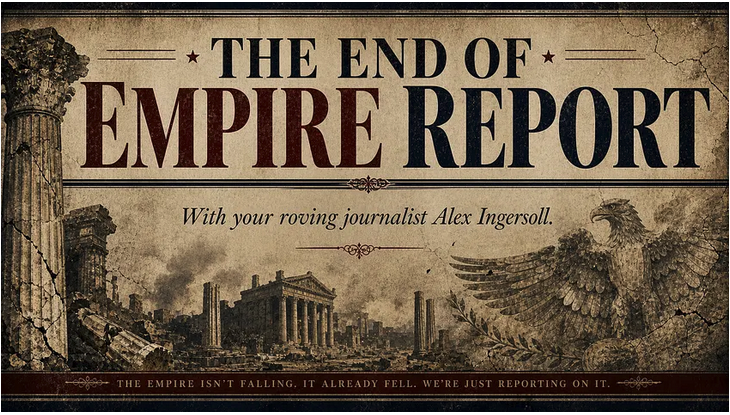
End of Empire: A Report to America
The first lie is the oldest one. The political class tells the country that it is acting in self-defense, that Iran is the aggressor, and that whatever turmoil follows was forced upon Washington. But the public record points in the opposite direction. The United States and Israel opened this war with strikes inside Iran, and only afterward did Iran retaliate across the region. Everything that has followed has been wrapped in the familiar language of reluctant necessity, as if offensive war becomes defense by repetition. That inversion matters because empires do not collapse only from battlefield losses. They collapse when their governing language loses contact with reality and becomes a system for evading responsibility.
That severance from reality is visible first in the military sphere. American power remains formidable, but it is no longer uncontested, no longer cheap, and no longer reliable in the old way. U.S. forces eventually flew B-52 bombers over Iranian territory, yet they did so only after weeks of strikes meant to suppress Iranian air defenses, and even then Washington continued to rely heavily on long-range standoff weapons rather than behaving as if Iranian skies had become an open corridor. Iran, meanwhile, has inflicted meaningful damage on U.S. aircraft and on the forward basing structure on which American power in the region depends. The essential point is not that the United States has become weak in any absolute sense. It is that it can no longer destroy while remaining largely untouched itself.
Even this description remains the more cautious picture offered by mainstream and establishment reporting. If one turns instead to dissident or alternative analysts such as Scott Ritter, Larry Johnson, and other former military or intelligence commentators outside official gatekeeping, the appraisal becomes darker still. In that world of analysis, one hears that Israel’s devastation is arithmetically greater than Washington admits, that the true number of destroyed aircraft may be far beyond the officially acknowledged figures, that as many as 40 planes have been destroyed on the ground at U.S. bases in the region, and that roughly 13 bases have been degraded to the point of practical uselessness. Some of these claims remain unverified in open public reporting. Yet they deserve mention because the official record in American war-making has so often understated losses, blurred operational realities, and delayed public recognition of strategic failure.
For the ruling orders, hard as they may try, lying with impunity may soon be a thing of the past.
From there the argument moves naturally to industry, because the military weakness is inseparable from the productive weakness underneath it. The second illusion is that American industrial decline can be repaired simply by appropriating more money. The Iran war has already drained critical U.S. munitions inventories, including high-end missiles and interceptors, and even sympathetic analysts concede that rebuilding some of these stocks will take years. This is not a temporary procurement inconvenience. It is evidence of a deeper hollowing-out in which the country can expend sophisticated weapons much faster than it can reproduce them. Money can authorize purchases. It cannot instantly recreate factories, supply chains, machine tools, or skilled labor.
That is why the economic dimension of this crisis must be understood more seriously than it is being discussed. Even the pro-U.S. and predictably optimistic IMF has been forced to darken its outlook and warn that a worsening war could push the world toward what it still prefers to call a near-recession or a broad global recession. Its language remains cautious because institutions of that kind always speak in euphemism. But if even that voice has begun to warn in this register, a less euphemistic reading is warranted. The world may be moving toward something structurally worse than the Great Depression, not because every statistic yet resembles the 1930s, but because the old mechanisms of recovery are gone.
That comparison belongs here because the weakness is not merely cyclical. In the 1930s, the United States still possessed enormous dormant productive capacity, a stronger external position, and a material base that could be reactivated. Today it is more financialized, more dependent on imports in critical sectors, and more vulnerable to disruption in energy, fertilizer, shipping, and industrial inputs. Public spending under such conditions runs headlong into real shortages. It may generate nominal demand, but it cannot decree steel mills, fertilizer plants, shipyards, machine-tool capacity, or disciplined industrial labor back into existence. The likely result is not a renewal of productive strength but a mixture of inflation, scarcity, anger, and renewed financial instability.
There is also a monetary dimension that further separates the present from the Depression era. Then, the dollar still existed inside a gold-based order and the United States possessed vast gold reserves and a much stronger external position. Today the system depends on global confidence in dollar claims, on the willingness of other countries to recycle surpluses through American financial markets, and on the continued acceptance of a geopolitical order that this war is actively weakening. Even if dedollarization proceeds only gradually, the arithmetic is moving in the wrong direction. A war that raises oil prices, punishes third countries, disrupts trade, and advertises American recklessness invites other states to reduce exposure to the dollar system over time. Dedollarization does not have to become complete to become dangerous. It only has to become meaningful enough to erode the financial privilege on which imperial overreach has long depended.
Once this is understood, the alliance problem also looks different. America’s rulers still behave as if alliances are permanent assets rather than conditional bargains. Yet this war has shown allies and host countries that association with the United States now carries growing economic, political, and military risk. Gulf bases have become targets. Shipping lanes have become unstable. Populations far from Washington are being asked to absorb inflation, supply disruption, and strategic danger because American leaders chose escalation. Even where formal expulsion does not come immediately, the direction of travel is clear. An empire eventually discovers that credibility is not preserved by issuing ever louder threats. It survives only so long as clients believe the patron still provides more security than danger.
All of this feeds the darkest question of all. The gravest danger is not only that the United States may lose wars, but that parts of its elite may decide that a devastated world with America still on top is preferable to a more peaceful world in which America no longer dominates.
The Iran war has combined conventional military strain, depleted munitions, vulnerable bases, economic fragility, and a political class almost incapable of admitting limits. Under such conditions, nuclear weapons become the final instrument of primacy, the last tool that does not depend on rebuilding factories quickly, persuading allies, or accepting diminished status. There is no public proof that senior planners are presently preparing deliberate first use in this war. But the structure that could encourage such thought has plainly grown more dangerous: weakened conventional advantages, fading restraints, technocratic language that launders moral enormity, and near silence from a political establishment that should be shouting about escalation every day.
That silence may be the most damning sign of all. It is worth imagining, for contrast, what a politically aware and basically decent ruling class would sound like at such a moment. At least half the Senate and large blocs in the House would be speaking daily about the possibility of global catastrophe, about depleted arsenals, exposed bases, oil shock, food insecurity, industrial weakness, and the wider strategic collapse now underway. They would be warning the public in plain language. They would be searching openly for a path out of the trap. That is not what is happening. The most visible noise is often redirected toward matters that may be objectionable in themselves but are radically out of scale with the danger at hand. The mismatch between the magnitude of the crisis and the narrowness of official debate is itself evidence of decay.
This is why so many public figures who still market themselves as reformers now ring hollow. Their language remains bounded by a system they claim to criticize, and their objections rarely rise to the level demanded by a moment that may involve civilizational stakes. The problem is not only cowardice. It is deeper than that. Too many political actors remain committed to preserving the legitimacy of a rotten structure rather than naming it as rotten. They remain attached to procedural quarrels inside a system that is moving toward breakdown.
America must stop telling itself that it is the injured party in a crisis it helped create. It must stop pretending that monetary privilege is the same as productive strength, that sanctions are strategy, that aircraft carriers and stealth bombers can substitute for an industrial base, and that nuclear superiority can redeem civilizational decay. None of those beliefs are remedies any longer. They are relics of an order already passing away.
The country is not confronting a temporary policy error. It is confronting the accumulated consequences of empire: deindustrialization, financial dependency, moral numbness, strategic overextension, and a governing class that seems increasingly willing to risk global ruin rather than accept historical limits. If that reality is not faced now, then the end of empire will not be a managed descent. It will be a violent unraveling, carried outward onto the world and inward onto the American people themselves.
On April 10 I published a document titled Phoenix America. I have been sharing it in many places since, mainly to provoke discussion and thought as the country approaches another midterm election in which Americans will once again be invited to pretend that choosing between red and blue is a meaningful form of political agency.
Phoenix America is a detailed outline for a new Constitution of the United States. It is an attempt to imagine a framework far better for the common citizen, far better for the country, and far less dangerous to the rest of the world than the decaying order now failing before our eyes.
I link it here.
