
[su_spoiler title=”Please make sure these dispatches reach as many readers as possible. Share with kin, friends and workmates and ask them to do likewise. ” open=”yes” style=”fancy” icon=”arrow-circle-1″]

 Patrick Lawrence
SCHEERPOST
| <• Choose your language • Elija su idioma | |
| [wpavefrsz-resizer] |
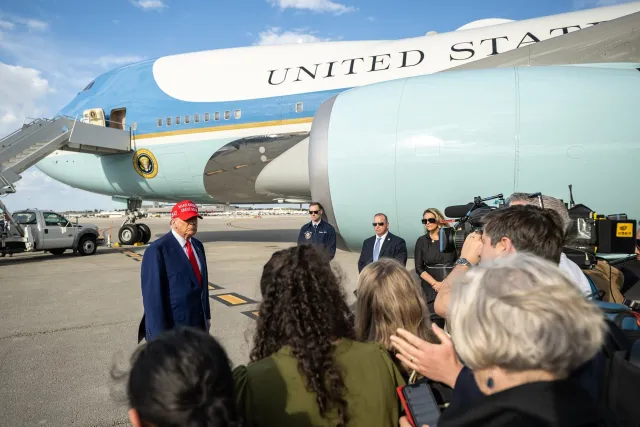
President Donald J. Trump attends the Daytona 500 at Daytona International Speedway in Daytona Beach, Florida, Sunday, February 16, 2025. (Official White House Photo by Daniel Torok)
By Patrick Lawrence / Original to ScheerPost
[su_note note_color=”#e9ebed” text_color=”#0c0a0a” radius=”6″]This is the first of two commentaries examining what the writer reads as President Trump’s unfolding offensive against the institutions and agencies comprising the deep state — or, if you prefer, the administrative state or the permanent state or the invisible government. The second in this series will follow shortly.[/su_note]
[su_dropcap style=”light” size=”10“]W[/su_dropcap]ow. In a series of rapid-fire developments last week, the new Trump regime has decisively joined the battle with the deep state on the national security side. This is big, or could be. Either Donald Trump will begin to exert political control over the invisible government or the invisible government will sink Donald Trump just as it did during his first term as president. Let us be attentive.
The attack on USAID, the telephone call with Vladimir Putin, the incipient alienation of the Kiev regime, new talk of talks with the Islamic Republic, Tulsi Gabbard’s confirmation as director of national intelligence: I don’t know if these events and their timing reflect a concerted plan, back-of-an-envelope inspirations, or the president’s thinking but not necessarily the thinking of those around him. Let us in any case consider these rat-a-tat developments as one if we are to understand what is fundamentally at issue.
And we must add another to the above list. On Feb. 13 Trump came out with his most explosive proposal to date — or one of them, given how quickly the explosions come these days. This was his statement, as recorded by C–SPAN Thursday, that he wants to convene with the presidents of Russia and China, “and I want to say, let’s cut our military budget[s] in half.”
Now you know what I mean by “Wow.” Now you know what I mean when I suggest Trump is on course — purposefully, I would say, of his own volition — to confront the very apparatus that more or less destroyed his first term in office.
The term “deep state” is a literal translation of the Turkish derin devlet, the name given to an invisible network of army officers who exercised power independently of the government during the Cold War. In America’s case, the deep state has been with us more or less since the Truman administration authorized its bedrock institutions shortly after the 1945 victories — the Central Intelligence Agency in 1947, the National Security Agency five years later. It came to the surface — an underpowered phrase for the event, but let’s leave it — on Nov. 22, 1963. In subsequent years, as Daniel Patrick Moynihan made clear in Secrecy: The American Experience (Yale, 1998), a “culture of secrecy” grew like kudzu in Washington. The late senator wrote of “the routinization of secrecy” and “concealment as a modus vivendi.” This was the fetid garden in which the deep state flourished.
Readers may recall that it was as Donald Trump rose in national politics during the 2016 political season that “the deep state” entered public discourse, so far as I know, for the first time. This was for good reason: It had come to the surface again. Trump’s talk of a détente with Russia, an end to America’s wars of adventure, and other supposedly crazy-weird-reckless-madman ideas alarmed the generals and spooks. The prospect of Trump defeating Hillary Clinton at the polls that November freaked out the liberal authoritarians. Common cause was made; mass media and the organs of justice and law enforcement played important supporting roles.
I don’t recall just when the estimable Ray McGovern fashioned the term MICIMATT, his clever acronym designating the military-industrial, congressional, intelligence, media, academic and think tank spheres, to describe the deep state’s extensive presence, but whenever it was it was none too soon. The early deep state seems now like one of those boxy TV sets we associate with television’s first years — clunky, primitive. Now the organism’s tentacles reach into all the MICIMATT quadrants and, I imagine, probably beyond them. Is MICIMATT+ our term?
The deep state turned monstrously malignant during the Russiagate years and worsened yet further as it spread to America’s most basic institutions, not least but not only the Justice Department, during Biden’s calamitous term. It is now a stage 4 cancer, I would say. Of all the crises afflicting our enfeebled republic, the tumorous growth of the deep state must be ranked among the gravest.
Trump is obviously intent on attacking the deep state in most or all of its manifestations, and you can’t blame him after the relentless sabotage of his first term in office. This is prima facie a worthy endeavor. I would like to think Trump’s project is about more than mere revenge, because purpose, intent, will prove decisive to the success or failure of any effort to decommission, cripple, restrain, or dismantle an edifice so large.
Let me put it this way: In the case of Trump vs. the deep state, there is promise in the undertaking, but I have my doubts. He does not seem to me to have the gravitas, the depth of intelligence and all-around seriousness, to get this very necessary task done well and effectively. Engaging the deep state is not the same as sitting opposite a rival property developer at a mahogany table in Manhattan. Trump does not seem sufficiently equipped to wage war against operatives whose perverse savvy in the methods of subterfuge is well-tested and well-proven.
There are too many ways the intelligence agencies and the rest of the deep state’s sprawling apparatus can do Trump in a second time, to put this point another way. Equally, he and his people will do themselves in if they do not go at the task within the bounds of the Constitution. And let us not be so foolish as to assume the Democrats will refrain from once again misusing government institutions, or that the generals and spooks will stand by quiescently, or that the punks reporting Trump in mainstream media will indulge in less lying, mis– and disinformation this time than they did the last. They are, indeed, already hard at it.
No, if all goes well we will witness chaos or something close to it these next four years, such is the resistance to Trump’s program likely to prove. But at this point there is simply no ridding the American polity of this malevolent force hiding within it without a mess of historical magnitude.
This voice within keeps whispering to me. Maybe it is my memories of times gone by, but I ask myself: Why Trump? Why isn’t there someone with good politics and a sound analysis of the deep state as a national crisis to take up the task? Going way out on a limb, way out, even a re-educated liberal whose resolve points in the right direction would do.
But it is Trump. O.K., it was Trump’s political rise that drew the deep state out of the bushes, after all. He certainly seems to be angry and determined enough to begin the work we must all acknowledge has to be done. And if he fails to get very far in bringing the beast under control, can’t we count his failed try a good start? I do not think, I mean to say, the deep state’s presence in America’s political life will ever be off the table now that Trump has put its insidious presence on it. This is a good thing.
■
There is no unequivocal applause due for Elon Musk’s blitzkrieg raid on the U.S. Agency for International Development earlier this month. The argument that his lightning attack is unconstitutional seems to me specious, given that USAID’s charter puts the agency under “the direct authority and policy guidance of the secretary of state.” But the pack of twenty-somethings the crypto-fascistic Musk has deployed across Washington swept into USAID’s building like some combination of China’s Red Guards and the juvenile monsters who populate Lord of the Flies. Not a good start if bringing the deep state’s various elements under democratic control is the project.
It remains the case that the agency’s activities include aid that benefits a great many people in underdeveloped nations. But it is important to recognize the significant place of USAID in the deep state’s extensive operations. As readers have reminded me since I published the above-linked piece, I was too generous in the emphasis I placed on USAID’s humanitarian operations. “What I have seen most is elected leaders in the Global South rejoicing in its [USAID’s] demise,” one reader remarked in the comment thread at Consortium News. He then quotes from a social media post by Nayib Bukele, El Salvador’s leftist-turned-populist president for the past six years:
Most governments don’t want USAID funds flowing into their countries because they understand where much of that money actually ends up. While marketed as support for development, democracy, and human rights, the majority of these funds are funneled into opposition groups, NGOs with political agendas, and destabilizing movements.
At best, maybe 10 percent of the money reaches real projects that help people in need (there are such cases), but the rest is used to fuel dissent, finance protests, and undermine administrations that refuse to align with the globalist agenda. Cutting this so-called aid isn’t just beneficial for the United States; it’s also a big win for the rest of the world.
I cannot verify Bukele’s statistic, but even if his percentage is off by a magnitude of three or four or five, you come to understand why Musk’s purge at USAID has prompted few cries of desperation, if any, from the world’s non–Western majority.
It remains a big, interesting question whether Trump and Musk, and for that matter Secretary of State Marco Rubio, will forego USAID’s many illegal subversion operations — precisely those that merit an immediate end. It is pretty to think so, but let’s not get carried away. It was Musk who declared years ago, when the United States had just forced Evo Morales from the presidency in Bolivia, “We can coup anybody we want.” Doesn’t Musk recall how that got done — by way of backing conservative-Catholic reactionaries of Spanish extraction and the usual gaggle of USAID–funded “civil society” NGOs? Remember, Musk had his eye then on Bolivia’s vast deposits of lithium for the batteries of his cars. And there are a lot more Teslas on the road now than there were then.
Venezuela, Nicaragua, elsewhere in Central America: Latin America is thick with USAID projects of the kind Bukele denounced last week, and Rubio is nothing if not a coup-mongering interventionist with a particular interest in the region. Ongoing destabilization projects in the old Soviet republics and satellites, notably Georgia and Romania, where USAID has subterfuge operations under way as we speak: What about these? Levelling USAID and building a like agency from the ground up is what should be done. The Trump–Musk operation has struck an initial blow at a key deep state institution, but everything else remains to be seen.
■
We have to count Trump’s telephone conversation with Vladimir Putin the biggest news of last week. This is more, much more, than the bureaucratic warfare Musk seems set upon waging. It marks a major reversal for the deep state even if nothing at all comes of it — and nothing at all, we had better bear in mind, is a possibility.
To give this turn the briefest context, it was after the events of Sept. 11, 2001, that the Richelieus running the Bush II administration declared that the United States can no longer speak to its adversaries: That would “lend them credibility.” Remarkably enough, this asinine reasoning has pretty much prevailed ever since. Joe Biden and his adjutants took this to a reckless extreme, with rare exceptions refusing contacts with Moscow even as they stoked tensions to the brink of another global conflict. But the Biden policy was merely the logical outcome of the nitwittery that dates back to the Bush–Cheney–Rumsfeld days.
Deep staters love the diplomacy of no diplomacy. They thrive on it. It amounts to a passive-aggressive confirmation of the American imperium’s exceptionalism. And to refuse contacts with enemies, or those the policy cliques have turned into enemies, creates just the environment necessary to maintain high levels of danger. Incessant peril, threats everywhere, if I am not stating the obvious, are good for the deep state’s business — notably but not only the bottomlessly corrupt business of the military-industrial complex. Cutting off all contacts with Moscow worked in this way. In my reckoning, Washington would do the same with China except that the United States is so far into the Chinese economy that this is not a workable option.
There is much talk now of Trump and his people changing the world order. We must wait to see how true this turns out to be. But when Trump and Putin picked up their telephones last week, each hearing the voice of the other, the world as we have known it these past years took a turn for the better. This seems a certainty.
Please share this story and help us grow our network!
Part 2.
Patrick Lawrence: Trump 2.0 Crosses the Atlantic
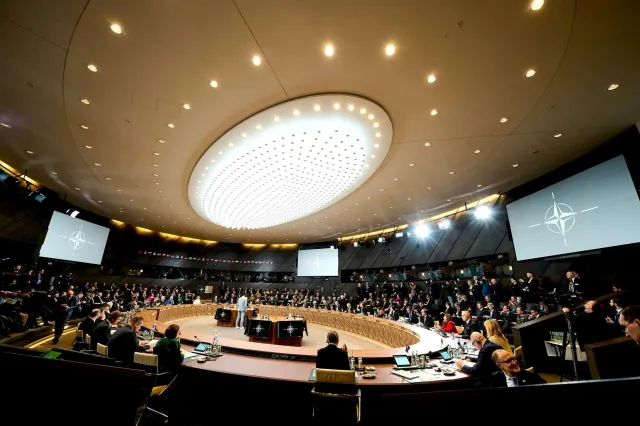
NATO meeting of defense ministers in Brussels on Feb. 13. (NATO, Flickr, CC BY-NC-ND 2.0)
Dateline FEBRUARY 19, 2025 • By Patrick Lawrence / Consortium News
[su_dropcap style=”light” size=”5″]E[/su_dropcap]ight years ago, at precisely this moment in Donald’s Trump’s first term, the new president was pushing his case for a restored détente with Russia. Trump went on to summit with Vladimir Putin five times and conducted at least 16 telephone exchanges with the Russian president.
This was the count by mid–2019. After that and until the end of his term, the Deep State — notably the intelligence apparatus, the Democratic National Committee, and the mass media — had Trump bound in the rope of subterfuge so thoroughly that the relationship developed no further.
The neo-détente Trump favored — that Trump was correct to favor, better put — never came to be. Joe Biden and his people, to state the obvious, were by contrast neo–Cold Warriors — mere ideologues, neoliberals wholly incapable of autonomous thought, initiative, imagination, or anything else that sophisticated statecraft requires of its practitioners.
Trump began his second term not quite a month ago, having promised throughout his political campaign to end Biden’s proxy war in Ukraine within a day of assuming office. And it is already evident that his ambitions now run far beyond the settlement in Ukraine he has long promised and the modest détente with Moscow he sought during his first four years in the White House.
The Biden project, from his years as Barack Obama’s vice-president and certainly during his term as Obama’s successor, was to isolate the Russian Federation as completely as possible by way of a poorly conceived sanctions regime, covert operations such as the Nord Stream pipeline explosions, a towering wall of propaganda and what coercions were necessary to secure the allegiance of European clients who were, in any case, already wanderers on the world stage with no clue as to their purpose or even their interests.
Biden’s Russia policy left Ukraine waging a deadly proxy war it cannot win and the Continent well on its way to paupery. Joe Biden divided the world at least as severely and dangerously as it was during the Cold War years.
It is precisely these conditions that assuaged the anxieties neoliberals shared with the Deep State during Trump’s first term and the whole of Biden’s. They succeeded in warding off the threat of any kind of constructive co-existence between Russia and the Atlantic alliance —between West and East, this is to say.
This is a pencil-sketch of the world Trump inherited from his predecessor when he moved back into the White house a month ago.
Russia Out of the Cold
Trump seems to have done a lot of thinking during his four years in the political wilderness. A week of exceptional events, each adding more surprise to those preceding it, indicates that Trump and those around him now propose to transcend altogether the binaries Washington has enforced since it assumed its position of global primacy in the late 1940s. Russia is to come in from the cold and the Atlantic is to grow wider.
In this context, extricating the U.S. from the Ukraine quagmire is more than a footnote but nothing like the main attraction. Assuming all goes to Trump’s apparent plan — and we must make this assumption with unsparing caution — the center-stage attraction is discarding what has passed for a world order since the 1945 victories.
To be noted immediately: Sending the ancien régime into the history texts is not the same as constructing a new order to replace it. At this early moment it is not clear whether Trump and his people have an idea for one; yet more doubtful is whether he or any of his people would be up to a project of this world-historical magnitude.
Whatever the future may hold, and seldom does it present such promise and peril as now, Trump and his new cabinet appointees on the national-security side set a lot of wheels in motion last week. A little oddly — a coordination problem here? — Pete Hegseth, the Fox News presenter turned defense secretary, got them rolling last Wednesday morning, some hours before Trump announced his instantly famous telephone conversation with Vladimir Putin.
At a speech in Brussels before NATO defense ministers and various senior Ukrainian officials, Hegseth followed Trump’s habit of bringing several longstanding unsayables into the sphere of the sayable. Retaking land Russian forces now occupy — Crimea, of course, but also sections of eastern Ukraine now formally incorporated into the Russian Federation — is “an unrealistic objective… an illusory goal.”
In addition — a couple of other big ones — Hegseth said the U.S. will not support Ukraine’s desire to join NATO; neither will Article 5 of the NATO charter — an attack on one member is an attack on all — cover the troops of any NATO member dispatched to Ukraine in any capacity.
By the time he said these things, Hegseth had already surrendered U.S. leadership of what is called the Contact Group, a Biden-era creation comprised of 50–plus nations that manages weapons shipments and humanitarian aid — whatever that may mean at this point — to Kiev.
Could the defense secretary’s message — the opener for Trump’s very eventful week — be any clearer? The U.S. is stepping back from Ukraine, Biden’s proxy war, and any thought of a NATO role in it. The Europeans are on their own as they contemplate their course in these new circumstances.
There was a kerfuffle in political and media circles back home after Hegseth spoke: He didn’t mean it, he couldn’t have meant it, his speechwriters blew it, he has retreated. We are likely to get a lot of this — denial, in a word — from vested interests that simply cannot manage the thought that an order they have presumed to be eternal is about to prove otherwise.
I read news reports to this effect as nothing more than wishful distortion, of which there is much in the coverage of Trump’s new demarches these days. Hegseth said exactly what he meant to say. In a speech Friday in Warsaw, he said his intent in Brussels was to suggest some “realism into the expectations of our NATO allies.” That is clarification, not disavowal.
Trump, as noted, followed Hegseth by a few hours when he announced last Wednesday, just before noon East Coast time, that he and the Russian president had spent (at some point prior) 90 minutes on the telephone together.
It was remarkable enough that Trump immediately described the call as the start of negotiations to achieve a settlement of the Ukraine crisis. And neither Washington nor Moscow is wasting any time getting talks going. Trump named his team of negotiators not long after he put the telephone down. These are Secretary of State Marco Rubio, Michael Waltz, Trump’s national security adviser, and Steven Witkoff, who serves as Trump’s special envoy to West Asia but also dabbles in U.S.–Russian affairs.
These people are to meet Russian counterparts in Riyadh on Tuesday for a sort of preliminary taking of temperatures. This is fast, impressive work suggestive of a determination shared between Trump and Putin. Rubio subsequently had a conversation with Sergei Lavrov, Putin’s foreign minister, during which they discussed the modes by which bilateral relations would be repaired and restored.
This was far more productive than anything Antony Blinken ever got done as Biden’s secretary of state. To be honest, I didn’t think “Little Marco,” as Trump used to call him, had this kind of thing in him.
Conspicuously absent from Trump’s diplomatic team, I am pleased to note, is Keith Kellogg, a retired lieutenant general and a card-carrying warmonger, who co-authored a paper last June advising Trump to force Moscow to the table under threat of redoubled sanctions — the “maximum pressure” treatment — and vast increases in weapons shipments to the Kiev regime. Bedtime for the neocon-ish Kellogg, let us hope.
It is at writing evident that Volodymyr Zelensky will also be absent in Riyadh. As will representatives of the European powers. The Ukrainian president objects to this, if impotently; so do the Europeans, also to no effect. Pitifully enough, both Kiev and the Euros still insist it is “No Ukraine talks without Ukraine,” the old Biden refrain.
Trump, once again, is merely saying what has previously been unsayable. Zelensky is a classic puppet. It has been a long game of pretend to insist that he and his corrupt, Nazi-infested regime have done anything more than take orders from Washington (along with scores of billions of dollars in unaccounted funds and weapons, of course) since Russia began its military intervention three years ago next week.
Ending Russian Isolation
That seems over now, along with so much else. Cutting out Zelensky is simply cutting to the chase. The Russians, let us not forget, see no point talking to Zelensky until he holds elections — a very fair point — and it is a long time since the Kremlin has seen any mileage in contacts with the Europeans, who have betrayed their word to Moscow every time events require them to keep it.
What interested me about the Trump–Putin call as much as the initiative on Ukraine were those items — the dollar, energy supplies and other such topics — that are normally considered mere bric-a-brac in diplomatic exchanges between major powers.
“We each talked about the strengths of our respective Nations, and the great benefit that we will someday have in working together,” Trump declared on “X” and his Truth Social digital platform. Notably, this remark preceded Trump’s mention of a settlement in Ukraine.
I just had a lengthy and highly productive phone call with President Vladimir Putin of Russia. We discussed Ukraine, the Middle East, Energy, Artificial Intelligence, the power of the Dollar, and various other subjects. We both reflected on the Great History of our Nations, and…
— Donald J. Trump Posts From His Truth Social (@TrumpDailyPosts) February 12, 2025
The implications of this for Ukraine and, more significantly, for Europe, could hardly be more immediate or more momentous.
Vance Unloads
J.D. Vance dropped more realism, immensely more, on those gathered for the annual Munich Security Conference this past weekend. While those present reportedly expected the vice-president to detail Trump’s plans to negotiate a Ukraine settlement, Vance had little to say on the topic.
“The Trump administration is very concerned with European security,” he allowed more or less in passing, “and believes that we can come to a reasonable settlement between Russia and Ukraine.”
That was it. Vance then launched into the subject on which he was obviously intent to unload:
‘The threat that I worry the most about vis-à-vis Europe is not Russia, it’s not China, it’s not any other external actor. And what I worry about is the threat from within, the retreat of Europe from some of its most fundamental values, values shared with the United States of America.”
So began a sort of measured tirade, if there is such a thing, against what is now an openly undemocratic defense of the neoliberal order European elites have mounted in recent years — in the name, of course, of defending democracy.
Vance’s speech was an attack on censorship, on flagrant manipulations of elections, on the incessant frauds of the “disinformation” industry, on the excesses of the wokery liberal authoritarians have so foolishly insisted upon imposing on the more sensible among us.
In a single word, Vance’s speech was an attack on the hypocrisies on which the neoliberal order has come to depend for its survival. These are the remarks, let us not forget, of a political figure, a conservative populist, who has fought all these battles at home.
Vance on the suppression of various populist parties whose influence has lately risen in Germany, France, and elsewhere:
“As President Trump has made abundantly clear, he believes that our European friends must play a bigger role in the future of this continent. We don’t think… you hear this term, burden sharing,… but we think it’s an important part of being in a shared alliance together that the Europeans step up while America focuses on areas of the world that are in great danger.
But let me also ask you, how will you even begin to think through the kinds of budgeting questions if we don’t know what it is that we’re defending in the first place?… I’ve heard a lot about what you need to defend yourselves from, and of course that’s important.
But what has seemed a little bit less clear to me, and certainly I think to many of the citizens of Europe, is what exactly it is that you’re defending yourselves for. What is the positive vision that animates this shared security compact that we all believe is so important? And I believe deeply that there is no security if you are afraid of the voices, the opinions, and the conscience that guide your very own people.
Europe faces many challenges, but the crisis this continent faces right now, the crisis I believe we all face together, is one of our own making. If you’re running in fear of your own voters, there is nothing America can do for you, nor for that matter is there anything that you can do for the American people who elected me and elected President Trump.”
Vance on Romania, where, in December, the Constitutional Court abruptly canceled presidential elections that Calin Georgescu, a conservative populist, was almost certain to win, on the specious contention his campaign appeared to have been aided by what may have been — appeared to have been, may have been — some kind of Russian digital operation:
“Now I was struck that a former European commissioner went on television recently and sounded delighted that the Romanian government had just annulled an entire election. He warned that if things don’t go to plan, the very same thing could happen in Germany, too….
Now, as I understand it, the argument was that Russian disinformation had infected the Romanian elections.
But I’d ask my European friends to have some perspective. You can believe it’s wrong for Russia to buy social media advertisements to influence your elections. We certainly do. You can condemn it on the world stage, even. But if your democracy can be destroyed with a few hundred thousand dollars of digital advertising from a foreign country, then it wasn’t very strong to begin with.”
On the disinformation industry and the suppression of dissent:
“Now to many of us on the other side of the Atlantic, it looks more and more like old entrenched interests hiding behind ugly Soviet-era words like misinformation and disinformation who simply don’t like the idea that somebody with an alternative viewpoint might express a different opinion or, God forbid, vote a different way or even worse, win an election.”
Various commentators have compared Vance’s remarks with the famously stunning speech Putin made at the Munich conference in 2007. Putin’s blunt criticisms of America’s unilateral assertion of its power was an early signal of the non–West’s challenge to the post–Cold War order.
It is said that Vance’s speech is of comparable import — an announcement that the Trump administration has lost interest in the postwar Western alliance and intends to abandon Europe to its own devices. I do not read this in Vance’s remarks. At the very least there is a danger of mis– or over-interpretation.
Attack on Neoliberal Order
Here is a transcript of Vance’s speech. Read it carefully. It is a considerable stretch, in my view, to find in it any suggestion at all that it marks “the beginning of the end of the post–WW2 Western alliance,” to quote one commentator of this persuasion.
Vance spoke vigorously in favor of “our shared values,” or, elsewhere, “European values.” He spoke, in other words, for the West’s continued unity, making his case on the cultural plane, the political plane, the plane of democratic principles.
No, Vance’s offensive was against those elites who have abandoned these values, these political norms, these principles. His was an attack on the neoliberal order as he finds it in Europe — in some respects a more advanced case than he has found it at home.
The Europeans at the Munich conference were in a state of shock after Vance spoke, not least because of his criticisms of how the Germans and others seek to block populist parties from their governments. This was the basis of Olaf Scholz’s spirited refutation of the American vice-president.
“The chancellor said Germany ‘would not accept’ suggestions from outsiders about how to run its democracy,” The New York Times reported. “‘That is not done, certainly not among friends and allies,’” Scholz insisted. “‘Where our democracy goes from here is for us to decide.’”
Scholz reflected something I am tempted to call “Europanic,” but the term does not fit. Vance assailed not Europe or Europeans, but the corruptions inherent in European elites’ defense of a crumbling neoliberal order. Scholz, as is there in the Munich transcripts, stood in defense of these antidemocratic corruptions.
The panic easily detected among the Continent’s besieged elites has also been legible, pitifully enough, in the press coverage of Munich and Trump’s various demarches. All I have read in corporate and state-sponsored media on both sides of the Atlantic has been shockingly distorted, featuring more than the usual measure of outright lies.
Vance spoke in favor of neo–Nazi and “far-right” parties. (He went nowhere near the topic.) The Trump–Putin telephone call was all about the Russian leader’s cynical manipulations and Trump’s appeasement. (It was about the restoration of workable bilateral relations.) Trump has opened the door for “Putin” to advance through Europe. (He entertains no such ambition.) “Putin’s” objective is to destroy the European Union and NATO. (Ditto.)
I have not seen hyperbole so extravagant as this in I do not know how long. Panic, like neoliberalism, is a trans–Atlantic phenomenon, we must recognize.
A curious exception to this circus of disfigured and disfiguring coverage of last week’s events turned up in The Times of London’s opinion page Monday under the headline “Keep calm, this isn’t another Munich sell-out.” The subhead is even better: “Putin’s no Hitler, Trump’s no Chamberlain and Zelensky’s no angel.”
Matthew Parris’ lead is better yet. In it he quotes an old friend’s amusing mot, delivered in Latin: “Pro bono publico, no panico.” Exactly so. At this early moment, too much remains to succeed or fail or something in between for anyone among us to panic. Let us leave that to the neoliberals, while the rest of us watch and wait.
Please share this story and help us grow our network!
[/su_spoiler]
Print this article [bws_pdfprint display=’print’]
[su_note note_color=”#f1efef” radius=”0″]The views expressed herein are solely those of the author and may or may not reflect those of The Greanville Post, although, if we publish them, we obviously find them noteworthy and valuable. [/su_note]
 This work is licensed under a Creative Commons Attribution-NonCommercial 4.0 International License •
ALL CAPTIONS AND PULL QUOTES BY THE EDITORS NOT THE AUTHORS

